
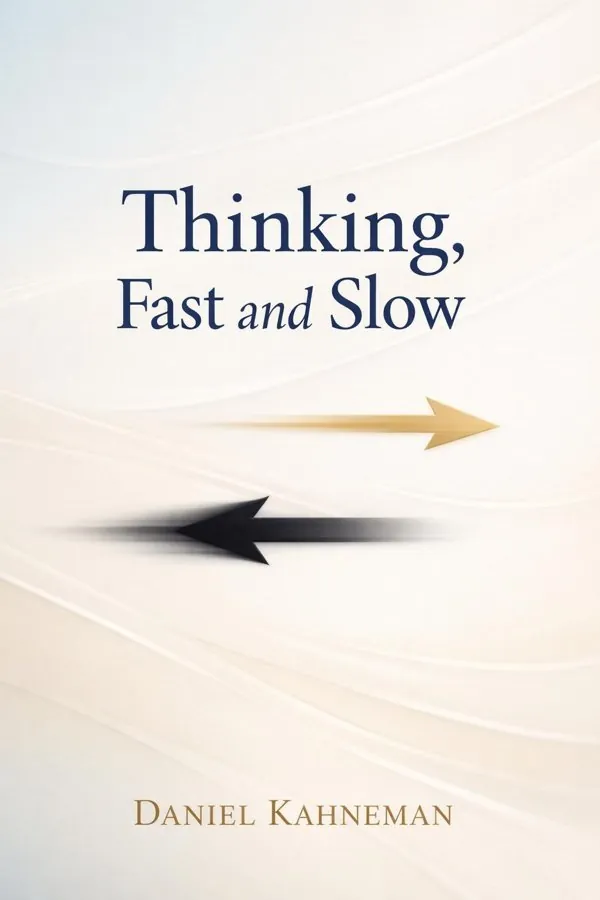
Thinking Fast and Slow: Summary & Key Insights
 10 min9 chaptersAudio available
Key Takeaways from Thinking Fast and Slow
Most of what you think feels deliberate, but much of it happens automatically.
The mind is built to simplify, not to calculate perfectly.
We are far better at creating explanations than at recognizing our ignorance.
A loss hurts more than an equivalent gain feels good.
Intuition is not always irrational; sometimes it is the mark of deep skill.
What Is Thinking Fast and Slow About?
Thinking Fast and Slow by Daniel Kahneman is a psychology book published in 2011 spanning 8 pages. Thinking Fast and Slow is one of the most influential books ever written about how the human mind works. In it, Daniel Kahneman distills decades of groundbreaking research in psychology and behavioral economics into a practical framework for understanding why people make smart decisions in some situations and surprisingly poor ones in others. His central insight is that our thinking is shaped by two systems: one that is fast, intuitive, and automatic, and another that is slow, effortful, and analytical. Most of the time, these systems cooperate efficiently. But just as often, the quick judgments of the mind lead us into predictable errors. What makes this book so powerful is that it changes how you see everyday life. From investing and hiring to relationships, planning, medicine, and public policy, Kahneman shows how biases quietly shape choices we assume are rational. He writes with the authority of a Nobel Prize-winning researcher whose work, much of it developed with Amos Tversky, transformed our understanding of judgment under uncertainty. This is not only a book about mistakes; it is a guide to better thinking, wiser decisions, and greater humility about the limits of human reason.
This FizzRead summary covers all 9 key chapters of Thinking Fast and Slow in approximately 10 minutes, distilling the most important ideas, arguments, and takeaways from Daniel Kahneman's work. Also available as an audio summary and Key Quotes Podcast.
Thinking Fast and Slow
Thinking Fast and Slow is one of the most influential books ever written about how the human mind works. In it, Daniel Kahneman distills decades of groundbreaking research in psychology and behavioral economics into a practical framework for understanding why people make smart decisions in some situations and surprisingly poor ones in others. His central insight is that our thinking is shaped by two systems: one that is fast, intuitive, and automatic, and another that is slow, effortful, and analytical. Most of the time, these systems cooperate efficiently. But just as often, the quick judgments of the mind lead us into predictable errors.
What makes this book so powerful is that it changes how you see everyday life. From investing and hiring to relationships, planning, medicine, and public policy, Kahneman shows how biases quietly shape choices we assume are rational. He writes with the authority of a Nobel Prize-winning researcher whose work, much of it developed with Amos Tversky, transformed our understanding of judgment under uncertainty. This is not only a book about mistakes; it is a guide to better thinking, wiser decisions, and greater humility about the limits of human reason.
Who Should Read Thinking Fast and Slow?
This book is perfect for anyone interested in psychology and looking to gain actionable insights in a short read. Whether you're a student, professional, or lifelong learner, the key ideas from Thinking Fast and Slow by Daniel Kahneman will help you think differently.
- ✓Readers who enjoy psychology and want practical takeaways
- ✓Professionals looking to apply new ideas to their work and life
- ✓Anyone who wants the core insights of Thinking Fast and Slow in just 10 minutes
Want the full summary?
Get instant access to this book summary and 100K+ more with Fizz Moment.
Get Free SummaryAvailable on App Store • Free to download
Key Chapters
Most of what you think feels deliberate, but much of it happens automatically. Kahneman’s most famous contribution is the distinction between System 1 and System 2, two modes of thinking that constantly interact. System 1 is fast, effortless, associative, and emotional. It helps you recognize a face, finish a familiar phrase, or slam on the brakes when danger appears. System 2 is slower, more effortful, and more reflective. It comes online when you solve a difficult math problem, compare mortgage options, or question a first impression.
The genius of this framework is that it explains both our efficiency and our vulnerability. System 1 allows us to function smoothly in a complex world without exhausting mental energy. But because it operates through patterns, shortcuts, and immediate impressions, it often jumps to conclusions. System 2 can correct these errors, yet it is lazy by nature. It tends to accept System 1’s suggestions unless something forces closer inspection.
This matters in everyday life. In hiring, a confident candidate may simply “feel right,” even if the evidence is weak. In relationships, a momentary impression can become a fixed judgment. In finance, an investor may react emotionally to market noise instead of thinking statistically. Understanding the two systems helps explain why intelligence alone does not protect us from bad decisions.
The practical lesson is simple: do not trust every thought equally. When stakes are high, slow down, check your assumptions, and deliberately invite System 2 to examine what System 1 wants you to believe.
The mind is built to simplify, not to calculate perfectly. To navigate uncertainty, we rely on heuristics, mental shortcuts that make judgment faster and easier. These shortcuts are often useful, but they also create systematic errors. Kahneman and Tversky showed that many of our mistakes are not random; they are predictable consequences of the way human cognition works.
One major shortcut is the availability heuristic. We judge likelihood by how easily examples come to mind. If news reports focus on airplane crashes, people may fear flying more than driving, even though driving is statistically more dangerous. Another is representativeness, where we assess probability by resemblance rather than by base rates. If someone seems quiet and analytical, we may assume they are a librarian rather than a salesperson, ignoring the fact that salespeople are far more common.
These errors show up in business, medicine, and personal life. Managers may overestimate the threat of a recent failure and underreact to a slow-building risk. Parents may judge a school by one dramatic story instead of broader data. Doctors may latch onto a diagnosis that “fits” a patient’s symptoms while overlooking more probable explanations.
Kahneman’s deeper point is that confidence and clarity do not guarantee accuracy. A judgment can feel compelling because the mind has constructed a coherent story from limited evidence. The remedy is not to eliminate intuition, which is impossible, but to balance it with disciplined thinking.
Actionable takeaway: whenever you make a judgment under uncertainty, ask two questions: What data am I ignoring, and am I relying on what is vivid rather than what is statistically likely?
We are far better at creating explanations than at recognizing our ignorance. Kahneman shows that overconfidence is one of the most powerful and dangerous features of human judgment. People routinely believe they understand the past better than they do, predict the future more accurately than they can, and assess their own abilities more favorably than evidence justifies.
This illusion is strengthened by hindsight. Once an event happens, it seems obvious and inevitable. A market crash, a failed product launch, or a political upset quickly gets woven into a neat story that makes the outcome appear predictable all along. But this storytelling ability hides the uncertainty that existed before the event. It gives us a false sense that the world is more orderly, explainable, and foreseeable than it really is.
Overconfidence has real costs. Executives make bold forecasts based on incomplete data. investors mistake luck for skill. Professionals cling to beliefs because they sound coherent, not because they are well tested. Even experts are vulnerable, especially in fields where feedback is noisy or delayed. Confidence is persuasive socially, but it is not a reliable sign of truth.
Kahneman does not argue for paralysis or cynicism. Instead, he advocates intellectual humility. Good judgment comes from acknowledging uncertainty, considering alternative outcomes, and respecting the limits of prediction. The best decision-makers are not those who feel most certain, but those who calibrate confidence to evidence.
Actionable takeaway: before committing to an important prediction, estimate how often similar predictions have been wrong in the past and deliberately consider at least one plausible way your forecast could fail.
A loss hurts more than an equivalent gain feels good. This asymmetry lies at the heart of prospect theory, the work for which Kahneman received the Nobel Prize. Traditional economics assumed that people make rational choices by evaluating final outcomes. Kahneman and Tversky showed instead that people evaluate gains and losses relative to a reference point, and that losses loom larger than gains.
This helps explain many puzzling behaviors. Someone may refuse a fair bet because losing $100 feels more painful than winning $100 feels pleasurable. Investors hold losing stocks too long because selling turns a paper loss into a realized one. Consumers react strongly to surcharges but barely notice equivalent discounts framed differently. Employees become more upset by a pay cut than they would be pleased by a comparable raise.
Prospect theory also shows that risk preferences change with framing. People tend to be risk-averse when choosing among gains, preferring a sure reward over a gamble with a higher expected value. But when facing losses, they often become risk-seeking, willing to gamble in hopes of avoiding a sure loss. This pattern can distort decisions in negotiations, health choices, and policy design.
The practical importance is enormous. How a choice is presented can shape what people choose, even when the underlying facts are the same. Framing influences medical consent, retirement saving, pricing, and leadership communication.
Actionable takeaway: when a decision feels emotionally charged, reframe it in multiple ways, especially in terms of both gains and losses, so you can judge the actual tradeoff rather than your reaction to the wording.
Intuition is not always irrational; sometimes it is the mark of deep skill. Kahneman makes an important distinction between valid intuition and misplaced confidence. Experts can develop trustworthy judgments when they operate in environments that are sufficiently regular and when they receive clear, repeated feedback over time. A firefighter sensing that a floor is about to collapse or a chess master recognizing a dangerous pattern may be using genuine expertise, not guesswork.
But many domains do not provide the conditions that make intuition reliable. Stock picking, political forecasting, and long-range strategic prediction are often too noisy, too complex, or too unstable for accurate gut judgment. In such environments, people may feel expert while actually responding to randomness. That is why charismatic certainty can be so misleading.
The key question is not whether someone has experience, but whether that experience produced learning. Did the environment offer consistent signals? Was feedback timely and accurate? Were outcomes tied clearly enough to decisions for patterns to be understood? If not, intuition may be little more than habit wrapped in confidence.
This idea is highly practical. Organizations often defer to seniority or strong personalities even when data should matter more. Individuals may trust their instincts in fields where instincts are poorly trained. Kahneman encourages us to respect intuition selectively rather than automatically.
Actionable takeaway: trust intuition most in areas where you have repeated practice and clear feedback, and rely more on checklists, statistics, and outside review in uncertain environments where pattern recognition is weak.
We routinely imagine the future as smoother, faster, and more controllable than it turns out to be. Kahneman calls this the planning fallacy: the tendency to underestimate time, cost, and difficulty while overestimating benefits. Even experienced people fall into it because they focus on the specifics of their own plan rather than on how similar projects have actually gone in the past.
Students underestimate how long essays will take. Homeowners assume renovations will finish on schedule. Entrepreneurs project rapid growth while ignoring the high failure rate of new ventures. Governments approve massive infrastructure projects that exceed budgets by wide margins. In each case, people build an internal scenario that feels plausible, then mistake that story for a forecast.
Optimism has benefits. It fuels effort, ambition, and resilience. But unchecked optimism can lead to wasted resources, burnout, and repeated disappointment. Kahneman does not suggest abandoning hope; he suggests balancing it with what he calls the outside view. Instead of asking only, “How will our plan unfold?” ask, “What happened in similar cases?” Base rates often provide a more honest picture than enthusiasm does.
This principle is especially useful in project management, career planning, and personal commitments. Before saying yes to a deadline, budget, or strategic plan, compare it with the track record of comparable efforts. If your estimate is much more favorable than the norm, caution is warranted.
Actionable takeaway: for any significant project, make two forecasts: your inside-view plan and an outside-view estimate based on similar past cases, then use the more conservative one to guide time and budget.
One of Kahneman’s most provocative claims is that simple formulas often outperform expert intuition. This is uncomfortable because we like to believe that skilled professionals can integrate subtle details in ways that no rule can match. Yet in many settings, basic statistical models make more accurate predictions than human judges, especially when consistency matters.
Why? Humans are noisy. We are influenced by mood, recent experiences, irrelevant details, and first impressions. The same interviewer may evaluate two identical candidates differently on different days. A clinician’s judgment can shift based on fatigue or emotional state. Formulas, by contrast, apply the same criteria every time. Even a crude algorithm can beat inconsistent human judgment if the inputs are reasonably chosen.
Kahneman does not argue that people should be removed from decisions altogether. Instead, he suggests structuring judgment more carefully. Use checklists. Define criteria in advance. Score options independently before discussing them. Delay holistic impressions until after objective factors have been reviewed. This reduces the power of bias and noise while preserving human insight where it adds value.
This lesson is highly relevant for hiring, admissions, lending, medical diagnosis, and performance reviews. Whenever judgment is repeated across cases, there is usually room to improve by making it more disciplined and less intuitive.
Actionable takeaway: in any recurring decision, create a simple set of measurable criteria and evaluate each option against them before allowing overall impressions to influence the final choice.
We assume our lives are defined by what we experience, but Kahneman shows that memory often has the final word. He distinguishes between the experiencing self, which lives through each moment, and the remembering self, which later tells the story. These two selves do not value events in the same way. The experiencing self cares about duration and real-time pleasure or pain. The remembering self cares disproportionately about peaks, endings, and narrative coherence.
This explains why we may prefer an experience that was objectively longer or even more painful if it ended better. In one famous example from medical research, patients remembered a procedure as less unpleasant when a mildly uncomfortable ending was added, even though it increased the total discomfort. Memory does not record experience like a camera; it edits according to rules that often ignore duration.
The consequences are profound. Vacations, careers, relationships, and even childhood memories are often judged less by the sum of moments than by standout episodes and how things concluded. Businesses rely on this when designing customer experiences. Leaders shape how people remember hard periods by managing endings well. Individuals may chase memorable milestones while neglecting everyday well-being.
Kahneman invites us to ask which self we are serving. A life optimized for memory is not always a life optimized for lived experience. Both perspectives matter, but they are not identical.
Actionable takeaway: when evaluating important choices, ask two separate questions: “Will this make my daily experience better?” and “Will this create a satisfying story later?” Then decide consciously how to balance them.
Happiness is not a single thing, and confusion about it leads to mistaken life choices. Building on the distinction between the two selves, Kahneman examines how people assess well-being. Life satisfaction reflects how the remembering self evaluates life as a whole. Experienced well-being reflects the quality of daily moments. These can move together, but not always.
A person may report high life satisfaction because they have status, achievement, or a compelling personal narrative, yet feel stressed and depleted most days. Another may have modest external success but enjoy more calm, connection, and pleasure in daily life. If we focus only on one kind of happiness, we may optimize for the wrong outcome.
Kahneman’s work also shows that context powerfully shapes satisfaction. Income matters more at lower levels where it reduces hardship, but beyond a point, increases in money do less for emotional experience than many expect. Attention matters too. We exaggerate the importance of whatever we are currently thinking about, a bias Kahneman summarizes as: nothing in life is as important as you think it is while you are thinking about it.
This insight encourages a broader view of a good life. Choices about work, family, place, and time should consider both narrative goals and lived reality. Prestige and achievement can be meaningful, but so can sleep, autonomy, and ordinary moments of ease.
Actionable takeaway: assess your life with two measures, overall satisfaction and daily emotional quality, and make changes based on whichever one is lagging rather than assuming success in one guarantees the other.
All Chapters in Thinking Fast and Slow
About the Author
Daniel Kahneman (1934–2024) was an Israeli-American psychologist whose work transformed modern understanding of judgment, decision-making, and human rationality. Although trained as a psychologist, he became one of the most influential thinkers in economics through his research with Amos Tversky on cognitive biases, heuristics, and prospect theory. Their findings showed that people often make decisions in ways that depart from classical rational models, laying the foundation for behavioral economics. Kahneman received the 2002 Nobel Memorial Prize in Economic Sciences for this work. He taught at several leading institutions, including Princeton University, where he served as professor emeritus. Known for combining scientific rigor with clarity and humility, Kahneman helped reshape psychology, public policy, finance, and management. Thinking Fast and Slow remains his most widely read and enduring book.
Get This Summary in Your Preferred Format
Read or listen to the Thinking Fast and Slow summary by Daniel Kahneman anytime, anywhere. FizzRead offers multiple formats so you can learn on your terms — all free.
Available formats: App · Audio · PDF · EPUB — All included free with FizzRead
Download Thinking Fast and Slow PDF and EPUB Summary
Key Quotes from Thinking Fast and Slow
“Most of what you think feels deliberate, but much of it happens automatically.”
“The mind is built to simplify, not to calculate perfectly.”
“We are far better at creating explanations than at recognizing our ignorance.”
“A loss hurts more than an equivalent gain feels good.”
“Intuition is not always irrational; sometimes it is the mark of deep skill.”
Frequently Asked Questions about Thinking Fast and Slow
Thinking Fast and Slow by Daniel Kahneman is a psychology book that explores key ideas across 9 chapters. Thinking Fast and Slow is one of the most influential books ever written about how the human mind works. In it, Daniel Kahneman distills decades of groundbreaking research in psychology and behavioral economics into a practical framework for understanding why people make smart decisions in some situations and surprisingly poor ones in others. His central insight is that our thinking is shaped by two systems: one that is fast, intuitive, and automatic, and another that is slow, effortful, and analytical. Most of the time, these systems cooperate efficiently. But just as often, the quick judgments of the mind lead us into predictable errors. What makes this book so powerful is that it changes how you see everyday life. From investing and hiring to relationships, planning, medicine, and public policy, Kahneman shows how biases quietly shape choices we assume are rational. He writes with the authority of a Nobel Prize-winning researcher whose work, much of it developed with Amos Tversky, transformed our understanding of judgment under uncertainty. This is not only a book about mistakes; it is a guide to better thinking, wiser decisions, and greater humility about the limits of human reason.
Compare Thinking Fast and Slow
More by Daniel Kahneman
You Might Also Like
The Body Keeps the Score
Bessel van der Kolk
10 min
Surrounded by Idiots
Thomas Erikson
10 min
Emotional Intelligence
Daniel Goleman
10 min
Attached
Amir Levine
10 min
Why Does He Do That
Lundy Bancroft
10 min
Women Who Run with the Wolves
Clarissa Pinkola Estés
10 minFeatured In
Bill Gates's Book Picks
Bill Gates' Reading List: The Books That Shaped a Visionary
Naval Ravikant's Book Picks
Naval Ravikant on Wealth and Wisdom: Essential Reads
Barack Obama's Book Picks
Barack Obama's Reading List: Books That Shaped a President
Joe Rogan's Book Picks
Joe Rogan's Go-To Books: What He Can't Stop Recommending
Richard Branson's Book Picks
Richard Branson's Lifetime Reading List: Adventure in Every Page
Ryan Holiday's Book Picks
Ryan Holiday's Stoic Reading List: Ancient Wisdom for Modern Life
James Clear's Book Picks
James Clear's Reading List: Books That Build Better Habits
Malcolm Gladwell's Book Picks
Malcolm Gladwell's Picks: Books That Make You See the World Differently
Sam Altman's Book Picks
Sam Altman's Reading List: Books Behind the AI Revolution
Sheryl Sandberg's Book Picks
Sheryl Sandberg's Must-Reads for Women in Leadership
Alex Hormozi's Book Picks
Alex Hormozi's Must-Read Books
Seth Godin's Book Picks
Seth Godin's Marketing Bookshelf
Neil deGrasse Tyson's Book Picks
Neil deGrasse Tyson's Science Bookshelf
Morgan Housel's Book Picks
Morgan Housel's Financial Wisdom Reads
Curated's Book Picks
Best Books of All Time — The Definitive List
Psychology's Book Picks
Inside Your Mind: Psychology Books That Change Everything
Browse by Category
Ready to read Thinking Fast and Slow?
Get the full summary and 100K+ more books with Fizz Moment.