
Naval Ravikant on Wealth and Wisdom: Essential Reads
Angel investor and philosopher Naval Ravikant is famous for his reading habits and timeless wisdom. His book recommendations blend Stoic philosophy, mental models, and practical wisdom for building wealth and finding happiness.
 10 min read
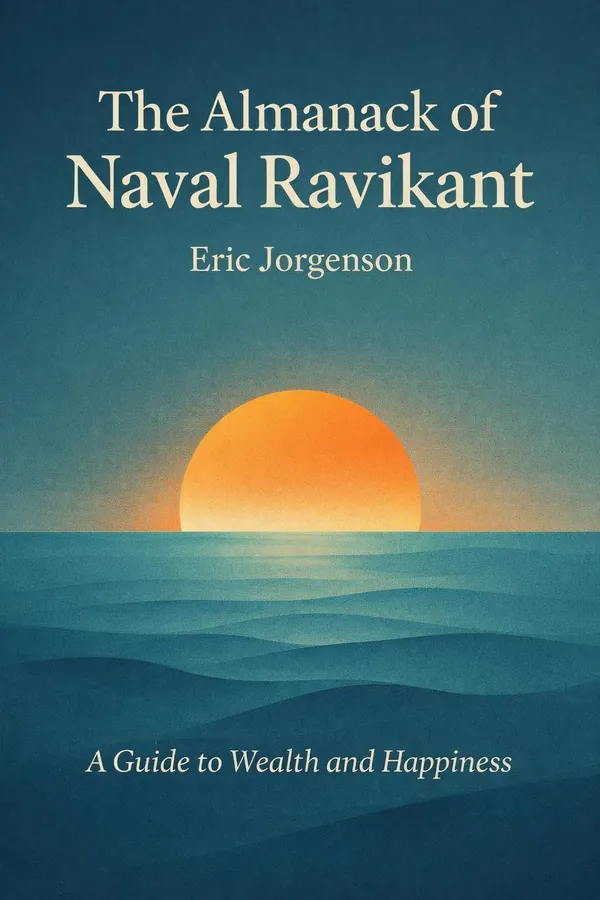
The Almanack of Naval Ravikant
by Eric Jorgenson
The Almanack of Naval Ravikant is not a traditional business book with a single linear argument. Instead, it is a carefully curated collection of entrepreneur and investor Naval Ravikant’s most valuable ideas on wealth, leverage, judgment, happiness, freedom, and self-mastery, assembled by Eric Jorgenson. Drawn from years of podcasts, interviews, tweets, and essays, the book reads like a distilled operating system for modern life: how to build wealth without renting out your soul, how to think clearly in a noisy world, and how to pursue happiness without falling into endless striving. What makes the book matter is its unusual combination of practicality and philosophy. Naval does not separate money from meaning, or career success from peace of mind. He argues that true wealth is freedom, that leverage is the engine of outsized results, and that inner clarity is as important as external achievement. Jorgenson’s contribution is significant because he organizes scattered insights into a coherent, accessible guide. The result is a book that speaks to founders, investors, creators, and anyone trying to build a life that is both financially successful and deeply satisfying.
Key Takeaways
- 1Wealth Means Freedom, Not Status — Most people chase money when what they really want is control over their time. One of Naval Ravikant’s most important di…
- 2Build Wealth Through Specific Knowledge — Hard work is common; irreplaceable value is rare. Naval argues that wealth is created not simply by effort, but by apply…
- 3Leverage Creates Outsized Results — You do not get rich by trading time for money forever. Naval repeatedly emphasizes leverage as the central mechanism beh…
 10 min read
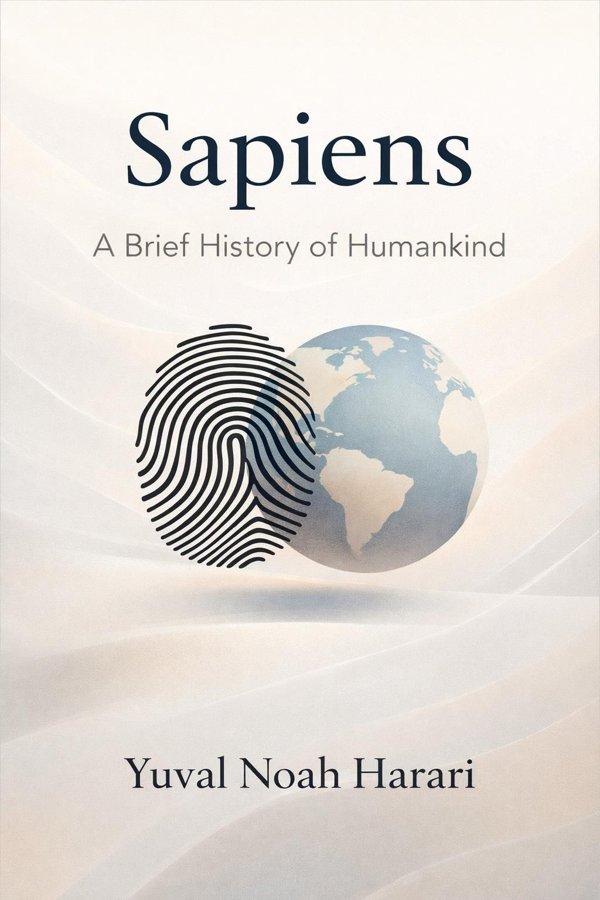
Sapiens
by Yuval Noah Harari
Sapiens: A Brief History of Humankind is an ambitious, big-picture history of our species, tracing how Homo sapiens rose from an unremarkable African ape to the dominant force on Earth. Yuval Noah Harari combines history, biology, anthropology, economics, and philosophy to explain the turning points that transformed human life: the Cognitive Revolution, the Agricultural Revolution, and the Scientific Revolution. Rather than offering a narrow chronological account, he asks a deeper question: what made humans uniquely capable of building empires, religions, markets, and nations? Harari’s answer is both provocative and memorable: our greatest power lies in our ability to create and believe shared stories. These collective fictions—such as money, laws, gods, and states—allow strangers to cooperate on a massive scale. The book matters because it challenges comforting assumptions about progress, happiness, and civilization. It invites readers to see modern society not as inevitable, but as the result of historical choices, accidents, and myths. As a historian and public intellectual, Harari brings scholarly range and narrative clarity to one of the most compelling questions in human history: how did we become who we are?
Key Takeaways
- 1The Cognitive Revolution and Shared Imagination — Human dominance did not begin with stronger bodies, sharper teeth, or faster legs; it began with a new kind of mind. Aro…
- 2The Agricultural Revolution: Progress or Trap? — What if one of history’s greatest achievements was also one of its greatest mistakes? Harari provocatively argues that t…
- 3Myths Make Large Societies Possible — Civilization runs not only on roads, crops, and armies, but on ideas that exist because people collectively agree they d…
 10 min read
Meditations
by Marcus Aurelius
What does it mean to stay calm, just, and fully human in a world full of pressure, conflict, ego, and loss? That is the enduring question at the heart of Meditations, the private journal of Roman emperor Marcus Aurelius. Written in Greek and never intended for publication, these reflections are not polished philosophy lectures. They are personal reminders from one of the most powerful men in the world trying to govern not only an empire, but also his own mind. That tension is exactly why this book still matters. Meditations remains one of the clearest guides to Stoic philosophy because it speaks directly to everyday struggles: dealing with difficult people, accepting change, resisting vanity, and acting with integrity when no one is watching. Marcus Aurelius is remembered as both a Roman emperor and a Stoic philosopher, a rare figure often described as a philosopher-king. His reflections on virtue, discipline, mortality, and inner peace have influenced readers for centuries. If you want practical wisdom rather than abstract theory, Meditations offers a deeply human blueprint for living with clarity, resilience, and moral purpose.
Key Takeaways
- 1Book I: Lessons from Those Who Shaped Me — The opening book of Meditations is an extraordinary act of gratitude. Instead of launching into abstract arguments, Marc…
- 2Book II: Accepting Fate and Living Rationally — Book II opens with one of the most quoted passages in Stoic philosophy: a morning reminder that we will meet interfering…
- 3Book III: Integrity Beyond Fame — In Book III, Marcus Aurelius turns his attention to time, mortality, and the danger of living for approval. He reminds h…
 10 min read
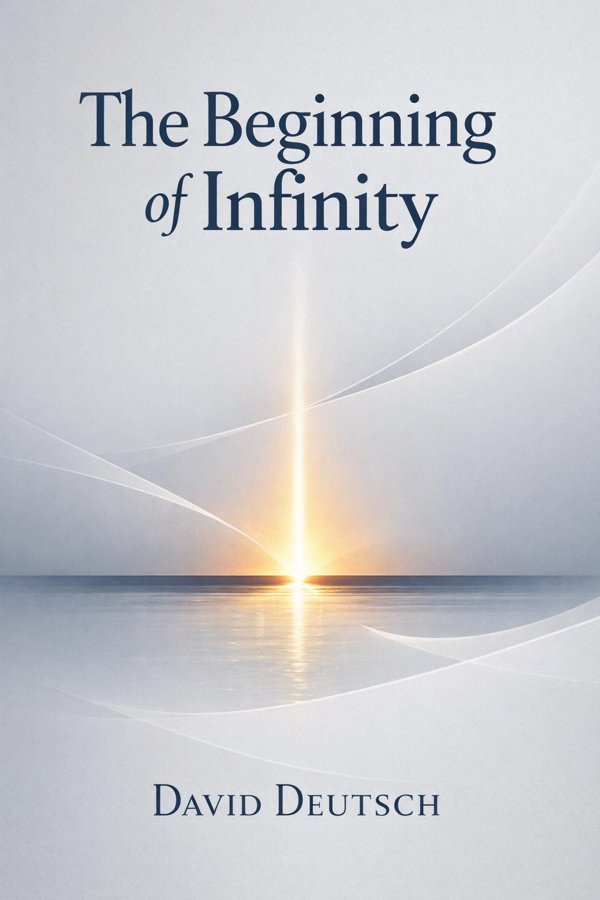
The Beginning of Infinity
by David Deutsch
The Beginning of Infinity is David Deutsch’s ambitious argument that human progress has no fixed ceiling. Rather than treating science as a collection of facts, Deutsch presents it as a method for creating good explanations—accounts of reality that are hard to vary without losing their power. From that starting point, he explores why knowledge grows, why problems are solvable, and why pessimism so often mistakes temporary limits for permanent ones. The book ranges across physics, evolution, political philosophy, art, morality, and the future of civilization, yet it remains centered on one radical claim: all evils are caused by insufficient knowledge, and knowledge can, in principle, continue to expand without end. That makes this more than a science book. It is a philosophy of progress and a defense of optimism grounded in reason rather than wishful thinking. Deutsch writes with unusual authority. A pioneering physicist at Oxford and one of the founders of quantum computation, he combines technical insight with sweeping philosophical ambition. The result is a challenging but rewarding work that asks readers to rethink what human beings are capable of achieving.
Key Takeaways
- 1The Reach of Good Explanations — The difference between knowledge and mere assertion begins with explanation. Deutsch argues that a good explanation is n…
- 2Optimism and Unlimited Human Progress — Optimism, in Deutsch’s sense, is not positive thinking. It is the belief that problems are inevitable but solvable. That…
- 3The Jump to Universality — Some ideas do more than solve a local problem; they become universal. Deutsch is fascinated by moments when systems cros…
 10 min read
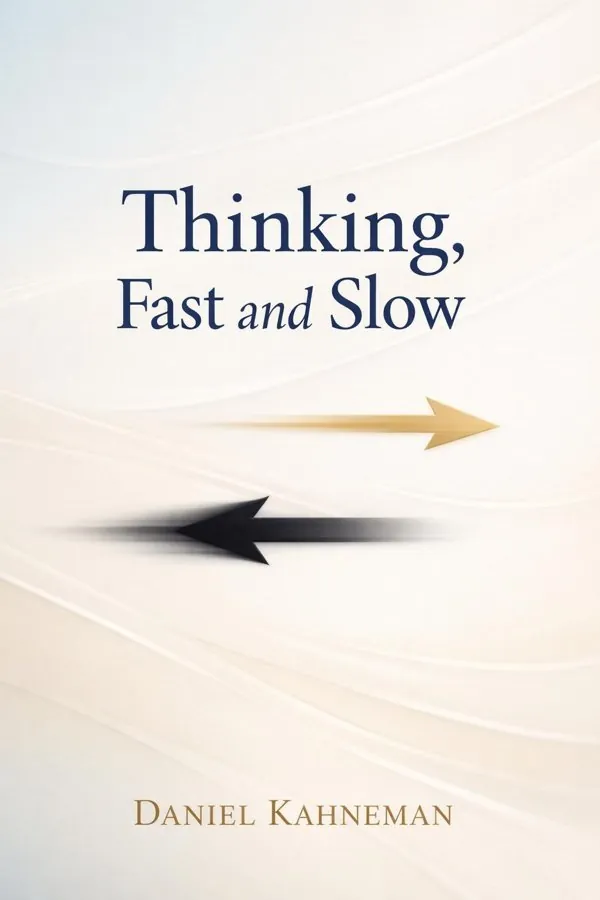
Thinking Fast and Slow
by Daniel Kahneman
Thinking Fast and Slow is one of the most influential books ever written about how the human mind works. In it, Daniel Kahneman distills decades of groundbreaking research in psychology and behavioral economics into a practical framework for understanding why people make smart decisions in some situations and surprisingly poor ones in others. His central insight is that our thinking is shaped by two systems: one that is fast, intuitive, and automatic, and another that is slow, effortful, and analytical. Most of the time, these systems cooperate efficiently. But just as often, the quick judgments of the mind lead us into predictable errors. What makes this book so powerful is that it changes how you see everyday life. From investing and hiring to relationships, planning, medicine, and public policy, Kahneman shows how biases quietly shape choices we assume are rational. He writes with the authority of a Nobel Prize-winning researcher whose work, much of it developed with Amos Tversky, transformed our understanding of judgment under uncertainty. This is not only a book about mistakes; it is a guide to better thinking, wiser decisions, and greater humility about the limits of human reason.
Key Takeaways
- 1The Two Systems That Shape Thought — Most of what you think feels deliberate, but much of it happens automatically. Kahneman’s most famous contribution is th…
- 2Heuristics Make Judgment Efficient and Flawed — The mind is built to simplify, not to calculate perfectly. To navigate uncertainty, we rely on heuristics, mental shortc…
- 3Confidence Often Exceeds What We Know — We are far better at creating explanations than at recognizing our ignorance. Kahneman shows that overconfidence is one …
 10 min read
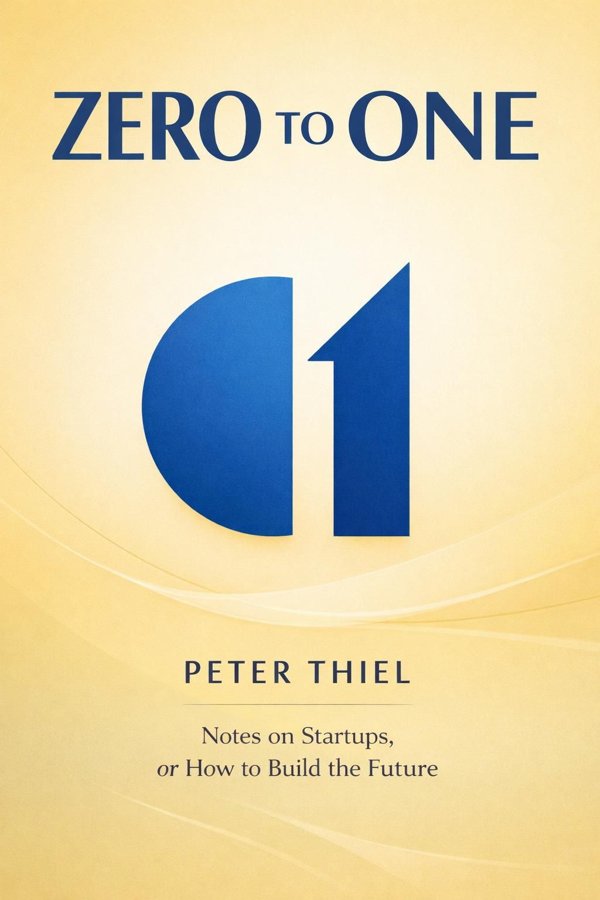
Zero to One
by Peter Thiel
Zero to One by Peter Thiel, based on notes by Blake Masters, is one of the most provocative books ever written about startups, innovation, and building companies that matter. Rather than offering generic business advice, Thiel asks a deeper question: how do you create something truly new? His answer is the idea of going from “zero to one” — producing a breakthrough that did not exist before — instead of going from “one to many,” which simply means copying or scaling what is already known. That distinction sits at the heart of the book. Drawing on his experience as a co-founder of PayPal, an early investor in Facebook, and a leading Silicon Valley thinker, Thiel challenges many popular assumptions about competition, risk, technology, and success. He argues that the best businesses are not those that fight hardest in crowded markets, but those that build unique products so valuable they effectively become monopolies. Along the way, he explores founding teams, sales, culture, long-term planning, and the role of secrets in entrepreneurship. For founders, investors, students, and ambitious professionals, Zero to One is a sharp, contrarian guide to creating the future instead of merely reacting to it.
Key Takeaways
- 1The Future Depends on New Creation — Most people talk about the future as if it will simply arrive on schedule. Thiel’s central insight is that the future is…
- 2Learn from Bubbles Without Becoming Cynical — A failed boom can teach more than a smooth success. Thiel uses the dot-com bubble of the late 1990s to show how mass ent…
- 3Happy Companies Escape Destructive Competition — Thiel’s famous claim that competition is for losers sounds extreme, but it highlights an important truth: the best busin…
 10 min read
Man's Search for Meaning
by Viktor Frankl
What keeps a person going when everything familiar has been taken away—comfort, identity, loved ones, freedom, and even the expectation of tomorrow? That is the unbearable and essential question at the heart of *Man's Search for Meaning*. Viktor E. Frankl’s landmark book is far more than a Holocaust memoir. It is a profound study of human endurance, an examination of suffering, and a practical philosophy for anyone trying to live with purpose in hard times. Drawing on his experiences in Nazi concentration camps, Frankl explores how people respond when life is reduced to its barest terms and why some still manage to preserve dignity, hope, and inner freedom. What makes this book endure is that Frankl does not offer empty inspiration. He writes as an Austrian neurologist, psychiatrist, and Holocaust survivor who later developed logotherapy, a school of psychotherapy centered on meaning as the primary human motivation. His insight is simple but life-changing: even when we cannot change our circumstances, we can still choose our response. That idea has made this book one of the most influential works in psychology and self-help, especially for readers facing grief, burnout, uncertainty, or the quiet fear that life has lost direction.
Key Takeaways
- 1The Shock of Arrival and the Dehumanization of Camp Life — When Frankl first arrived at Auschwitz, the destruction of the self began immediately. The process was systematic: priso…
- 2Emotional Detachment and the Apathy that Defines Survival — After the first shock came a second psychological stage: apathy. Frankl shows that this numbness was not indifference in…
- 3Moral Choice and Inner Freedom in the Midst of Suffering — One of the book’s most powerful claims is that even under extreme oppression, a human being retains a final freedom: the…
 10 min read
Siddhartha
by Hermann Hesse
Siddhartha is Hermann Hesse’s luminous 1922 novel about a young man’s search for enlightenment in ancient India, during the era of the Buddha. What begins as the story of a gifted Brahmin’s son quickly becomes a universal exploration of dissatisfaction, desire, suffering, love, loss, and inner awakening. Siddhartha is not content to inherit wisdom secondhand. He wants truth that is lived, not merely taught, and that longing drives him through extreme asceticism, sensual pleasure, wealth, despair, and finally a quiet, profound reconciliation with life itself. The novel matters because it speaks to a question that remains urgent today: how do we find meaning in a world full of advice, ideologies, and distractions? Hesse’s answer is subtle and enduring. Real understanding cannot be borrowed from doctrines alone; it must be discovered through experience, reflection, and attention. Drawing on Indian spiritual traditions while writing for a modern Western audience, Hesse created a work that bridges cultures without losing psychological depth. A Nobel Prize-winning author celebrated for his insight into self-realization, Hesse makes Siddhartha both a spiritual parable and a deeply human coming-of-age story.
Key Takeaways
- 1The Dissatisfied Brahmin — A privileged life can still feel empty when the soul remains unanswered. At the beginning of Siddhartha, we meet a brill…
- 2Learning Through Self-Denial’s Limits — Escaping the world is not the same as understanding it. After leaving home, Siddhartha joins the Samanas, wandering asce…
- 3The Buddha Cannot Be Imitated — Even perfect teaching cannot spare us from having to live our own path. One of the most memorable moments in Siddhartha …
Want the full summary?
Get instant access to this book summary and 100K+ more with Fizz Moment.
Get Free SummaryAvailable on App Store • Free to download
About This List
Angel investor and philosopher Naval Ravikant is famous for his reading habits and timeless wisdom. His book recommendations blend Stoic philosophy, mental models, and practical wisdom for building wealth and finding happiness.
This list features 8 carefully selected books. With FizzRead, you can read AI-powered summaries of each book in just 15 minutes. Get the key takeaways and start applying the insights immediately.
Ready to start reading?
Get instant access to all 8 book summaries and 100K+ more with FizzRead.