
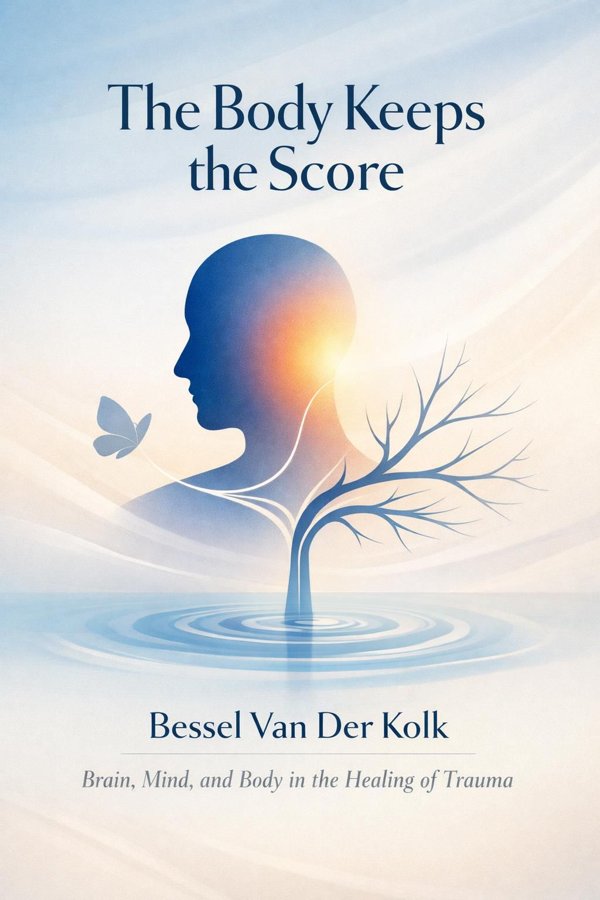
The Body Keeps the Score: Summary & Key Insights
 10 min11 chaptersAudio available
Key Takeaways from The Body Keeps the Score
One of the book’s most powerful contributions is its account of how trauma finally became visible to modern psychiatry.
Van der Kolk explains trauma through a clear neurological lens: trauma changes how the brain detects danger, stores memory, and regulates emotion.
A central message of *The Body Keeps the Score* is that trauma is not just remembered intellectually—it is carried physiologically.
When trauma happens early, it shapes the very systems a child depends on to form identity, trust, and self-regulation.
Trauma memory behaves differently from ordinary memory.
What Is The Body Keeps the Score About?
The Body Keeps the Score by Bessel van der Kolk is a psychology book published in 2014 spanning 11 pages. What if trauma is not just something you remember, but something your body continues to live? That is the central, unforgettable insight of *The Body Keeps the Score*. In this influential psychology classic, Bessel van der Kolk explains why traumatic experiences do not simply fade with time or disappear through willpower. Instead, they can reshape the brain, dysregulate the nervous system, and alter how people feel, think, relate, and even move through everyday life. The result is often a life organized around survival rather than presence, trust, or joy. What makes this book so important is that it does more than describe trauma’s damage—it offers a hopeful, science-based map for recovery. Van der Kolk draws on decades of work as a psychiatrist, researcher, and educator, including his experience founding the Trauma Center in Brookline, Massachusetts. With clarity and compassion, he bridges neuroscience, clinical stories, and practical treatment approaches. For readers trying to understand PTSD, childhood abuse, chronic stress, or emotional dysregulation, this book provides both language and direction. It shows that healing is possible, but only when we address the body as seriously as we address the mind.
This FizzRead summary covers all 11 key chapters of The Body Keeps the Score in approximately 10 minutes, distilling the most important ideas, arguments, and takeaways from Bessel van der Kolk's work. Also available as an audio summary and Key Quotes Podcast.
The Body Keeps the Score: Brain, Mind, and Body in the Healing of Trauma
What if trauma is not just something you remember, but something your body continues to live? That is the central, unforgettable insight of *The Body Keeps the Score*. In this influential psychology classic, Bessel van der Kolk explains why traumatic experiences do not simply fade with time or disappear through willpower. Instead, they can reshape the brain, dysregulate the nervous system, and alter how people feel, think, relate, and even move through everyday life. The result is often a life organized around survival rather than presence, trust, or joy. What makes this book so important is that it does more than describe trauma’s damage—it offers a hopeful, science-based map for recovery. Van der Kolk draws on decades of work as a psychiatrist, researcher, and educator, including his experience founding the Trauma Center in Brookline, Massachusetts. With clarity and compassion, he bridges neuroscience, clinical stories, and practical treatment approaches. For readers trying to understand PTSD, childhood abuse, chronic stress, or emotional dysregulation, this book provides both language and direction. It shows that healing is possible, but only when we address the body as seriously as we address the mind.
Who Should Read The Body Keeps the Score?
This book is perfect for anyone interested in psychology and looking to gain actionable insights in a short read. Whether you're a student, professional, or lifelong learner, the key ideas from The Body Keeps the Score by Bessel van der Kolk will help you think differently.
- ✓Readers who enjoy psychology and want practical takeaways
- ✓Professionals looking to apply new ideas to their work and life
- ✓Anyone who wants the core insights of The Body Keeps the Score in just 10 minutes
Want the full summary?
Get instant access to this book summary and 100K+ more with Fizz Moment.
Get Free SummaryAvailable on App Store • Free to download
Key Chapters
One of the book’s most powerful contributions is its account of how trauma finally became visible to modern psychiatry. In the 1970s, many clinicians were seeing Vietnam veterans whose symptoms did not fit neat diagnostic boxes. They relived combat in nightmares, startled easily, lashed out in panic, avoided reminders of war, and felt emotionally deadened around the people they loved. Yet the system often labeled them as unstable, aggressive, or addicted rather than injured by overwhelming experience. Van der Kolk shows how listening carefully to patients changed that. Similar recognition emerged as women spoke more openly about rape, domestic violence, and childhood abuse, making it impossible to ignore the fact that external violence could leave profound psychological and biological scars. This shift mattered because it reframed trauma symptoms as survival adaptations rather than personal failings. A flashback was no longer “crazy behavior”; it was an unfinished alarm response. Hypervigilance was not paranoia in the ordinary sense; it was a nervous system stuck on guard duty. The practical takeaway is simple but profound: healing starts with accurate naming. Whether for clinicians, caregivers, or survivors themselves, replacing shame with understanding is the first intervention. Once people recognize that their reactions make sense in the context of trauma, they can begin treatment with dignity instead of self-blame.
Van der Kolk explains trauma through a clear neurological lens: trauma changes how the brain detects danger, stores memory, and regulates emotion. He focuses on three major regions. First, the amygdala, the brain’s alarm center, becomes overreactive, scanning constantly for threat. A slammed door, angry tone, or certain smell can trigger the same panic as the original event. Second, the hippocampus, which helps organize memory into time and place, often becomes less effective. That is why trauma survivors may remember isolated fragments—an image, a sound, pressure in the chest—rather than a coherent story with a beginning, middle, and end. Third, the prefrontal cortex, which supports reasoning and self-control, tends to go offline during perceived danger. In real life, this can look like freezing during conflict, going blank in stressful conversations, or feeling unable to think clearly when upset. Van der Kolk also discusses reduced activity in Broca’s area, helping explain why many survivors say, “I don’t have words for it.” The actionable lesson is that trauma treatment must go beyond talking. Helpful practices include grounding through sensory awareness, rhythmic movement, slow breathing, and therapies that reconnect body sensations with present-moment safety. When people understand that their “overreactions” are often brain-based survival responses, they can respond with skill rather than shame.
A central message of *The Body Keeps the Score* is that trauma is not just remembered intellectually—it is carried physiologically. Survivors may live with a racing heart, shallow breathing, muscle tension, digestive problems, numbness, or a persistent sense of dread even when no immediate threat exists. Van der Kolk argues that these bodily states are not side issues; they are core expressions of trauma. The body learns danger and keeps repeating it. That is why someone can say, logically, “I know I’m safe,” while their chest tightens, their stomach drops, and their whole system prepares for attack or escape. This insight has major implications for healing. Recovery requires learning to notice internal signals without being overwhelmed by them. Practices such as breathwork, yoga, stretching, body scans, and simple interoceptive check-ins can help people recognize what their bodies are communicating. For example, pausing three times a day to ask, “What do I feel in my shoulders, jaw, chest, and stomach?” builds awareness that many trauma survivors have had to suppress. Van der Kolk’s point is not that the body is the enemy, but that it often becomes the messenger. When people learn to track sensation, regulate arousal, and reconnect with physical experience safely, they begin to reclaim a sense of ownership over themselves.
Van der Kolk makes a crucial distinction between single-event trauma and developmental trauma—the kind that unfolds in childhood through neglect, abuse, chronic fear, or emotional inconsistency. When trauma happens early, it shapes the very systems a child depends on to form identity, trust, and self-regulation. A child who grows up with unpredictable caregivers may become hyperaware of others’ moods, disconnected from their own needs, or unable to calm down without external reassurance. Over time, these adaptations can harden into adult patterns: people-pleasing, emotional shutdown, explosive anger, dissociation, or difficulty sustaining healthy relationships. The tragedy is that many survivors then blame themselves for patterns that began as intelligent survival strategies. Van der Kolk emphasizes that traumatized children are often mislabeled as oppositional, inattentive, or difficult when they are actually dysregulated and frightened. A child who cannot sit still may not be defiant; they may be biologically primed for danger. The practical lesson is to ask, “What happened to you?” rather than “What’s wrong with you?” For adults reflecting on their past, this chapter offers a framework for self-compassion. For parents, teachers, and therapists, it highlights the importance of predictable routines, emotional attunement, and safe relationships. Developmental trauma interrupts growth, but nurturing environments and targeted treatment can help restore capacities that were never fully supported.
Trauma memory behaves differently from ordinary memory. Rather than being stored as a clear narrative, it often remains fragmented, sensory, and intensely alive. Van der Kolk shows that survivors may not remember events in a linear way, but they may react powerfully to cues linked to the past: a smell, a facial expression, a season, or a particular type of touch. This is why trauma can feel less like remembering and more like reliving. The body responds as if the event is happening now. Such memories may emerge as flashbacks, nightmares, physical pain, or sudden emotional states that seem to come out of nowhere. Understanding this can be deeply relieving, because it explains why “just move on” advice is so ineffective. Trauma is not stored like a story tucked away on a shelf; it is stored like an alarm waiting to be reactivated. A practical implication is that healing often involves helping the brain and body distinguish past from present. Grounding techniques—naming five things you see, pressing your feet into the floor, orienting to the room, or repeating the date and location—can interrupt the sense of timeless terror. Over time, therapies that safely process traumatic memories can help transform fragments into a coherent experience that belongs to the past rather than constantly intruding into the present.
Van der Kolk does not dismiss talk therapy, but he argues strongly that insight alone is often insufficient for trauma recovery. Many survivors can explain exactly what happened to them and still remain trapped in panic, shame, numbness, or disconnection. That is because trauma lives not only in conscious thought but in automatic physiological reactions. If the nervous system remains chronically activated, a person may understand their triggers intellectually while still being unable to calm their body when triggered. This helps explain why some people feel frustrated after years of therapy: they know the story, but they do not feel different. Van der Kolk’s point is that verbal processing should be paired with methods that target embodied experience. For example, someone who freezes in conflict may benefit from movement-based work that restores a sense of agency, not just discussion about childhood fear. Someone who dissociates may need grounding and sensory awareness before deep narrative work is possible. The practical takeaway is to look for treatment that includes regulation, not just reflection. Useful questions to ask are: Does this therapy help me notice my body? Do I leave sessions more resourced or more flooded? Can I practice skills between sessions? Talk matters, but for trauma survivors, words are often most effective when the body has begun to feel safe enough to hear them.
One of the most hopeful ideas in the book is that the traumatized brain is not permanently fixed. Thanks to neuroplasticity, the brain can form new pathways through repeated experiences of safety, regulation, and connection. Van der Kolk emphasizes that recovery does not require erasing the past; it requires building new patterns that are stronger than old survival responses. This means healing is less about a single breakthrough and more about consistent retraining. Small, repeated practices matter: calming the breath, completing a movement, tolerating a difficult sensation for a few seconds longer, or having a safe interaction in which the body learns, “This time, nothing bad happened.” A person who has lived in chronic hyperarousal may slowly train their system through yoga, music, martial arts, or neurofeedback to return to baseline more easily. Someone who has lived in emotional shutdown may use creative expression or supportive group work to restore feeling and agency. The key is repetition with safety. Van der Kolk’s broader message is empowering: trauma changes the brain, but experience also changes the brain. Readers can apply this by treating healing as practice rather than performance. Progress often looks subtle—sleeping better, recovering faster from stress, noticing triggers earlier—but these shifts are signs that the nervous system is learning a new script.
A defining feature of *The Body Keeps the Score* is its openness to trauma treatments that extend beyond conventional psychotherapy. Van der Kolk highlights approaches such as neurofeedback, EMDR, yoga, theater, sports, and other experiential methods because they help regulate systems that language cannot fully reach. Neurofeedback, for instance, aims to train brain activity patterns, helping people who feel chronically agitated or shut down achieve greater stability. EMDR is presented as a method that can help traumatic memories become less overwhelming by integrating them differently. Yoga helps survivors feel their bodies from the inside while restoring choice and control over movement and breath. Theater and group-based role work can rebuild spontaneity, confidence, and connection—capacities often damaged by trauma. What ties these methods together is not novelty for its own sake, but their ability to create embodied experiences of mastery and safety. Van der Kolk encourages a flexible, individualized approach: what works for one person may not work for another. A practical takeaway is to think in terms of fit rather than ideology. If traditional therapy has plateaued, it may be worth exploring trauma-informed yoga, expressive arts, or biofeedback with qualified providers. Effective healing is often multimodal. The best treatment is not necessarily the most familiar one, but the one that helps the body stop bracing for danger.
Mindfulness plays a vital role in van der Kolk’s model because trauma often disrupts the capacity to notice inner experience without becoming hijacked by it. Many survivors swing between two extremes: they are either flooded by sensations and emotions or cut off from them entirely. Mindfulness offers a middle path by strengthening the ability to observe what is happening inside the body and mind in real time. This may begin with very small acts of attention: noticing the breath, tracking tension in the jaw, naming an emotion, or observing a trigger before it turns into a full reaction. Van der Kolk values mindfulness not as a trendy wellness add-on, but as a practical skill for reclaiming self-leadership. If you can notice “my heart is racing” or “I’m leaving my body right now,” you gain a chance to intervene. Importantly, mindfulness for trauma survivors must be paced carefully. Long silent meditation can be overwhelming for some people, especially early in recovery. Gentler options—walking meditation, guided grounding, short body scans, or mindful movement—may be safer starting points. The actionable lesson is that awareness creates choice. By developing the capacity to witness internal states instead of immediately obeying them, survivors begin to separate the present moment from old survival patterns.
Trauma isolates. It teaches people that others are dangerous, that their own needs are unacceptable, or that no one can truly understand their experience. Van der Kolk argues that this relational damage is one of trauma’s deepest wounds. Because trauma so often occurs in the context of relationships—family violence, assault, betrayal, neglect—healing also requires relational repair. Safe connection helps regulate the nervous system in ways no solo technique fully can. A calm, attuned other person can communicate safety through voice, facial expression, pacing, and presence. This is why therapeutic relationships, support groups, trusted friendships, and structured communities can be so powerful. They help people experience being seen without being harmed. Van der Kolk also points toward activities that foster synchronized engagement—group movement, music, drama, sports—because shared rhythm can rebuild social trust and a sense of belonging. Practically, this means recovery should not be treated as a purely private project. Even one dependable relationship can make a profound difference. Readers can apply this by identifying who feels grounding rather than draining, seeking trauma-informed communities, and practicing honest but bounded connection. The goal is not instant vulnerability with everyone; it is gradual participation in relationships where safety, reciprocity, and respect are consistently present.
In the end, recovery from trauma is about integration: bringing body, mind, memory, and relationship back into a workable whole. Van der Kolk emphasizes that healing does not mean forgetting what happened or pretending the past no longer matters. It means that traumatic experience is no longer running the entire system. A recovered person can feel emotions without drowning in them, recall the past without reliving it, and inhabit the body without constant fear or numbness. Integration also involves restoring agency. Trauma robs people of choice; recovery rebuilds it. This might look like setting boundaries, recognizing triggers earlier, returning to calm more quickly, or discovering pleasure in movement, creativity, and connection again. Importantly, van der Kolk does not offer a one-size-fits-all cure. Recovery is uneven and deeply personal. Some people need body-based practices first; others benefit from relational work, memory processing, or structured routines that restore predictability. The key is that healing must be lived, not merely understood. An actionable way to think about this chapter is to ask three questions regularly: Do I feel safe in my body more often? Can I stay present during stress longer than before? Am I building relationships and routines that support regulation? Progress often begins there—quietly, steadily, and with growing self-trust.
All Chapters in The Body Keeps the Score
About the Author
Bessel van der Kolk, M.D., is a psychiatrist, researcher, and educator specializing in post-traumatic stress and related disorders. He founded the Trauma Center in Brookline, Massachusetts, and has been a leading figure in trauma research and treatment for over four decades. His work has helped shape how clinicians understand the effects of trauma on the brain, body, and relationships. Known for combining neuroscience with practical therapeutic approaches, van der Kolk has been especially influential in advancing body-based and integrative models of healing. *The Body Keeps the Score* is his best-known work and has become a landmark book in the fields of trauma psychology and recovery.
Get This Summary in Your Preferred Format
Read or listen to the The Body Keeps the Score summary by Bessel van der Kolk anytime, anywhere. FizzRead offers multiple formats so you can learn on your terms — all free.
Available formats: App · Audio · PDF · EPUB — All included free with FizzRead
Download The Body Keeps the Score PDF and EPUB Summary
Key Quotes from The Body Keeps the Score
“One of the book’s most powerful contributions is its account of how trauma finally became visible to modern psychiatry.”
“Van der Kolk explains trauma through a clear neurological lens: trauma changes how the brain detects danger, stores memory, and regulates emotion.”
“A central message of *The Body Keeps the Score* is that trauma is not just remembered intellectually—it is carried physiologically.”
“Van der Kolk makes a crucial distinction between single-event trauma and developmental trauma—the kind that unfolds in childhood through neglect, abuse, chronic fear, or emotional inconsistency.”
“Trauma memory behaves differently from ordinary memory.”
Frequently Asked Questions about The Body Keeps the Score
The Body Keeps the Score by Bessel van der Kolk is a psychology book that explores key ideas across 11 chapters. What if trauma is not just something you remember, but something your body continues to live? That is the central, unforgettable insight of *The Body Keeps the Score*. In this influential psychology classic, Bessel van der Kolk explains why traumatic experiences do not simply fade with time or disappear through willpower. Instead, they can reshape the brain, dysregulate the nervous system, and alter how people feel, think, relate, and even move through everyday life. The result is often a life organized around survival rather than presence, trust, or joy. What makes this book so important is that it does more than describe trauma’s damage—it offers a hopeful, science-based map for recovery. Van der Kolk draws on decades of work as a psychiatrist, researcher, and educator, including his experience founding the Trauma Center in Brookline, Massachusetts. With clarity and compassion, he bridges neuroscience, clinical stories, and practical treatment approaches. For readers trying to understand PTSD, childhood abuse, chronic stress, or emotional dysregulation, this book provides both language and direction. It shows that healing is possible, but only when we address the body as seriously as we address the mind.
Compare The Body Keeps the Score

You Might Also Like

Surrounded by Idiots
Thomas Erikson
10 min
Emotional Intelligence
Daniel Goleman
10 min
Attached
Amir Levine
10 min
Why Does He Do That
Lundy Bancroft
10 min
Women Who Run with the Wolves
Clarissa Pinkola Estés
10 min
Codependent No More
Melody Beattie
10 minFeatured In
Oprah Winfrey's Book Picks
Oprah's Book Club Favorites That Changed Millions of Lives
Joe Rogan's Book Picks
Joe Rogan's Go-To Books: What He Can't Stop Recommending
Brené Brown's Book Picks
Brené Brown's Bookshelf: Reads on Courage, Vulnerability, and Connection
Arianna Huffington's Book Picks
Arianna Huffington's Wellness Reading
Curated's Book Picks
Best Psychology Books That Will Change How You Think
Curated's Book Picks
Books That Will Change Your Life — Must-Read List
Browse by Category
Ready to read The Body Keeps the Score?
Get the full summary and 100K+ more books with Fizz Moment.