
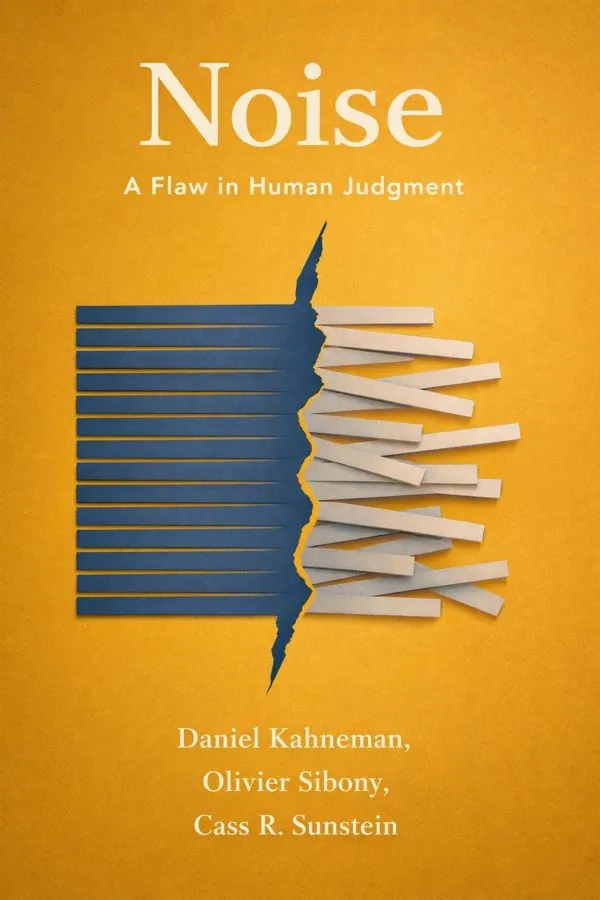
Noise: Summary & Key Insights
 10 min11 chaptersAudio available
What Is Noise About?
Noise by Daniel Kahneman is a psychology book published in 2021 spanning 11 pages. Noise: A Flaw in Human Judgment explores the concept of 'noise'—the unwanted variability in human judgments that leads to inconsistent decisions in fields such as law, medicine, and business. The authors analyze how noise differs from bias, how it affects organizations and individuals, and propose methods to reduce it through structured decision-making and improved judgment practices.
This FizzRead summary covers all 11 key chapters of Noise in approximately 10 minutes, distilling the most important ideas, arguments, and takeaways from Daniel Kahneman's work. Also available as an audio summary and Key Quotes Podcast.
Noise: A Flaw in Human Judgment
Noise: A Flaw in Human Judgment explores the concept of 'noise'—the unwanted variability in human judgments that leads to inconsistent decisions in fields such as law, medicine, and business. The authors analyze how noise differs from bias, how it affects organizations and individuals, and propose methods to reduce it through structured decision-making and improved judgment practices.
Who Should Read Noise?
This book is perfect for anyone interested in psychology and looking to gain actionable insights in a short read. Whether you're a student, professional, or lifelong learner, the key ideas from Noise by Daniel Kahneman will help you think differently.
- ✓Readers who enjoy psychology and want practical takeaways
- ✓Professionals looking to apply new ideas to their work and life
- ✓Anyone who wants the core insights of Noise in just 10 minutes
Want the full summary?
Get instant access to this book summary and 100K+ more with Fizz Moment.
Get Free SummaryAvailable on App Store • Free to download
Key Chapters
To appreciate noise, let us observe how it manifests across professional domains. When we conducted studies with insurance underwriters, judges, forensic scientists, and physicians, we found that their judgments—though informed by rigorous training—were astonishingly inconsistent. Take underwriting decisions: when given the same case file, two experienced underwriters could propose premium rates differing by more than fifty percent. In our surveys within judicial systems, sentencing for identical crimes varied wildly based on which judge presided. In medicine, diagnostic outcomes changed with the hospital, the department, or even the time of day.
These disparities can be unsettling. Professionals often feel insulted when confronted with evidence of inconsistency because their self-concept rests on expertise and disciplined reasoning. Yet noise does not stem from lack of skill—it arises precisely because human judgment is inherently variable. We make decisions under fluctuating states of mind, in diverse contexts, influenced by irrelevant cues: mood, framing, fatigue, hunger, even the weather outside.
Noise undermines reliability by introducing randomness into systems that presume consistency. Two reasonable individuals, both committed to accuracy, can arrive at different conclusions simply because they are human. This means that algorithms—cold, emotionless, perfectly consistent—often outperform people not because they are smarter, but because they are noiseless. Recognizing this does not diminish human dignity; rather, it illuminates our limitations and calls for disciplined guardrails.
Throughout each field, noise has concrete consequences. In law, it leads to unequal treatment under the same statutes. In medicine, it generates misdiagnoses and inconsistent prescriptions. In business, it produces erratic hiring, unreliable credit evaluation, and unstable pricing. Across sectors, these inconsistencies accumulate into systemic inefficiency and moral unfairness. Once you observe this variability, you feel a kind of awakening—a realization that striving for better judgment is not about perfection but about predictability. We must acknowledge that variability is an error source, just as bias is, and addressing it requires institutional courage.
Bias and noise are twin sources of error, yet they differ profoundly. Bias is directional—it pushes all judgments systematically away from accuracy in a predictable way. Noise, by contrast, is dispersive—it scatters judgments around the truth in random directions. Think of an arrow shot repeatedly at a target: bias reveals itself when all arrows land in the same wrong corner; noise when the arrows form a wide, chaotic pattern around the bull’s-eye.
Understanding the distinction is crucial because organizations often focus exclusively on bias, assuming that eliminating prejudice or cognitive distortion will produce fair and accurate judgments. They forget that variance itself is a distortion. You can have an unbiased system that is still wildly noisy, and in aggregate, that noise can cause more harm than bias.
When teams analyze errors, they often search for reasons—beliefs, motives, flawed data. These are bias explanations. Rarely do they ask whether their judgments would be consistent if repeated. This oversight perpetuates the illusion of reliability. An organization blind to noise may believe its decision process is fair simply because it lacks overt bias, unaware that randomness itself corrupts fairness.
By distinguishing noise from bias, we open new pathways for improvement. Bias calls for correction through reeducation and recalibration; noise calls for standardization and structure. Bias reduction aims to change our thinking; noise reduction aims to change our processes. Recognizing both allows us to build more dependable systems—ones that yield consistent outcomes across decision-makers and contexts.
In truth, bias and noise coexist, and their effects compound. A biased but noisy system produces outcomes both uneven and inaccurate. Therefore, judgment hygiene—the systematic discipline of reducing both—becomes the ultimate aim of rational organizations. This conceptual divide is not merely academic; it reshapes how we manage people and policies.
+ 9 more chapters — available in the FizzRead app
All Chapters in Noise
About the Author
Daniel Kahneman is a Nobel Prize–winning psychologist known for his work on behavioral economics and decision-making. Olivier Sibony is a professor of strategy and a former senior partner at McKinsey & Company. Cass R. Sunstein is a legal scholar and professor at Harvard Law School, recognized for his research on behavioral economics and public policy.
Get This Summary in Your Preferred Format
Read or listen to the Noise summary by Daniel Kahneman anytime, anywhere. FizzRead offers multiple formats so you can learn on your terms — all free.
Available formats: App · Audio · PDF · EPUB — All included free with FizzRead
Download Noise PDF and EPUB Summary
Key Quotes from Noise
“To appreciate noise, let us observe how it manifests across professional domains.”
“Bias and noise are twin sources of error, yet they differ profoundly.”
Frequently Asked Questions about Noise
Noise by Daniel Kahneman is a psychology book that explores key ideas across 11 chapters. Noise: A Flaw in Human Judgment explores the concept of 'noise'—the unwanted variability in human judgments that leads to inconsistent decisions in fields such as law, medicine, and business. The authors analyze how noise differs from bias, how it affects organizations and individuals, and propose methods to reduce it through structured decision-making and improved judgment practices.
More by Daniel Kahneman
You Might Also Like
The Body Keeps the Score
Bessel van der Kolk
10 min
Surrounded by Idiots
Thomas Erikson
10 min
Emotional Intelligence
Daniel Goleman
10 min
Attached
Amir Levine
10 min
Why Does He Do That
Lundy Bancroft
10 min
Women Who Run with the Wolves
Clarissa Pinkola Estés
10 minBrowse by Category
Ready to read Noise?
Get the full summary and 100K+ more books with Fizz Moment.