
Alex Hormozi's Must-Read Books
Discover the books that shaped Alex Hormozi's business empire. From sales strategies to mindset shifts, these are the titles he credits for his success.

 10 min read
100M Offers
by Alex Hormozi
What separates a business that struggles to close sales from one that seems to attract customers effortlessly? According to Alex Hormozi, the answer is rarely better branding, a prettier website, or a larger audience. More often, it is the quality of the offer itself. In 100M Offers, Hormozi argues that when an offer is so compelling that people feel foolish saying no, marketing becomes easier, sales objections shrink, and growth accelerates. The book is a practical guide to building what Hormozi calls a “Grand Slam Offer”: a package so valuable, specific, and outcome-driven that it stands out in even crowded markets. Rather than focusing on theory, he gives entrepreneurs a clear framework for understanding customer desire, increasing perceived value, reducing risk, and pricing for profit. His advice is grounded in hard-won experience from building and scaling multiple businesses, including companies that helped thousands of owners grow revenue. For founders, freelancers, consultants, and operators, 100M Offers matters because it reframes selling. The goal is not to push harder. It is to create something people genuinely want—an offer that solves an urgent problem, promises a meaningful transformation, and feels impossible to ignore.
Key Takeaways
- 1People Buy Outcomes, Not Products — A customer rarely wants your service for its own sake; they want the better version of themselves they believe it can cr…
- 2Use the Value Equation Intentionally — Value is not fixed; it is perceived. Hormozi distills this into one of the book’s most important frameworks: perceived v…
- 3Choose a Painful, Hungry Market — Even a strong offer struggles in a weak market. Hormozi emphasizes that who you sell to matters as much as what you sell…
 10 min read
Influence
by Robert Cialdini
Why do people say yes when they would prefer to say no? Why do intelligent, careful individuals still fall for pressure, urgency, and persuasive framing? In Influence, Robert B. Cialdini answers these questions by uncovering the hidden psychological patterns that shape everyday decisions. Drawing on decades of research in social psychology, as well as undercover fieldwork in sales, fundraising, advertising, and compliance professions, Cialdini explains how persuasion often works not through logic alone, but through reliable mental shortcuts. He identifies six core principles of influence—reciprocity, commitment and consistency, social proof, liking, authority, and scarcity—and shows how they operate in business, relationships, politics, and consumer behavior. What makes the book so enduring is its balance of scientific rigor and practical usefulness. It helps readers become both more persuasive and more resistant to manipulation. Whether you work in marketing, negotiation, leadership, or simply want to make better decisions in a world full of influence attempts, this book offers a framework that remains remarkably relevant. Influence is not just about persuasion; it is about understanding human behavior under pressure.
Key Takeaways
- 1Weapons of Influence and Automaticity — Much of persuasion succeeds not because people are foolish, but because people are busy. Cialdini begins with a crucial …
- 2Reciprocity Creates Powerful Obligation — A small favor can create a surprisingly large sense of debt. That is the essence of reciprocity, one of the oldest and m…
- 3Commitment Shapes Future Behavior — People do not just want to make decisions; they want to appear consistent with them. Cialdini explains that once individ…
 10 min read
The Hard Thing About Hard Things
by Ben Horowitz
Building a company is often romanticized as a thrilling journey powered by vision, talent, and hustle. Ben Horowitz shatters that illusion. In The Hard Thing About Hard Things, he focuses on the brutal realities of leadership: running out of cash, firing friends, laying off loyal employees, managing executives who disappoint, and making high-stakes decisions when no option feels right. This is not a book of tidy frameworks or motivational slogans. It is a survival guide for leaders facing ambiguity, pressure, and fear. Horowitz writes from hard-earned experience. As cofounder and CEO of Loudcloud, later transformed into Opsware, he led a company through the dot-com crash, near-collapse, painful restructuring, and ultimately a successful sale to Hewlett-Packard. He later became a cofounder of Andreessen Horowitz, one of Silicon Valley’s most influential venture capital firms, giving him a front-row seat to the struggles of countless founders. What makes this book matter is its honesty. Horowitz argues that the toughest moments in business rarely come with clear answers. Leadership is not about avoiding pain; it is about carrying responsibility through it. For founders, executives, and anyone managing under pressure, this book offers unusually practical wisdom for doing the job when it is hardest.
Key Takeaways
- 1Entrepreneurship Means Entering Organized Chaos — The biggest shock of entrepreneurship is not the workload; it is the absence of certainty. People often imagine startups…
- 2Crisis Leadership Requires Choosing Under Pressure — A crisis does not test your intelligence nearly as much as it tests your nerve. Horowitz shows that when companies appro…
- 3The CEO Job Is Inherently Lonely — The hardest part of being a CEO is not the title, the schedule, or even the responsibility. It is the isolation. Horowit…
 10 min read
How to Win Friends and Influence People
by Dale Carnegie
First published in 1936, How to Win Friends and Influence People remains one of the most influential self-help books ever written because it addresses a timeless truth: success depends not only on what you know, but on how you relate to people. Dale Carnegie argues that influence is rarely won through force, criticism, or cleverness alone. Instead, it grows from empathy, respect, sincere appreciation, and the ability to understand what motivates others. Drawing from years of teaching public speaking and human relations, Carnegie distilled practical lessons from business leaders, historical figures, and everyday interactions into a set of principles anyone can apply. The book shows how to handle people without creating resentment, make others feel important, persuade without argument, and lead in ways that inspire cooperation rather than resistance. Its enduring appeal lies in its simplicity: these ideas are easy to understand, yet difficult enough in practice to be transformative. Whether you want to improve your career, strengthen relationships, or communicate with more confidence and tact, Carnegie offers a powerful guide to becoming someone others genuinely want to listen to and work with.
Key Takeaways
- 1Master the Fundamentals of Human Relations — Most conflict begins not with major disagreements, but with small failures in emotional intelligence. Carnegie’s first l…
- 2Make People Feel Seen and Valued — People are drawn less to brilliance than to warmth. Carnegie’s famous principles for making people like you are built on…
- 3Influence Begins with Empathy, Not Pressure — The fastest way to create resistance is to make people feel pushed. Carnegie teaches that real influence does not begin …
 10 min read
Thinking Fast and Slow
by Daniel Kahneman
Thinking Fast and Slow is one of the most influential books ever written about how the human mind works. In it, Daniel Kahneman distills decades of groundbreaking research in psychology and behavioral economics into a practical framework for understanding why people make smart decisions in some situations and surprisingly poor ones in others. His central insight is that our thinking is shaped by two systems: one that is fast, intuitive, and automatic, and another that is slow, effortful, and analytical. Most of the time, these systems cooperate efficiently. But just as often, the quick judgments of the mind lead us into predictable errors. What makes this book so powerful is that it changes how you see everyday life. From investing and hiring to relationships, planning, medicine, and public policy, Kahneman shows how biases quietly shape choices we assume are rational. He writes with the authority of a Nobel Prize-winning researcher whose work, much of it developed with Amos Tversky, transformed our understanding of judgment under uncertainty. This is not only a book about mistakes; it is a guide to better thinking, wiser decisions, and greater humility about the limits of human reason.
Key Takeaways
- 1The Two Systems That Shape Thought — Most of what you think feels deliberate, but much of it happens automatically. Kahneman’s most famous contribution is th…
- 2Heuristics Make Judgment Efficient and Flawed — The mind is built to simplify, not to calculate perfectly. To navigate uncertainty, we rely on heuristics, mental shortc…
- 3Confidence Often Exceeds What We Know — We are far better at creating explanations than at recognizing our ignorance. Kahneman shows that overconfidence is one …
 10 min read
Lean Analytics
by Alistair Croll, Benjamin Yoskovitz
Most startups do not fail because founders lack passion. They fail because they mistake motion for progress and opinions for evidence. Lean Analytics shows entrepreneurs how to replace guesswork with disciplined measurement, using data not as a reporting tool but as a way to discover what really drives growth. Building on the ideas of Lean Startup, Alistair Croll and Benjamin Yoskovitz argue that every business must identify the one metric that matters most at a given moment, then use it to guide product decisions, experiments, and strategy. The book matters because modern companies can track almost everything, yet that abundance often creates confusion rather than clarity. Instead of collecting endless dashboards, the authors offer a practical framework for deciding what to measure, when to measure it, and how to act on it. Their authority comes from direct experience advising startups, building products, and working with founders under real market pressure. The result is a highly usable playbook for entrepreneurs, product teams, and growth leaders who want to build companies based on evidence, learning, and traction rather than intuition alone.
Key Takeaways
- 1Find Your One Metric That Matters — What kills many startups is not a lack of data but too much of the wrong data. Founders can easily become obsessed with …
- 2Measure According to Startup Growth Stages — A startup is not one problem repeated over time; it is a sequence of very different problems. That is why metrics that m…
- 3Start With Empathy, Not Features — Before you can measure growth, you must first understand whose problem you are solving and why it matters deeply enough …
 10 min read
Good to Great
by Jim Collins
What separates a merely good company from one that becomes truly great? In Good to Great, Jim Collins tackles that question with unusual rigor, moving beyond inspirational slogans and management fads to study how enduring business excellence actually happens. Based on a five-year research project, Collins and his team examined companies that achieved extraordinary long-term results after years of ordinary performance, then compared them with similar firms that failed to make the leap. The result is a practical framework for transformation built on discipline, leadership, culture, and strategic clarity. This book matters because it challenges many popular assumptions about success. Great companies, Collins argues, are not built by celebrity CEOs, dramatic turnarounds, or lucky timing alone. Instead, they emerge when leaders combine humility with fierce resolve, place the right people in the right roles, confront brutal facts without losing faith, and focus relentlessly on what they can do better than anyone else. Jim Collins is one of the most respected voices in business research, known for combining data-driven analysis with memorable ideas. Good to Great remains a foundational read for executives, entrepreneurs, managers, and anyone interested in building organizations that last.
Key Takeaways
- 1Level 5 Leadership Drives Lasting Greatness — The most powerful leaders are often the least theatrical. One of Collins’s most surprising findings is that the companie…
- 2First Who, Then What — Great strategy begins with people, not plans. Collins argues that before a company decides exactly where to go, it must …
- 3Confront Brutal Facts Without Losing Faith — Hope is not a strategy, but pessimism is not leadership either. One of the most enduring ideas in Good to Great is the S…
 10 min read
The E-Myth Revisited
by Michael E. Gerber
Most small businesses do not fail because their owners are lazy, untalented, or uncommitted. They fail because the people who start them often misunderstand what a business actually requires. In The E-Myth Revisited, Michael E. Gerber argues that many entrepreneurs are trapped by a dangerous assumption: if you understand the technical work of a business, you also understand how to build and run one. That misunderstanding leads owners to create jobs for themselves rather than companies that can grow. Gerber’s book is a classic in business thinking because it translates entrepreneurial ambition into a practical framework. He explains why owners get stuck in daily chaos, why hard work alone is not enough, and how systems, processes, and structure create freedom. Drawing on years of experience as a small business consultant, Gerber shows how to shift from being the overworked operator to becoming the designer of a business that can function consistently without constant rescue. For founders, freelancers, managers, and anyone dreaming of starting a company, this book remains one of the clearest guides to building a business that works.
Key Takeaways
- 1The Entrepreneurial Myth and Three Selves — The biggest surprise in small business is that passion is often the beginning of the problem, not the solution. Gerber c…
- 2Work On It, Not In It — A business becomes dangerous when the owner is indispensable. One of Gerber’s most enduring ideas is the distinction bet…
- 3The Turn-Key Revolution and Systems Thinking — Freedom in business does not come from spontaneity; it comes from intelligent design. Gerber uses the idea of the Turn-K…
 10 min read
Never Eat Alone
by Keith Ferrazzi
Never Eat Alone is a practical and persuasive guide to one of the most underrated drivers of success: relationships. In this business classic, Keith Ferrazzi argues that achievement is rarely a solo act. Careers accelerate, ideas spread, and opportunities appear when people build authentic connections rooted in generosity, trust, and mutual support. Rather than treating networking as manipulation or self-promotion, Ferrazzi reframes it as a lifelong practice of helping others, sharing knowledge, and staying meaningfully connected. What makes the book especially powerful is its blend of mindset and method. Ferrazzi does not simply say that relationships matter; he explains how to build them deliberately, from identifying your purpose and reaching out with confidence to maintaining contact and creating value over time. His advice applies whether you are an entrepreneur, executive, job seeker, student, or anyone trying to grow in a competitive world. Ferrazzi writes with unusual authority. A Harvard and Yale graduate, former CMO, entrepreneur, and trusted advisor to major companies, he built his own career through strategic generosity and human connection. The result is a business book that feels both ambitious and deeply humane.
Key Takeaways
- 1Networking Means Relationships, Not Transactions — Many people resist networking because they associate it with shallow small talk, opportunism, and using people. Ferrazzi…
- 2Build Relationships Around A Clear Mission — Connection without direction can become noise. Ferrazzi emphasizes that meaningful relationship-building starts with kno…
- 3Create Visibility Before You Need It — Opportunity rarely goes to the most talented unknown person. Ferrazzi argues that if people do not know who you are, wha…
 10 min read
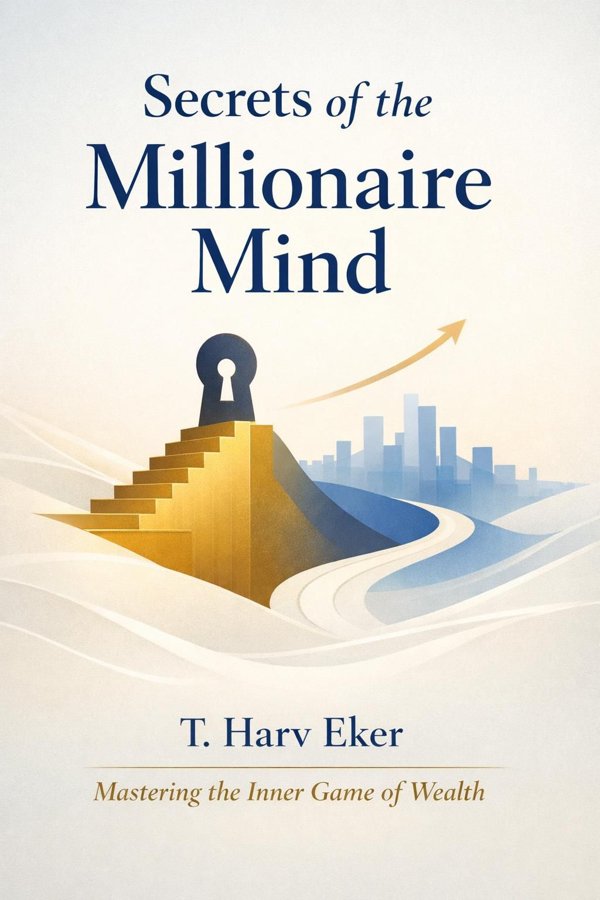
Secrets of the Millionaire Mind
by T. Harv Eker
In this influential personal finance and mindset book, T. Harv Eker explores the psychological and behavioral patterns that differentiate wealthy individuals from those who struggle financially. He introduces the concept of a 'money blueprint'—the subconscious set of beliefs about money learned in childhood—and provides practical steps to reprogram these beliefs to achieve financial success. The book combines motivational insights with actionable strategies for developing a millionaire mindset.
Key Takeaways
- 1Part I – Your Money Blueprint — When I talk about the Money Blueprint, I’m referring to the automatic script running underneath your financial life. It …
- 2Part II – The Wealth Files — Now that your inner foundation has begun to shift, it’s time to learn the behaviors and attitudes that define the rich. …
- 3Integration and Maintenance
Want the full summary?
Get instant access to this book summary and 100K+ more with Fizz Moment.
Get Free SummaryAvailable on App Store • Free to download
About This List
Discover the books that shaped Alex Hormozi's business empire. From sales strategies to mindset shifts, these are the titles he credits for his success.
This list features 10 carefully selected books. With FizzRead, you can read AI-powered summaries of each book in just 15 minutes. Get the key takeaways and start applying the insights immediately.
Ready to start reading?
Get instant access to all 10 book summaries and 100K+ more with FizzRead.