
Neil deGrasse Tyson's Science Bookshelf
Books recommended by astrophysicist Neil deGrasse Tyson for understanding the universe and our place in it.
 10 min read
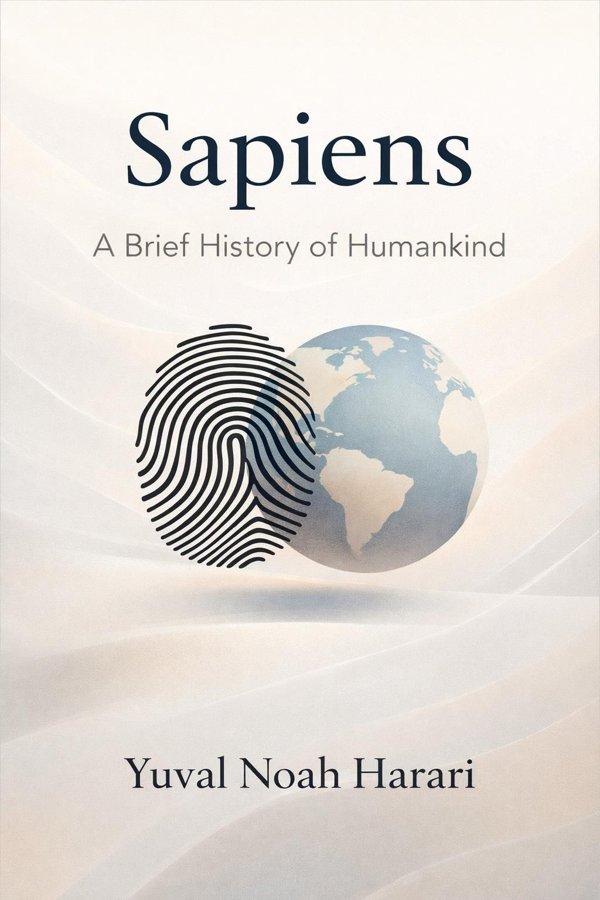
Sapiens
by Yuval Noah Harari
Sapiens: A Brief History of Humankind is an ambitious, big-picture history of our species, tracing how Homo sapiens rose from an unremarkable African ape to the dominant force on Earth. Yuval Noah Harari combines history, biology, anthropology, economics, and philosophy to explain the turning points that transformed human life: the Cognitive Revolution, the Agricultural Revolution, and the Scientific Revolution. Rather than offering a narrow chronological account, he asks a deeper question: what made humans uniquely capable of building empires, religions, markets, and nations? Harari’s answer is both provocative and memorable: our greatest power lies in our ability to create and believe shared stories. These collective fictions—such as money, laws, gods, and states—allow strangers to cooperate on a massive scale. The book matters because it challenges comforting assumptions about progress, happiness, and civilization. It invites readers to see modern society not as inevitable, but as the result of historical choices, accidents, and myths. As a historian and public intellectual, Harari brings scholarly range and narrative clarity to one of the most compelling questions in human history: how did we become who we are?
Key Takeaways
- 1The Cognitive Revolution and Shared Imagination — Human dominance did not begin with stronger bodies, sharper teeth, or faster legs; it began with a new kind of mind. Aro…
- 2The Agricultural Revolution: Progress or Trap? — What if one of history’s greatest achievements was also one of its greatest mistakes? Harari provocatively argues that t…
- 3Myths Make Large Societies Possible — Civilization runs not only on roads, crops, and armies, but on ideas that exist because people collectively agree they d…
 10 min read
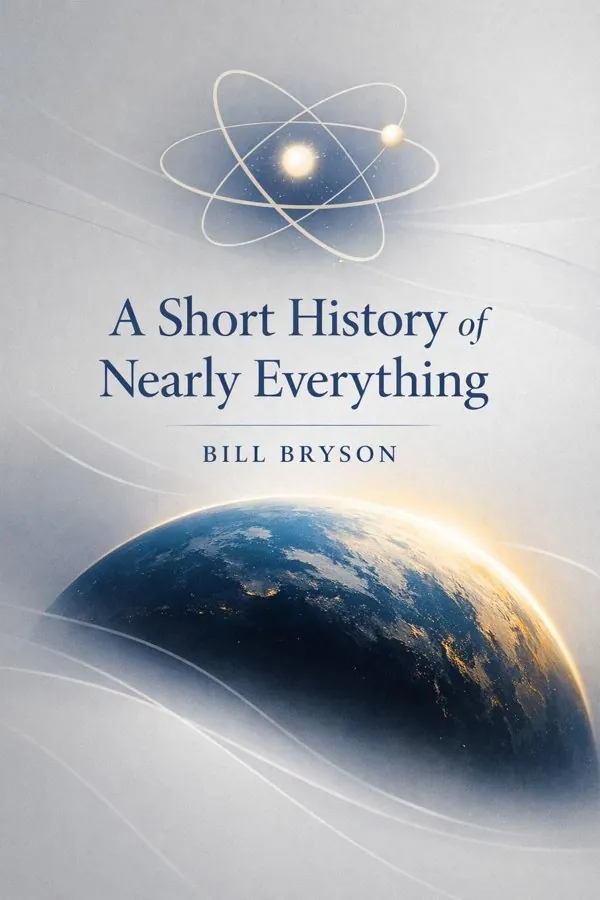
A Short History of Nearly Everything
by Bill Bryson
A Short History of Nearly Everything is Bill Bryson’s ambitious attempt to answer some of humanity’s biggest questions: How did the universe begin? How did Earth form? How did life emerge, evolve, and eventually produce us? Rather than writing a dry scientific survey, Bryson turns these immense topics into a vivid, highly readable journey through cosmology, geology, chemistry, physics, biology, and human evolution. He is especially interested in how we know what we know, so the book does not just present facts—it tells the stories of the curious, stubborn, brilliant, and often eccentric people who discovered them. What makes the book matter is its rare combination of scope, clarity, and humility. Bryson reminds readers that modern science is one of humanity’s greatest achievements, yet much of reality remains astonishingly mysterious. He also shows how fragile life is and how improbable our existence may be. Though Bryson is not a scientist by training, that is part of his strength: he writes as an intelligent outsider asking the questions many readers themselves would ask. The result is one of the most engaging introductions to scientific thought ever written for general readers.
Key Takeaways
- 1Origins of the Universe and Time — Everything you know—every star, atom, ocean, and memory—began in an event so extreme that ordinary language barely helps…
- 2Earth’s Violent Formation and Unlikely Stability — The ground beneath your feet feels permanent, but Earth’s existence is the result of chaos, collision, and extraordinary…
- 3Deep Time Changes Human Perspective — One of science’s most revolutionary discoveries is not a machine or a formula, but a timescale. Bryson shows how difficu…
 10 min read
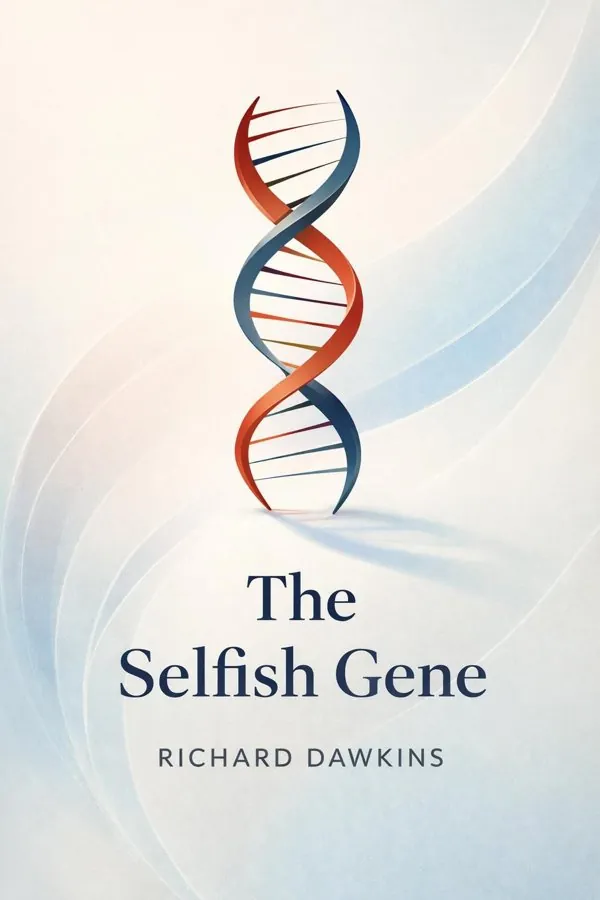
The Selfish Gene
by Richard Dawkins
Richard Dawkins’s The Selfish Gene is one of the most influential science books of the twentieth century because it changes the angle from which evolution is viewed. Instead of treating organisms, species, or groups as the main units of natural selection, Dawkins argues that genes are the more enduring players. Organisms, in this framework, are temporary survival machines built by genes to help them persist and replicate. This perspective does not mean genes possess intentions or moral character; “selfish” is a metaphor for the logic of differential survival. What makes the book so powerful is that it explains seemingly puzzling phenomena—altruism, cooperation, parental conflict, sexual competition, and even culture—through a single unifying lens. Dawkins combines rigorous evolutionary thinking with vivid examples and memorable language, making difficult ideas accessible without stripping them of depth. He also introduced the concept of the “meme,” extending evolutionary logic into the realm of culture. As an evolutionary biologist and gifted science communicator, Dawkins brought gene-centered thinking into mainstream discussion. The Selfish Gene remains essential reading for anyone who wants to understand evolution, human behavior, and the deeper logic of life.
Key Takeaways
- 1Genes Are Evolution’s Real Units — The most unsettling idea in the book is also the most clarifying: evolution does not primarily reward species, groups, o…
- 2Replicators Build Bodies as Vehicles — Life becomes easier to understand once we separate two roles that are often confused: replicators and vehicles. Dawkins …
- 3Altruism Can Serve Selfish Genes — At first glance, altruism seems to contradict evolution. Why would natural selection favor behavior that helps others at…
 10 min read
Guns Germs and Steel
by Jared Diamond
Why did some societies develop writing, steel weapons, large empires, and ocean-crossing ships, while others did not? That deceptively simple question sits at the center of Guns, Germs, and Steel, one of the most influential history books of the modern era. In this sweeping work, Jared Diamond challenges the comforting but dangerous idea that global inequality can be explained by differences in intelligence, culture, or race. Instead, he argues that the deepest causes of historical dominance were geographical and ecological: access to domesticable crops and animals, the spread of disease, the shape of continents, and the ability of ideas to travel. What makes this book matter is not just its bold thesis, but its scale. Diamond connects anthropology, geography, biology, and history into one big explanation for how the modern world took shape. He asks readers to zoom out from kings and battles and look instead at seeds, livestock, climate, and migration routes. Diamond, a geographer and historian at UCLA and Pulitzer Prize winner for this book, brings unusual interdisciplinary authority to the subject. The result is a provocative, readable framework for understanding why power accumulated unevenly across the globe—and why that history still matters today.
Key Takeaways
- 1Yali’s Question — The book begins with a question that is both personal and world-historical. In New Guinea, a local leader named Yali ask…
- 2Natural Experiments of History — To test his theory, Diamond looks for what he calls “natural experiments of history”—cases where related peoples ended u…
- 3The Evolution of Human Societies — Diamond places human history on a very long timeline. For most of our species’ existence, humans lived as hunter-gathere…
 10 min read
The Demon-Haunted World
by Carl Sagan
Carl Sagan’s The Demon-Haunted World: Science as a Candle in the Dark is both a defense of science and a warning about what happens when societies lose their grip on critical thinking. Written in 1995 but startlingly relevant today, the book examines why people are drawn to superstition, pseudoscience, conspiracy theories, and magical thinking—even in technologically advanced cultures. Sagan argues that science is not merely a body of facts but a disciplined way of testing ideas, questioning assumptions, and protecting ourselves from deception. He explores UFO claims, alien abductions, faith healing, witch hunts, and media-driven misinformation to show how easily human beings can be misled when skepticism is weak. What makes the book powerful is Sagan’s rare combination of scientific authority and human warmth. As an astronomer, educator, and one of the world’s great science communicators, he understood both the grandeur of discovery and the fragility of reason. This book matters because it teaches readers how to think, not what to think—and in an age of viral falsehoods, that skill is indispensable.
Key Takeaways
- 1Science Begins With Informed Doubt — The deepest strength of science is not certainty but organized skepticism. Many people imagine that science is a system …
- 2The Baloney Detection Kit — Bad ideas often sound persuasive because they appeal to emotion, authority, or wishful thinking rather than evidence. To…
- 3Why Pseudoscience Feels So Convincing — False beliefs often succeed not because they are well supported, but because they are psychologically satisfying. Sagan …
 10 min read
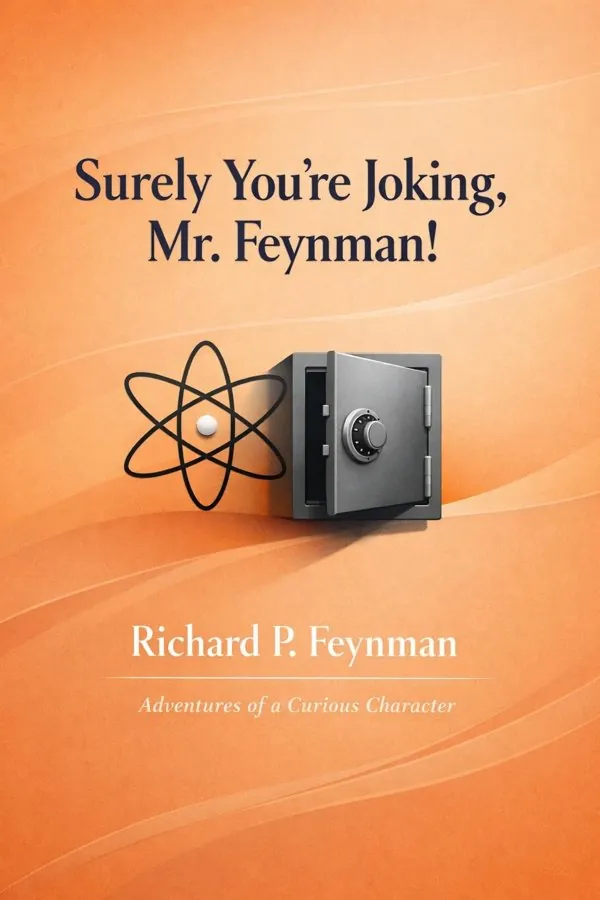
Surely You're Joking, Mr. Feynman!
by Richard P. Feynman
Surely You're Joking, Mr. Feynman! is not a conventional memoir, and that is exactly why it remains so memorable. Drawn from conversations between Nobel Prize–winning physicist Richard P. Feynman and Ralph Leighton, the book gathers a series of lively autobiographical stories that show Feynman at work, at play, and in constant pursuit of understanding. We meet him as a curious boy in Far Rockaway, a gifted student at MIT and Princeton, a young scientist at Los Alamos, and later a world-famous professor who still approached life with the enthusiasm of an amateur. What makes the book matter is that it is not really about fame or even physics. It is about a way of seeing: questioning assumptions, testing ideas firsthand, resisting pretension, and staying open to surprise. Feynman’s adventures with safecracking, teaching, drumming, drawing, and traveling reveal the same mindset that fueled his scientific breakthroughs. His authority comes not only from winning the 1965 Nobel Prize in Physics for work in quantum electrodynamics, but from his rare ability to connect rigorous thinking with playful curiosity. The result is a biography of a mind fully awake to the world.
Key Takeaways
- 1Curiosity Begins Before Formal Education — A great mind is often shaped less by answers than by the habit of asking better questions. In the opening episodes of Fe…
- 2Real Learning Comes From Play — The fastest route to mastery is often disguised as enjoyment. Feynman’s years at MIT and Princeton show that his brillia…
- 3Skepticism Protects Independent Thinking — Intelligence becomes far more useful when it is paired with the courage to doubt appearances. Throughout the book, Feynm…
 10 min read
The Structure of Scientific Revolutions
by Thomas S. Kuhn
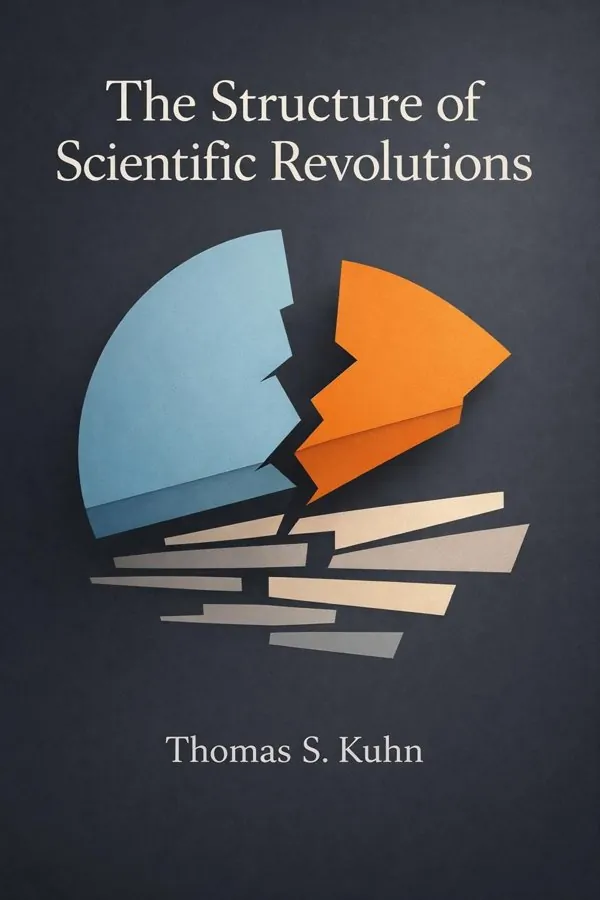
What if science does not advance mainly by steadily piling up facts, but by periodically overturning its own deepest assumptions? In The Structure of Scientific Revolutions, Thomas S. Kuhn challenged the traditional picture of science as a linear march toward truth and replaced it with a far more dynamic account. He argues that scientific fields are organized around paradigms: shared frameworks that shape what researchers study, how they interpret evidence, and what counts as a legitimate solution. Most of the time, scientists work within these frameworks in periods of “normal science.” But when persistent anomalies accumulate, confidence weakens, crises emerge, and eventually a scientific revolution may install a new paradigm. First published in 1962, Kuhn’s book transformed the philosophy and history of science. Its language, especially the phrase “paradigm shift,” entered culture far beyond academia because it captures a universal pattern of change in ideas, institutions, and worldviews. Kuhn wrote with rare authority, drawing on both scientific training and historical scholarship. The result is a landmark work that helps readers understand not only how science changes, but how human communities decide what counts as reality, reason, and progress.
Key Takeaways
- 1Normal Science Solves Approved Puzzles — Scientific work is often less about wild originality than disciplined problem-solving inside an accepted framework. Kuhn…
- 2Paradigms Shape What Scientists Can See — We do not simply observe the world; we observe it through concepts we have learned. Kuhn’s idea of a paradigm is therefo…
- 3Anomalies Begin Where Confidence Weakens — Breakthroughs often begin as irritations. During normal science, not every mismatch between theory and reality causes al…
 10 min read
The Beginning of Infinity
by David Deutsch
The Beginning of Infinity is David Deutsch’s ambitious argument that human progress has no fixed ceiling. Rather than treating science as a collection of facts, Deutsch presents it as a method for creating good explanations—accounts of reality that are hard to vary without losing their power. From that starting point, he explores why knowledge grows, why problems are solvable, and why pessimism so often mistakes temporary limits for permanent ones. The book ranges across physics, evolution, political philosophy, art, morality, and the future of civilization, yet it remains centered on one radical claim: all evils are caused by insufficient knowledge, and knowledge can, in principle, continue to expand without end. That makes this more than a science book. It is a philosophy of progress and a defense of optimism grounded in reason rather than wishful thinking. Deutsch writes with unusual authority. A pioneering physicist at Oxford and one of the founders of quantum computation, he combines technical insight with sweeping philosophical ambition. The result is a challenging but rewarding work that asks readers to rethink what human beings are capable of achieving.
Key Takeaways
- 1The Reach of Good Explanations — The difference between knowledge and mere assertion begins with explanation. Deutsch argues that a good explanation is n…
- 2Optimism and Unlimited Human Progress — Optimism, in Deutsch’s sense, is not positive thinking. It is the belief that problems are inevitable but solvable. That…
- 3The Jump to Universality — Some ideas do more than solve a local problem; they become universal. Deutsch is fascinated by moments when systems cros…
 10 min read
Thinking Fast and Slow
by Daniel Kahneman
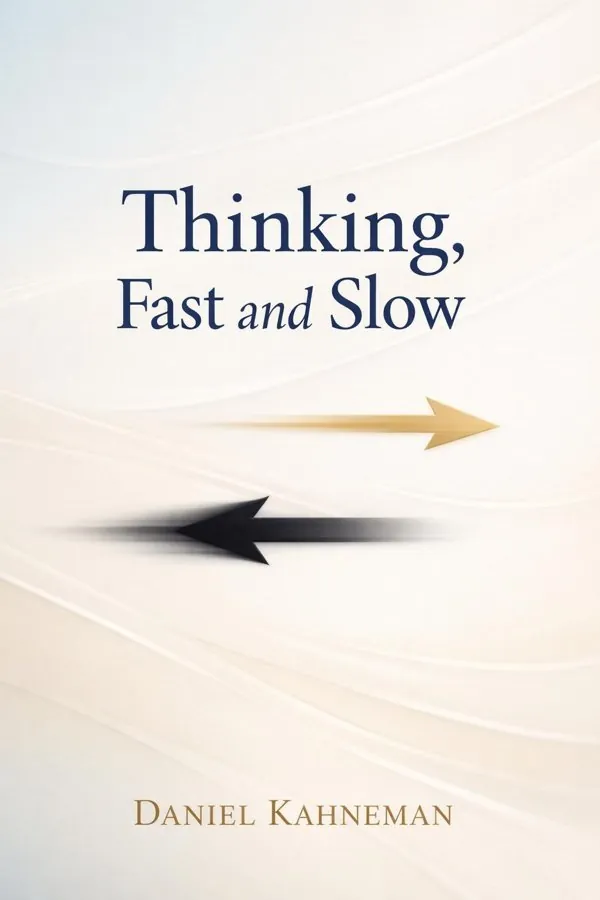
Thinking Fast and Slow is one of the most influential books ever written about how the human mind works. In it, Daniel Kahneman distills decades of groundbreaking research in psychology and behavioral economics into a practical framework for understanding why people make smart decisions in some situations and surprisingly poor ones in others. His central insight is that our thinking is shaped by two systems: one that is fast, intuitive, and automatic, and another that is slow, effortful, and analytical. Most of the time, these systems cooperate efficiently. But just as often, the quick judgments of the mind lead us into predictable errors. What makes this book so powerful is that it changes how you see everyday life. From investing and hiring to relationships, planning, medicine, and public policy, Kahneman shows how biases quietly shape choices we assume are rational. He writes with the authority of a Nobel Prize-winning researcher whose work, much of it developed with Amos Tversky, transformed our understanding of judgment under uncertainty. This is not only a book about mistakes; it is a guide to better thinking, wiser decisions, and greater humility about the limits of human reason.
Key Takeaways
- 1The Two Systems That Shape Thought — Most of what you think feels deliberate, but much of it happens automatically. Kahneman’s most famous contribution is th…
- 2Heuristics Make Judgment Efficient and Flawed — The mind is built to simplify, not to calculate perfectly. To navigate uncertainty, we rely on heuristics, mental shortc…
- 3Confidence Often Exceeds What We Know — We are far better at creating explanations than at recognizing our ignorance. Kahneman shows that overconfidence is one …
 10 min read
Freakonomics
by Steven Levitt
Why do people cheat in some situations but act generously in others? Why do smart policies sometimes fail, while simple changes create outsized results? These are the kinds of questions that made the Freakonomics approach famous. In this book, Steven D. Levitt and Stephen J. Dubner invite readers to go beyond surface explanations and learn a more useful skill: how to think clearly when the world seems confusing. Rather than offering motivational slogans or neat formulas, they show how curiosity, data, and a willingness to challenge assumptions can uncover the hidden logic behind human behavior. What makes this book matter is its practicality. The ideas are not limited to economics classrooms or policy debates; they apply to parenting, business, negotiation, career choices, and everyday decisions. Levitt, a University of Chicago economist known for his work on crime and incentives, teams up with Dubner, a journalist and storyteller, to translate complex insights into memorable lessons. Together, they make a compelling case that better thinking starts with humility, sharper questions, and a habit of following evidence instead of intuition. If you want to solve problems more creatively and understand why people do what they do, this book offers a powerful mental toolkit.
Key Takeaways
- 1The Value of Saying 'I Don’t Know' — Thinking like a Freak starts with the most radical admission you can make: acknowledging your ignorance. When Levitt and…
- 2Incentives and Human Behavior — One of the central ideas in the Freakonomics worldview is that incentives drive behavior, but not always in the way we e…
- 3Thinking Small — Big problems often tempt us into big, dramatic solutions. But one of the most useful lessons in this book is that meanin…
Want the full summary?
Get instant access to this book summary and 100K+ more with Fizz Moment.
Get Free SummaryAvailable on App Store • Free to download
About This List
Books recommended by astrophysicist Neil deGrasse Tyson for understanding the universe and our place in it.
This list features 10 carefully selected books. With FizzRead, you can read AI-powered summaries of each book in just 15 minutes. Get the key takeaways and start applying the insights immediately.
Ready to start reading?
Get instant access to all 10 book summaries and 100K+ more with FizzRead.