
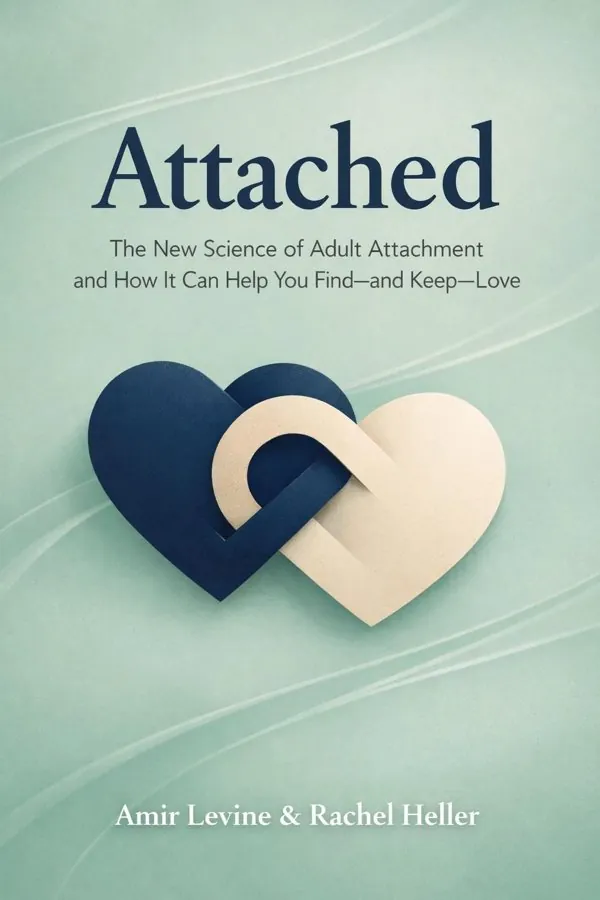
Attached: Summary & Key Insights
by Amir Levine
 10 min4 chaptersAudio available
Key Takeaways from Attached
Attachment theory began with John Bowlby’s insight that human beings are wired to seek closeness to trusted others, especially in moments of stress.
Attached explains that most adults lean toward one of three attachment styles: secure, anxious, or avoidant.
One of the most useful ideas in Attached is that relationships are shaped not just by your attachment style, but by the interaction between your style and your partner’s.
A hopeful message at the heart of Attached is that attachment style is influential, but it is not destiny.
What Is Attached About?
Attached by Amir Levine is a psychology book published in 2010 spanning 4 pages. Why do some relationships feel calm, safe, and nourishing while others leave you second-guessing every text, every pause, and every shift in tone? In Attached, Amir Levine and Rachel S. F. Heller offer a clear, research-based answer: much of our romantic behavior is driven by attachment style. The book takes a concept once associated mainly with childhood development and shows how powerfully it shapes adult love, dating, conflict, trust, and commitment. That alone makes this book deeply useful—but what makes it especially valuable is how practical it is. Rather than reducing relationship struggles to vague compatibility issues, it helps readers identify recurring patterns and understand why they keep happening. Levine, a psychiatrist and neuroscientist at Columbia University, brings clinical and scientific depth to the subject, while Heller adds a grounded, accessible perspective on relationships and behavior. Together, they explain how secure, anxious, and avoidant attachment styles influence the way we seek closeness, react to distance, and communicate needs. Whether you are dating, in a long-term partnership, recovering from heartbreak, or simply trying to understand yourself better, Attached gives you a smarter framework for building healthier, more fulfilling relationships.
This FizzRead summary covers all 4 key chapters of Attached in approximately 10 minutes, distilling the most important ideas, arguments, and takeaways from Amir Levine's work. Also available as an audio summary and Key Quotes Podcast.
Attached: The New Science of Adult Attachment and How It Can Help You Find—and Keep—Love
Why do some relationships feel calm, safe, and nourishing while others leave you second-guessing every text, every pause, and every shift in tone? In Attached, Amir Levine and Rachel S. F. Heller offer a clear, research-based answer: much of our romantic behavior is driven by attachment style. The book takes a concept once associated mainly with childhood development and shows how powerfully it shapes adult love, dating, conflict, trust, and commitment. That alone makes this book deeply useful—but what makes it especially valuable is how practical it is. Rather than reducing relationship struggles to vague compatibility issues, it helps readers identify recurring patterns and understand why they keep happening.
Levine, a psychiatrist and neuroscientist at Columbia University, brings clinical and scientific depth to the subject, while Heller adds a grounded, accessible perspective on relationships and behavior. Together, they explain how secure, anxious, and avoidant attachment styles influence the way we seek closeness, react to distance, and communicate needs. Whether you are dating, in a long-term partnership, recovering from heartbreak, or simply trying to understand yourself better, Attached gives you a smarter framework for building healthier, more fulfilling relationships.
Who Should Read Attached?
This book is perfect for anyone interested in psychology and looking to gain actionable insights in a short read. Whether you're a student, professional, or lifelong learner, the key ideas from Attached by Amir Levine will help you think differently.
- ✓Readers who enjoy psychology and want practical takeaways
- ✓Professionals looking to apply new ideas to their work and life
- ✓Anyone who wants the core insights of Attached in just 10 minutes
Want the full summary?
Get instant access to this book summary and 100K+ more with Fizz Moment.
Get Free SummaryAvailable on App Store • Free to download
Key Chapters
Attachment theory began with John Bowlby’s insight that human beings are wired to seek closeness to trusted others, especially in moments of stress. What started as a theory about infants and caregivers eventually revealed something much bigger: this need for connection does not disappear in adulthood. It simply changes form. In romantic relationships, a partner often becomes the person our nervous system looks to for reassurance, stability, and emotional safety. That is why separation, inconsistency, or emotional distance can feel so intense—our attachment system reads those signals as a threat.
Mary Ainsworth’s research helped identify different attachment patterns, and Attached extends that framework into adult life. The book argues that many behaviors people judge harshly—needing reassurance, feeling distressed by mixed signals, or pulling away from too much closeness—are not random flaws. They are predictable responses from an attachment system trying to restore balance. This is a freeing idea. It reframes so-called neediness or detachment as understandable, often deeply ingrained patterns.
A practical takeaway is to stop moralizing your emotional reactions and start observing them. Ask: What situations activate me? Do I feel calmer with consistency? Do I shut down when someone gets too close? By treating your responses as signals rather than defects, you gain self-awareness and make better relationship decisions. As the book suggests, dependence is not the opposite of strength; healthy interdependence is part of how humans thrive.
Attached explains that most adults lean toward one of three attachment styles: secure, anxious, or avoidant. Secure people are generally comfortable with closeness and trust. They can express needs directly, offer support without feeling trapped, and navigate conflict without assuming the relationship is in danger. In practice, this might look like saying, “I felt disconnected this week—can we make time to talk?” instead of withdrawing or escalating. Secure partners tend to create emotional stability because they are responsive and consistent.
Anxious individuals, by contrast, often crave closeness but worry about losing it. They may read deeply into delayed replies, feel unsettled by ambiguity, or seek repeated reassurance. The book is careful to point out that these reactions are not manipulation; they are the result of a highly activated attachment system. For example, someone with anxious attachment might repeatedly check in after sensing emotional distance, not because they want control, but because uncertainty feels genuinely distressing.
Avoidant individuals value independence and often feel uncomfortable with too much emotional intensity. They may minimize needs, keep partners at arm’s length, or focus on a partner’s flaws when intimacy deepens. One useful insight from the book is that avoidant behavior is often protective, not uncaring. Actionably, the goal is not to label yourself and stop there. It is to notice your default tendencies, understand how they affect your relationships, and move toward more secure habits through honesty, emotional awareness, and better communication.
One of the most useful ideas in Attached is that relationships are shaped not just by your attachment style, but by the interaction between your style and your partner’s. Some pairings create ease, while others trigger a painful cycle of pursuit and withdrawal. The classic example is the anxious-avoidant dynamic. The anxious partner seeks more closeness to feel secure; the avoidant partner feels pressured and pulls back to regain space. That withdrawal increases the anxious partner’s distress, which leads to more pursuit, which then pushes the avoidant partner even farther away. Without understanding the pattern, both people often blame each other instead of seeing the cycle itself as the problem.
The book helps readers spot these dynamics in everyday moments: one person wanting more communication, the other calling it “too much”; one asking for reassurance, the other responding with silence; one trying to resolve conflict immediately, the other shutting down. These moments can look personal, but they are often attachment-driven.
An actionable lesson is to evaluate compatibility through responsiveness, not chemistry alone. Intense attraction can mask an unhealthy dynamic, especially when uncertainty is mistaken for passion. A more secure relationship usually feels steadier, more direct, and less emotionally exhausting. If you tend to become activated, ask whether your partner reliably shows up. If you tend to withdraw, ask whether you are creating distance instead of communicating honestly. The right relationship is not one without needs—it is one where needs can be expressed and met with respect.
A hopeful message at the heart of Attached is that attachment style is influential, but it is not destiny. People can become more secure by learning to recognize triggers, choose healthier partners, and practice clearer forms of communication. The first step is awareness. If you know that inconsistency activates your anxiety, you can stop dismissing your discomfort and start treating it as useful information. If you know you pull away when intimacy increases, you can pause before distancing and ask what fear is underneath that reaction.
The book emphasizes direct communication as a cornerstone of secure functioning. Instead of protest behaviors like testing a partner, sending mixed signals, or pretending not to care, it recommends expressing needs plainly: “I feel more connected when we talk regularly,” or “I need reassurance when plans suddenly change.” This may feel vulnerable, but it reduces confusion and gives the relationship a real chance to succeed.
Another practical tool is partner selection. Attached strongly suggests that secure partners are often the best match for both anxious and avoidant individuals because they bring consistency, emotional availability, and calm. Security can also be built through repetition: responding instead of reacting, asking instead of assuming, and staying present during discomfort rather than escaping it. Over time, these habits help reshape relationship expectations. The goal is not perfection. It is to create relationships where closeness feels safe, needs are not shamed, and love becomes more stable than stressful.
All Chapters in Attached
About the Author
Amir Levine, M.D., is a psychiatrist and neuroscientist at Columbia University. He is best known for bringing adult attachment theory into mainstream relationship advice in a way that is both scientifically grounded and easy to apply. In Attached, he teams up with Rachel S. F. Heller, M.A., a social psychologist and relationship coach, to explain how attachment styles influence romantic behavior, communication, and compatibility. Together, they connect psychological research with everyday dating and partnership challenges, helping readers better understand emotional needs, intimacy patterns, and the foundations of secure love.
Get This Summary in Your Preferred Format
Read or listen to the Attached summary by Amir Levine anytime, anywhere. FizzRead offers multiple formats so you can learn on your terms — all free.
Available formats: App · Audio · PDF · EPUB — All included free with FizzRead
Download Attached PDF and EPUB Summary
Key Quotes from Attached
“Attachment theory began with John Bowlby’s insight that human beings are wired to seek closeness to trusted others, especially in moments of stress.”
“Attached explains that most adults lean toward one of three attachment styles: secure, anxious, or avoidant.”
“One of the most useful ideas in Attached is that relationships are shaped not just by your attachment style, but by the interaction between your style and your partner’s.”
“A hopeful message at the heart of Attached is that attachment style is influential, but it is not destiny.”
Frequently Asked Questions about Attached
Attached by Amir Levine is a psychology book that explores key ideas across 4 chapters. Why do some relationships feel calm, safe, and nourishing while others leave you second-guessing every text, every pause, and every shift in tone? In Attached, Amir Levine and Rachel S. F. Heller offer a clear, research-based answer: much of our romantic behavior is driven by attachment style. The book takes a concept once associated mainly with childhood development and shows how powerfully it shapes adult love, dating, conflict, trust, and commitment. That alone makes this book deeply useful—but what makes it especially valuable is how practical it is. Rather than reducing relationship struggles to vague compatibility issues, it helps readers identify recurring patterns and understand why they keep happening. Levine, a psychiatrist and neuroscientist at Columbia University, brings clinical and scientific depth to the subject, while Heller adds a grounded, accessible perspective on relationships and behavior. Together, they explain how secure, anxious, and avoidant attachment styles influence the way we seek closeness, react to distance, and communicate needs. Whether you are dating, in a long-term partnership, recovering from heartbreak, or simply trying to understand yourself better, Attached gives you a smarter framework for building healthier, more fulfilling relationships.
Compare Attached

More by Amir Levine
You Might Also Like
The Body Keeps the Score
Bessel van der Kolk
10 min
Surrounded by Idiots
Thomas Erikson
10 min
Emotional Intelligence
Daniel Goleman
10 min
Why Does He Do That
Lundy Bancroft
10 min
Women Who Run with the Wolves
Clarissa Pinkola Estés
10 min
Codependent No More
Melody Beattie
10 minFeatured In
Browse by Category
Ready to read Attached?
Get the full summary and 100K+ more books with Fizz Moment.