
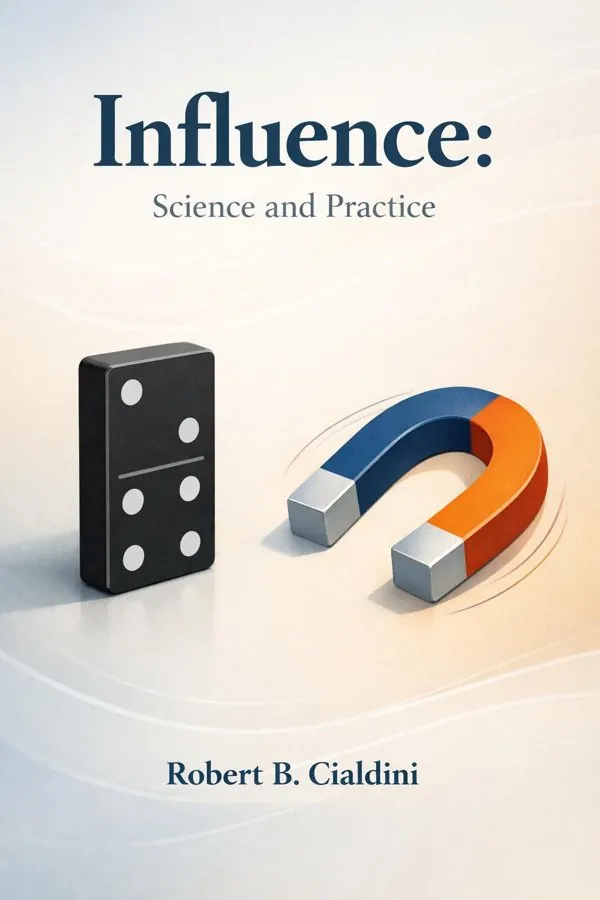
Influence: Summary & Key Insights
 10 min9 chaptersAudio available
Key Takeaways from Influence
Much of persuasion succeeds not because people are foolish, but because people are busy.
A small favor can create a surprisingly large sense of debt.
People do not just want to make decisions; they want to appear consistent with them.
When people are unsure what to do, they look to others.
We prefer to say yes to people we like, often without realizing how much that preference shapes our judgment.
What Is Influence About?
Influence by Robert Cialdini is a psychology book published in 2009 spanning 9 pages. Why do people say yes when they would prefer to say no? Why do intelligent, careful individuals still fall for pressure, urgency, and persuasive framing? In Influence, Robert B. Cialdini answers these questions by uncovering the hidden psychological patterns that shape everyday decisions. Drawing on decades of research in social psychology, as well as undercover fieldwork in sales, fundraising, advertising, and compliance professions, Cialdini explains how persuasion often works not through logic alone, but through reliable mental shortcuts. He identifies six core principles of influence—reciprocity, commitment and consistency, social proof, liking, authority, and scarcity—and shows how they operate in business, relationships, politics, and consumer behavior. What makes the book so enduring is its balance of scientific rigor and practical usefulness. It helps readers become both more persuasive and more resistant to manipulation. Whether you work in marketing, negotiation, leadership, or simply want to make better decisions in a world full of influence attempts, this book offers a framework that remains remarkably relevant. Influence is not just about persuasion; it is about understanding human behavior under pressure.
This FizzRead summary covers all 9 key chapters of Influence in approximately 10 minutes, distilling the most important ideas, arguments, and takeaways from Robert Cialdini's work. Also available as an audio summary and Key Quotes Podcast.
Influence
Why do people say yes when they would prefer to say no? Why do intelligent, careful individuals still fall for pressure, urgency, and persuasive framing? In Influence, Robert B. Cialdini answers these questions by uncovering the hidden psychological patterns that shape everyday decisions. Drawing on decades of research in social psychology, as well as undercover fieldwork in sales, fundraising, advertising, and compliance professions, Cialdini explains how persuasion often works not through logic alone, but through reliable mental shortcuts. He identifies six core principles of influence—reciprocity, commitment and consistency, social proof, liking, authority, and scarcity—and shows how they operate in business, relationships, politics, and consumer behavior. What makes the book so enduring is its balance of scientific rigor and practical usefulness. It helps readers become both more persuasive and more resistant to manipulation. Whether you work in marketing, negotiation, leadership, or simply want to make better decisions in a world full of influence attempts, this book offers a framework that remains remarkably relevant. Influence is not just about persuasion; it is about understanding human behavior under pressure.
Who Should Read Influence?
This book is perfect for anyone interested in psychology and looking to gain actionable insights in a short read. Whether you're a student, professional, or lifelong learner, the key ideas from Influence by Robert Cialdini will help you think differently.
- ✓Readers who enjoy psychology and want practical takeaways
- ✓Professionals looking to apply new ideas to their work and life
- ✓Anyone who wants the core insights of Influence in just 10 minutes
Want the full summary?
Get instant access to this book summary and 100K+ more with Fizz Moment.
Get Free SummaryAvailable on App Store • Free to download
Key Chapters
Much of persuasion succeeds not because people are foolish, but because people are busy. Cialdini begins with a crucial insight: in everyday life, we rely on mental shortcuts to make rapid decisions. These shortcuts are useful, even necessary, because the modern world bombards us with more information and choices than we can fully process. But the same efficiency that helps us function also leaves us vulnerable to predictable influence tactics.
He compares human responses to the fixed-action patterns seen in animals, where a single trigger can produce an automatic behavior. In people, these triggers are often social cues: a gift, a badge of authority, a crowd’s approval, or the suggestion that something is rare. Rather than carefully evaluating every request, we frequently respond to one meaningful feature and let it stand in for the whole situation. “Expensive means better,” “experts know best,” or “if everyone is doing it, it must be right” are examples of this shortcut thinking.
This does not mean automatic responding is bad. In fact, it is essential for navigating daily life. The problem arises when persuaders intentionally design messages that activate these shortcuts while bypassing deeper judgment. A salesperson may use urgency to suppress reflection. A charity may send small gifts to trigger obligation. A website may highlight “most popular” to suggest social approval.
The practical lesson is to notice when a decision is being rushed by a simple cue rather than informed by full understanding. When stakes are meaningful—money, time, trust, or reputation—pause and ask what evidence actually supports the choice. Actionable takeaway: when you feel an immediate pull to comply, slow down and identify which influence trigger is being activated before deciding.
A small favor can create a surprisingly large sense of debt. That is the essence of reciprocity, one of the oldest and most universal rules of social life. Across cultures, people are taught that if someone gives them something, they should give something back. This norm makes cooperation possible, strengthens relationships, and helps societies function. But it can also be exploited with remarkable effectiveness.
Cialdini shows that even unsolicited gifts can trigger this sense of obligation. The key is not the objective value of what is given, but the social pressure it creates. A free sample in a store, a personalized service, a thoughtful gesture before a request, or even a holiday card from someone you barely know can make refusal feel uncomfortable. The rule works so strongly that people often repay more than they received, simply to relieve the psychological tension of being indebted.
This principle explains why organizations give away trial offers, why waiters sometimes leave a mint with the check, and why fundraisers may send small tokens before asking for donations. It also explains why manipulative influence can begin with a “gift” you never requested. Once people feel they owe something, they may comply even when the exchange is unequal.
Yet reciprocity is not only a defensive concern; it is also a tool for ethical influence. Leaders who offer help first, businesses that create genuine value before pitching, and colleagues who give support without immediate demands often earn trust and cooperation naturally.
Actionable takeaway: accept that generosity creates pressure, and distinguish between a genuine relationship and a strategic obligation. Before saying yes, ask whether you are responding to the value of the request or merely repaying a debt.
People do not just want to make decisions; they want to appear consistent with them. Cialdini explains that once individuals commit to a position, especially publicly or in writing, they feel internal and social pressure to behave in ways that match that commitment. Consistency is generally admired. It signals stability, reliability, and integrity. But because we value consistency so much, it becomes a lever of influence.
Even small commitments can alter later behavior. If someone agrees to a minor request, they become more likely to agree to a larger, related one later. This is the logic behind the famous foot-in-the-door technique. A person who signs a petition about neighborhood safety may later be more willing to host a large campaign sign. A customer who begins with a free trial may come to view themselves as the kind of person who uses that product. Once identity becomes involved, consistency becomes powerful.
Cialdini also notes that commitments are strongest when they are active, public, voluntary, and effortful. If people write down their goals, announce them to others, or work hard toward them, they are more motivated to follow through. This is why public pledges, onboarding steps, and user-generated declarations can be so effective in organizations and marketing.
The danger is that people can be trapped by commitments that no longer serve them. A bad purchase, weak strategy, or unhealthy relationship may continue simply because changing course feels inconsistent.
Used ethically, this principle can help build positive habits. Asking team members to define their values, having customers articulate why they care, or making small first steps easy can create meaningful momentum.
Actionable takeaway: be deliberate about what you commit to, especially in public, because even a small yes can shape your future identity and decisions.
We prefer to say yes to people we like, often without realizing how much that preference shapes our judgment. Cialdini’s principle of liking reveals that persuasion frequently depends less on the merits of the request than on the emotional relationship between the requester and the target. People are more easily influenced by those who seem warm, attractive, similar, flattering, or familiar.
Several forces feed liking. Physical attractiveness creates a halo effect, leading us to assume that attractive people possess other positive qualities. Similarity matters too: shared backgrounds, opinions, hobbies, or experiences make interaction feel safer and more cooperative. Compliments and praise can also lower resistance, even when we suspect they are strategic. Repeated exposure increases comfort, which is why familiarity breeds trust more often than contempt in persuasion settings.
Association is another powerful driver. We transfer positive feelings from one thing to another. A brand linked to admired celebrities, joyful music, or successful outcomes may inherit some of that appeal. In sales and leadership, rapport-building often works because it creates genuine or perceived connection before a request is made.
This does not mean liking is superficial. Trust, empathy, and affinity are central to human cooperation. But they can cloud evaluation. A charming salesperson may seem more credible than a careful one. A likable colleague may receive support for weak ideas. A charismatic public figure may persuade beyond the strength of evidence.
Ethically, the lesson is to build authentic connection, not artificial charm. Learn people’s priorities, show respect, and create shared ground without using friendliness as camouflage for poor substance.
Actionable takeaway: enjoy rapport, but separate your feelings about the person from your judgment of the proposal. Ask yourself whether you would agree if the same request came from someone less likable.
Things seem more valuable when they are less available. Scarcity works because people do not merely want useful things; they want opportunities that feel special, limited, or at risk of disappearing. When access narrows, desire often grows. Cialdini shows that this response is deeply tied to human psychology, especially our aversion to loss. We are often more motivated by the possibility of missing out than by the possibility of gaining something equivalent.
This is why “limited time offer,” “only three left,” and “exclusive access” are such effective triggers. Scarcity creates urgency, and urgency discourages careful analysis. Buyers begin focusing on whether they can get the item rather than whether they should want it in the first place. The same effect appears beyond retail: jobs become more attractive when positions are few, information seems more compelling when restricted, and social attention becomes more valuable when access is selective.
Cialdini also notes that scarcity intensifies when the opportunity was available before and is now diminishing. Losing freedom of choice creates psychological reactance: people want something more when they feel it may be taken away. This helps explain bidding wars, deadline pressure, and heightened competition for limited resources.
Used ethically, scarcity can communicate real constraints. If inventory is genuinely low or a deadline is real, sharing that information helps people decide. The problem arises when scarcity is manufactured to manipulate emotions.
Actionable takeaway: whenever scarcity enters a decision, separate the value of the thing from the pressure of the shrinking opportunity. Ask yourself whether you would still want it just as much if it were plentiful and available tomorrow.
Persuasion often succeeds in a split second, before conscious reasoning has time to catch up. Cialdini emphasizes that many influence attempts work because they activate immediate cues that stand in for deeper evaluation. These cues are not random; they are learned associations developed through experience. When the cue appears, people respond as if the whole case has been made.
A higher price may imply higher quality. A long queue may imply a great restaurant. A polished website may imply legitimacy. A gift may imply generosity. In each case, one visible signal substitutes for a more demanding investigation. This rapid decision-making is not irrational in itself; it is an adaptive strategy in information-rich environments. But it creates openings for manipulation whenever surface cues are easier to fake than underlying quality.
The practical relevance of this idea is enormous. Marketing, interface design, sales scripts, and negotiations all rely on trigger management. Businesses optimize first impressions because they know people infer trustworthiness quickly. Fundraisers frame requests to create immediate emotional resonance. Negotiators establish anchors early because initial signals shape later interpretation.
For individuals, the challenge is not to eliminate shortcuts but to know when to distrust them. In low-stakes situations, efficient heuristics are fine. In high-stakes situations, they can become expensive mistakes. Awareness is the first defense. If you notice an unusually strong immediate reaction—confidence, urgency, trust, or fear—it may be coming from a trigger rather than thoughtful analysis.
Actionable takeaway: identify the cues that most strongly affect you, such as prestige, urgency, friendliness, or popularity, and build a habit of pausing when those cues appear in important decisions.
The most important question in a book about influence is not how to get compliance, but how to use persuasive knowledge responsibly. Cialdini does not present these principles as tricks to exploit others. He argues that understanding influence should make us both more effective and more ethical. Persuasion becomes dangerous when it secures short-term agreement at the cost of long-term trust.
Ethical influence starts with truthfulness. If social proof is cited, it should be real. If scarcity is claimed, it should reflect actual limits. If authority is invoked, it should be relevant and deserved. If reciprocity is used, the initial value provided should be genuine rather than bait. The goal should be to help people recognize real reasons to act, not to pressure them into choices they would reject under calmer reflection.
This distinction matters in leadership, marketing, teaching, fundraising, and relationships. A manager can use commitment to increase accountability by inviting team members to define goals publicly. A nonprofit can use reciprocity by offering genuinely useful information before requesting support. A company can use scarcity honestly when a product launch has limited capacity. In each case, the principle works best when it aligns with actual value.
Cialdini’s broader warning is that manipulative persuasion is self-defeating. People eventually notice deception, and when they do, trust collapses. Sustainable influence depends on credibility, respect, and mutual benefit.
Actionable takeaway: before using any persuasive technique, apply a simple test: if the other person fully understood what I am doing and why, would I still feel comfortable? If the answer is no, the method is probably manipulative rather than ethical.
All Chapters in Influence
About the Author
Robert B. Cialdini is an American social psychologist, researcher, and professor emeritus of psychology and marketing at Arizona State University. He is one of the world’s leading authorities on persuasion, compliance, and behavioral influence. Trained in social psychology, Cialdini built his reputation through both academic research and unusually hands-on fieldwork, studying how influence operates in real settings such as sales, fundraising, advertising, and negotiation. His landmark book Influence introduced a broad audience to the core principles that shape why people say yes, and it became a foundational text in psychology, marketing, leadership, and behavioral economics. Cialdini is especially respected for combining scientific rigor with practical application, and for emphasizing the ethical use of persuasive techniques in business and everyday life.
Get This Summary in Your Preferred Format
Read or listen to the Influence summary by Robert Cialdini anytime, anywhere. FizzRead offers multiple formats so you can learn on your terms — all free.
Available formats: App · Audio · PDF · EPUB — All included free with FizzRead
Download Influence PDF and EPUB Summary
Key Quotes from Influence
“Much of persuasion succeeds not because people are foolish, but because people are busy.”
“A small favor can create a surprisingly large sense of debt.”
“People do not just want to make decisions; they want to appear consistent with them.”
“When people are unsure what to do, they look to others.”
“We prefer to say yes to people we like, often without realizing how much that preference shapes our judgment.”
Frequently Asked Questions about Influence
Influence by Robert Cialdini is a psychology book that explores key ideas across 9 chapters. Why do people say yes when they would prefer to say no? Why do intelligent, careful individuals still fall for pressure, urgency, and persuasive framing? In Influence, Robert B. Cialdini answers these questions by uncovering the hidden psychological patterns that shape everyday decisions. Drawing on decades of research in social psychology, as well as undercover fieldwork in sales, fundraising, advertising, and compliance professions, Cialdini explains how persuasion often works not through logic alone, but through reliable mental shortcuts. He identifies six core principles of influence—reciprocity, commitment and consistency, social proof, liking, authority, and scarcity—and shows how they operate in business, relationships, politics, and consumer behavior. What makes the book so enduring is its balance of scientific rigor and practical usefulness. It helps readers become both more persuasive and more resistant to manipulation. Whether you work in marketing, negotiation, leadership, or simply want to make better decisions in a world full of influence attempts, this book offers a framework that remains remarkably relevant. Influence is not just about persuasion; it is about understanding human behavior under pressure.
Compare Influence
More by Robert Cialdini
You Might Also Like
The Body Keeps the Score
Bessel van der Kolk
10 min
Surrounded by Idiots
Thomas Erikson
10 min
Emotional Intelligence
Daniel Goleman
10 min
Attached
Amir Levine
10 min
Why Does He Do That
Lundy Bancroft
10 min
Women Who Run with the Wolves
Clarissa Pinkola Estés
10 minFeatured In
Tim Ferriss's Book Picks
Tim Ferriss's Toolkit: Books for Peak Performance
James Clear's Book Picks
James Clear's Reading List: Books That Build Better Habits
Malcolm Gladwell's Book Picks
Malcolm Gladwell's Picks: Books That Make You See the World Differently
Alex Hormozi's Book Picks
Alex Hormozi's Must-Read Books
Adam Grant's Book Picks
Adam Grant's Favorite Reads
Tony Robbins's Book Picks
Tony Robbins' Life-Changing Books
Seth Godin's Book Picks
Seth Godin's Marketing Bookshelf
Morgan Housel's Book Picks
Morgan Housel's Financial Wisdom Reads
Curated's Book Picks
Best Psychology Books That Will Change How You Think
Curated's Book Picks
Books Everyone Should Read — Universal Essentials
Curated's Book Picks
Best Audiobooks of All Time — Listen to the Greatest Books
Browse by Category
Ready to read Influence?
Get the full summary and 100K+ more books with Fizz Moment.