
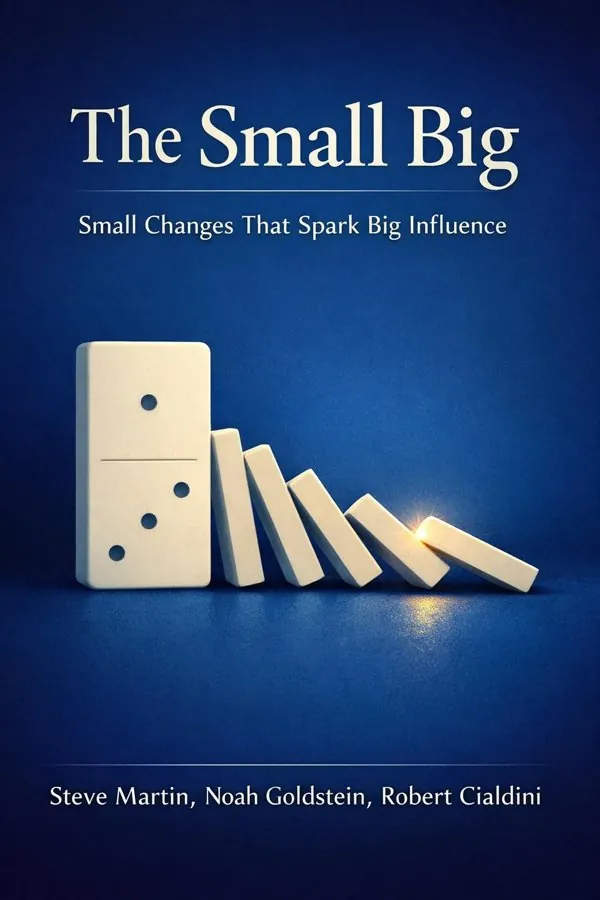
The Small Big: Small Changes That Spark Big Influence: Summary & Key Insights
by Steve Martin, Noah Goldstein, Robert Cialdini
 10 min10 chaptersAudio available
Key Takeaways from The Small Big: Small Changes That Spark Big Influence
The most powerful persuasive shifts are often nearly invisible.
People rarely decide in isolation; they look sideways before they look inward.
A strong message can fail if the messenger lacks authority.
People want to see themselves as consistent.
Influence often starts before the request is made.
What Is The Small Big: Small Changes That Spark Big Influence About?
The Small Big: Small Changes That Spark Big Influence by Steve Martin, Noah Goldstein, Robert Cialdini is a marketing book spanning 11 pages. What if the difference between being ignored and being persuasive was not a dramatic reinvention, but a tiny adjustment in wording, timing, or context? That is the central promise of The Small Big. In this concise but idea-packed book, Steve Martin, Noah Goldstein, and Robert Cialdini show how modest, evidence-based changes can produce outsized effects in marketing, leadership, negotiation, sales, and everyday communication. Rather than relying on guesswork or manipulative tricks, the authors draw from behavioral science, social psychology, and real-world experiments to explain how people actually make decisions. The book matters because influence is often misunderstood. Many assume persuasion depends on charisma, pressure, or large incentives. The authors argue the opposite: human behavior is highly responsive to subtle cues, and those cues can be designed ethically. That makes the book especially valuable for marketers, managers, entrepreneurs, and anyone who needs to gain cooperation without force. The authors write with unusual authority. Cialdini is one of the world’s leading experts on persuasion, while Martin and Goldstein are respected behavioral scientists known for translating research into practical action. Together, they offer a smart, usable guide to influence that is both scientific and immediately applicable.
This FizzRead summary covers all 10 key chapters of The Small Big: Small Changes That Spark Big Influence in approximately 10 minutes, distilling the most important ideas, arguments, and takeaways from Steve Martin, Noah Goldstein, Robert Cialdini's work. Also available as an audio summary and Key Quotes Podcast.
The Small Big: Small Changes That Spark Big Influence
What if the difference between being ignored and being persuasive was not a dramatic reinvention, but a tiny adjustment in wording, timing, or context? That is the central promise of The Small Big. In this concise but idea-packed book, Steve Martin, Noah Goldstein, and Robert Cialdini show how modest, evidence-based changes can produce outsized effects in marketing, leadership, negotiation, sales, and everyday communication. Rather than relying on guesswork or manipulative tricks, the authors draw from behavioral science, social psychology, and real-world experiments to explain how people actually make decisions.
The book matters because influence is often misunderstood. Many assume persuasion depends on charisma, pressure, or large incentives. The authors argue the opposite: human behavior is highly responsive to subtle cues, and those cues can be designed ethically. That makes the book especially valuable for marketers, managers, entrepreneurs, and anyone who needs to gain cooperation without force. The authors write with unusual authority. Cialdini is one of the world’s leading experts on persuasion, while Martin and Goldstein are respected behavioral scientists known for translating research into practical action. Together, they offer a smart, usable guide to influence that is both scientific and immediately applicable.
Who Should Read The Small Big: Small Changes That Spark Big Influence?
This book is perfect for anyone interested in marketing and looking to gain actionable insights in a short read. Whether you're a student, professional, or lifelong learner, the key ideas from The Small Big: Small Changes That Spark Big Influence by Steve Martin, Noah Goldstein, Robert Cialdini will help you think differently.
- ✓Readers who enjoy marketing and want practical takeaways
- ✓Professionals looking to apply new ideas to their work and life
- ✓Anyone who wants the core insights of The Small Big: Small Changes That Spark Big Influence in just 10 minutes
Want the full summary?
Get instant access to this book summary and 100K+ more with Fizz Moment.
Get Free SummaryAvailable on App Store • Free to download
Key Chapters
The most powerful persuasive shifts are often nearly invisible. That is the book’s starting insight: people like to imagine that big outcomes come from big actions, yet behavioral science repeatedly shows that small changes in presentation can alter decisions in meaningful ways. A sentence rewritten, a request reordered, a social cue highlighted, or a comparison reframed can produce a very different response without changing the core offer at all.
The reason is simple. Human decision-making is not purely rational or stable. We interpret information through mental shortcuts, social expectations, and contextual signals. That means influence does not happen only through the strength of an argument; it also depends on how, when, and in what setting the argument appears. If a hotel asks guests to reuse towels because it helps the environment, some will comply. If it adds that most guests in that room also reused their towels, compliance often rises. The request is nearly the same, but the social framing changes behavior.
For marketers, this means conversion rates may improve not because a product changes, but because the message better matches how people decide. For leaders, it means employee buy-in can improve through wording that emphasizes shared norms and voluntary commitment. For everyday life, it means influence is less about overpowering others and more about removing friction and aligning with natural psychology.
The brilliance of this idea is its efficiency. You do not always need bigger budgets, louder campaigns, or more pressure. You may just need a smarter cue. Actionable takeaway: before changing your offer, first test small changes in wording, ordering, framing, and context to see whether they unlock a better response.
A strong message can fail if the messenger lacks authority. Another major lesson from the book is that credibility is not a decorative extra; it is part of the argument itself. People are more likely to follow recommendations when they trust the source’s expertise, legitimacy, or experience. In many situations, demonstrating authority briefly and clearly can matter more than adding pages of explanation.
This does not mean showing off or intimidating others. The authors emphasize signals that reduce uncertainty. A physician whose introduction includes their specialization is more persuasive than one described vaguely. A consultant who is introduced with one relevant credential may gain more traction than one who launches into a long self-promotional speech. Authority works because people often cannot independently evaluate every claim, so they rely on credible indicators that the source knows what they are talking about.
For marketers, this may include expert endorsements, certifications, years of experience, or trusted institutional backing. For leaders, it may mean explaining why a recommendation comes from hard-won expertise rather than formal rank alone. For sales teams, it can be as simple as beginning a conversation with a relevant client success story or demonstrating category knowledge before making the ask.
There is also a subtle but important point: authority is more persuasive when it is introduced naturally. Having someone else mention your expertise can work better than doing it yourself because it feels less self-serving. In digital settings, concise trust markers near decision points often outperform a long “About Us” page that few people read.
Actionable takeaway: identify the one or two most relevant indicators of expertise or trust in your context and place them near the moment when people must decide.
People want to see themselves as consistent. Once they have taken a small stand, made a choice, or expressed a commitment, they feel psychological pressure to behave in ways that match that earlier position. The Small Big shows how this desire for consistency can be used to encourage follow-through, not through coercion, but through carefully structured commitments.
A small initial step often matters more than a big persuasive push. If customers check a box stating that they intend to complete a process, they may be more likely to finish it. If employees publicly state a goal, they may be more motivated to meet it. If donors are first asked whether they support a cause before being asked for money, they may become more likely to contribute because the later action fits their self-image.
This principle helps explain why getting people to write down commitments, make plans, or choose a preferred path can be so effective. The commitment does not have to be large. In fact, it often works better when it is voluntary and easy to make. A gym asking members to specify when they will come next week may increase attendance more than simply reminding them of the health benefits. A software platform asking users to customize their first dashboard may increase retention because people begin to feel invested.
The key is that commitments should be active, personal, and ideally public or recorded. Passive agreement is weak. Saying “yes” in theory does less than selecting a date, signing a pledge, or taking a preparatory step. When people behave consistently, they reinforce a preferred identity.
Actionable takeaway: ask for a small, voluntary commitment that aligns with the larger action you want, and make it specific enough that people can easily act in accordance with it.
Influence often starts before the request is made. Reciprocity, one of the best-established principles of persuasion, reflects the human tendency to return benefits we have received from others. When someone gives us something useful, thoughtful, or generous, we feel an impulse to respond in kind. The Small Big reminds readers that this principle is not about manipulation through favors; it is about the social power of giving first.
In practice, reciprocity works best when the initial value is meaningful and unexpected. A business that provides genuinely helpful advice before making a sales pitch creates a different emotional context than one that immediately asks for attention. A nonprofit that shares a compelling free resource may increase goodwill before requesting donations. A manager who offers support and recognition may find that team members become more cooperative and engaged.
Importantly, not all gifts are equal. Generic giveaways often have little impact because they feel transactional. Personalized help, useful information, or a concession that clearly benefits the other person creates stronger reciprocity. Even small acts can matter. A restaurant server who offers a small extra treat with warmth may receive higher tips. A B2B company that shares custom benchmarking insights before a proposal may be seen as a partner rather than a vendor.
There is also a strategic lesson here: timing matters. If the benefit appears clearly independent of the request, it feels more authentic and therefore more persuasive. Reciprocity weakens when people sense they are being handled.
Actionable takeaway: before asking for commitment, attention, or purchase, offer something genuinely useful, relevant, and preferably personalized so that goodwill is established naturally.
People do not evaluate value in a vacuum; they notice what might disappear. Scarcity is persuasive because limited availability changes how we perceive an opportunity. If something is rare, time-sensitive, or at risk of being missed, it often feels more important and more desirable. The authors show that this effect can be strong, but only when it is communicated honestly and specifically.
Many marketers use urgency poorly. Vague messages like “limited time only” appear everywhere and often lose force because audiences have learned to distrust them. What works better is real, concrete scarcity: a product with only a small number of units left, a deadline tied to a meaningful event, or a chance that is genuinely exclusive. Even more effective is explaining why the scarcity exists. If customers know that a workshop is limited because interaction quality drops beyond a certain size, the constraint feels credible rather than manipulative.
Scarcity also applies beyond commerce. Leaders can motivate action by showing what may be lost through delay, not just what could be gained. Public health campaigns can highlight the cost of inaction. Recruiters can increase response by clearly indicating when an opportunity will close. In all cases, the principle is not to manufacture pressure but to draw attention to what is truly finite.
A subtle insight from the book is that people can be especially motivated by unique losses. It may be more persuasive to say, “If you wait, you may lose this particular benefit,” than simply, “This is a good offer.” Losses loom large, and exclusivity sharpens attention.
Actionable takeaway: communicate only genuine scarcity, make it specific, explain its cause when possible, and emphasize what people may miss if they do not act.
The same information can produce different decisions depending on how it is framed. This is one of the most practical insights in The Small Big. Facts do not speak for themselves; they are interpreted through context, comparison, and wording. A message can therefore become more persuasive not by changing the substance, but by changing the lens through which people view it.
Consider pricing. A $50 monthly service may seem expensive on its own, but modest when framed against the cost of the problem it solves or against a premium alternative. A health treatment may sound risky when framed by side effects, but reassuring when framed by survival rates. Neither frame is necessarily deceptive, but each highlights a different dimension of the same reality.
The authors encourage communicators to think carefully about reference points. People judge value comparatively. In marketing, this means the order of options, the contrast between packages, and the labels attached to choices can shape perceived attractiveness. A middle option often becomes more appealing when a higher-priced premium option is presented first. In negotiation, a proposal framed as preserving value may land differently than one framed as demanding sacrifice. In management, a change effort framed as an opportunity to protect gains can feel more compelling than one framed abstractly.
Framing also affects motivation. Messages that connect behavior to identity, contribution, or fairness can outperform purely functional explanations. A customer is not just buying software; they may be protecting time, reducing stress, or becoming more effective.
Actionable takeaway: review your message for its hidden frame, then test alternative wording, comparisons, and reference points to ensure people are seeing the value you intend them to see.
People do not only ask, “What should I do?” They also ask, often unconsciously, “What do people like me do?” and “What kind of person am I?” This is why norms and identity are such potent drivers of behavior. The Small Big highlights that influence becomes more durable when it aligns not just with immediate incentives, but with a person’s sense of belonging and self-concept.
Social norms tell us what behavior is common or approved. Identity tells us whether that behavior fits who we are. When the two reinforce each other, change becomes much easier. An environmental campaign that says “responsible neighbors recycle” combines a norm with an identity cue. A workplace safety initiative that frames compliance as what professional teams do can be more effective than rules alone. In marketing, brands often succeed when customers feel that choosing them expresses something about their values, style, or aspirations.
This principle also helps explain why labels can shape action. Telling someone “please vote” is one thing; inviting them to “be a voter” can be more powerful because it shifts from behavior to identity. Similarly, asking children to “be helpers” may work better than simply telling them to help. The identity frame makes the action feel self-expressive rather than externally imposed.
For organizations, the lesson is strategic. Culture is persuasive when people see desired behavior as part of “how we do things here.” For customers, loyalty strengthens when they feel part of a meaningful group.
Actionable takeaway: connect your request to a valued identity or group norm, so the behavior feels like a natural expression of who the person already is or wants to become.
Persuasion is not only about what you say, but when you say it and what comes first. The Small Big shows that the order and timing of information can change outcomes dramatically because early cues anchor perception and later cues are interpreted through them. A well-timed prompt can increase compliance, while a poorly timed one can trigger resistance or indifference.
Sequence matters in sales, negotiation, and leadership communication. If you ask for a major commitment too early, people may withdraw before they understand the value. If you wait too long to establish trust, they may never listen closely. Effective influence often involves building a path: establish credibility, create relevance, reduce uncertainty, then invite action. In digital design, this may mean showing social proof before the sign-up form. In fundraising, it may mean telling a compelling story before presenting the donation amount. In management, it may mean beginning with shared goals before introducing difficult changes.
Timing also matters relative to moments of attention and emotion. A request made when people feel rushed, threatened, or cognitively overloaded will often underperform, even if the message is strong. By contrast, asking immediately after a positive interaction, a small success, or a helpful gesture can increase receptivity. The same principle applies to follow-up. Reminders work better when they are tied to implementation moments, not sent randomly.
The broader point is that influence unfolds over time. People interpret each step in relation to the last one. The smartest persuaders design sequences rather than isolated messages.
Actionable takeaway: map your influence process from first contact to final decision, then adjust the order and timing so trust, relevance, and commitment build progressively instead of all at once.
The most sustainable persuasion is the kind people do not regret. Although The Small Big is full of techniques, its deeper contribution is ethical: influence works best when it helps people make sound decisions, not when it tricks them into poor ones. The authors’ research-based approach is a reminder that behavioral science can be used either responsibly or irresponsibly, and the difference matters.
Short-term manipulation can produce immediate wins but long-term losses. A fake countdown timer may boost conversions today and damage trust tomorrow. Inflated claims of popularity may create curiosity once and skepticism forever after. Ethical influence, by contrast, strengthens relationships because it clarifies value, reduces friction, and aligns decisions with people’s genuine interests. When social proof is truthful, scarcity is real, authority is earned, and framing is fair, persuasion becomes more credible and repeatable.
This principle is especially important in marketing and management. Teams that rely on deceptive urgency or confusing defaults may hit targets temporarily, but customers and employees eventually notice. On the other hand, organizations that use these principles transparently can improve outcomes while preserving loyalty. A company can ethically use social proof by accurately showing customer adoption. A leader can ethically use commitment by inviting people to choose goals they truly support. A nonprofit can ethically use reciprocity by offering meaningful resources before asking for support.
The final lesson is that ethics is not separate from effectiveness. Trust compounds. The more people believe your motives and methods are sound, the more open they become to future influence.
Actionable takeaway: use every persuasion technique as a test of trust, asking whether the message is truthful, respectful, and beneficial to the audience as well as to you.
All Chapters in The Small Big: Small Changes That Spark Big Influence
About the Authors
Steve Martin, Noah Goldstein, and Robert Cialdini are internationally respected experts on persuasion and behavioral science. Robert Cialdini is one of the foundational figures in the study of influence and the author of the classic bestseller Influence: The Psychology of Persuasion. His research has shaped business, marketing, and social psychology for decades. Noah Goldstein is a behavioral scientist and academic known for his work on social influence, decision-making, and the practical application of psychological principles. Steve Martin is an author, researcher, and consultant who specializes in turning scientific findings about behavior into real-world strategies for leaders and organizations. Together, the three authors are known for making complex research accessible, practical, and ethically grounded for business and everyday life.
Get This Summary in Your Preferred Format
Read or listen to the The Small Big: Small Changes That Spark Big Influence summary by Steve Martin, Noah Goldstein, Robert Cialdini anytime, anywhere. FizzRead offers multiple formats so you can learn on your terms — all free.
Available formats: App · Audio · PDF · EPUB — All included free with FizzRead
Download The Small Big: Small Changes That Spark Big Influence PDF and EPUB Summary
Key Quotes from The Small Big: Small Changes That Spark Big Influence
“The most powerful persuasive shifts are often nearly invisible.”
“People rarely decide in isolation; they look sideways before they look inward.”
“A strong message can fail if the messenger lacks authority.”
“People want to see themselves as consistent.”
“Influence often starts before the request is made.”
Frequently Asked Questions about The Small Big: Small Changes That Spark Big Influence
The Small Big: Small Changes That Spark Big Influence by Steve Martin, Noah Goldstein, Robert Cialdini is a marketing book that explores key ideas across 10 chapters. What if the difference between being ignored and being persuasive was not a dramatic reinvention, but a tiny adjustment in wording, timing, or context? That is the central promise of The Small Big. In this concise but idea-packed book, Steve Martin, Noah Goldstein, and Robert Cialdini show how modest, evidence-based changes can produce outsized effects in marketing, leadership, negotiation, sales, and everyday communication. Rather than relying on guesswork or manipulative tricks, the authors draw from behavioral science, social psychology, and real-world experiments to explain how people actually make decisions. The book matters because influence is often misunderstood. Many assume persuasion depends on charisma, pressure, or large incentives. The authors argue the opposite: human behavior is highly responsive to subtle cues, and those cues can be designed ethically. That makes the book especially valuable for marketers, managers, entrepreneurs, and anyone who needs to gain cooperation without force. The authors write with unusual authority. Cialdini is one of the world’s leading experts on persuasion, while Martin and Goldstein are respected behavioral scientists known for translating research into practical action. Together, they offer a smart, usable guide to influence that is both scientific and immediately applicable.
You Might Also Like
Captivology: The Science of Capturing People's Attention
Ben Parr
10 min
Marketing 5.0: Technology for Humanity
Philip Kotler, Hermawan Kartajaya, Iwan Setiawan
10 min
Marketing Strategy
Paul Fifield
10 min
UnMarketing: Stop Marketing. Start Engaging.
Scott Stratten
10 min
$100M Leads: How to Get Strangers to Want to Buy Your Stuff
Alex Hormozi
10 min
80/20 Sales and Marketing: The Definitive Guide to Working Less and Making More
Perry Marshall
10 minBrowse by Category
Ready to read The Small Big: Small Changes That Spark Big Influence?
Get the full summary and 100K+ more books with Fizz Moment.