
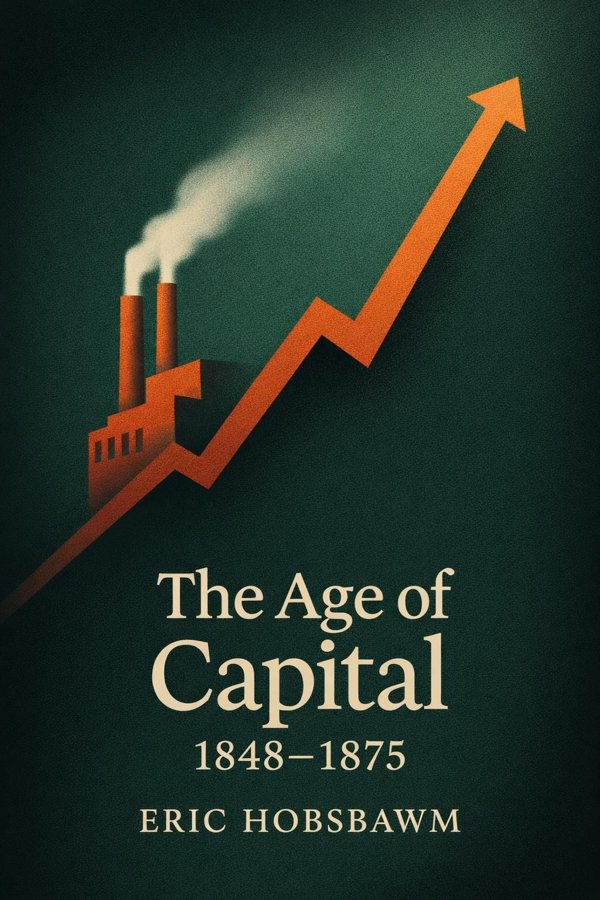
The Age of Capital: Summary & Key Insights
 10 min9 chaptersAudio available
Key Takeaways from The Age of Capital
History often advances not only through victories, but through the consequences of defeat.
Prosperity can feel natural in retrospect, but Hobsbawm reminds us that the mid-nineteenth century witnessed an extraordinary acceleration in productive power.
A class truly rules when its values become common sense.
Globalization did not begin in our time; the nineteenth century built one of its earliest powerful versions.
Modernity is often imagined as an urban story, but Hobsbawm insists that capitalism transformed the countryside as well.
What Is The Age of Capital About?
The Age of Capital by Eric Hobsbawm is a world_history book published in 1996 spanning 8 pages. The Age of Capital: 1848–1875 is Eric Hobsbawm’s sweeping account of the decades in which capitalism moved from disruptive force to organizing principle of the modern world. Beginning in the aftermath of the failed revolutions of 1848, Hobsbawm shows how political instability gave way to a new kind of order—one shaped by industrial growth, bourgeois confidence, expanding markets, and the belief that progress was both inevitable and desirable. This was the era of railways, free trade, finance, urbanization, scientific optimism, and middle-class ascendancy, but it was also a period marked by class conflict, inequality, colonial expansion, and the sharpening contradictions of liberal society. What makes the book so powerful is that Hobsbawm never treats economics, politics, and culture as separate stories. He reveals how they formed a single historical system. As one of the twentieth century’s most influential historians, Hobsbawm brings extraordinary range and clarity to this period, making the book essential for anyone who wants to understand how the modern capitalist world was built—and why its promises were always entangled with tension and crisis.
This FizzRead summary covers all 9 key chapters of The Age of Capital in approximately 10 minutes, distilling the most important ideas, arguments, and takeaways from Eric Hobsbawm's work. Also available as an audio summary and Key Quotes Podcast.
The Age of Capital
The Age of Capital: 1848–1875 is Eric Hobsbawm’s sweeping account of the decades in which capitalism moved from disruptive force to organizing principle of the modern world. Beginning in the aftermath of the failed revolutions of 1848, Hobsbawm shows how political instability gave way to a new kind of order—one shaped by industrial growth, bourgeois confidence, expanding markets, and the belief that progress was both inevitable and desirable. This was the era of railways, free trade, finance, urbanization, scientific optimism, and middle-class ascendancy, but it was also a period marked by class conflict, inequality, colonial expansion, and the sharpening contradictions of liberal society. What makes the book so powerful is that Hobsbawm never treats economics, politics, and culture as separate stories. He reveals how they formed a single historical system. As one of the twentieth century’s most influential historians, Hobsbawm brings extraordinary range and clarity to this period, making the book essential for anyone who wants to understand how the modern capitalist world was built—and why its promises were always entangled with tension and crisis.
Who Should Read The Age of Capital?
This book is perfect for anyone interested in world_history and looking to gain actionable insights in a short read. Whether you're a student, professional, or lifelong learner, the key ideas from The Age of Capital by Eric Hobsbawm will help you think differently.
- ✓Readers who enjoy world_history and want practical takeaways
- ✓Professionals looking to apply new ideas to their work and life
- ✓Anyone who wants the core insights of The Age of Capital in just 10 minutes
Want the full summary?
Get instant access to this book summary and 100K+ more with Fizz Moment.
Get Free SummaryAvailable on App Store • Free to download
Key Chapters
History often advances not only through victories, but through the consequences of defeat. Hobsbawm argues that the revolutions of 1848 failed in immediate political terms, yet their collapse helped create the conditions for a more stable and expansive capitalist order. The radical coalitions of workers, democrats, and nationalists fractured, conservative states regained control, and revolutionary hopes temporarily receded. But this restoration did not simply turn back the clock. Instead, governments and ruling elites learned to govern more pragmatically, while the middle classes emerged more confident than ever in their social mission.
This new order was less heroic than the rhetoric of 1848, but more durable. Across Europe, states became better at administration, taxation, policing, and infrastructure. Reform replaced insurrection as the preferred route of change for many liberals. National unification in places like Italy and Germany eventually moved forward, but increasingly under elite leadership rather than popular revolution. The result was a political environment better suited to investment, industrial expansion, and bourgeois influence.
A practical way to understand this shift is to think of modern societies after periods of unrest. Once upheaval subsides, the groups best positioned to organize institutions often shape the next era. Hobsbawm’s point is that capitalism flourished not despite the collapse of revolutionary politics, but partly because political order made sustained accumulation possible.
Actionable takeaway: When analyzing social change, look beyond who won the uprising and ask who gained the ability to build lasting institutions afterward.
Prosperity can feel natural in retrospect, but Hobsbawm reminds us that the mid-nineteenth century witnessed an extraordinary acceleration in productive power. Between roughly 1850 and 1875, industrial capitalism entered what he portrays as its heroic age. Britain remained the leading industrial power, yet the transformation spread well beyond it. Railways connected markets, steamships shortened distances, telegraphs accelerated communication, and mechanized production expanded output on a scale previously unimaginable.
This was not merely more industry; it was a reorganization of time, labor, and space. Factories concentrated workers and machinery. Transport innovations reduced costs and opened interior regions to trade. Coal, iron, and later steel became strategic materials of modern growth. Entire industries depended on synchronized systems of supply, finance, and distribution. Economic expansion also created confidence in the idea that growth itself was the normal condition of society.
Examples are everywhere in this period: railway booms reshaped landscapes and investment patterns; expanding textile output linked European mills to cotton-producing regions abroad; telegraph lines made business decisions more coordinated and more global. These changes helped create the infrastructure of modern capitalism, where speed and scale became competitive advantages.
For contemporary readers, the parallel is clear. Just as digital networks transformed the late twentieth and early twenty-first centuries, rail and steam transformed the nineteenth. Each revolution created new winners, new dependencies, and new forms of inequality.
Actionable takeaway: To understand any economic era, identify its core technologies and ask how they reshape production, communication, and the geography of power.
A class truly rules when its values become common sense. One of Hobsbawm’s central insights is that the age was not defined only by economic growth, but by the cultural and social ascendancy of the bourgeoisie. The middle classes—industrialists, merchants, professionals, financiers, and administrators—gained not just wealth, but legitimacy. Their habits, moral codes, family structures, educational ideals, and notions of respectability spread outward as models of civilized life.
Bourgeois rule meant more than owning capital. It meant celebrating discipline, thrift, punctuality, self-improvement, domestic order, and property. It meant seeing society as a field of competition in which success reflected merit, even when inherited advantage remained decisive. It also meant reshaping cities with department stores, business districts, suburban neighborhoods, museums, concert halls, and schools that reflected middle-class priorities.
Yet Hobsbawm is careful not to romanticize this class. Bourgeois confidence rested on exploitation at home and expansion abroad. Respectability often coexisted with fear of the poor, hostility to labor radicalism, and deep gender hierarchies. Even so, the bourgeoisie proved historically powerful because it universalized its worldview. What looked like private morality became public ideology.
We can apply this insight today by observing which class norms dominate institutions. When hiring practices, educational credentials, family expectations, and definitions of success all reflect a particular social group, that group’s power extends beyond economics into culture.
Actionable takeaway: When studying power, examine not only who owns wealth, but whose lifestyle and values are treated as the default standard for everyone else.
Globalization did not begin in our time; the nineteenth century built one of its earliest powerful versions. Hobsbawm shows that the age of capital was marked by the dramatic integration of world markets through trade, shipping, insurance, banking, and investment. Goods, money, and information moved more quickly and predictably, linking industrial centers in Europe to raw-material producers, food exporters, and colonial territories across the globe.
Britain sat at the center of this system, using its industrial strength, naval supremacy, and financial institutions to mediate global exchange. London became a command center of credit and investment. Capital flowed outward to railways in Latin America, mining ventures, ports, public debt, and colonial infrastructure. At the same time, distant regions became more dependent on world price movements. A harvest failure, a banking shock, or a commodity slump in one place could have consequences far away.
This integration brought enormous opportunities for profit and growth, but it also deepened asymmetry. Industrial powers exported manufactured goods and imported raw materials, reinforcing unequal relationships. Regions were often drawn into the world economy on terms they did not control. In that sense, free trade was never simply free; it reflected power.
A useful modern comparison is today’s supply-chain economy. When countries depend on global finance and specialized exports, they gain access to markets but become vulnerable to distant decisions. Hobsbawm helps us see that this pattern has deep historical roots.
Actionable takeaway: Whenever you hear claims about open markets, ask who sets the rules, who finances the connections, and who bears the risks when the system falters.
Modernity is often imagined as an urban story, but Hobsbawm insists that capitalism transformed the countryside as well. Agriculture in the age of capital did not remain a traditional world untouched by markets. Instead, rural life was increasingly reorganized by commercial pressures, technological change, landownership patterns, and the need to supply growing cities and export networks.
In some regions, large landowners and commercial farmers introduced more productive methods, better transport links, and stronger ties to national and international markets. In others, peasants faced mounting pressure as common lands disappeared, debts increased, and subsistence economies gave way to market dependence. Rural populations were drawn into cash cropping, wage labor, seasonal migration, and new forms of vulnerability linked to price fluctuations and harvest risks.
The countryside therefore became a crucial arena of capitalist expansion. Urban industry needed food, raw materials, and labor. Railways connected fields to ports and cities. Grain, meat, wool, wine, and other agricultural products entered wider circuits of exchange. This did not produce a uniform rural experience: some farmers prospered, while many smallholders and laborers became more insecure.
This matters because it challenges the false divide between industrial and agricultural history. Even today, debates about agribusiness, land concentration, migration, and food systems reflect the same basic question: who controls rural transformation, and who benefits from it?
Actionable takeaway: To understand economic change fully, follow how market forces reshape land, food production, and rural labor—not just factories and cities.
Few ideas were more powerful in the nineteenth century than the belief that history was moving forward. Hobsbawm emphasizes that the age of capital was sustained not only by profits and institutions, but by a broad ideology of liberalism, science, and progress. Many educated Europeans came to believe that reason, technological innovation, constitutional government, and economic freedom would steadily improve human life.
This confidence shaped politics, education, and public culture. Liberalism promised limited government, legal equality, free exchange, and civic rights, at least in principle. Science seemed to reveal a rational universe open to mastery and improvement. Statistics, engineering, medicine, and industrial technology gave concrete evidence that knowledge could transform society. International exhibitions and world fairs turned progress into spectacle, displaying machines, consumer goods, and imperial reach as proof of civilization’s advance.
Yet Hobsbawm also reveals the blind spots in this creed. Progress was often defined from the viewpoint of the victorious classes and nations. Liberal equality coexisted with severe social inequality. Scientific confidence could shade into social arrogance. Peoples who did not fit the dominant model were judged backward and made targets of reform, domination, or conquest.
The lesson remains relevant. Every era creates narratives that justify its leading institutions as natural and progressive. Today’s language may be innovation, efficiency, or disruption rather than progress, but the function can be similar: to present a contested social order as historical necessity.
Actionable takeaway: Treat every confident story of progress as a historical argument—useful, powerful, and potentially misleading unless tested against who gains and who is left behind.
Cities are engines of opportunity, but they also make inequality visible. Hobsbawm presents the industrial city as one of the defining social spaces of the age of capital. Urban growth concentrated labor, capital, commerce, and administration in unprecedented ways. New neighborhoods, transport systems, factories, docks, and commercial centers reflected expanding prosperity. But the same cities also exposed class divisions with brutal clarity.
The middle and upper classes increasingly separated themselves spatially and culturally from the laboring poor. Better housing, cleaner districts, and different patterns of consumption reinforced social distance. Meanwhile, many workers lived in overcrowded neighborhoods marked by insecurity, long hours, irregular wages, and exposure to disease. Urban life also transformed family structures, gender roles, leisure, and political organization. Workers, artisans, servants, migrants, and petty traders all occupied different positions within this changing social landscape.
Importantly, cities were not only places of suffering; they were also laboratories of collective consciousness. Workers met in clubs, pubs, unions, associations, and streets. Newspapers circulated ideas rapidly. Strikes and demonstrations became more organized. The city made class society harder to ignore because it put wealth and poverty side by side.
A modern application is straightforward. When housing costs, transport access, schooling, and public health differ sharply across urban districts, class remains embedded in the city’s physical form. Urban planning is never neutral; it expresses social priorities.
Actionable takeaway: Read cities as maps of power. Ask how housing, transport, sanitation, and public space reveal who is protected, who is exploited, and who is expected to remain invisible.
Capitalism did not create a passive working class; it created new conditions for solidarity and struggle. Although the revolutionary hopes of 1848 were defeated, Hobsbawm shows that labor did not disappear from history. Workers adapted to industrial society while building organizations capable of defending wages, hours, dignity, and political representation. The period saw the growth of trade unions, cooperative movements, friendly societies, and eventually more structured forms of labor politics.
This evolution mattered because it reflected a shift from spontaneous revolt to sustained organization. Industrial discipline imposed regular time, supervision, and dependence on wages, but it also brought workers together in factories, mines, and cities where they could recognize common interests. Skilled workers often led early associations, but broader segments of labor increasingly entered collective action. Demands that began as economic—better pay, shorter hours, safer conditions—could easily become political, especially when repression exposed the limits of liberal inclusion.
Hobsbawm also suggests that working-class culture formed in response to bourgeois society. Mutual aid, popular education, local institutions, and shared rituals gave workers resources for survival and resistance. This was not yet the full age of mass socialist parties, but the foundations were being laid.
The contemporary relevance is clear in every workplace debate about unions, precarity, and employee power. Systems that concentrate economic power often unintentionally create the basis for organized opposition.
Actionable takeaway: When examining labor history or modern work, look for the institutions workers build to turn shared vulnerability into collective bargaining power.
The most confident systems often carry the seeds of their own instability. Hobsbawm ends this period by showing that the apparent triumph of liberal capitalism was not permanent or complete. By the 1870s, strains were becoming harder to ignore: economic volatility, intensified competition, class conflict, national rivalries, and the limits of free-trade optimism all suggested that the system was entering a more troubled phase.
The long boom of mid-century had encouraged faith in self-regulating markets and peaceful progress. But growth produced overcapacity, speculative excess, and sharper international competition. Industrialization spread beyond Britain, creating challengers and altering the balance of power. Political participation widened unevenly, making class tensions harder to contain through elite consensus alone. At the same time, states became more willing to intervene, and national ambitions increasingly intersected with economic interests.
For Hobsbawm, this transition matters because it points toward the next historical era: one more shaped by empire, protectionism, organized mass politics, and intensified geopolitical rivalry. Liberal capitalism had transformed the world, but it could not stabilize it indefinitely on its own terms.
A modern reader may recognize the pattern. Periods of market triumph often generate inequality, backlash, and strategic competition that later demand new forms of state involvement and international conflict management. Success creates complexity; complexity produces crisis.
Actionable takeaway: Never mistake a period of rapid growth for final stability. Ask what contradictions are accumulating beneath prosperity and which institutions will be forced to change when confidence breaks.
All Chapters in The Age of Capital
About the Author
Eric Hobsbawm (1917–2012) was a British historian whose work reshaped the study of modern history. Born in Alexandria and raised in Vienna and Berlin before settling in Britain, he brought a distinctly international perspective to the history of Europe, capitalism, nationalism, and revolution. He taught for many years at Birkbeck College, University of London, and became one of the most widely read historians of his generation. Hobsbawm is best known for his landmark 'Age' series, which traces the development of the modern world from the late eighteenth century to the twentieth. His scholarship combined economic, political, social, and cultural analysis on a grand scale. Admired for his range, clarity, and interpretive boldness, he remains essential reading for anyone seeking to understand the historical roots of modern society.
Get This Summary in Your Preferred Format
Read or listen to the The Age of Capital summary by Eric Hobsbawm anytime, anywhere. FizzRead offers multiple formats so you can learn on your terms — all free.
Available formats: App · Audio · PDF · EPUB — All included free with FizzRead
Download The Age of Capital PDF and EPUB Summary
Key Quotes from The Age of Capital
“History often advances not only through victories, but through the consequences of defeat.”
“Prosperity can feel natural in retrospect, but Hobsbawm reminds us that the mid-nineteenth century witnessed an extraordinary acceleration in productive power.”
“A class truly rules when its values become common sense.”
“Globalization did not begin in our time; the nineteenth century built one of its earliest powerful versions.”
“Modernity is often imagined as an urban story, but Hobsbawm insists that capitalism transformed the countryside as well.”
Frequently Asked Questions about The Age of Capital
The Age of Capital by Eric Hobsbawm is a world_history book that explores key ideas across 9 chapters. The Age of Capital: 1848–1875 is Eric Hobsbawm’s sweeping account of the decades in which capitalism moved from disruptive force to organizing principle of the modern world. Beginning in the aftermath of the failed revolutions of 1848, Hobsbawm shows how political instability gave way to a new kind of order—one shaped by industrial growth, bourgeois confidence, expanding markets, and the belief that progress was both inevitable and desirable. This was the era of railways, free trade, finance, urbanization, scientific optimism, and middle-class ascendancy, but it was also a period marked by class conflict, inequality, colonial expansion, and the sharpening contradictions of liberal society. What makes the book so powerful is that Hobsbawm never treats economics, politics, and culture as separate stories. He reveals how they formed a single historical system. As one of the twentieth century’s most influential historians, Hobsbawm brings extraordinary range and clarity to this period, making the book essential for anyone who wants to understand how the modern capitalist world was built—and why its promises were always entangled with tension and crisis.
More by Eric Hobsbawm
The Age of Extremes: 1914–1991: The Short Twentieth Century
Eric Hobsbawm
10 min
The Age Of Empire: 1875–1914
Eric Hobsbawm
10 min
The Invention of Tradition
Eric Hobsbawm, Terence Ranger
10 min
The Age Of Extremes: The Short Twentieth Century, 1914–1991
Eric Hobsbawm
10 minYou Might Also Like
The Gulag Archipelago
Aleksandr Solzhenitsyn
10 min
Jerusalem: The Biography
Simon Sebag Montefiore
10 min
The Anglo-Saxons
James Campbell
10 min
The Boer War
Thomas Pakenham
10 min
The Industrial Revolutionaries: The Making of the Modern World 1776–1914
Gavin Weightman
10 min
The Poison Squad: One Chemist's Single-Minded Crusade for Food Safety at the Turn of the Twentieth Century
Deborah Blum
10 minFeatured In
Browse by Category
Ready to read The Age of Capital?
Get the full summary and 100K+ more books with Fizz Moment.