
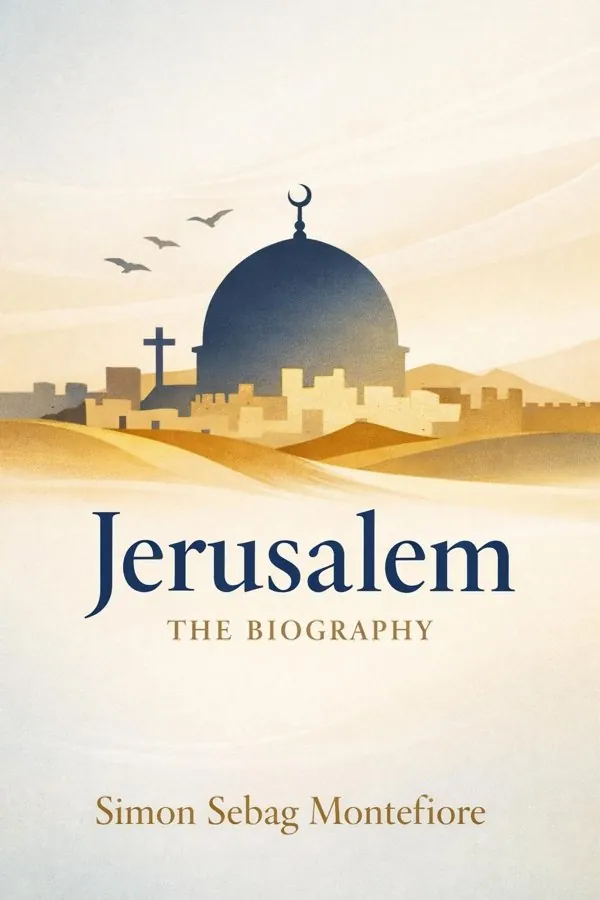
Jerusalem: The Biography: Summary & Key Insights
 10 min8 chaptersAudio available
Key Takeaways from Jerusalem: The Biography
One of history’s greatest paradoxes is that tiny places can exert enormous influence, and Jerusalem may be the ultimate example.
What people believe about the past often determines what they demand in the present.
Cities usually preserve their past in streets and buildings, but Jerusalem preserves it in layers of memory, ruin, reconstruction, and reinvention.
Jerusalem’s story is not driven only by religion or empire.
Few books illustrate more vividly the unsettling truth that holiness does not eliminate brutality.
What Is Jerusalem: The Biography About?
Jerusalem: The Biography by Simon Sebag Montefiore is a world_history book. Jerusalem: The Biography is an ambitious, sweeping history of one of the world’s most contested and revered cities. In this monumental work, Simon Sebag Montefiore traces Jerusalem’s story across roughly three millennia, from its early biblical beginnings to the modern age, showing how a relatively small hill town became the spiritual center of Judaism, Christianity, and Islam. The book is not just a chronicle of rulers, wars, and monuments; it is a portrait of a city where faith, empire, memory, politics, and family dynasties have collided again and again. Montefiore’s great achievement lies in making Jerusalem feel both epic and intimate. He explores kings, prophets, conquerors, caliphs, crusaders, pilgrims, and politicians, while also revealing the human passions behind the city’s public dramas. His authority comes from deep historical research, mastery of multiple eras, and a talent for storytelling that brings ancient and modern Jerusalem vividly to life. This book matters because it helps readers understand not only the city itself, but also the enduring power of sacred places in shaping world history and modern conflict.
This FizzRead summary covers all 8 key chapters of Jerusalem: The Biography in approximately 10 minutes, distilling the most important ideas, arguments, and takeaways from Simon Sebag Montefiore's work. Also available as an audio summary and Key Quotes Podcast.
Jerusalem: The Biography
Jerusalem: The Biography is an ambitious, sweeping history of one of the world’s most contested and revered cities. In this monumental work, Simon Sebag Montefiore traces Jerusalem’s story across roughly three millennia, from its early biblical beginnings to the modern age, showing how a relatively small hill town became the spiritual center of Judaism, Christianity, and Islam. The book is not just a chronicle of rulers, wars, and monuments; it is a portrait of a city where faith, empire, memory, politics, and family dynasties have collided again and again. Montefiore’s great achievement lies in making Jerusalem feel both epic and intimate. He explores kings, prophets, conquerors, caliphs, crusaders, pilgrims, and politicians, while also revealing the human passions behind the city’s public dramas. His authority comes from deep historical research, mastery of multiple eras, and a talent for storytelling that brings ancient and modern Jerusalem vividly to life. This book matters because it helps readers understand not only the city itself, but also the enduring power of sacred places in shaping world history and modern conflict.
Who Should Read Jerusalem: The Biography?
This book is perfect for anyone interested in world_history and looking to gain actionable insights in a short read. Whether you're a student, professional, or lifelong learner, the key ideas from Jerusalem: The Biography by Simon Sebag Montefiore will help you think differently.
- ✓Readers who enjoy world_history and want practical takeaways
- ✓Professionals looking to apply new ideas to their work and life
- ✓Anyone who wants the core insights of Jerusalem: The Biography in just 10 minutes
Want the full summary?
Get instant access to this book summary and 100K+ more with Fizz Moment.
Get Free SummaryAvailable on App Store • Free to download
Key Chapters
One of history’s greatest paradoxes is that tiny places can exert enormous influence, and Jerusalem may be the ultimate example. Montefiore shows that Jerusalem’s physical scale has always been modest compared with imperial capitals like Rome, Constantinople, or Baghdad, yet its symbolic weight has been immeasurable. The city’s significance does not come from geography, wealth, or military strength alone. It comes from meaning. Jerusalem became a city onto which generations projected divine promises, political legitimacy, apocalyptic hopes, and personal longing.
The book explains how this meaning accumulated over centuries. For Jews, Jerusalem became the site of the Temple and the heart of covenantal identity. For Christians, it became the setting of Jesus’ final days, death, and resurrection. For Muslims, it became connected to the Prophet’s Night Journey and an important center of Islamic devotion. Because each tradition layered its own sacred narrative onto the city, Jerusalem became more than a place: it became an emotional map of salvation, belonging, and destiny.
This helps explain why struggles over Jerusalem have rarely been ordinary territorial disputes. Battles for the city often combine piety, prestige, and power. Leaders have pursued Jerusalem not only to govern land, but to claim divine favor or historical legitimacy. Even today, debates about the city often involve memory and identity as much as policy.
A practical lesson follows from this. When trying to understand political conflict, do not focus only on economics or borders. Ask what symbols are at stake and what stories people believe about a place. Sacred meaning can outlast armies and empires.
Actionable takeaway: When analyzing any modern conflict, identify the emotional and symbolic value attached to the place, not just its strategic importance.
What people believe about the past often determines what they demand in the present. A central insight of Jerusalem: The Biography is that sacred history is never merely historical in Jerusalem; it becomes political energy. Narratives about David, Solomon, the destruction of the Temple, Jesus’ Passion, the caliphate, the Crusades, and later imperial interventions all continue to influence claims to authority and belonging.
Montefiore demonstrates that rulers repeatedly used older sacred stories to legitimize new regimes. Biblical kings linked monarchy to divine promise. Roman emperors reshaped the city after revolt while trying to redefine its identity. Christian Byzantine rulers elevated holy sites to embed theology in urban space. Muslim dynasties built monuments that expressed both faith and sovereignty. Crusaders presented conquest as redemption. Ottoman sultans restored walls and shrines to display guardianship. In every age, controlling the city meant controlling the narrative.
This pattern matters because it reveals that historical memory is not passive. It can mobilize armies, justify law, inspire architecture, and sustain resistance. Sacred history can unify communities, but it can also harden disputes when rival groups each see themselves as guardians of an exclusive truth. That dynamic remains visible in modern diplomacy, heritage debates, and arguments over archaeological interpretation.
Readers can apply this insight beyond Jerusalem. In organizations, nations, and communities, founding stories shape current behavior. A company myth, a constitutional ideal, or a family memory can become a source of legitimacy and conflict alike.
Actionable takeaway: Whenever you encounter a heated modern dispute, ask which historical narrative each side is trying to defend, revive, or sanctify.
Cities usually preserve their past in streets and buildings, but Jerusalem preserves it in layers of memory, ruin, reconstruction, and reinvention. Montefiore presents the city almost like an archaeological and human palimpsest: every era builds over what came before, yet never fully erases it. Temples become ruins, ruins become shrines, shrines become battlegrounds, and battlegrounds become sites of pilgrimage. The result is a city where the past is physically present and emotionally active.
This layered quality is essential to the book’s method. Montefiore does not treat Jerusalem as a series of disconnected eras. Instead, he shows continuity through repeated patterns: conquest followed by sanctification, destruction followed by rebuilding, and memory followed by mythmaking. The city’s architecture reflects these cycles. The Temple Mount/Haram al-Sharif, the Holy Sepulchre, city walls, palaces, and neighborhoods all carry traces of successive regimes. What one ruler constructs, another repurposes. What one faith venerates, another reinterprets.
This has practical implications for how we think about identity. Individuals and societies are layered too. We are shaped by inheritance, trauma, adaptation, and revision. Ignoring earlier layers produces simplistic judgments. Montefiore’s portrait of Jerusalem teaches patience with complexity: a place can be holy and violent, local and universal, ancient and constantly reinvented.
In practical life, this mindset can improve decision-making. A neighborhood conflict, workplace culture problem, or family tension often makes more sense once you understand the older layers beneath the current dispute.
Actionable takeaway: Before forming conclusions about a complex situation, map its historical layers and ask what unfinished past still influences the present.
History is often presented as the movement of abstract forces, but Montefiore reminds us that cities are shaped by human appetites, rivalries, marriages, vanities, and family networks. Jerusalem’s story is not driven only by religion or empire. It is also driven by ambitious kings, scheming courtiers, charismatic preachers, powerful clans, and fragile rulers trying to survive. This focus on personality gives the book much of its power.
Across the centuries, Montefiore highlights how dynasties and households mattered as much as doctrines. The city’s fate changed because a ruler sought glory, a queen forged an alliance, a governor rebelled, a priestly faction maneuvered, or a family secured patronage. Even in deeply sacred settings, personal ambition could be decisive. Piety and self-interest frequently worked together rather than separately.
This insight helps readers avoid a common mistake: assuming that ideological language fully explains political action. Leaders may speak in the vocabulary of faith or destiny, but they still pursue status, security, revenge, and legacy. Understanding this dual motive makes historical events more intelligible. It also makes contemporary politics easier to read. Public rhetoric often masks private calculation.
There is a practical application here for leadership analysis. When evaluating institutions, ask not only what the official mission says, but also who benefits, who competes, and what personal incentives shape decisions. Human beings bring their inner dramas into every public system.
Actionable takeaway: To understand power clearly, examine the personalities, family interests, and private ambitions operating behind grand public ideals.
Few books illustrate more vividly the unsettling truth that holiness does not eliminate brutality. In Jerusalem, reverence and bloodshed have repeatedly occupied the same streets. Montefiore does not romanticize the city’s sanctity; he shows how devotion can inspire extraordinary beauty, endurance, scholarship, and generosity, but also fanaticism, exclusion, massacre, and vengeance. The city’s history is a warning against assuming that sacred purpose guarantees moral conduct.
This theme appears in many eras. Pilgrimage brought hope and wonder, yet also competition over access and authority. Crusaders marched under religious banners while committing horrific violence. Imperial rulers endowed sacred architecture while crushing dissent. Communities persecuted one another while defending their own rites. Even internal struggles within a single faith could become fierce and unforgiving. Jerusalem reveals how proximity to the sacred can intensify human passions rather than calm them.
The lesson is not that religion is uniquely violent. Rather, Montefiore shows that when ultimate meanings are attached to earthly control, compromise becomes harder. If a place is seen as divinely guaranteed, opponents may appear not just wrong but profane. That dynamic can transform ordinary politics into existential struggle.
This insight applies widely. In modern debates, people may attach sacred intensity to ideology, nation, ethnicity, or identity, even when the language is secular. Whenever disagreement becomes absolute, empathy and negotiation suffer.
Actionable takeaway: In any conflict charged with moral certainty, deliberately separate genuine values from dehumanizing absolutism before the dispute escalates.
Jerusalem’s rulers have changed constantly, yet the city outlasts them all. One of Montefiore’s most powerful achievements is showing how Assyrians, Babylonians, Persians, Greeks, Romans, Byzantines, Arab caliphates, Crusaders, Mamluks, Ottomans, and modern powers all left their mark, only to pass away. The city survives each age of domination, absorbing, resisting, and transforming what empires impose.
This endurance does not mean stability. Jerusalem often suffered siege, ruin, depopulation, neglect, and radical reinvention. Yet even at low points, its symbolic status kept drawing people back. Empires sought to own it because it conferred prestige. Pilgrims sought it because it offered proximity to the divine. Communities mourned it, rebuilt it, and imagined it even from afar. The city endured because it lived not only in stone, but in texts, liturgies, and collective memory.
Montefiore’s long view also challenges the arrogance of any present moment. Powers that seem permanent often prove temporary. Political systems that claim finality eventually weaken. Jerusalem teaches historical humility. No regime controls meaning forever, and no single era exhausts a place’s significance.
For readers, this perspective is calming as well as sobering. Institutions, careers, and nations all feel urgent from inside the present, but long-term thinking reveals how much changes. Endurance often belongs not to those who dominate briefly, but to those who preserve memory, adapt, and rebuild.
Actionable takeaway: Practice long-range thinking by asking whether your decisions are built for temporary victory or lasting resilience.
People often want a clean boundary between fact and legend, but Jerusalem resists that division. Montefiore handles a city where scripture, tradition, archaeology, and political memory overlap in complicated ways. His approach suggests that myth is not simply falsehood. Myths can encode identity, aspiration, and emotional truth, even when historians debate details. In Jerusalem, myths have shaped real actions, real architecture, and real sacrifices.
This interaction matters because many of the city’s defining events are known through texts that are sacred to millions. Historical scholarship may ask critical questions about chronology, authorship, or interpretation, yet believers experience these narratives as living truth. Montefiore’s strength lies in taking both dimensions seriously. He neither dismisses faith nor abandons historical rigor. Instead, he shows how stories themselves become historical forces.
The practical lesson is that human beings do not act only on verified data. We act on meanings, inherited narratives, and symbols that organize experience. A national founding myth, a family legend, or a corporate success story can inspire courage and belonging. But myths can also distort judgment when they become immune to evidence.
The best response is not cynicism, but disciplined interpretation. Respect the emotional and cultural power of stories while still asking what the evidence supports. That balance helps preserve meaning without surrendering clarity.
Actionable takeaway: Treat powerful narratives with both empathy and scrutiny, asking not only whether they are believed, but how they shape behavior and decisions.
A city with such a long sacred and political history cannot be reduced to a single modern slogan. Montefiore’s narrative ultimately leads readers toward the modern era, where nationalism, imperial decline, colonial policy, archaeology, religious revival, and competing identities converge with explosive force. The result is not a simple continuation of the ancient past, but a new struggle built on older memories.
The book helps explain why modern Jerusalem remains so difficult to resolve. Different communities do not merely disagree over administration. They often hold competing visions of justice, inheritance, and sacred legitimacy. International powers have also repeatedly intervened, often misunderstanding the depth of local attachment. Meanwhile, every stone, excavation, neighborhood, and ceremony can take on outsized symbolic significance.
Montefiore’s contribution is to resist simplistic moral framing. He shows cruelty, courage, pragmatism, and passion on many sides across many centuries. That does not erase responsibility, but it does demand seriousness. The city cannot be understood through one era alone, one religion alone, or one ideology alone.
Readers can apply this lesson whenever they face polarized issues. Simplification feels satisfying, but it usually obscures causes and reduces empathy. Complex conflicts require historical depth, emotional intelligence, and intellectual restraint.
Actionable takeaway: When discussing modern Jerusalem or any polarizing issue, replace slogans with questions that uncover history, identity, and competing experiences of legitimacy.
All Chapters in Jerusalem: The Biography
About the Author
Simon Sebag Montefiore is a British historian, biographer, and novelist celebrated for turning complex history into compelling narrative. He studied history at Gonville and Caius College, Cambridge, and became widely known for acclaimed works such as Stalin: The Court of the Red Tsar, Young Stalin, The Romanovs, and Jerusalem: The Biography. His writing is distinguished by deep archival research, vivid character portraits, and a strong sense of drama, allowing him to bridge academic history and popular nonfiction. Montefiore often focuses on power, dynasty, ambition, and the personalities behind major historical events. In Jerusalem: The Biography, he brings these strengths to one of the world’s most symbolically charged cities, tracing its story across millennia with both scholarly authority and narrative energy.
Get This Summary in Your Preferred Format
Read or listen to the Jerusalem: The Biography summary by Simon Sebag Montefiore anytime, anywhere. FizzRead offers multiple formats so you can learn on your terms — all free.
Available formats: App · Audio · PDF · EPUB — All included free with FizzRead
Download Jerusalem: The Biography PDF and EPUB Summary
Key Quotes from Jerusalem: The Biography
“One of history’s greatest paradoxes is that tiny places can exert enormous influence, and Jerusalem may be the ultimate example.”
“What people believe about the past often determines what they demand in the present.”
“Cities usually preserve their past in streets and buildings, but Jerusalem preserves it in layers of memory, ruin, reconstruction, and reinvention.”
“History is often presented as the movement of abstract forces, but Montefiore reminds us that cities are shaped by human appetites, rivalries, marriages, vanities, and family networks.”
“Few books illustrate more vividly the unsettling truth that holiness does not eliminate brutality.”
Frequently Asked Questions about Jerusalem: The Biography
Jerusalem: The Biography by Simon Sebag Montefiore is a world_history book that explores key ideas across 8 chapters. Jerusalem: The Biography is an ambitious, sweeping history of one of the world’s most contested and revered cities. In this monumental work, Simon Sebag Montefiore traces Jerusalem’s story across roughly three millennia, from its early biblical beginnings to the modern age, showing how a relatively small hill town became the spiritual center of Judaism, Christianity, and Islam. The book is not just a chronicle of rulers, wars, and monuments; it is a portrait of a city where faith, empire, memory, politics, and family dynasties have collided again and again. Montefiore’s great achievement lies in making Jerusalem feel both epic and intimate. He explores kings, prophets, conquerors, caliphs, crusaders, pilgrims, and politicians, while also revealing the human passions behind the city’s public dramas. His authority comes from deep historical research, mastery of multiple eras, and a talent for storytelling that brings ancient and modern Jerusalem vividly to life. This book matters because it helps readers understand not only the city itself, but also the enduring power of sacred places in shaping world history and modern conflict.
More by Simon Sebag Montefiore


You Might Also Like
The Age of Capital
Eric Hobsbawm
10 min
The Gulag Archipelago
Aleksandr Solzhenitsyn
10 min
The Anglo-Saxons
James Campbell
10 min
The Boer War
Thomas Pakenham
10 min
The Industrial Revolutionaries: The Making of the Modern World 1776–1914
Gavin Weightman
10 min
The Poison Squad: One Chemist's Single-Minded Crusade for Food Safety at the Turn of the Twentieth Century
Deborah Blum
10 minBrowse by Category
Ready to read Jerusalem: The Biography?
Get the full summary and 100K+ more books with Fizz Moment.