
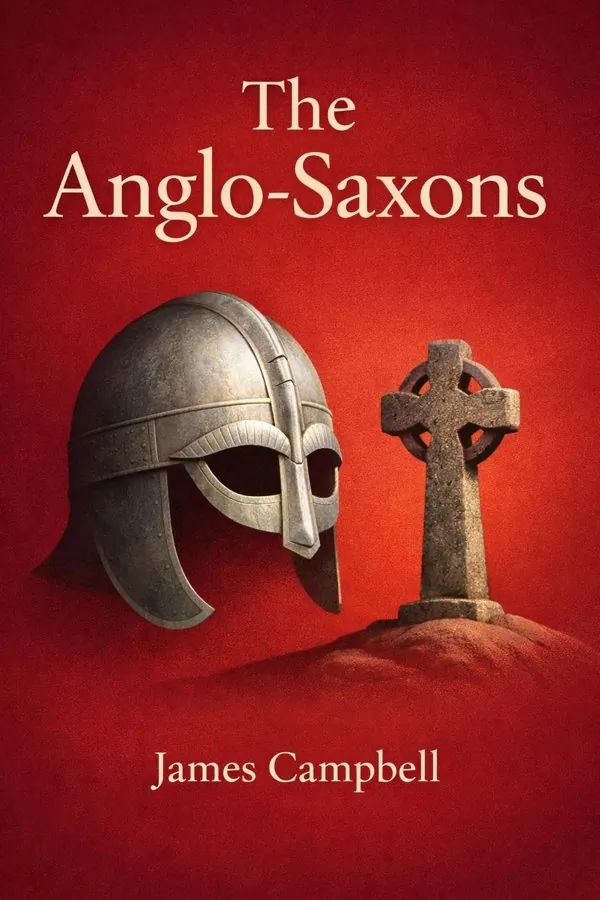
The Anglo-Saxons: Summary & Key Insights
 10 min9 chaptersAudio available
Key Takeaways from The Anglo-Saxons
A nation often looks ancient only in retrospect.
Periods labeled “dark” are often dark only because later observers failed to look carefully enough.
Power lasts only when it becomes legible, expected, and accepted.
Religious conversion changes more than worship; it alters how a society understands time, authority, learning, and itself.
History is often built from surviving scraps, not complete stories.
What Is The Anglo-Saxons About?
The Anglo-Saxons by James Campbell is a world_history book. James Campbell’s The Anglo-Saxons is a landmark history of early medieval England, offering a vivid, scholarly, and surprisingly accessible account of the peoples, kingdoms, institutions, and cultural achievements that shaped the centuries between the end of Roman Britain and the Norman Conquest. Rather than treating the Anglo-Saxon era as a dark or primitive prelude to “real” English history, Campbell presents it as a dynamic and formative age in its own right—one in which political authority, Christian identity, legal order, landholding, literacy, and artistic expression all took enduring form. What makes the book especially valuable is Campbell’s command of the evidence: chronicles, law codes, charters, archaeology, and material culture are woven into a rich narrative that balances detail with broad interpretation. As one of the leading historians of Anglo-Saxon England, Campbell writes with authority, but also with clarity and restraint, helping readers understand both what we know and what remains uncertain. For anyone interested in the foundations of England, state formation, medieval society, or how historians reconstruct distant worlds, this book remains essential reading.
This FizzRead summary covers all 9 key chapters of The Anglo-Saxons in approximately 10 minutes, distilling the most important ideas, arguments, and takeaways from James Campbell's work. Also available as an audio summary and Key Quotes Podcast.
The Anglo-Saxons
James Campbell’s The Anglo-Saxons is a landmark history of early medieval England, offering a vivid, scholarly, and surprisingly accessible account of the peoples, kingdoms, institutions, and cultural achievements that shaped the centuries between the end of Roman Britain and the Norman Conquest. Rather than treating the Anglo-Saxon era as a dark or primitive prelude to “real” English history, Campbell presents it as a dynamic and formative age in its own right—one in which political authority, Christian identity, legal order, landholding, literacy, and artistic expression all took enduring form. What makes the book especially valuable is Campbell’s command of the evidence: chronicles, law codes, charters, archaeology, and material culture are woven into a rich narrative that balances detail with broad interpretation. As one of the leading historians of Anglo-Saxon England, Campbell writes with authority, but also with clarity and restraint, helping readers understand both what we know and what remains uncertain. For anyone interested in the foundations of England, state formation, medieval society, or how historians reconstruct distant worlds, this book remains essential reading.
Who Should Read The Anglo-Saxons?
This book is perfect for anyone interested in world_history and looking to gain actionable insights in a short read. Whether you're a student, professional, or lifelong learner, the key ideas from The Anglo-Saxons by James Campbell will help you think differently.
- ✓Readers who enjoy world_history and want practical takeaways
- ✓Professionals looking to apply new ideas to their work and life
- ✓Anyone who wants the core insights of The Anglo-Saxons in just 10 minutes
Want the full summary?
Get instant access to this book summary and 100K+ more with Fizz Moment.
Get Free SummaryAvailable on App Store • Free to download
Key Chapters
A nation often looks ancient only in retrospect. One of the central insights of The Anglo-Saxons is that England did not suddenly appear as a unified people or state; it emerged slowly through conflict, alliance, migration, conversion, administration, and memory. Campbell shows that what later generations called “England” began as a mosaic of kingdoms such as Wessex, Mercia, Northumbria, East Anglia, and Kent. These were not merely regions waiting to be joined, but ambitious political communities with their own rulers, interests, and traditions.
This matters because it overturns simple origin stories. Instead of imagining a straight line from Germanic settlement to English nationhood, Campbell traces a more fragile process shaped by military success, royal marriages, church organization, legal practice, and responses to external threats, especially Viking attacks. Kingship became more expansive over time, and rulers increasingly developed claims that went beyond local lordship toward wider overlordship. Institutions such as written law, taxation, coinage, and ecclesiastical networks helped create habits of rule that bound territories together.
A practical way to apply this idea is to rethink how states and identities form in any era. Political communities are usually built through administration and storytelling as much as through conquest. When examining modern national identities, the Anglo-Saxon case reminds us to ask: what institutions made unity possible, and what narratives made it believable?
Campbell’s treatment encourages readers to look past myths of timeless nationhood and attend instead to the labor of state formation. Actionable takeaway: when studying any country’s past, focus on the processes, institutions, and pressures that created unity rather than assuming that unity always existed.
Periods labeled “dark” are often dark only because later observers failed to look carefully enough. Campbell challenges the familiar stereotype that Anglo-Saxon England was culturally barren, politically chaotic, and historically insignificant. He demonstrates that this was a society capable of durable political organization, legal sophistication, impressive craftsmanship, religious scholarship, and international connection.
The book highlights a world in which monasteries served as centers of literacy and learning, royal courts managed land and loyalty, and artisans produced metalwork, manuscripts, and stone sculpture of striking quality. Far from being cut off from Europe, Anglo-Saxon England participated in wider Christian and commercial networks. Missionaries, scholars, relics, texts, and ideas moved across the Channel and beyond. Even when sources are uneven, Campbell shows enough surviving evidence to reveal structured communities rather than cultural emptiness.
This insight is useful beyond medieval history. It teaches intellectual caution: whenever a period is dismissed as backward, the judgment may say more about inherited prejudice than about the evidence. In classrooms, discussions, or personal reading, one can use Anglo-Saxon England as a case study in how labels distort the past. The phrase “Dark Ages” may be memorable, but it can flatten complexity and discourage real inquiry.
Campbell’s reconstruction makes readers appreciate how much innovation can happen in seemingly unstable times. Social resilience, legal norms, religious reform, and artistic expression often develop under pressure, not only in eras of obvious prosperity. Actionable takeaway: challenge broad historical labels and ask what specific institutions, artifacts, and texts reveal before accepting a period as culturally inferior.
Power lasts only when it becomes legible, expected, and accepted. In The Anglo-Saxons, kingship is not portrayed simply as brute domination by warrior rulers. Campbell presents royal authority as something built through a combination of military leadership, gift-giving, lawmaking, religious patronage, ceremonial legitimacy, and administrative reach. A king had to defeat enemies, but he also had to govern followers, reward elites, work with bishops, and project order.
This more nuanced view helps explain why some rulers mattered far beyond their lifetimes. Successful kings created structures that outlived campaign victories: legal codes, systems of local administration, royal estates, tax or tribute mechanisms, and partnerships with the church. Campbell makes clear that authority depended on relationships. Nobles, abbots, bishops, reeves, and local communities all shaped how rule functioned in practice. A king who could not convert personal power into recognized governance remained vulnerable.
A modern reader can apply this insight to leadership in many settings. In business, politics, education, or civic life, authority that relies on fear or charisma alone is unstable. Durable leadership requires institutions, norms, communication, and trusted intermediaries. The Anglo-Saxon example illustrates that legitimacy grows when people understand the rules, see benefits from the system, and believe power is tied to larger purposes.
Campbell’s analysis also helps explain why legal texts and charters matter so much to historians: they show kingship becoming articulated in writing and embedded in administration. Actionable takeaway: when evaluating leadership, ask not only who holds power, but what institutions, relationships, and moral claims make that power workable over time.
Religious conversion changes more than worship; it alters how a society understands time, authority, learning, and itself. Campbell treats the conversion of the Anglo-Saxons to Christianity as one of the decisive transformations of the period. Christianity did not merely replace pagan ritual. It introduced literate institutions, linked English kingdoms to Rome and continental Europe, created new moral vocabularies of rulership, and generated records without which much of Anglo-Saxon history would be invisible.
Monasteries and bishoprics became centers of education, manuscript production, administration, and landholding. Clergy advised rulers, shaped law, and interpreted events through providential history. Saints’ cults organized local devotion; church building reordered landscapes; liturgy connected communities to a universal faith. Campbell also suggests that Christianity helped rulers strengthen claims to legitimacy. Kings were increasingly judged not only as war leaders, but as Christian governors responsible for justice, patronage, and peace.
This idea offers a useful framework for understanding cultural change. Institutions of belief often function simultaneously as systems of knowledge, social organization, and political legitimacy. In the Anglo-Saxon case, conversion changed what could be written down, commemorated, taught, and governed. For modern readers, the lesson extends to any ideological transformation: when a society adopts a new worldview, the deepest changes may occur in schools, archives, laws, and collective memory rather than in formal declarations.
Campbell’s account avoids reducing conversion to either pure sincerity or pure politics; it was both spiritual and strategic, personal and institutional. That balance is one of the book’s strengths. Actionable takeaway: when studying major belief shifts, track how they reshape education, law, memory, and political legitimacy—not just private conviction.
History is often built from surviving scraps, not complete stories. A major strength of The Anglo-Saxons is Campbell’s disciplined use of evidence. He works with chronicles, saints’ lives, law codes, charters, place names, coinage, burial finds, and archaeology, while constantly recognizing their limitations. The Anglo-Saxon past is not neatly documented. Sources are uneven across regions and centuries, often written with religious or political agendas, and sometimes preserved only by chance.
Rather than treating these limitations as a reason for despair, Campbell shows how careful historical method turns fragments into meaningful patterns. A charter may reveal landholding and political networks. A coin series can illuminate economic integration and royal control. A burial assemblage can suggest beliefs, status, and contact with wider worlds. A law code can show aspirations of rule even when actual enforcement remains uncertain. In this way, the book becomes not only a history of Anglo-Saxon England but also an implicit lesson in how historians reason.
This has practical value for any reader trying to assess evidence today. We rarely possess complete information, whether in history, journalism, or public debate. The key is not to demand impossible certainty, but to weigh sources, compare types of evidence, and distinguish between strong conclusions and plausible speculation. Campbell models this intellectual honesty well.
The result is a richer understanding of the past and a more mature respect for uncertainty. Readers learn that gaps in evidence do not eliminate knowledge; they require better questions and sharper interpretation. Actionable takeaway: when confronting incomplete information, compare multiple source types, note their biases, and separate what is certain, probable, and merely possible.
Civilization is often sustained by routines that look dull on the surface. Campbell emphasizes that Anglo-Saxon England was not held together only by warriors and monasteries, but also by laws, local offices, fiscal practices, and administrative habits. The survival of law codes, charters, and references to local officials reveals a society increasingly concerned with regulation, compensation, land rights, dispute settlement, and the responsibilities of rulers and subjects.
These materials matter because they show order becoming structured rather than merely personal. Written law helped define expectations, even if enforcement varied. Administrative divisions and officials connected kingship to local realities. Systems of taxation, tribute, and estate management underpinned military and political power. Coinage and market frameworks suggest that governance reached into everyday life more deeply than older stereotypes allow. Campbell argues, in effect, that the foundations of later English government were not simply Norman imports but had important Anglo-Saxon precedents.
For modern readers, this is a reminder that functioning states depend on unglamorous capacities: recordkeeping, local accountability, predictable rules, and revenue collection. Dramatic events like battles make history memorable, but it is administration that allows power to endure. This is true in governments, nonprofits, and organizations of any size. A vision without systems rarely survives contact with reality.
Campbell’s account invites renewed respect for institutional development. It also complicates simplistic before-and-after narratives about 1066 by showing the depth of pre-Conquest political organization. Actionable takeaway: when judging whether a society or institution is strong, look beyond leaders and crises to the administrative systems that make everyday order possible.
External threats do not merely destroy states; they can also force them to evolve. Campbell treats the Viking invasions and settlements not as a dramatic interruption to an otherwise stable story, but as a crucial catalyst in the making of later Anglo-Saxon England. Raiding, conquest, tribute demands, and the establishment of Scandinavian-controlled territories transformed political priorities and exposed the strengths and weaknesses of existing kingdoms.
In this context, the rise of Wessex becomes especially significant. Facing existential danger, rulers had to improve military coordination, fortification, taxation, and local defense. Burhs, reorganized obligations, and stronger royal leadership were not abstract reforms; they were practical responses to pressure. Campbell shows how resistance, accommodation, and reconquest all contributed to a more integrated political order. The struggle against Viking power helped sharpen ideas of kingship, territorial rule, and English identity.
This insight has broad relevance. Societies often modernize or centralize not in calm conditions but under intense threat. Crises can expose institutional weaknesses and create support for reforms previously impossible. That does not make conflict desirable, but it does explain why periods of danger frequently produce lasting administrative change. In strategy, business, or public policy, severe competition or disruption can clarify priorities and accelerate coordination.
Campbell’s analysis also avoids reducing Vikings to caricatures. They were raiders, settlers, rulers, and participants in a wider northern world. Their impact was destructive, but also historically generative. Actionable takeaway: when analyzing a crisis, ask not only what it damaged, but also what new capacities, institutions, or identities it compelled a society to build.
Instability does not prevent creativity; sometimes it sharpens it. One of the most rewarding aspects of The Anglo-Saxons is Campbell’s insistence that this era should be recognized for its cultural achievements as well as its political development. Anglo-Saxon England produced remarkable poetry, learned scholarship, illuminated manuscripts, intricate metalwork, sculpture, and ecclesiastical architecture. These were not isolated curiosities but expressions of a society capable of aesthetic ambition, technical skill, and intellectual seriousness.
The cultural record reveals a civilization negotiating memory, faith, status, and power. Poetry reflects themes of exile, loyalty, loss, and heroic identity. Manuscripts and biblical commentary reveal networks of learning. Decorative arts show mastery of form and contact with wider artistic traditions. Even when much has been lost, what survives demonstrates that cultural vitality persisted through warfare, dynastic struggle, and regional rivalry.
For contemporary readers, this is a valuable corrective to the assumption that flourishing culture requires peace and prosperity alone. Human communities often create meaning most intensely when circumstances are uncertain. In practical terms, the Anglo-Saxon example encourages us to value art and scholarship not as luxuries added after stability is achieved, but as essential ways societies interpret change and preserve continuity.
Campbell helps readers connect cultural artifacts to broader historical questions: who commissioned them, who used them, what institutions sustained them, and what identities they expressed. This makes culture central to history rather than decorative background. Actionable takeaway: when exploring any historical period, study its art and literature as evidence of social values, political ambition, and collective resilience—not as secondary embellishments.
Historical turning points are real, but they rarely erase everything that came before. Although 1066 looms large in English history, Campbell’s work helps readers see that the Anglo-Saxon past was not simply swept away by Norman rule. The Conquest brought profound changes in aristocracy, language, landholding, and political connection to the continent, yet it landed on a society that already possessed substantial administrative sophistication, legal traditions, territorial organization, and a developed idea of kingship.
This perspective is important because it prevents two opposite errors: minimizing the scale of Norman change and undervaluing Anglo-Saxon achievement. Campbell demonstrates that pre-Conquest England was already unusually organized by early medieval standards. That made conquest both possible and consequential. The Normans inherited and adapted institutions they did not create from nothing. In other words, rupture and continuity coexisted.
This way of thinking can be applied to many historical transitions. Revolutions, conquests, and regime changes often transform personnel and priorities while preserving useful structures. Analysts of modern change—whether in politics, corporate mergers, or social movements—can learn from this: new leaders often depend on systems built by predecessors, even when they claim total renewal.
Campbell’s balanced approach encourages readers to resist simplistic before-and-after narratives. The Anglo-Saxon centuries were not merely a prologue ended by a superior order; they were formative, durable, and deeply embedded in what followed. Actionable takeaway: when assessing major transitions, identify both what changed dramatically and what underlying institutions or habits continued beneath the new regime.
All Chapters in The Anglo-Saxons
About the Author
James Campbell was a highly respected British historian and one of the foremost authorities on Anglo-Saxon England. His scholarship focused on the political, administrative, and cultural history of early medieval England, and he played a major role in challenging outdated views of the Anglo-Saxon period as unsophisticated or historically marginal. Known for his rigorous command of primary sources and his measured, elegant prose, Campbell helped both academic and general readers appreciate the complexity of pre-Conquest English society. His work often emphasized the strength of Anglo-Saxon institutions, the importance of kingship and governance, and the deep roots of English state formation. Through books such as The Anglo-Saxons, he left a lasting mark on medieval studies and on popular understanding of early English history.
Get This Summary in Your Preferred Format
Read or listen to the The Anglo-Saxons summary by James Campbell anytime, anywhere. FizzRead offers multiple formats so you can learn on your terms — all free.
Available formats: App · Audio · PDF · EPUB — All included free with FizzRead
Download The Anglo-Saxons PDF and EPUB Summary
Key Quotes from The Anglo-Saxons
“A nation often looks ancient only in retrospect.”
“Periods labeled “dark” are often dark only because later observers failed to look carefully enough.”
“Power lasts only when it becomes legible, expected, and accepted.”
“Religious conversion changes more than worship; it alters how a society understands time, authority, learning, and itself.”
“History is often built from surviving scraps, not complete stories.”
Frequently Asked Questions about The Anglo-Saxons
The Anglo-Saxons by James Campbell is a world_history book that explores key ideas across 9 chapters. James Campbell’s The Anglo-Saxons is a landmark history of early medieval England, offering a vivid, scholarly, and surprisingly accessible account of the peoples, kingdoms, institutions, and cultural achievements that shaped the centuries between the end of Roman Britain and the Norman Conquest. Rather than treating the Anglo-Saxon era as a dark or primitive prelude to “real” English history, Campbell presents it as a dynamic and formative age in its own right—one in which political authority, Christian identity, legal order, landholding, literacy, and artistic expression all took enduring form. What makes the book especially valuable is Campbell’s command of the evidence: chronicles, law codes, charters, archaeology, and material culture are woven into a rich narrative that balances detail with broad interpretation. As one of the leading historians of Anglo-Saxon England, Campbell writes with authority, but also with clarity and restraint, helping readers understand both what we know and what remains uncertain. For anyone interested in the foundations of England, state formation, medieval society, or how historians reconstruct distant worlds, this book remains essential reading.
You Might Also Like
The Age of Capital
Eric Hobsbawm
10 min
The Gulag Archipelago
Aleksandr Solzhenitsyn
10 min
Jerusalem: The Biography
Simon Sebag Montefiore
10 min
The Boer War
Thomas Pakenham
10 min
The Industrial Revolutionaries: The Making of the Modern World 1776–1914
Gavin Weightman
10 min
The Poison Squad: One Chemist's Single-Minded Crusade for Food Safety at the Turn of the Twentieth Century
Deborah Blum
10 minBrowse by Category
Ready to read The Anglo-Saxons?
Get the full summary and 100K+ more books with Fizz Moment.