
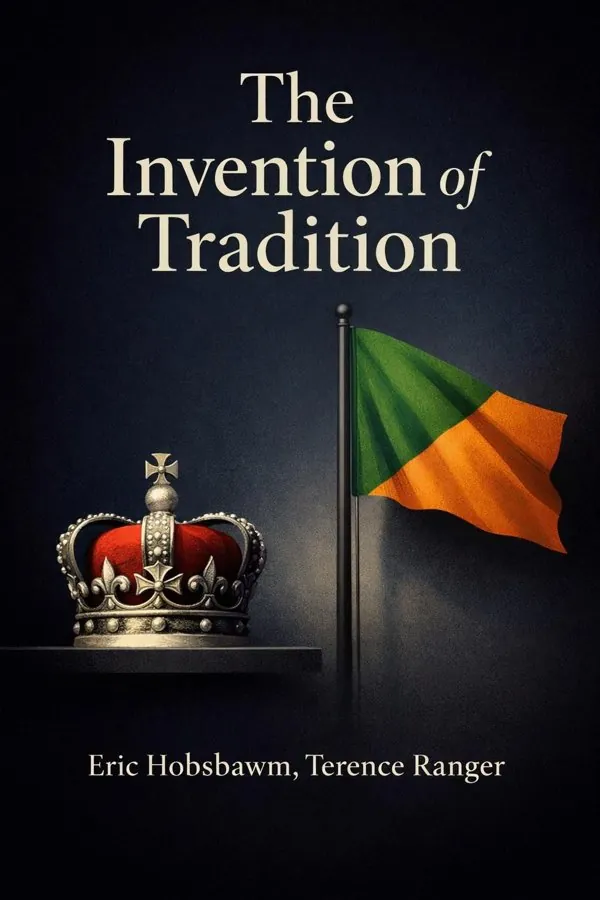
The Invention of Tradition: Summary & Key Insights
by Eric Hobsbawm, Terence Ranger
 10 min9 chaptersAudio available
Key Takeaways from The Invention of Tradition
The most powerful traditions are often the ones people never think to question.
We often assume modern life erodes tradition, but this book makes a more surprising claim: modernity frequently produces traditions at high speed.
Nothing looks more ancient than royal ceremony, and that is exactly why it makes such an effective case study.
Colonial rule did not merely conquer territories; it often reorganized memory.
Tradition survives not only in grand ceremonies but in ordinary routines.
What Is The Invention of Tradition About?
The Invention of Tradition by Eric Hobsbawm, Terence Ranger is a civilization book spanning 6 pages. What if some of the most “ancient” customs in modern society are not ancient at all? In The Invention of Tradition, historians Eric Hobsbawm and Terence Ranger assemble a powerful set of essays arguing that many practices presented as timeless are in fact recent creations, designed to produce legitimacy, loyalty, and social order. Ceremonies, uniforms, national myths, royal pageantry, school rituals, and colonial identities often feel inherited from a distant past, yet the book shows how frequently they were consciously assembled in moments of political change. This matters because tradition is never just about memory; it is also about power. By tracing how states, elites, imperial administrations, and social institutions manufacture continuity with the past, the book reveals how identity itself can be organized through repetition and symbolism. Hobsbawm, one of the twentieth century’s most influential historians, and Ranger, a leading scholar of African history and colonialism, bring extraordinary authority to the topic. Their work remains essential for understanding nationalism, empire, public ceremony, and the politics of culture. Once you grasp their argument, you begin to see invented traditions everywhere.
This FizzRead summary covers all 9 key chapters of The Invention of Tradition in approximately 10 minutes, distilling the most important ideas, arguments, and takeaways from Eric Hobsbawm, Terence Ranger's work. Also available as an audio summary and Key Quotes Podcast.
The Invention of Tradition
What if some of the most “ancient” customs in modern society are not ancient at all? In The Invention of Tradition, historians Eric Hobsbawm and Terence Ranger assemble a powerful set of essays arguing that many practices presented as timeless are in fact recent creations, designed to produce legitimacy, loyalty, and social order. Ceremonies, uniforms, national myths, royal pageantry, school rituals, and colonial identities often feel inherited from a distant past, yet the book shows how frequently they were consciously assembled in moments of political change.
This matters because tradition is never just about memory; it is also about power. By tracing how states, elites, imperial administrations, and social institutions manufacture continuity with the past, the book reveals how identity itself can be organized through repetition and symbolism. Hobsbawm, one of the twentieth century’s most influential historians, and Ranger, a leading scholar of African history and colonialism, bring extraordinary authority to the topic. Their work remains essential for understanding nationalism, empire, public ceremony, and the politics of culture. Once you grasp their argument, you begin to see invented traditions everywhere.
Who Should Read The Invention of Tradition?
This book is perfect for anyone interested in civilization and looking to gain actionable insights in a short read. Whether you're a student, professional, or lifelong learner, the key ideas from The Invention of Tradition by Eric Hobsbawm, Terence Ranger will help you think differently.
- ✓Readers who enjoy civilization and want practical takeaways
- ✓Professionals looking to apply new ideas to their work and life
- ✓Anyone who wants the core insights of The Invention of Tradition in just 10 minutes
Want the full summary?
Get instant access to this book summary and 100K+ more with Fizz Moment.
Get Free SummaryAvailable on App Store • Free to download
Key Chapters
The most powerful traditions are often the ones people never think to question. Hobsbawm’s central concept is deceptively simple: an “invented tradition” is a set of practices, usually governed by explicit or implicit rules, that uses repetition to instill values, norms, and a sense of continuity with the past. These traditions present themselves as old, stable, and natural, even when they are relatively recent creations.
The book carefully distinguishes invented tradition from ordinary custom. Custom is flexible, shaped slowly through lived practice, and often adapts to changing circumstances without losing its social meaning. Invented tradition, by contrast, tends to be more formalized, ritualized, and self-conscious. It often emerges when rapid social change weakens older habits and institutions. In such moments, societies create symbolic anchors: ceremonies, costumes, oaths, parades, anniversaries, and official narratives that claim to preserve an ancient essence.
Consider modern graduation robes, military rituals, or national anthem protocols. Many people experience these as natural inheritances, yet their current forms often date to the nineteenth or twentieth century. Their function is not mainly historical accuracy. Their function is social effect: to create obedience, belonging, hierarchy, or patriotism.
This concept has practical use far beyond history. It helps explain corporate culture, political branding, school ceremonies, even family rituals. When an organization creates a yearly tradition, it is often trying to manufacture solidarity and legitimacy.
Actionable takeaway: whenever a practice is described as timeless, ask three questions: when did it begin, who formalized it, and what social purpose does its repetition serve?
We often assume modern life erodes tradition, but this book makes a more surprising claim: modernity frequently produces traditions at high speed. Industrialization, urbanization, democratic politics, mass education, and expanding bureaucracy disrupted older social bonds across Europe and beyond. As inherited local identities weakened, states and institutions responded by creating new symbolic frameworks to hold society together.
This is one of the book’s most important reversals. Tradition is not simply what survives from the past; it is often what is fabricated in response to change. The faster society moves, the stronger the temptation to stage permanence. When millions move to cities, when literacy spreads, when citizens begin participating in national politics, elites need new ways to teach people who they are and where they belong. Ritual becomes a technology of social integration.
A practical example is the national holiday. It may commemorate a real event, but its meaning is shaped through organized repetition: flags, speeches, school performances, military displays, and media coverage. These repeated forms transform a historical memory into a civic habit. The same pattern appears in companies during rapid growth. Startups that become large firms often invent “founding stories,” annual off-sites, or signature rituals to preserve culture amid expansion.
The point is not that invented traditions are fake in a trivial sense. They can become deeply meaningful. People may sincerely identify with them, build memories around them, and organize life through them. Their recent origin does not eliminate their power.
Actionable takeaway: in periods of rapid change, pay attention to newly formalized rituals. They often reveal what a society or institution fears losing and what it most wants to stabilize.
Nothing looks more ancient than royal ceremony, and that is exactly why it makes such an effective case study. One of the book’s most memorable arguments is that many rituals associated with British national identity and monarchy were not immemorial survivals but nineteenth-century constructions or reinventions. At a time when industrial capitalism, class conflict, and democratic pressures were transforming Britain, monarchy was re-presented through spectacle as the embodiment of continuity.
Public ceremonials expanded dramatically: jubilees, coronation pageantry, military display, and carefully choreographed appearances connected crown, empire, and nation in a single visual language. These rituals helped turn monarchy into a mass institution. What had once been a more politically contested and less emotionally central institution became a symbol of shared history and national cohesion.
This process worked because ritual communicates across class lines. A factory worker, a schoolchild, and an aristocrat could all encounter the same symbols: uniforms, anthems, flags, and public celebrations. The message was simple but potent: despite social upheaval, the nation had an unbroken core. Yet that “core” was being continuously staged.
We can see similar strategies today whenever institutions under pressure lean harder into ceremony. Universities facing criticism often emphasize commencement grandeur. Governments in crisis may rely more heavily on national symbolism. The more uncertain legitimacy becomes, the more useful ritual can appear.
Actionable takeaway: when public pageantry grows more elaborate, do not ask only what is being celebrated. Also ask what social tensions the ceremony is trying to contain, soften, or unite.
Colonial rule did not merely conquer territories; it often reorganized memory. Ranger’s contribution is especially important here. In colonial Africa, European administrations frequently codified “traditional” authorities, tribal identities, legal practices, and ceremonial forms that were in fact simplified, exaggerated, or newly constructed under imperial rule. Colonizers claimed to preserve native custom, but often they were inventing manageable versions of it.
Why would empires do this? Because governance becomes easier when fluid societies are turned into fixed categories. If communities are labeled as tribes with defined chiefs, territories, and customs, colonial administrations can rule indirectly, delegate control, collect taxes, and discipline populations. The language of tradition gives political decisions the appearance of cultural authenticity.
The irony is profound. Colonial states presented themselves as protectors of ancient order while actively reshaping social life. Complex local identities became rigid ethnic boxes. Negotiated authority became formal chieftaincy. Diverse legal practices became “customary law.” What looked like preservation was often administrative invention.
This insight remains highly relevant. Modern organizations also freeze complex realities into official categories: job families, demographic segments, cultural values, best practices. Once codified, these categories can start to feel natural even if they were originally imposed for convenience.
The book does not deny that precolonial traditions existed. Its point is that colonial power selected, redefined, and institutionalized particular versions of them. That process had long afterlives, shaping postcolonial politics, ethnic conflict, and national identity.
Actionable takeaway: be skeptical when powerful institutions claim they are simply “respecting tradition.” Investigate whether they are preserving lived practices or formalizing selective versions that make people easier to govern.
Tradition survives not only in grand ceremonies but in ordinary routines. One of the book’s key insights is that schools, youth organizations, civic associations, and class institutions are crucial machines for transmitting invented traditions. If rituals are to shape behavior, they must be repeated in everyday life, especially among the young.
Mass education in the modern era did far more than teach literacy. It taught citizenship through schedules, uniforms, assemblies, pledges, songs, historical narratives, and commemorative practices. These forms helped turn populations into nations. Students learned not just facts about the state but habits of belonging to it. The classroom became a workshop of collective identity.
Class also matters. Different groups receive different traditions. Elite schools often cultivate lineage, prestige, and institutional loyalty through gowns, mottos, houses, ceremonies, and alumni rituals. Working-class organizations, trade unions, and political movements likewise create banners, anniversaries, songs, and commemorative marches. Tradition is therefore not only national; it can bind classes, professions, and movements.
This is easy to observe today. Orientation weeks, company onboarding, sports chants, national pledges, and annual remembrance events all perform similar work. They make identity feel normal through repetition. People often internalize the values before they consciously analyze them.
The broader lesson is that tradition is not merely inherited from family or locality. It is systematically taught through institutions. Whoever controls ritualized education shapes what counts as respectable memory, appropriate behavior, and common belonging.
Actionable takeaway: examine the routines you consider normal in schools or workplaces. Ask what values they reward, what hierarchies they reinforce, and what version of community they quietly teach.
Nations are not sustained by territory alone; they are sustained by stories that make populations feel historically connected. The book shows that nationalism frequently relies on invented traditions to create the impression of ancient continuity. Flags, monuments, patriotic holidays, folk revivals, military ceremonies, and official histories all help transform a modern political community into something that feels timeless.
This process is especially important because most modern nations are recent formations. Their boundaries, institutions, and populations often emerged through war, reform, revolution, or state-building in the last few centuries. Invented traditions bridge that recency problem. They say, in effect, “We have always been who we are now,” even when the evidence is far messier.
Historical storytelling is therefore not just descriptive; it is constitutive. A people becomes a nation partly by being taught to remember together. Selective memory plays a major role. Episodes that support unity are celebrated; divisions, losses, exclusions, and contradictions may be softened or forgotten. Folklore can be standardized. Regional diversity can be recast as national heritage. Ancient symbols can be attached to modern political projects.
You can see this in contemporary nation branding, museum design, constitution days, and sports culture. International competition often intensifies the need for symbolic coherence, making invented traditions even more attractive.
The book’s argument is not that nations are illegitimate because some symbols are constructed. Rather, it asks us to recognize how political communities use myth, ritual, and repetition to become emotionally real.
Actionable takeaway: when encountering patriotic narratives, compare the official story with historical complexity. Doing so does not weaken civic life; it makes your belonging more conscious and less manipulable.
A ritual does not need to be old to feel sacred; it only needs to be repeated until it becomes unquestioned. One reason invented traditions are so effective is psychological rather than purely historical. Repetition stabilizes meaning. What is done regularly in formal settings starts to feel proper, obvious, and emotionally charged.
Think about standing for an anthem, wearing black at a funeral, observing a minute of silence, or following protocol at civic events. Participants may not know when or why these forms originated, but that ignorance often strengthens their aura. The ritual’s authority comes from enactment, not investigation. By repeating actions in predictable ways, communities turn symbols into bodily habits.
This matters because identity is learned not just through ideas but through performance. A student reciting a pledge, a soldier saluting, a graduate crossing a stage, a citizen voting in a ceremonial setting: each act ties the individual to a larger order. Ritual creates emotional resonance precisely because it places people inside a sequence larger than themselves.
Modern brands and organizations exploit the same principle. Product launches, annual meetings, awards nights, founder stories, and internal slogans can become ritualized tools for coherence. Social media has accelerated this dynamic by making repeated symbolic acts highly visible and easily shareable.
The danger is that repetition can naturalize power. Hierarchies, exclusions, and selective histories may come to seem inevitable simply because they are regularly performed.
Actionable takeaway: when you participate in a ritual, notice not only what it expresses but what it trains. Ask how repeated performance is shaping your emotions, loyalties, and assumptions about authority.
One common misunderstanding is that if a tradition is invented, it must be shallow or fraudulent. The book resists that simplistic conclusion. All traditions, even very old ones, have histories of adaptation, selection, and reinterpretation. Calling something invented does not make it unreal; it means its historical construction should be examined rather than romanticized.
This is a crucial nuance. People can form deep attachments to recently created practices. A national remembrance day established within living memory may carry immense emotional weight. A school ceremony invented decades ago can shape identity across generations. A community festival revived or redesigned for modern audiences can still create genuine belonging. Human meaning does not depend on antiquity alone.
What matters is honesty about origins and function. Problems arise when invented traditions claim unquestionable authority because they are said to be ancient, natural, or sacred. That claim can shut down debate and hide political interests. But acknowledging that traditions are made opens the possibility of making them better. Communities can choose rituals that are inclusive, reflective, and responsive to current values.
This insight has practical relevance for families, institutions, and nations. You do not need to inherit a perfect past to build shared meaning. You can consciously create forms that express what you care about now, while remaining transparent about their newness.
The book therefore encourages critical maturity, not cynical dismissal. It teaches readers to separate social usefulness from mythic self-deception.
Actionable takeaway: treat traditions as human creations that can still be valuable. Preserve those that foster belonging and dignity, but challenge any that demand obedience merely because they claim ancient authority.
The book remains strikingly contemporary because the invention of tradition did not end with empire or the nineteenth century. It continues in politics, media, corporations, and digital culture. Whenever institutions face uncertainty, they often build or intensify rituals that communicate continuity, authenticity, and purpose.
Consider modern political movements that revive symbols, slogans, dress codes, or heroic historical narratives. Consider corporations that celebrate founder myths, “culture days,” and ritualized mission statements. Consider online communities that develop annual events, insider phrases, and codified norms within a few years, yet treat them as essential identity markers. These are not accidental decorations. They are mechanisms for creating solidarity and defining insiders and outsiders.
The framework also helps explain contemporary culture wars. Disputes over statues, school curricula, public holidays, royal ceremonies, and indigenous recognition are often disputes over which traditions deserve authority and whose past will be staged as the national story. Once you understand invented tradition, these conflicts look less like arguments about neutral heritage and more like struggles over political meaning.
For readers today, the book offers both warning and opportunity. The warning is that symbols can manipulate, sanitize history, and legitimize unequal power. The opportunity is that collective life need not be trapped by inherited myths. Societies can consciously redesign rituals to reflect pluralism, truth, and democratic inclusion.
Actionable takeaway: use the book’s lens whenever you encounter claims of heritage in public life. Instead of asking only whether a tradition is old, ask whether it is truthful, whom it serves, and whether it still deserves loyalty.
All Chapters in The Invention of Tradition
About the Authors
Eric Hobsbawm (1917–2012) was a British historian and public intellectual widely regarded as one of the leading interpreters of modern history. He is best known for his landmark studies of the long nineteenth century, capitalism, revolution, nationalism, and class formation. His writing combined wide historical sweep with sharp political insight. Terence Ranger (1929–2015) was a distinguished British historian of Africa whose work focused especially on Zimbabwe, colonialism, resistance, and the politics of identity. He played a major role in reshaping how scholars understand African history and the uses of “tradition” under colonial rule. Together, Hobsbawm and Ranger edited The Invention of Tradition, a seminal volume that transformed the study of ritual, nationalism, empire, and historical memory.
Get This Summary in Your Preferred Format
Read or listen to the The Invention of Tradition summary by Eric Hobsbawm, Terence Ranger anytime, anywhere. FizzRead offers multiple formats so you can learn on your terms — all free.
Available formats: App · Audio · PDF · EPUB — All included free with FizzRead
Download The Invention of Tradition PDF and EPUB Summary
Key Quotes from The Invention of Tradition
“The most powerful traditions are often the ones people never think to question.”
“We often assume modern life erodes tradition, but this book makes a more surprising claim: modernity frequently produces traditions at high speed.”
“Nothing looks more ancient than royal ceremony, and that is exactly why it makes such an effective case study.”
“Colonial rule did not merely conquer territories; it often reorganized memory.”
“Tradition survives not only in grand ceremonies but in ordinary routines.”
Frequently Asked Questions about The Invention of Tradition
The Invention of Tradition by Eric Hobsbawm, Terence Ranger is a civilization book that explores key ideas across 9 chapters. What if some of the most “ancient” customs in modern society are not ancient at all? In The Invention of Tradition, historians Eric Hobsbawm and Terence Ranger assemble a powerful set of essays arguing that many practices presented as timeless are in fact recent creations, designed to produce legitimacy, loyalty, and social order. Ceremonies, uniforms, national myths, royal pageantry, school rituals, and colonial identities often feel inherited from a distant past, yet the book shows how frequently they were consciously assembled in moments of political change. This matters because tradition is never just about memory; it is also about power. By tracing how states, elites, imperial administrations, and social institutions manufacture continuity with the past, the book reveals how identity itself can be organized through repetition and symbolism. Hobsbawm, one of the twentieth century’s most influential historians, and Ranger, a leading scholar of African history and colonialism, bring extraordinary authority to the topic. Their work remains essential for understanding nationalism, empire, public ceremony, and the politics of culture. Once you grasp their argument, you begin to see invented traditions everywhere.
You Might Also Like
The Structure of Scientific Revolutions
Thomas S. Kuhn
10 min
Genius
Harold Bloom
10 min
A Cultural History of the Medieval Age
Various Editors
10 min
A History of God: The 4,000-Year Quest of Judaism, Christianity and Islam
Karen Armstrong
10 min
A History of the World in 10½ Chapters
Julian Barnes
10 min
A Short History of Progress
Ronald Wright
10 minBrowse by Category
Ready to read The Invention of Tradition?
Get the full summary and 100K+ more books with Fizz Moment.