
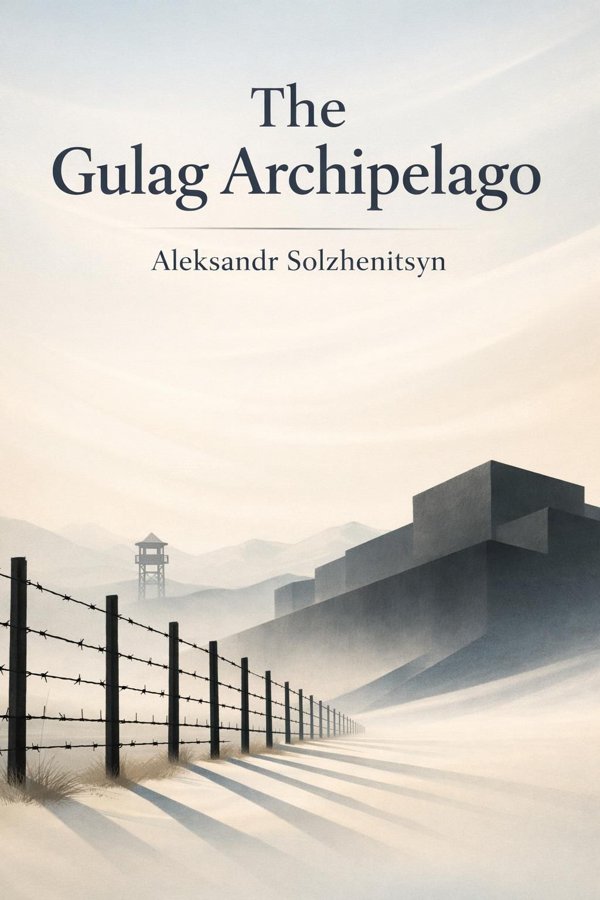
The Gulag Archipelago: Summary & Key Insights
 10 min9 chaptersAudio available
Key Takeaways from The Gulag Archipelago
A totalitarian system often reveals itself in a single knock at the door.
When a regime no longer seeks truth, confession becomes a political performance.
Long before prisoners reached the camps, the system had already begun reducing them to cargo.
The Gulag was not a marginal excess of Soviet rule; it was one of its operating foundations.
The most surprising claim in The Gulag Archipelago is not that human beings can be broken, but that they can also be morally awakened in conditions meant to destroy them.
What Is The Gulag Archipelago About?
The Gulag Archipelago by Aleksandr Solzhenitsyn is a world_history book published in 2007 spanning 11 pages. The Gulag Archipelago is one of the most powerful works ever written about state violence, ideological fanaticism, and the destruction of human dignity. In this vast literary investigation, Aleksandr Solzhenitsyn maps the hidden world of the Soviet prison and labor camp system: the arrests in the middle of the night, the fabricated charges, the interrogations, the transport convoys, the slave labor, and the moral corrosion that spread far beyond the camps themselves. The “archipelago” of the title refers to a chain of prisons, transit points, and camps scattered across the Soviet Union, linked not by geography but by terror. What makes the book extraordinary is the authority behind it. Solzhenitsyn writes not as an outside commentator, but as a former prisoner who endured the system himself and gathered testimony from hundreds of other survivors. He combines memoir, history, moral reflection, and documentary evidence to show how an entire political order normalized lies and cruelty. First published in the West in 1973, The Gulag Archipelago changed how the world understood the Soviet regime. It remains essential not only as a record of suffering, but as a warning about what happens when power escapes moral limits.
This FizzRead summary covers all 9 key chapters of The Gulag Archipelago in approximately 10 minutes, distilling the most important ideas, arguments, and takeaways from Aleksandr Solzhenitsyn's work. Also available as an audio summary and Key Quotes Podcast.
The Gulag Archipelago
The Gulag Archipelago is one of the most powerful works ever written about state violence, ideological fanaticism, and the destruction of human dignity. In this vast literary investigation, Aleksandr Solzhenitsyn maps the hidden world of the Soviet prison and labor camp system: the arrests in the middle of the night, the fabricated charges, the interrogations, the transport convoys, the slave labor, and the moral corrosion that spread far beyond the camps themselves. The “archipelago” of the title refers to a chain of prisons, transit points, and camps scattered across the Soviet Union, linked not by geography but by terror.
What makes the book extraordinary is the authority behind it. Solzhenitsyn writes not as an outside commentator, but as a former prisoner who endured the system himself and gathered testimony from hundreds of other survivors. He combines memoir, history, moral reflection, and documentary evidence to show how an entire political order normalized lies and cruelty. First published in the West in 1973, The Gulag Archipelago changed how the world understood the Soviet regime. It remains essential not only as a record of suffering, but as a warning about what happens when power escapes moral limits.
Who Should Read The Gulag Archipelago?
This book is perfect for anyone interested in world_history and looking to gain actionable insights in a short read. Whether you're a student, professional, or lifelong learner, the key ideas from The Gulag Archipelago by Aleksandr Solzhenitsyn will help you think differently.
- ✓Readers who enjoy world_history and want practical takeaways
- ✓Professionals looking to apply new ideas to their work and life
- ✓Anyone who wants the core insights of The Gulag Archipelago in just 10 minutes
Want the full summary?
Get instant access to this book summary and 100K+ more with Fizz Moment.
Get Free SummaryAvailable on App Store • Free to download
Key Chapters
A totalitarian system often reveals itself in a single knock at the door. Solzhenitsyn begins with arrest because this is the moment when ordinary life is split in two: before and after the state claims total power over a person. One can be taken from work, from home, from a train platform, or from bed at night. The charge may be vague, absurd, or never clearly explained at all. The point is not lawful procedure but psychological shock. Arrest teaches the citizen that innocence offers no protection when institutions exist to serve power rather than justice.
In Solzhenitsyn’s account, this first stage matters because it destroys the illusion that repression affects only the obviously guilty. Teachers, engineers, soldiers, clerks, peasants, party members, and loyal patriots all enter the system. The randomness is part of the design. When everyone can be accused, everyone becomes fearful, cautious, and politically obedient. People learn to censor themselves long before formal punishment arrives.
This idea has modern relevance beyond the Soviet case. Whenever legal norms weaken, vague accusations, selective enforcement, or public shaming can become tools of intimidation. A society does not need labor camps to suffer from the same underlying problem: the replacement of clear standards with arbitrary power.
Solzhenitsyn also asks a painful question: why did so many comply silently when others were taken away? Fear explains much, but habit, denial, and the desire to feel safe also play their part. The first lesson of the Archipelago is therefore civic, not merely historical. Defending due process, transparency, and equal protection must happen before the knock comes, not after. Actionable takeaway: pay attention to how a society treats the accused, especially unpopular or powerless people, because that is where freedom is first lost.
When a regime no longer seeks truth, confession becomes a political performance. Solzhenitsyn describes interrogation as a system designed not to discover facts but to manufacture guilt. Investigators use exhaustion, threats, isolation, deception, and endless repetition to break resistance. A confession becomes the central object because it allows the state to present repression as justice. The prisoner is not merely punished; he is made to endorse the story written about him.
This mechanism exposes one of the deepest insights of the book: tyranny depends on language as much as violence. The forced confession creates an official reality. It turns innocence into “proof” of conspiracy, loyalty into “evidence” of treason, and silence into “admission” of hidden guilt. Law remains on paper, but in practice it becomes theater with a predetermined ending.
Solzhenitsyn pays close attention to how psychological pressure works. Few people can withstand sleepless nights, fabricated witness statements, threats against family, and the constant suggestion that resistance is pointless. The system counts on human limits. This matters because outsiders often judge victims too harshly, asking why they signed false statements. Solzhenitsyn insists that institutions built to crush the person must be understood as systems of engineered breakdown.
The broader application is clear. In any organization, when incentives reward agreement over truth, people begin saying what authority wants to hear. This may happen in governments, corporations, media, or schools. The scale differs, but the principle is the same: truth becomes subordinate to the needs of power.
The antidote is not simply courage, though courage matters. It is the protection of procedures that make truth harder to manipulate: independent courts, recorded proceedings, legal counsel, and public scrutiny. Actionable takeaway: whenever you see pressure to produce a preferred narrative rather than examine evidence honestly, treat that as a serious warning sign.
Long before prisoners reached the camps, the system had already begun reducing them to cargo. Solzhenitsyn’s descriptions of transport are among the book’s most revealing passages because they show how cruelty becomes routine through logistics. People are packed into railway cars, prison vans, and holding cells with little air, little food, and almost no information. The journey is chaotic, degrading, and deliberately disorienting. One no longer belongs to a family, a profession, or a civic community; one belongs to the machinery of transfer.
This stage matters because bureaucracy often hides violence behind procedure. A person is moved from one numbered place to another, counted, filed, and delivered. Each official may feel only partly responsible, yet the whole chain produces extreme suffering. Solzhenitsyn shows that evil does not always appear as dramatic sadism. Often it appears as indifference administered efficiently.
There is also a psychological function to transport. By stripping prisoners of sleep, privacy, orientation, and human recognition, the system weakens their capacity for resistance. The uncertainty is part of the punishment. Not knowing where you are going, how long the trip will last, or whether you will survive creates a permanent state of dependence.
The lesson extends beyond Soviet history. Whenever institutions reduce people to cases, numbers, or units of movement, moral perception begins to dim. In medicine, law, education, and public administration, systems are necessary, but they become dangerous when they erase the person inside the process.
Solzhenitsyn’s insight is practical: inhumane outcomes often begin with impersonal routines that no one pauses to question. To preserve dignity, procedures must be judged not only by efficiency but by their human consequences. Actionable takeaway: examine the systems around you and ask where convenience, secrecy, or scale may be turning individuals into abstractions.
The Gulag was not a marginal excess of Soviet rule; it was one of its operating foundations. Solzhenitsyn presents the camps as a parallel state with their own hierarchies, economies, rules, punishments, and social codes. Millions passed through this world, where survival depended on work quotas, food rations, weather, luck, and the constantly shifting relationship between political prisoners, criminal inmates, guards, and administrators. The camps were not chaotic accidents. They were organized environments built to extract labor and obedience from exhausted bodies.
One of the book’s central contributions is to show how repression can become institutionalized until it feels normal to those inside it. A camp has routines, paperwork, schedules, production targets, and administrative logic. This normality is precisely what makes it terrifying. Atrocity no longer appears exceptional; it becomes policy translated into daily habit.
Solzhenitsyn also demonstrates that the camp system reshaped society outside the wire. Families were shattered, regions were built by forced labor, and whole sectors of the economy depended on imprisoned workers. The Archipelago was therefore not isolated from Soviet life. It was woven into it.
This idea challenges a comforting myth that extreme injustice always announces itself loudly. Often it arrives through stable institutions carrying official seals. The practical application is broad: whenever a system rewards output while ignoring human costs, it risks becoming morally blind. Organizations can learn to excuse harm if the process appears orderly and productive.
To resist this drift, citizens and leaders must judge institutions by what they do to real people, not by slogans or statistics alone. Efficiency without conscience is dangerous. Actionable takeaway: when evaluating any large system, ask not only whether it functions, but whom it sacrifices in order to function.
The most surprising claim in The Gulag Archipelago is not that human beings can be broken, but that they can also be morally awakened in conditions meant to destroy them. Solzhenitsyn does not romanticize suffering; he records hunger, humiliation, betrayal, and death with relentless clarity. Yet he also insists that the camps exposed a spiritual question that ordinary life often hides: what remains of a person when possessions, status, comfort, and security are stripped away?
For some prisoners, the answer was despair or moral collapse. For others, suffering became a severe teacher. Solzhenitsyn reflects on guilt, repentance, conscience, and inner freedom. He argues that evil is not confined to political systems or social classes; it runs through every human heart. This recognition is one reason the book transcends memoir and becomes moral philosophy. It refuses a simplistic division between pure victims and pure monsters, even while forcefully condemning the regime.
His insight has practical value today. Many people assume freedom is mainly external: the ability to travel, speak, consume, or choose. Solzhenitsyn agrees these freedoms matter, but he adds that a person can remain inwardly enslaved by lies, vanity, resentment, or fear even in comfortable conditions. Conversely, a person can preserve moral agency under pressure by refusing to cooperate inwardly with falsehood.
This does not mean oppression is unimportant; it means dignity has an inner dimension that power cannot fully command. In daily life, that may look less dramatic than camp resistance. It can mean telling the truth when lying would be convenient, refusing gossip that dehumanizes others, or accepting responsibility instead of hiding behind excuses.
Actionable takeaway: build habits of conscience in ordinary life, because inner freedom is strengthened long before it is tested by crisis.
The Gulag was not only a prison system; it was also an economic engine powered by coercion. Solzhenitsyn shows how forced labor was used to mine, build, log, dig, and construct across vast and often brutal landscapes. Official ideology portrayed this labor as corrective, productive, even noble. In reality, it consumed human beings at shocking speed. Starvation, exposure, overwork, and impossible quotas made many camp jobs slow forms of execution.
A key insight here is that ideological language can disguise exploitation. If suffering is renamed “re-education,” and slave labor is called “productive contribution,” moral outrage is dulled. The system then treats people as raw material, useful only insofar as they can meet targets. Solzhenitsyn dismantles this logic by showing its wastefulness as well as its cruelty. A society that rules through fear often becomes economically distorted, because truth about failure cannot be spoken openly.
This has broader relevance for modern readers. Not every abusive system looks like a labor camp, but any workplace or institution can drift toward dehumanization when metrics replace judgment and human beings are valued only as instruments. Burnout cultures, exploitative labor practices, and organizations that hide harm behind uplifting language all echo the same moral pattern on a lesser scale.
Solzhenitsyn invites us to ask what kind of economy we are willing to legitimize. Productivity is necessary, but when detached from dignity, it corrodes both workers and institutions. The worth of labor lies not only in output, but in whether the worker remains recognized as fully human.
Actionable takeaway: be skeptical of systems that justify harsh treatment in the name of efficiency, progress, or moral uplift, and insist on standards that protect human dignity alongside performance.
One of the most chilling lessons of The Gulag Archipelago is that injustice becomes hardest to resist when it borrows the appearance of legality. Solzhenitsyn details how decrees, articles of the criminal code, signatures, and court procedures gave repression a respectable mask. Charges were framed in legal language, sentences were formally issued, and bureaucratic records were meticulously kept. Yet the substance of justice had vanished. The law no longer restrained power; it became one of power’s instruments.
This distinction matters enormously. Open brutality can provoke resistance because it is easily recognized. Corruption wrapped in legal form is more insidious because it teaches citizens to confuse procedure with fairness. A trial occurs, therefore justice must have been done. A document exists, therefore the claim must be true. Solzhenitsyn shows how dangerous that assumption is.
He also exposes the social consequences of living in a culture of official falsehood. When everyone knows the public story is fraudulent but must repeat it anyway, trust decays. Language becomes contaminated. People learn to speak in formulas, conceal what they think, and survive by performing agreement. The damage is therefore not only legal or political, but moral and cultural.
The modern application is straightforward. Healthy societies need more than laws on paper. They need independent institutions, civic courage, and a public culture that values truth over convenience. Without those conditions, even impressive constitutional language can coexist with abuse.
For individual readers, the lesson is to look beyond formal compliance. Ask whether a process genuinely protects rights, allows challenge, and treats evidence honestly. Respect for law should never mean blind reverence for authority.
Actionable takeaway: judge legal systems not by their vocabulary or ritual, but by whether they consistently protect the vulnerable and constrain the powerful.
Freedom after captivity is rarely simple. Solzhenitsyn’s treatment of release and return is deeply unsettling because it shows that leaving the camps did not mean fully reentering normal life. Former prisoners often returned with damaged health, broken family ties, limited rights, surveillance, stigma, and the knowledge that they could be taken again. The state’s power extended beyond the prison fence, shaping memory, reputation, employment, and belonging.
This is one of the book’s most important insights: oppressive systems do not only punish bodies; they reorganize social life. A released prisoner may be physically outside confinement while still trapped by fear, silence, and exclusion. Loved ones have learned to be cautious. Communities may avoid contact. The victim is expected to resume life while carrying experiences that cannot safely be spoken aloud.
The idea resonates far beyond the Soviet context. People who survive war, prison, political persecution, or other forms of institutional violence often discover that recovery requires more than formal liberation. Trauma persists. Social trust must be rebuilt. A person may need a new language to make sense of what happened.
Solzhenitsyn also hints at a responsibility borne by the wider society. If communities prefer forgetting to truth, survivors are isolated twice: first by the system that harmed them, and then by the silence that follows. Honest memory becomes a form of justice.
Practically, this chapter reminds us that policy and compassion must continue after release. Reintegration, recognition, testimony, and truth-telling are not secondary matters. They are part of restoring dignity. Actionable takeaway: when considering justice after oppression or punishment, focus not only on release itself, but on what survivors need to rebuild trust, voice, and human connection.
A regime built on fear depends on forgetting. Solzhenitsyn writes The Gulag Archipelago as an act of witness precisely because memory is a form of resistance. If victims disappear without testimony, power wins twice: first by inflicting suffering, and then by erasing the evidence of that suffering from public consciousness. The book therefore serves not only as history, but as moral preservation. It gathers voices that the Soviet system intended to scatter, silence, and bury.
This commitment to witness explains the unusual form of the work. It is not a conventional archive, nor only a memoir. It is a chorus of experiences shaped into a literary investigation. Solzhenitsyn understands that statistics matter, but numbers alone cannot restore the human reality of what happened. Testimony gives back names, choices, fears, betrayals, and moments of courage. It makes denial harder.
The practical application is profound. Every society creates pressures to forget what is inconvenient, embarrassing, or politically destabilizing. Institutions prefer clean narratives. Yet without serious memory, there can be no serious accountability. Families, schools, journalists, scholars, and citizens all have a role in preserving truthful records against simplification and propaganda.
Solzhenitsyn also suggests that witness is not only retrospective. Remembering past abuses trains us to recognize emerging ones. A people that forgets how lies, fear, and bureaucracy once worked together may welcome their return in new forms.
For individuals, this can mean listening carefully to survivors, supporting truthful education, and resisting the temptation to reduce historical suffering to slogans. Memory is an ethical discipline, not merely a cultural exercise.
Actionable takeaway: treat testimony with seriousness, preserve difficult histories, and understand that honest remembrance is one of the strongest defenses against future abuses.
All Chapters in The Gulag Archipelago
About the Author
Aleksandr Solzhenitsyn (1918–2008) was a Russian writer, historian, and dissident whose work transformed global understanding of Soviet repression. After serving as an officer in the Red Army during World War II, he was arrested in 1945 for remarks critical of Stalin and sentenced to prison, labor camps, and internal exile. Those experiences became the foundation of his literary and historical work. Solzhenitsyn gained international recognition with One Day in the Life of Ivan Denisovich and received the Nobel Prize in Literature in 1970. His most influential work, The Gulag Archipelago, exposed the Soviet forced labor camp system with unmatched moral intensity and documentary force. Through his writing, he became one of the twentieth century’s most important witnesses against totalitarianism and political lies.
Get This Summary in Your Preferred Format
Read or listen to the The Gulag Archipelago summary by Aleksandr Solzhenitsyn anytime, anywhere. FizzRead offers multiple formats so you can learn on your terms — all free.
Available formats: App · Audio · PDF · EPUB — All included free with FizzRead
Download The Gulag Archipelago PDF and EPUB Summary
Key Quotes from The Gulag Archipelago
“A totalitarian system often reveals itself in a single knock at the door.”
“When a regime no longer seeks truth, confession becomes a political performance.”
“Long before prisoners reached the camps, the system had already begun reducing them to cargo.”
“The Gulag was not a marginal excess of Soviet rule; it was one of its operating foundations.”
“The most surprising claim in The Gulag Archipelago is not that human beings can be broken, but that they can also be morally awakened in conditions meant to destroy them.”
Frequently Asked Questions about The Gulag Archipelago
The Gulag Archipelago by Aleksandr Solzhenitsyn is a world_history book that explores key ideas across 9 chapters. The Gulag Archipelago is one of the most powerful works ever written about state violence, ideological fanaticism, and the destruction of human dignity. In this vast literary investigation, Aleksandr Solzhenitsyn maps the hidden world of the Soviet prison and labor camp system: the arrests in the middle of the night, the fabricated charges, the interrogations, the transport convoys, the slave labor, and the moral corrosion that spread far beyond the camps themselves. The “archipelago” of the title refers to a chain of prisons, transit points, and camps scattered across the Soviet Union, linked not by geography but by terror. What makes the book extraordinary is the authority behind it. Solzhenitsyn writes not as an outside commentator, but as a former prisoner who endured the system himself and gathered testimony from hundreds of other survivors. He combines memoir, history, moral reflection, and documentary evidence to show how an entire political order normalized lies and cruelty. First published in the West in 1973, The Gulag Archipelago changed how the world understood the Soviet regime. It remains essential not only as a record of suffering, but as a warning about what happens when power escapes moral limits.
More by Aleksandr Solzhenitsyn
You Might Also Like

The Age of Capital
Eric Hobsbawm
10 min
Jerusalem: The Biography
Simon Sebag Montefiore
10 min
The Anglo-Saxons
James Campbell
10 min
The Boer War
Thomas Pakenham
10 min
The Industrial Revolutionaries: The Making of the Modern World 1776–1914
Gavin Weightman
10 min
The Poison Squad: One Chemist's Single-Minded Crusade for Food Safety at the Turn of the Twentieth Century
Deborah Blum
10 minFeatured In
Browse by Category
Ready to read The Gulag Archipelago?
Get the full summary and 100K+ more books with Fizz Moment.