
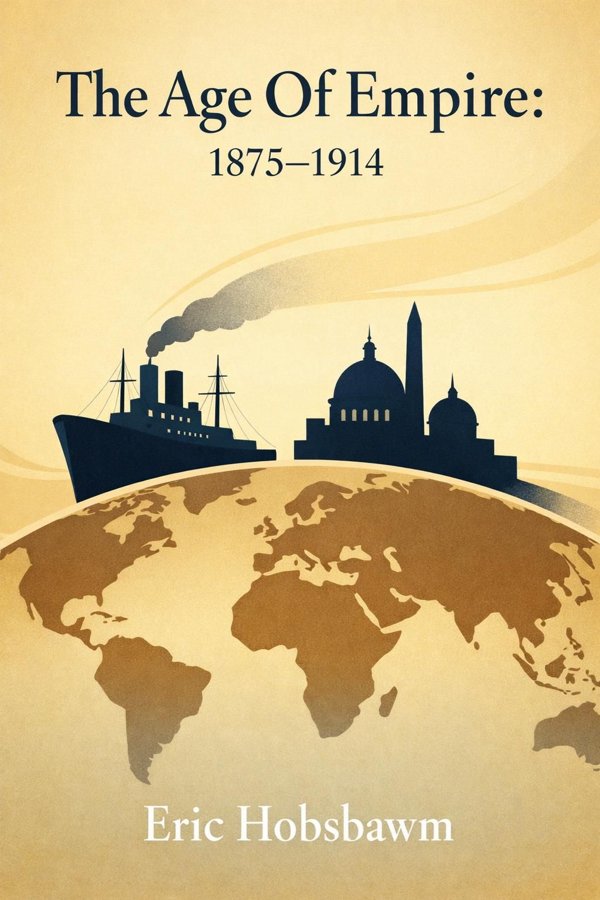
The Age Of Empire: 1875–1914: Summary & Key Insights
 10 min10 chaptersAudio available
Key Takeaways from The Age Of Empire: 1875–1914
One of Hobsbawm’s central insights is that by the late nineteenth century, capitalism had become truly global, and that transformation changed nearly everything.
Empires often present themselves as civilizing missions, but Hobsbawm insists that imperial expansion must be understood as a system of power.
Modern society did not simply become richer in this period; it became more structured by class, and more conscious of class.
The nation-state appears natural in retrospect, but Hobsbawm shows that it was actively constructed—and often contested.
Periods of great optimism often produce their own forms of unease.
What Is The Age Of Empire: 1875–1914 About?
The Age Of Empire: 1875–1914 by Eric Hobsbawm is a world_history book spanning 11 pages. Eric Hobsbawm’s The Age Of Empire: 1875–1914 is a sweeping account of the world in the decades before the First World War, when industrial capitalism reached new heights, European empires expanded across the globe, and modern mass society took shape. This was an era of astonishing confidence: economies grew, cities swelled, science advanced, and elites believed progress was unstoppable. Yet beneath that optimism lay deep tensions—class conflict, nationalist rivalry, colonial domination, and political instability—that would eventually erupt into catastrophe. What makes this book so powerful is Hobsbawm’s ability to connect economics, politics, culture, and everyday life into one coherent picture. He does not treat imperialism as a side story to European history; he shows that empire was central to how wealth, power, and identity were organized in the modern world. A renowned Marxist historian and one of the twentieth century’s great interpreters of global change, Hobsbawm writes with authority, breadth, and clarity. This book matters because it explains how the modern age was built—not only through progress and innovation, but also through inequality, conquest, and the contradictions of capitalism itself.
This FizzRead summary covers all 10 key chapters of The Age Of Empire: 1875–1914 in approximately 10 minutes, distilling the most important ideas, arguments, and takeaways from Eric Hobsbawm's work. Also available as an audio summary and Key Quotes Podcast.
The Age Of Empire: 1875–1914
Eric Hobsbawm’s The Age Of Empire: 1875–1914 is a sweeping account of the world in the decades before the First World War, when industrial capitalism reached new heights, European empires expanded across the globe, and modern mass society took shape. This was an era of astonishing confidence: economies grew, cities swelled, science advanced, and elites believed progress was unstoppable. Yet beneath that optimism lay deep tensions—class conflict, nationalist rivalry, colonial domination, and political instability—that would eventually erupt into catastrophe.
What makes this book so powerful is Hobsbawm’s ability to connect economics, politics, culture, and everyday life into one coherent picture. He does not treat imperialism as a side story to European history; he shows that empire was central to how wealth, power, and identity were organized in the modern world. A renowned Marxist historian and one of the twentieth century’s great interpreters of global change, Hobsbawm writes with authority, breadth, and clarity. This book matters because it explains how the modern age was built—not only through progress and innovation, but also through inequality, conquest, and the contradictions of capitalism itself.
Who Should Read The Age Of Empire: 1875–1914?
This book is perfect for anyone interested in world_history and looking to gain actionable insights in a short read. Whether you're a student, professional, or lifelong learner, the key ideas from The Age Of Empire: 1875–1914 by Eric Hobsbawm will help you think differently.
- ✓Readers who enjoy world_history and want practical takeaways
- ✓Professionals looking to apply new ideas to their work and life
- ✓Anyone who wants the core insights of The Age Of Empire: 1875–1914 in just 10 minutes
Want the full summary?
Get instant access to this book summary and 100K+ more with Fizz Moment.
Get Free SummaryAvailable on App Store • Free to download
Key Chapters
One of Hobsbawm’s central insights is that by the late nineteenth century, capitalism had become truly global, and that transformation changed nearly everything. Markets were no longer mainly local or even national. Railways, steamships, telegraphs, and expanding finance linked producers, investors, governments, and consumers across continents. Wheat from North America, rubber from Southeast Asia, cotton from Egypt and India, and industrial goods from Europe all circulated within an increasingly integrated world economy.
This economic transformation created enormous wealth, especially in industrial centers such as Britain, Germany, and later the United States. But it also made societies more interdependent and more vulnerable. A downturn in one region could affect employment, trade, and prices elsewhere. Economic life became more complex, more concentrated, and more dominated by large firms, banks, and financial institutions. Hobsbawm shows that this was not simply an age of free competition; it was also an age of monopolies, cartels, and corporate power.
The effects were visible in everyday life. Cities expanded as workers moved from countryside to factory. Consumer goods became more available. Governments paid increasing attention to economic management. At the same time, workers faced insecurity, colonial regions were reorganized to serve metropolitan needs, and local economies were often subordinated to global demand.
A useful way to apply Hobsbawm’s point today is to compare this era with modern globalization. When supply chains, finance, and technology connect the world, prosperity and instability travel together. The late nineteenth century reminds us that integration does not eliminate inequality; it often redistributes it.
Actionable takeaway: When analyzing any modern economy, look beyond national borders and ask how global trade, finance, and power shape local outcomes.
Empires often present themselves as civilizing missions, but Hobsbawm insists that imperial expansion must be understood as a system of power. From roughly 1875 onward, European states accelerated their conquest and partition of Africa, Asia, and the Pacific. This expansion was driven by strategic rivalry, economic interests, political prestige, and elite ideology. Empire was not an accidental side effect of progress. It was one of the defining structures of the age.
Hobsbawm explains that imperialism worked on several levels at once. Economically, colonies offered raw materials, captive markets, and opportunities for investment. Politically, empire enhanced the status of states competing for global influence. Socially, it could rally domestic support by redirecting attention away from internal divisions. Culturally, it encouraged racial hierarchies and fantasies of European superiority.
The “Scramble for Africa” is an obvious example. European powers divided vast territories with little regard for local societies, histories, or political systems. The consequences were long-lasting: artificial borders, extractive economies, and institutions designed to serve imperial rule rather than local development. In India, imperial administration reorganized economic life in ways that tied the colony more tightly to British interests. Across the world, empire generated both modern infrastructure and deep structural dependency.
For modern readers, Hobsbawm’s analysis is a reminder to question the moral language that often surrounds great-power expansion. Claims about order, development, or civilization frequently conceal struggles over resources and dominance.
Actionable takeaway: Whenever a state justifies overseas intervention in idealistic terms, also examine the material interests, strategic calculations, and domestic political motives behind it.
Modern society did not simply become richer in this period; it became more structured by class, and more conscious of class. Hobsbawm shows that industrial capitalism produced new social hierarchies while also making those hierarchies more visible. The bourgeoisie expanded through business, finance, and the professions. The working class grew in size and importance as factories, mines, transport networks, and urban industry absorbed millions. Between these poles stood a varied middle class of clerks, teachers, civil servants, shopkeepers, and technicians.
What mattered was not only economic position but collective identity. Workers organized in trade unions, cooperatives, and socialist parties. Middle-class groups defended respectability, education, and professional status. Elites sought to preserve authority through property, social ritual, and political influence. Hobsbawm emphasizes that the late nineteenth century saw the rise of mass politics precisely because large social groups began to act with greater coordination and self-awareness.
This social transformation reshaped political life. Demands for voting rights, labor protection, education, and social welfare became harder to ignore. Governments that had once represented narrow elites now had to manage broader populations. Even conservative states recognized that order required some concessions. Bismarck’s Germany, for example, introduced early welfare measures not out of pure generosity but partly to contain socialism.
The practical lesson is that social structures are never static. Economic change creates new groups, and those groups eventually seek recognition, power, and protection. Today, similar patterns can be seen in debates over precarious work, the shrinking middle class, and the political influence of professional and technological sectors.
Actionable takeaway: To understand political conflict, identify which social classes are rising, which feel threatened, and how institutions respond to those pressures.
The nation-state appears natural in retrospect, but Hobsbawm shows that it was actively constructed—and often contested. In the age of empire, governments invested heavily in turning populations into nations through schools, military service, public ceremonies, national languages, and shared symbols. Flags, anthems, monuments, and historical myths helped transform diverse populations into political communities.
Yet the same process that unified some people excluded others. National identity could be empowering, especially for groups seeking self-determination. But it could also become aggressive, intolerant, and expansionist. Hobsbawm is especially good at showing how nationalism worked both as a democratic language and as a tool of state power. The nation-state asked people to imagine solidarity with strangers, but it also encouraged them to define enemies beyond or within the national border.
The multinational empires of Austria-Hungary, Russia, and the Ottoman realm reveal these tensions clearly. They contained many linguistic, ethnic, and religious communities whose demands could not easily be reconciled within old imperial frameworks. Meanwhile, newer nation-states such as Germany and Italy sought prestige and influence through military and diplomatic assertion. Nationalism therefore became both a principle of legitimacy and a source of instability.
This insight remains highly relevant. Contemporary politics still relies on narratives about belonging, memory, and identity. Debates over immigration, secession, language policy, and historical monuments show that nations continue to be made, defended, and revised.
Actionable takeaway: When you hear appeals to national unity, ask how that unity is being constructed, who is included, and who may be marginalized by the story being told.
Periods of great optimism often produce their own forms of unease. Hobsbawm presents the culture of 1875–1914 as dazzling, inventive, and contradictory. On one side stood bourgeois confidence: grand museums, opera houses, world’s fairs, scientific exhibitions, public monuments, and faith in progress. This was the age that celebrated civilization, refinement, and technical mastery. On the other side were restless artistic movements that challenged convention, exposed alienation, and questioned inherited values.
Mass literacy, cheaper newspapers, and commercial entertainment expanded cultural life beyond old elites. Novels, illustrated journals, music halls, and popular theater reached wider audiences. At the same time, modernist trends in painting, music, and literature signaled dissatisfaction with established forms. The late nineteenth century was therefore not just an age of polished respectability; it was also a prelude to cultural rupture.
Hobsbawm treats culture as part of social history rather than a decorative extra. What people admired, feared, consumed, and imagined reveals how they understood their world. The celebration of empire in exhibitions, for instance, normalized colonial domination. Likewise, the fascination with degeneration, decadence, or urban nervousness revealed anxiety beneath the rhetoric of progress.
A practical application of this idea is to read culture as evidence. Popular media, architecture, fashion, and entertainment can tell us what a society values and what it tries to suppress. In our own age, social media trends, blockbuster narratives, and public spectacles similarly express both aspiration and insecurity.
Actionable takeaway: To understand any era, study not just its laws and wars but also its art, media, and public rituals—they often reveal the emotional truth of a society.
Modernization did not automatically produce equality, but it did unsettle older gender arrangements. Hobsbawm shows that the late nineteenth and early twentieth centuries brought major changes in family life, work, education, and public expectations for women. Industrialization and urbanization altered domestic structures. Expanding bureaucracies and service sectors created some new employment opportunities. Education widened for middle-class women, and feminist movements increasingly challenged legal and political exclusion.
Still, change was uneven and limited. Most societies remained deeply patriarchal. Respectable ideology often celebrated women primarily as wives, mothers, and guardians of morality. Working-class women frequently combined paid labor with unpaid domestic burdens. In many cases, the modern family became a site of both protection and control. The separation between public and private life, often associated with bourgeois norms, reinforced the idea that politics and power belonged mainly to men.
Hobsbawm’s value lies in placing gender within wider social transformation. Women’s changing roles were linked to class, urban life, demography, and the development of the state. Campaigns for suffrage and legal reform did not emerge in isolation; they grew from broader shifts in literacy, organization, and public participation.
This perspective is useful today because discussions of equality still require attention to economic structure. Formal rights matter, but so do working conditions, care burdens, and access to institutions. Progress in one sphere can coexist with persistent inequality in another.
Actionable takeaway: When assessing social progress, look beyond symbolic inclusion and ask whether economic, legal, and domestic structures have actually redistributed power.
A major strength of The Age Of Empire is that it refuses to tell the story of modernity from Europe alone. Hobsbawm demonstrates that the prosperity of imperial centers depended heavily on the labor, land, and resources of the global periphery. Colonized and semi-colonized regions were drawn into the world economy on unequal terms. They supplied raw materials, cheap labor, and investment opportunities while often losing control over their own development.
This pattern did not look identical everywhere. In some places, local elites collaborated with imperial power. In others, resistance was open and sustained. Some regions experienced infrastructure development, export growth, or administrative reform, but these changes usually served imperial priorities first. Railways could move troops and goods more efficiently; cash-crop production could enrich investors while increasing local vulnerability to famine or price shocks.
Hobsbawm helps readers see that underdevelopment was not simply the absence of progress. It was often produced through integration into a system designed elsewhere. This is one of the book’s most enduring insights. The global order was hierarchical, and that hierarchy shaped the possibilities available to different societies.
Modern parallels are easy to spot. Countries rich in minerals or agricultural exports may still struggle to convert those assets into broad-based prosperity if global finance, trade terms, and political dependence work against them. Hobsbawm encourages readers to think structurally rather than morally or nationally.
Actionable takeaway: When evaluating global inequality, ask not only which countries are poor, but also how international systems of trade, extraction, debt, and investment helped create that condition.
The late nineteenth century is often remembered as an age of liberal progress, but Hobsbawm argues that liberalism was already under strain well before 1914. Classical liberal ideals—limited government, free markets, parliamentary rule, and individual rights—faced mounting pressure from mass politics, organized labor, nationalism, imperial rivalry, and social inequality. Liberal states had to govern larger, more mobilized populations than earlier elites had imagined.
As a result, many governments modified liberal principles in practice. They expanded administration, regulated social life, and built welfare measures. They also relied more heavily on patriotism, military preparedness, and imperial prestige to sustain legitimacy. In some cases, anti-liberal forces gained momentum from the right as well as from the left. Authoritarian habits, exclusionary nationalism, and aggressive statecraft grew within societies that still claimed commitment to civilization and progress.
Hobsbawm’s insight is not that liberalism simply failed, but that it became unstable when confronted with the consequences of the very modernity it had helped unleash. Mass literacy created public opinion. Industrial capitalism created class conflict. National self-assertion destabilized old balances. The political center became harder to hold.
This argument speaks directly to the present. Modern democracies also face pressure when economic change, social fragmentation, and geopolitical competition undermine trust in institutions. Liberal systems survive not through rhetoric alone, but by adapting to real social demands.
Actionable takeaway: Do not judge a political system only by its ideals; examine whether its institutions can handle inequality, mass participation, and social conflict without abandoning their core principles.
Few eras believed in progress as intensely as the decades before the First World War. Hobsbawm shows how science and technology transformed both material life and public imagination. Electricity, chemicals, engineering, medicine, urban infrastructure, telegraphs, telephones, and transport networks changed how people worked, traveled, communicated, and understood possibility. Innovation seemed to promise mastery over nature, disease, distance, and time itself.
These changes had obvious practical effects. Cities became more connected and more governable. Factories increased output. States could communicate and mobilize faster. Medical advances improved public health in some settings. The world felt smaller, faster, and more manageable. Yet Hobsbawm also reminds us that technology is never neutral. The same industrial capacities that raised living standards also strengthened armies, bureaucracies, and imperial administration.
Scientific prestige fed wider cultural assumptions as well. Claims of rationality and objectivity were sometimes used to justify hierarchy, including racism, social Darwinism, and imperial domination. In other words, progress in technique did not guarantee progress in ethics.
This idea remains vital in the twenty-first century. We often speak about digital tools, artificial intelligence, or biotechnology as though innovation itself were a social good. Hobsbawm encourages a more critical view: every technology redistributes power, creates winners and losers, and can serve liberation or domination depending on institutions and values.
Actionable takeaway: Treat technological progress as a political question as well as a technical one, and always ask who controls it, who benefits, and what unintended consequences it may produce.
The most haunting lesson of The Age Of Empire is that an era of apparent stability can contain the seeds of disaster. Europe before 1914 was wealthy, interconnected, and culturally confident. Trade expanded, diplomacy functioned, and many elites assumed that major war among advanced states had become irrational or unlikely. Yet Hobsbawm shows that beneath this surface lay an increasingly dangerous international system.
Great powers competed for colonies, naval supremacy, alliances, and regional influence. Nationalist passions intensified public life. Military planning became more rigid. Arms races, especially between Britain and Germany, deepened mistrust. Crises in the Balkans exposed how local conflicts could trigger wider confrontation. The international order was not held together by shared peace, but by unstable balances and misjudged calculations.
Hobsbawm’s broader argument is that modern systems can become more fragile as they become more interconnected. Economic globalization did not prevent geopolitical rivalry. Cultural sophistication did not restrain militarism. Administrative efficiency even made mass warfare more feasible. The First World War was not an inexplicable accident descending on a civilized continent. It emerged from tensions that had been building within the age itself.
The application is clear for modern readers. Prosperity, trade, and diplomacy are important, but they do not eliminate competition, grievance, or escalation risk. A system can look orderly right up to the moment it breaks.
Actionable takeaway: Never assume that economic interdependence guarantees peace; examine alliance structures, nationalist rhetoric, arms buildups, and unresolved regional conflicts before concluding that a stable order is truly secure.
All Chapters in The Age Of Empire: 1875–1914
About the Author
Eric Hobsbawm (1917–2012) was a British historian widely regarded as one of the most important interpreters of the modern world. Born in Alexandria and educated in Berlin and London, he went on to teach for many years at Birkbeck, University of London. Hobsbawm was closely associated with Marxist history, but his reputation rested above all on the range, ambition, and clarity of his scholarship. He wrote extensively on capitalism, revolution, labor movements, nationalism, and social change. His best-known works include The Age of Revolution, The Age of Capital, The Age of Empire, and The Age of Extremes, a landmark series tracing modern history from the late eighteenth century to the twentieth. Hobsbawm remains influential for his ability to connect economic systems, political power, and everyday social life within a single historical vision.
Get This Summary in Your Preferred Format
Read or listen to the The Age Of Empire: 1875–1914 summary by Eric Hobsbawm anytime, anywhere. FizzRead offers multiple formats so you can learn on your terms — all free.
Available formats: App · Audio · PDF · EPUB — All included free with FizzRead
Download The Age Of Empire: 1875–1914 PDF and EPUB Summary
Key Quotes from The Age Of Empire: 1875–1914
“One of Hobsbawm’s central insights is that by the late nineteenth century, capitalism had become truly global, and that transformation changed nearly everything.”
“Empires often present themselves as civilizing missions, but Hobsbawm insists that imperial expansion must be understood as a system of power.”
“Modern society did not simply become richer in this period; it became more structured by class, and more conscious of class.”
“The nation-state appears natural in retrospect, but Hobsbawm shows that it was actively constructed—and often contested.”
“Periods of great optimism often produce their own forms of unease.”
Frequently Asked Questions about The Age Of Empire: 1875–1914
The Age Of Empire: 1875–1914 by Eric Hobsbawm is a world_history book that explores key ideas across 10 chapters. Eric Hobsbawm’s The Age Of Empire: 1875–1914 is a sweeping account of the world in the decades before the First World War, when industrial capitalism reached new heights, European empires expanded across the globe, and modern mass society took shape. This was an era of astonishing confidence: economies grew, cities swelled, science advanced, and elites believed progress was unstoppable. Yet beneath that optimism lay deep tensions—class conflict, nationalist rivalry, colonial domination, and political instability—that would eventually erupt into catastrophe. What makes this book so powerful is Hobsbawm’s ability to connect economics, politics, culture, and everyday life into one coherent picture. He does not treat imperialism as a side story to European history; he shows that empire was central to how wealth, power, and identity were organized in the modern world. A renowned Marxist historian and one of the twentieth century’s great interpreters of global change, Hobsbawm writes with authority, breadth, and clarity. This book matters because it explains how the modern age was built—not only through progress and innovation, but also through inequality, conquest, and the contradictions of capitalism itself.
More by Eric Hobsbawm
You Might Also Like
The Age of Capital
Eric Hobsbawm
10 min
The Gulag Archipelago
Aleksandr Solzhenitsyn
10 min
Jerusalem: The Biography
Simon Sebag Montefiore
10 min
The Anglo-Saxons
James Campbell
10 min
The Boer War
Thomas Pakenham
10 min
The Industrial Revolutionaries: The Making of the Modern World 1776–1914
Gavin Weightman
10 minBrowse by Category
Ready to read The Age Of Empire: 1875–1914?
Get the full summary and 100K+ more books with Fizz Moment.