
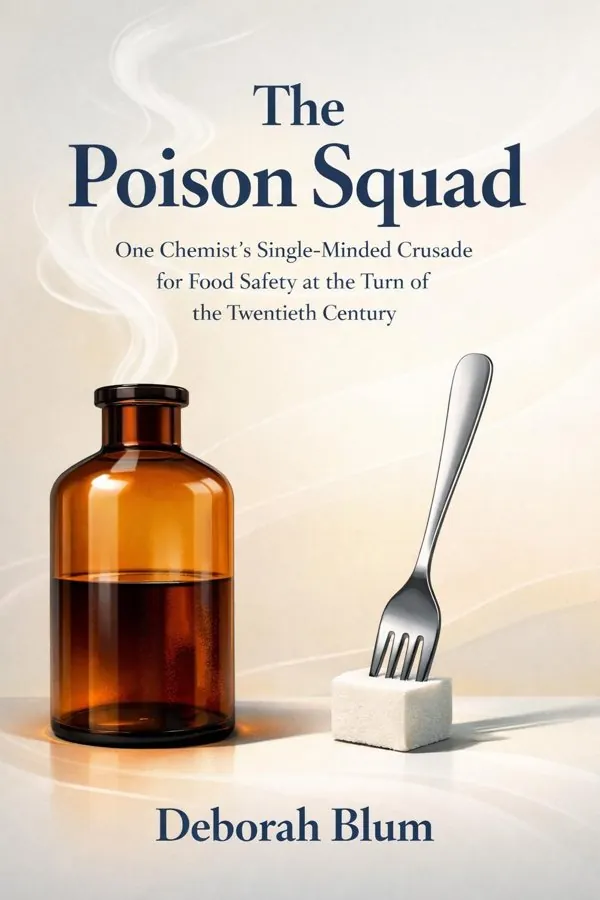
The Poison Squad: One Chemist's Single-Minded Crusade for Food Safety at the Turn of the Twentieth Century: Summary & Key Insights
by Deborah Blum
 10 min8 chaptersAudio available
Key Takeaways from The Poison Squad: One Chemist's Single-Minded Crusade for Food Safety at the Turn of the Twentieth Century
The most unsettling truth in The Poison Squad is that danger once sat openly on the dinner table, disguised as progress.
Real reform often begins when one stubborn person refuses to accept “that’s just how things are.
People rarely mobilize against invisible threats until someone finds a way to make those threats undeniable.
One of the book’s most enduring insights is that dangerous products do not persist because no one notices them; they persist because powerful interests work to protect them.
Facts do not travel far on their own; they need messengers.
What Is The Poison Squad: One Chemist's Single-Minded Crusade for Food Safety at the Turn of the Twentieth Century About?
The Poison Squad: One Chemist's Single-Minded Crusade for Food Safety at the Turn of the Twentieth Century by Deborah Blum is a world_history book. Deborah Blum’s The Poison Squad tells the gripping true story of how modern food safety began—not in a sterile laboratory or a government hearing room, but in a chaotic age when everyday products were routinely laced with dangerous chemicals. At the center of the book is Dr. Harvey Washington Wiley, a determined government chemist who challenged powerful food manufacturers and political interests at a time when Americans had little protection from contaminated, diluted, or deceptively labeled food. Through the now-famous “Poison Squad” experiments, Wiley recruited volunteers to eat meals dosed with preservatives and additives so he could gather evidence about what industry insisted was harmless. Blum, a Pulitzer Prize-winning science journalist, brings this forgotten history to life with narrative energy, scientific clarity, and a sharp eye for the human costs of weak regulation. The book matters because it shows that consumer protections we now take for granted were won through conflict, public education, and persistence. More than a historical account, it is a reminder that safety standards are not inevitable—they are built, defended, and constantly tested.
This FizzRead summary covers all 8 key chapters of The Poison Squad: One Chemist's Single-Minded Crusade for Food Safety at the Turn of the Twentieth Century in approximately 10 minutes, distilling the most important ideas, arguments, and takeaways from Deborah Blum's work. Also available as an audio summary and Key Quotes Podcast.
The Poison Squad: One Chemist's Single-Minded Crusade for Food Safety at the Turn of the Twentieth Century
Deborah Blum’s The Poison Squad tells the gripping true story of how modern food safety began—not in a sterile laboratory or a government hearing room, but in a chaotic age when everyday products were routinely laced with dangerous chemicals. At the center of the book is Dr. Harvey Washington Wiley, a determined government chemist who challenged powerful food manufacturers and political interests at a time when Americans had little protection from contaminated, diluted, or deceptively labeled food. Through the now-famous “Poison Squad” experiments, Wiley recruited volunteers to eat meals dosed with preservatives and additives so he could gather evidence about what industry insisted was harmless. Blum, a Pulitzer Prize-winning science journalist, brings this forgotten history to life with narrative energy, scientific clarity, and a sharp eye for the human costs of weak regulation. The book matters because it shows that consumer protections we now take for granted were won through conflict, public education, and persistence. More than a historical account, it is a reminder that safety standards are not inevitable—they are built, defended, and constantly tested.
Who Should Read The Poison Squad: One Chemist's Single-Minded Crusade for Food Safety at the Turn of the Twentieth Century?
This book is perfect for anyone interested in world_history and looking to gain actionable insights in a short read. Whether you're a student, professional, or lifelong learner, the key ideas from The Poison Squad: One Chemist's Single-Minded Crusade for Food Safety at the Turn of the Twentieth Century by Deborah Blum will help you think differently.
- ✓Readers who enjoy world_history and want practical takeaways
- ✓Professionals looking to apply new ideas to their work and life
- ✓Anyone who wants the core insights of The Poison Squad: One Chemist's Single-Minded Crusade for Food Safety at the Turn of the Twentieth Century in just 10 minutes
Want the full summary?
Get instant access to this book summary and 100K+ more with Fizz Moment.
Get Free SummaryAvailable on App Store • Free to download
Key Chapters
Real reform often begins when one stubborn person refuses to accept “that’s just how things are.” Harvey Washington Wiley, the book’s central figure, was not merely a chemist conducting technical analyses; he was a public-minded scientist who understood that evidence has little power unless it is translated into action. As chief chemist at the U.S. Department of Agriculture, Wiley became increasingly alarmed by the chemicals saturating the American food supply and by the indifference of industries profiting from them.
What made Wiley effective was his unusual combination of scientific rigor, political instinct, and moral conviction. He did not limit himself to writing obscure reports. He investigated products, challenged manufacturers, cultivated journalists, and pushed public debate forward. He recognized that science alone would not move a resistant system. Data had to be made visible, intelligible, and urgent. Blum portrays him as a flawed but formidable reformer: principled, strategic, and relentless in the face of bureaucratic resistance and organized commercial opposition.
Wiley’s significance extends beyond food safety. He represents a broader model of how technical experts can influence society. Expertise matters, but expertise with courage matters more. In many fields today—public health, climate science, digital privacy, pharmaceuticals, environmental safety—specialists often discover harms long before institutions are ready to respond. Wiley’s example suggests that waiting for universal consensus can become a form of surrender.
For modern readers, the application is clear: knowledge gains force when communicated in ways ordinary people can grasp. Whether you work in healthcare, education, business, or policy, the ability to connect facts to public consequences is essential. A spreadsheet rarely changes history on its own; a persuasive narrative built on evidence sometimes can.
Actionable takeaway: If you see a systemic problem in your field, do more than document it—learn to communicate the evidence clearly, build allies, and connect your expertise to the public good.
People rarely mobilize against invisible threats until someone finds a way to make those threats undeniable. Wiley’s most famous innovation was the set of controlled human experiments that became known as the Poison Squad. Young volunteers, many of them healthy government employees, agreed to eat meals prepared with measured amounts of common chemical preservatives such as borax, salicylic acid, and formaldehyde-related compounds. Their physical reactions were monitored to assess the effects on appetite, digestion, weight, and overall health.
By modern ethical standards, these experiments raise difficult questions, and Blum does not ignore them. But in historical context, they were a dramatic effort to gather concrete evidence in a world where manufacturers insisted additives were harmless and where regulatory science was still emerging. The phrase “Poison Squad” itself captured the public imagination. Newspapers covered the trials closely, turning technical toxicology into front-page news. Wiley understood something crucial: people respond when abstract concerns become personal, embodied, and narratively vivid.
The broader lesson is that reform movements often need demonstrative proof. Statistics matter, but examples that people can picture matter too. Today, this dynamic appears in investigative journalism, patient advocacy, whistleblower testimony, and public-interest research. Whether the issue is lead contamination, unsafe drugs, deceptive financial products, or flawed algorithms, the public usually becomes attentive when harm is concretely illustrated.
At work, in community organizing, or in policy debates, making risk visible can change everything. That may mean translating technical findings into plain language, gathering user stories, creating clear comparisons, or showing how a hidden issue affects everyday life. Effective evidence is not only accurate; it is accessible.
Actionable takeaway: When trying to persuade others about a hidden problem, do not rely only on abstract claims—present evidence in a concrete, human-centered way that makes the risk visible and memorable.
One of the book’s most enduring insights is that dangerous products do not persist because no one notices them; they persist because powerful interests work to protect them. Blum chronicles how food manufacturers, chemical companies, trade groups, and political allies resisted Wiley’s efforts at nearly every turn. They challenged his findings, attacked his credibility, lobbied officials, and framed regulation as anti-business interference. The struggle over food safety was never just scientific. It was economic, political, and cultural.
This pattern feels strikingly modern. Industries facing scrutiny often argue that existing products are safe enough, that regulation will destroy innovation, that critics are alarmists, or that consumers should decide for themselves. These arguments can sound reasonable until one remembers the imbalance of information and power. Consumers cannot make informed choices when ingredients are hidden, risks are understated, or alternatives are unavailable. Markets reward transparency only when transparency exists.
Blum’s history shows that resistance to oversight is often strongest precisely where oversight is most needed. If a company’s profits depend on cutting corners, delaying regulation becomes a business strategy. That does not mean every manufacturer is malicious, but it does mean self-policing has limits. Voluntary responsibility tends to erode when it conflicts with competitive pressure.
This insight applies well beyond food. From tobacco to fossil fuels to addictive app design, powerful organizations have repeatedly tried to shape science, messaging, and law to preserve freedom of action. Readers can use this historical lens to evaluate contemporary claims from any industry under scrutiny. Ask who benefits from uncertainty, who funds the evidence, and what costs are being externalized onto the public.
Actionable takeaway: When evaluating corporate assurances about safety or fairness, look beyond marketing—seek independent evidence, follow the money, and assume that accountability requires more than voluntary promises.
Facts do not travel far on their own; they need messengers. A major force in Wiley’s campaign was the rise of investigative journalism and public-interest reporting. Blum highlights how newspapers and reform-minded writers amplified concerns about adulterated food, misleading labels, and chemical preservatives, helping transform a technical dispute into a national issue. Sensational headlines alone were not enough, but attention created pressure, and pressure made political inaction harder to sustain.
This alliance between science and journalism was essential because the public needed interpreters. Most citizens were not chemists. They did not understand dosage studies, analytical methods, or the difference between spoilage prevention and toxic exposure. Journalists translated the implications: what was in the milk, what was in the canned peas, what might be happening inside the body. That translation gave consumers language for their anxiety and reformers leverage in Washington.
The lesson remains deeply relevant. In every era, democratic accountability depends on intermediaries who can investigate, verify, and explain complex issues. Without credible reporting, technical truths remain trapped within institutions, while misinformation spreads more easily. Today, the challenge is even more difficult because attention is fragmented and trust is contested. Yet the need is the same. Public understanding of health, environment, technology, and finance still depends on people who can connect evidence to real-world consequences.
For readers, this means media literacy is part of citizenship. It matters where information comes from, how evidence is sourced, and whether claims are independently checked. It also means experts should not dismiss the role of storytelling. Accurate, vivid communication can mobilize reforms that technical documents alone cannot.
Actionable takeaway: Build your understanding of important issues through reputable reporting, and when sharing information yourself, aim to make complex evidence clear, engaging, and verifiable.
Modern commerce depends on an invisible foundation: trust. The Poison Squad makes clear that food regulation is not an enemy of markets but one of the conditions that allow markets to function. When consumers cannot know whether a bottle contains medicine or filler, whether jam contains fruit or dye, or whether a preservative is harmless or hazardous, buying and selling become acts of blind faith. Standards, inspections, and labeling rules reduce that uncertainty and make exchange more honest.
Before federal food protections took shape, consumers were left to navigate a marketplace full of hidden substitutions and exaggerated claims. Honest producers were often disadvantaged because competitors could lower costs through adulteration. In that environment, the “free market” rewarded deception. Wiley and his allies argued that law was necessary not to eliminate commerce, but to create fairer conditions for both buyers and ethical sellers.
This principle remains widely applicable. Good regulation can increase confidence, level the playing field, and reward quality rather than manipulation. We see this in building codes, securities disclosures, drug approvals, aviation standards, and financial audits. Although poorly designed regulation can become cumbersome, the absence of standards can be far more costly, especially when harms are delayed or hard to detect.
The practical implication is that debates about regulation should not begin with the assumption that rules are obstacles. The better question is what kind of rules produce transparency, accountability, and informed consent. Consumers, professionals, and business leaders alike benefit when core protections are clear and enforceable.
Actionable takeaway: Evaluate regulation not by whether it exists, but by whether it increases transparency, prevents hidden harm, and creates fair competition for responsible actors.
Progress often looks inevitable in hindsight, but Blum reminds us that landmark protections usually emerge from long, uneven struggle. The 1906 Pure Food and Drug Act did not appear simply because scientific evidence had accumulated. It required decades of agitation, coalition-building, public outrage, political bargaining, and strategic persistence. Wiley’s work mattered, but so did women’s groups, reform organizations, journalists, sympathetic legislators, and broader Progressive Era activism.
This is one of the book’s most important historical correctives. We often tell change as a heroic single-person narrative, yet durable reform typically depends on networks. Wiley supplied energy and expertise, but he succeeded because others turned concern into collective force. Even then, the resulting law was imperfect and enforcement remained contested. Victory did not end the fight; it changed the terrain of the fight.
That lesson is useful for anyone frustrated by slow-moving institutions. Meaningful reform rarely follows a straight line. Opponents delay, compromise waters things down, and implementation reveals new gaps. But imperfect advances still matter. The Pure Food and Drug Act established federal authority and a public expectation that the government had a role in protecting consumers from fraud and unsafe products. That shift in principle had lasting consequences.
In contemporary life, the same dynamic appears in labor protections, environmental laws, consumer privacy rules, and public health policies. Large systems seldom change because one report proves the case beyond dispute. They change when evidence, advocacy, and public pressure converge over time.
Actionable takeaway: If you care about a public issue, expect reform to be slow and collective—join coalitions, support incremental progress, and recognize that persistence is often more powerful than dramatic moments.
Perhaps the book’s most modern warning is this: rights that seem settled can erode if people stop paying attention. The world Wiley fought to change is not identical to ours, but the underlying tensions remain. Businesses still seek competitive advantage. Governments still balance public welfare against political pressure. Science still evolves faster than regulation. And consumers still face systems too complex to evaluate on their own.
Blum’s account is therefore not just a story of triumph. It is a reminder that food safety, truthful labeling, and public-health protections are living achievements that must be maintained. New technologies, novel additives, global supply chains, and changing business models continually create fresh questions. Even where regulations exist, enforcement can weaken, budgets can shrink, and loopholes can expand. The central conflict—between profit incentives and precaution—never disappears.
For everyday readers, this means historical memory has practical value. Knowing how protections were won helps people recognize what is at stake when agencies are undermined, evidence is politicized, or transparency is framed as unnecessary. It also encourages humility: many harmful practices once defended as normal or harmless were later recognized as unacceptable. That should make us cautious about easy assurances in the present.
The book invites a broader civic ethic. Safe food is not merely a technical achievement produced by experts somewhere else. It is the result of institutions, watchdogs, researchers, reporters, and informed citizens doing sustained work. The same is true of many public goods we barely notice until they fail.
Actionable takeaway: Do not treat consumer protections as permanent—stay informed about how products are regulated, support institutions that monitor safety, and speak up when transparency or oversight is weakened.
All Chapters in The Poison Squad: One Chemist's Single-Minded Crusade for Food Safety at the Turn of the Twentieth Century
About the Author
Deborah Blum is a Pulitzer Prize-winning science journalist and bestselling author known for writing vivid, accessible books about science, medicine, and public health. She has reported extensively on the ways scientific discoveries shape everyday life, often focusing on toxicology, risk, and the human stories behind technical debates. Blum has worked as a newspaper reporter, columnist, and professor, and she has served as director of the Knight Science Journalism Program at MIT. Her books are praised for combining rigorous research with narrative storytelling that makes complex subjects readable and compelling. In The Poison Squad, she brings those strengths to the history of food safety, illuminating how one chemist’s crusade helped transform consumer protection in the modern age.
Get This Summary in Your Preferred Format
Read or listen to the The Poison Squad: One Chemist's Single-Minded Crusade for Food Safety at the Turn of the Twentieth Century summary by Deborah Blum anytime, anywhere. FizzRead offers multiple formats so you can learn on your terms — all free.
Available formats: App · Audio · PDF · EPUB — All included free with FizzRead
Download The Poison Squad: One Chemist's Single-Minded Crusade for Food Safety at the Turn of the Twentieth Century PDF and EPUB Summary
Key Quotes from The Poison Squad: One Chemist's Single-Minded Crusade for Food Safety at the Turn of the Twentieth Century
“The most unsettling truth in The Poison Squad is that danger once sat openly on the dinner table, disguised as progress.”
“Real reform often begins when one stubborn person refuses to accept “that’s just how things are.”
“People rarely mobilize against invisible threats until someone finds a way to make those threats undeniable.”
“One of the book’s most enduring insights is that dangerous products do not persist because no one notices them; they persist because powerful interests work to protect them.”
“Facts do not travel far on their own; they need messengers.”
Frequently Asked Questions about The Poison Squad: One Chemist's Single-Minded Crusade for Food Safety at the Turn of the Twentieth Century
The Poison Squad: One Chemist's Single-Minded Crusade for Food Safety at the Turn of the Twentieth Century by Deborah Blum is a world_history book that explores key ideas across 8 chapters. Deborah Blum’s The Poison Squad tells the gripping true story of how modern food safety began—not in a sterile laboratory or a government hearing room, but in a chaotic age when everyday products were routinely laced with dangerous chemicals. At the center of the book is Dr. Harvey Washington Wiley, a determined government chemist who challenged powerful food manufacturers and political interests at a time when Americans had little protection from contaminated, diluted, or deceptively labeled food. Through the now-famous “Poison Squad” experiments, Wiley recruited volunteers to eat meals dosed with preservatives and additives so he could gather evidence about what industry insisted was harmless. Blum, a Pulitzer Prize-winning science journalist, brings this forgotten history to life with narrative energy, scientific clarity, and a sharp eye for the human costs of weak regulation. The book matters because it shows that consumer protections we now take for granted were won through conflict, public education, and persistence. More than a historical account, it is a reminder that safety standards are not inevitable—they are built, defended, and constantly tested.
More by Deborah Blum
You Might Also Like
The Age of Capital
Eric Hobsbawm
10 min
The Gulag Archipelago
Aleksandr Solzhenitsyn
10 min
Jerusalem: The Biography
Simon Sebag Montefiore
10 min
The Anglo-Saxons
James Campbell
10 min
The Boer War
Thomas Pakenham
10 min
The Industrial Revolutionaries: The Making of the Modern World 1776–1914
Gavin Weightman
10 minBrowse by Category
Ready to read The Poison Squad: One Chemist's Single-Minded Crusade for Food Safety at the Turn of the Twentieth Century?
Get the full summary and 100K+ more books with Fizz Moment.