
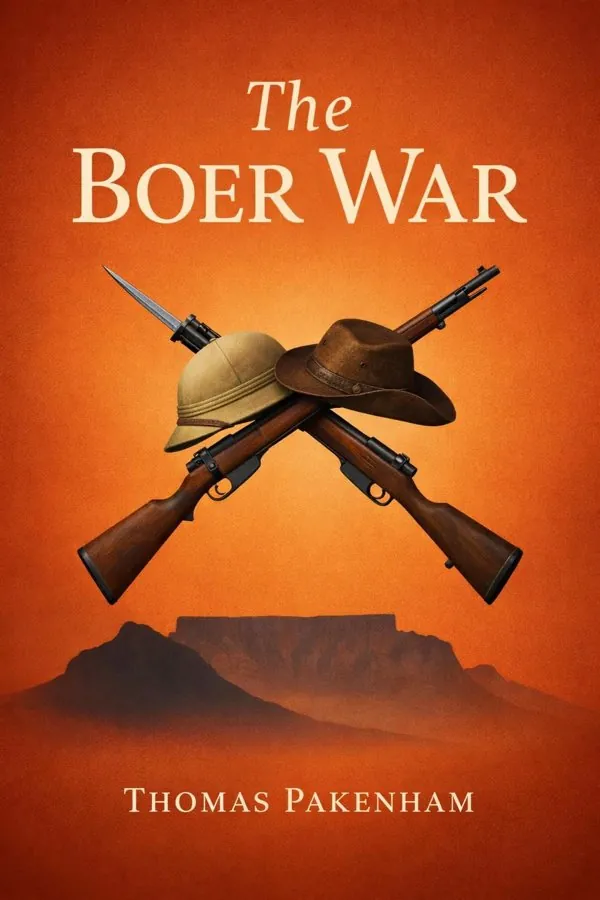
The Boer War: Summary & Key Insights
 10 min9 chaptersAudio available
Key Takeaways from The Boer War
The British political and military establishment expected a short campaign against what many regarded as a minor agrarian enemy.
Behind the patriotic speeches and diplomatic maneuvering lay a harder truth: economic interests helped propel the war.
A powerful insight running through The Boer War is that people rarely submit quietly when they feel cornered, insulted, or existentially threatened.
Wars are not won by numbers alone; they are shaped by the quality of leadership when plans collapse.
One of the most important transitions in The Boer War comes when conventional battle gives way to guerrilla struggle.
What Is The Boer War About?
The Boer War by Thomas Pakenham is a world_history book. Thomas Pakenham’s The Boer War is a sweeping, deeply researched history of the South African conflict fought between the British Empire and the two Boer republics, the Transvaal and the Orange Free State, from 1899 to 1902. Far more than a military narrative, the book reveals how ambition, gold, racial politics, imperial anxiety, and political miscalculation combined to produce one of the most consequential wars at the turn of the twentieth century. Pakenham shows how a supposedly easy colonial campaign became a prolonged and brutal struggle that exposed weaknesses in British leadership, transformed modern warfare, and left enduring scars on South Africa. What makes the book especially compelling is its human texture: generals, politicians, farmers, miners, civilians, and prisoners all emerge as participants in a conflict shaped as much by pride and fear as by strategy. Pakenham writes with the authority of a serious historian and the narrative power of a novelist, drawing on extensive archival research, letters, diaries, and official records. The result is an essential account of how empires overreach, how resistance hardens, and how war reshapes nations long after the shooting stops.
This FizzRead summary covers all 9 key chapters of The Boer War in approximately 10 minutes, distilling the most important ideas, arguments, and takeaways from Thomas Pakenham's work. Also available as an audio summary and Key Quotes Podcast.
The Boer War
Thomas Pakenham’s The Boer War is a sweeping, deeply researched history of the South African conflict fought between the British Empire and the two Boer republics, the Transvaal and the Orange Free State, from 1899 to 1902. Far more than a military narrative, the book reveals how ambition, gold, racial politics, imperial anxiety, and political miscalculation combined to produce one of the most consequential wars at the turn of the twentieth century. Pakenham shows how a supposedly easy colonial campaign became a prolonged and brutal struggle that exposed weaknesses in British leadership, transformed modern warfare, and left enduring scars on South Africa. What makes the book especially compelling is its human texture: generals, politicians, farmers, miners, civilians, and prisoners all emerge as participants in a conflict shaped as much by pride and fear as by strategy. Pakenham writes with the authority of a serious historian and the narrative power of a novelist, drawing on extensive archival research, letters, diaries, and official records. The result is an essential account of how empires overreach, how resistance hardens, and how war reshapes nations long after the shooting stops.
Who Should Read The Boer War?
This book is perfect for anyone interested in world_history and looking to gain actionable insights in a short read. Whether you're a student, professional, or lifelong learner, the key ideas from The Boer War by Thomas Pakenham will help you think differently.
- ✓Readers who enjoy world_history and want practical takeaways
- ✓Professionals looking to apply new ideas to their work and life
- ✓Anyone who wants the core insights of The Boer War in just 10 minutes
Want the full summary?
Get instant access to this book summary and 100K+ more with Fizz Moment.
Get Free SummaryAvailable on App Store • Free to download
Key Chapters
One of the most striking lessons of The Boer War is that leaders often enter war imagining control, speed, and certainty, only to discover confusion, resistance, and unintended consequences. The British political and military establishment expected a short campaign against what many regarded as a minor agrarian enemy. Instead, they encountered determined resistance, serious logistical problems, humiliating defeats, and a drawn-out war that damaged Britain’s prestige around the world.
Pakenham shows that this failure began with misjudgment. British officials underestimated the military abilities of the Boers, overestimated the power of imperial momentum, and treated political threats as if they could be resolved through pressure alone. The Boers, by contrast, fought with local knowledge, mobility, marksmanship, and strong motivation. Their decentralized structure, often seen as a weakness, became a source of resilience in the early stages of the conflict.
This idea has applications far beyond military history. In politics, business, and diplomacy, powerful institutions often assume that weaker opponents will quickly yield. Yet commitment, terrain, local support, and asymmetric tactics can reverse expectations. A large company entering a niche market, for example, may be defeated by smaller competitors who understand customer needs better. A government may assume public resistance will fade, only to find it intensifies when pressure grows.
Pakenham’s account reminds readers that overconfidence is not a side issue in conflict; it is often the engine of disaster. The war escalated because decision-makers confused superiority on paper with superiority in reality.
Actionable takeaway: whenever a challenge looks easy because the other side seems smaller or weaker, pause and test your assumptions against local realities, hidden strengths, and worst-case outcomes.
Behind the patriotic speeches and diplomatic maneuvering lay a harder truth: economic interests helped propel the war. Pakenham makes clear that the discovery of gold in the Transvaal transformed South Africa from a distant imperial concern into a strategic obsession. Control of resources, access to wealth, and influence over the political future of the region intensified British involvement and sharpened conflict with the Boer republics.
The goldfields drew foreign capital, migrants, and imperial attention. They also destabilized existing political arrangements. The Uitlanders, foreign settlers working in the Transvaal, became both a real social force and a political instrument. British politicians and imperial advocates framed their grievances as a matter of rights and justice, but economic stakes made the issue far more combustible. Figures such as Cecil Rhodes embodied the fusion of commercial ambition and imperial ideology.
Pakenham does not reduce the war to greed alone, but he insists that material incentives mattered. This is a valuable historical correction because wars are often remembered in moral or national terms while their economic foundations are softened or ignored. Modern readers can apply this lens to current events by asking not only what leaders say they are defending, but also what resources, markets, or strategic assets are at stake.
In organizational life, the same pattern appears when noble language masks financial motivations. A restructuring may be presented as visionary change when it is really a resource grab. A partnership may be sold as cooperation when market control is the central aim.
Actionable takeaway: when analyzing any major conflict or power struggle, look beneath public rhetoric and identify the economic interests shaping decisions, alliances, and escalation.
A powerful insight running through The Boer War is that people rarely submit quietly when they feel cornered, insulted, or existentially threatened. British pressure on the Boer republics did not simply intimidate them; it helped consolidate Boer identity and stiffen their willingness to fight. Pakenham shows that nationalist feeling, fear of political subordination, and resentment of imperial interference made compromise progressively harder.
The Boers were not a unified modern nation in the conventional sense, yet the crisis forged solidarity. External pressure created internal cohesion. Once war began, early Boer victories reinforced a sense of purpose, while British determination to impose political outcomes deepened Boer conviction that surrender meant the end of their way of life. Even later, when British strength became overwhelming, humiliation and loss did not dissolve resistance; they often intensified it in guerrilla form.
This pattern appears in many settings. A manager who publicly shames a team may get short-term compliance but create long-term resistance. A government that imposes reform without legitimacy may provoke backlash. In personal life, criticism delivered as domination often produces defensiveness rather than change.
Pakenham’s narrative also warns against reading resistance only through ideology. Much of it grows from dignity. People fight not merely because they calculate victory, but because yielding under pressure becomes psychologically intolerable. This helps explain why stronger powers so often fail to secure stable settlements after military success.
Actionable takeaway: if you want cooperation, reduce humiliation. In negotiation, conflict resolution, or leadership, protect the other side’s sense of dignity or expect resistance to grow stronger, not weaker.
Wars are not won by numbers alone; they are shaped by the quality of leadership when plans collapse. Pakenham offers a gallery of commanders and politicians whose personalities, habits, rivalries, and blind spots influenced the course of the war. British leadership in the early phase was marred by complacency, poor coordination, and outdated assumptions. The result was not merely tactical failure but a deeper exposure of institutional rigidity.
The sieges of Ladysmith, Mafeking, and Kimberley, along with defeats during Black Week, demonstrated how dangerous weak command can be when facing an adaptive enemy. Some British generals clung to conventional methods unsuited to South African conditions. Others struggled with communication and logistics. The Boers, meanwhile, benefited early from leaders more attuned to mobility and terrain, though they too suffered from divided authority and strategic inconsistency over time.
Pakenham’s larger point is that leadership is not a title but a capacity to learn under stress. Effective leaders revise assumptions, understand context, and adapt quickly. Ineffective leaders double down on familiar methods because change feels like weakness. This is highly practical beyond military history. In a business crisis, a leader who insists on old metrics during a market shift can deepen losses. In public health or education, administrators who cannot adapt policy to local realities often turn manageable problems into systemic failures.
The book also highlights the cost of ego. Prestige, career anxieties, and political appearances distorted military decision-making. When leaders protect image over truth, institutions suffer.
Actionable takeaway: judge leaders not by confidence or rank, but by how quickly they learn, adapt, and align strategy with reality when circumstances change.
One of the most important transitions in The Boer War comes when conventional battle gives way to guerrilla struggle. After major towns were occupied and the Boer republics seemingly subdued, the war did not end. Instead, Boer commandos shifted to raids, mobility, sabotage, and dispersal, forcing Britain into a long, expensive counterinsurgency. Pakenham shows that military victory in set-piece engagements can mean little if political control remains fragile.
Guerrilla warfare worked because it turned imperial advantages into burdens. Large armies needed supply lines, railways, depots, and static defenses. Small mounted units could exploit speed, local support, and surprise. The British responded with blockhouses, scorched-earth tactics, mass sweeps, and civilian internment, but these measures revealed how difficult it is to defeat an opponent embedded in the landscape and sustained by social networks.
This insight remains highly relevant. In modern conflict, insurgency often thrives when a stronger power misunderstands what must actually be controlled. Territory can be occupied without securing legitimacy. Metrics can mislead: numbers of towns held or fighters captured may not reflect strategic success if resistance remains adaptive.
Outside war, the lesson applies to any contest between centralized systems and agile networks. A startup can outmaneuver a giant firm through speed and flexibility. A decentralized social movement can endure despite official crackdowns because it does not rely on a single vulnerable center.
Pakenham’s account teaches that when the character of a struggle changes, strategy must change with it. Clinging to conventional measures in an unconventional contest invites exhaustion.
Actionable takeaway: when facing an agile opponent, stop measuring success by old standards and redesign your strategy around mobility, networks, and the real sources of resilience.
Perhaps the most morally haunting theme in The Boer War is that civilians are not accidental bystanders in modern conflict; they often become central targets of strategy. As the war shifted into its guerrilla phase, British authorities adopted scorched-earth methods, destroying farms, livestock, and crops to deprive Boer fighters of support. They also interned civilians, especially women and children, in concentration camps where disease, hunger, and administrative neglect caused appalling mortality.
Pakenham does not treat these camps as a footnote. He places them at the center of the war’s human meaning. The suffering was not merely a tragic side effect but a result of strategic choices. Once military planners decided that civilian support sustained resistance, they redefined entire communities as part of the battlefield. This had devastating consequences and permanently stained Britain’s claim to moral superiority.
The broader application is sobering. Any institution under pressure is tempted to treat collateral damage as regrettable but necessary. Governments may justify harsh policies as temporary. Companies may rationalize layoffs or unsafe practices as strategic imperatives. Yet when human costs are hidden behind abstract goals, moral boundaries erode quickly.
The book also reminds readers why testimony and public scrutiny matter. Reformers such as Emily Hobhouse helped expose camp conditions, showing that truth-telling can restrain abuse when official systems fail.
Actionable takeaway: whenever leaders describe civilian, employee, or community suffering as secondary to strategy, examine the human consequences directly and ask who is paying the hidden price of victory.
Wars are fought on battlefields, but they are also fought in newspapers, parliaments, and public conscience. Pakenham demonstrates that the Boer War unfolded during a period of expanding mass media and politicized public debate. Reports from the front, patriotic campaigns, criticism from opposition figures, and humanitarian exposés all influenced how the war was understood and justified.
The siege of Mafeking became a propaganda triumph, helping sustain imperial enthusiasm. At the same time, military blunders and revelations about concentration camps generated sharp criticism at home and abroad. Britain found itself not only trying to defeat the Boers but also trying to preserve legitimacy. This is one of the book’s great strengths: it shows that military operations cannot be separated from public narratives.
For modern readers, the relevance is obvious. Organizations today operate in environments where perception can alter outcomes. A policy may be technically effective but politically disastrous if communicated poorly. A company may weather an operational setback, but not a credibility collapse. Public trust determines how much room leaders have to act.
Pakenham also illustrates the limits of propaganda. Symbolic victories can lift morale, but they cannot permanently conceal structural failures. Spin may delay accountability, not eliminate it. Over time, facts have a way of breaking through, especially when suffering becomes visible.
The practical lesson is to take narrative seriously without mistaking narrative for reality. Leaders must manage communication, but they must also solve underlying problems. Otherwise, public opinion becomes volatile and unforgiving.
Actionable takeaway: in any high-stakes situation, align messaging with truth; communication can buy time, but only credibility and results can sustain support.
Although often told as a struggle between Briton and Boer, Pakenham’s history makes clear that the war unfolded within a wider racial order that structured South African society. African communities were not irrelevant spectators. They were drawn into the conflict as laborers, scouts, guides, victims of displacement, and political subjects of competing white powers. Yet both British and Boer visions of the future largely marginalized Black South Africans.
This matters because it challenges simplified narratives. The war was not just a clash of national liberties; it was also part of the making of a segregated political system in which white reconciliation would later come at the expense of African rights. British critics sometimes framed the war as a fight for progress against Boer backwardness, but imperial rule itself remained deeply racialized. Boer republicanism, meanwhile, rested on exclusionary assumptions about political power and land.
Pakenham helps readers see how historical memory can erase those who suffer most from conflict. This is relevant in contemporary analysis whenever a dominant narrative focuses on elite combatants while obscuring marginalized populations. In workplace disputes, public controversies, or policy debates, the loudest actors are not always the most affected.
The deeper lesson is that conflict settlements often look stable because they satisfy the strongest parties, not because they are just. When excluded groups are ignored, unresolved inequalities persist and shape the future.
Actionable takeaway: when studying any conflict, ask whose voices are centered, whose are omitted, and how the final settlement distributes power beyond the main protagonists.
The end of a war is never simply an ending; it is a blueprint for what comes next. Pakenham’s treatment of the peace settlement shows that the conclusion of the Boer War was shaped by exhaustion, pragmatism, and political calculation rather than clear moral resolution. The Treaty of Vereeniging ended formal resistance, but it also laid foundations for later tensions in South Africa by prioritizing reconciliation among white combatants while postponing fundamental questions of racial justice.
Britain ultimately absorbed the Boer republics, yet it also moved toward accommodating Boer leaders within a new political framework. This was sensible in narrow strategic terms: reconciliation reduced the likelihood of endless insurgency and helped stabilize the region. But the costs were long-term. By failing to address broader inclusion, the settlement contributed to a future in which power remained concentrated and racial hierarchy endured.
Pakenham’s account offers a wider principle: peacemaking is not only about stopping violence but about deciding whose grievances count. Settlements that ignore major structural issues may achieve immediate calm while storing up future conflict. This is true in postwar politics, corporate mergers, family disputes, and institutional reform. If peace only rewards those with leverage, the silenced may remain trapped under the terms of someone else’s compromise.
The book invites readers to evaluate endings not by relief alone but by the fairness and foresight of what is agreed. Durable peace requires more than capitulation and reconstruction; it requires legitimacy.
Actionable takeaway: when resolving a major conflict, do not ask only whether fighting has stopped; ask whether the settlement addresses the deeper injustices that made future instability likely.
All Chapters in The Boer War
About the Author
Thomas Pakenham is an Irish historian, author, and public intellectual known for his richly researched narrative histories, especially on Africa and the British Empire. Born in 1933, he studied at Oxford and built a distinguished reputation by combining archival depth with an engaging, story-driven style. His best-known works include The Boer War and The Scramble for Africa, both admired for their ability to make large historical events vivid, complex, and accessible. Beyond history, Pakenham has also written extensively about trees and conservation, reflecting his wide-ranging intellectual interests. As a historian, he is valued for his attention to personalities, political context, and moral ambiguity. His work on the Boer War remains a landmark account, widely regarded as one of the most compelling single-volume histories of the conflict.
Get This Summary in Your Preferred Format
Read or listen to the The Boer War summary by Thomas Pakenham anytime, anywhere. FizzRead offers multiple formats so you can learn on your terms — all free.
Available formats: App · Audio · PDF · EPUB — All included free with FizzRead
Download The Boer War PDF and EPUB Summary
Key Quotes from The Boer War
“One of the most striking lessons of The Boer War is that leaders often enter war imagining control, speed, and certainty, only to discover confusion, resistance, and unintended consequences.”
“Behind the patriotic speeches and diplomatic maneuvering lay a harder truth: economic interests helped propel the war.”
“A powerful insight running through The Boer War is that people rarely submit quietly when they feel cornered, insulted, or existentially threatened.”
“Wars are not won by numbers alone; they are shaped by the quality of leadership when plans collapse.”
“One of the most important transitions in The Boer War comes when conventional battle gives way to guerrilla struggle.”
Frequently Asked Questions about The Boer War
The Boer War by Thomas Pakenham is a world_history book that explores key ideas across 9 chapters. Thomas Pakenham’s The Boer War is a sweeping, deeply researched history of the South African conflict fought between the British Empire and the two Boer republics, the Transvaal and the Orange Free State, from 1899 to 1902. Far more than a military narrative, the book reveals how ambition, gold, racial politics, imperial anxiety, and political miscalculation combined to produce one of the most consequential wars at the turn of the twentieth century. Pakenham shows how a supposedly easy colonial campaign became a prolonged and brutal struggle that exposed weaknesses in British leadership, transformed modern warfare, and left enduring scars on South Africa. What makes the book especially compelling is its human texture: generals, politicians, farmers, miners, civilians, and prisoners all emerge as participants in a conflict shaped as much by pride and fear as by strategy. Pakenham writes with the authority of a serious historian and the narrative power of a novelist, drawing on extensive archival research, letters, diaries, and official records. The result is an essential account of how empires overreach, how resistance hardens, and how war reshapes nations long after the shooting stops.
More by Thomas Pakenham
You Might Also Like
The Age of Capital
Eric Hobsbawm
10 min
The Gulag Archipelago
Aleksandr Solzhenitsyn
10 min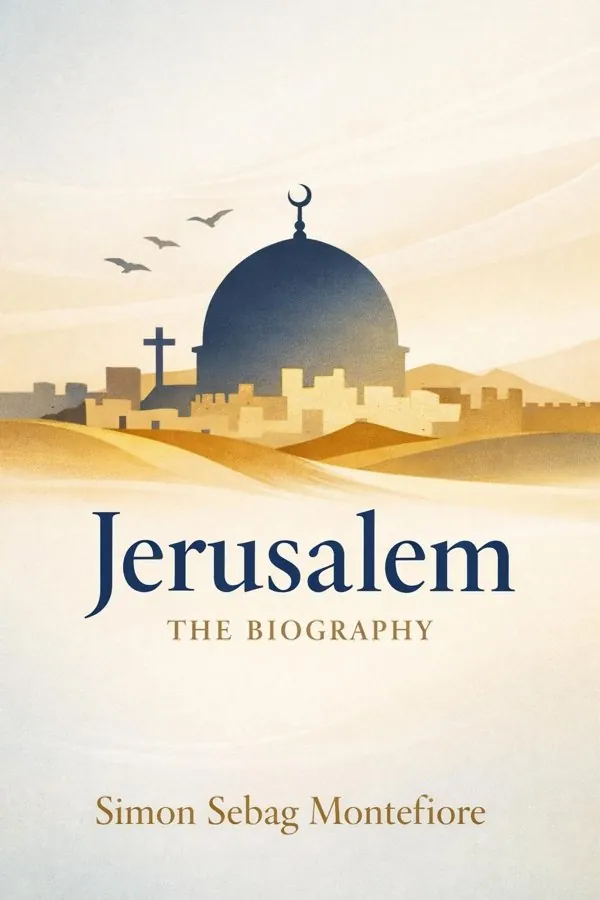
Jerusalem: The Biography
Simon Sebag Montefiore
10 min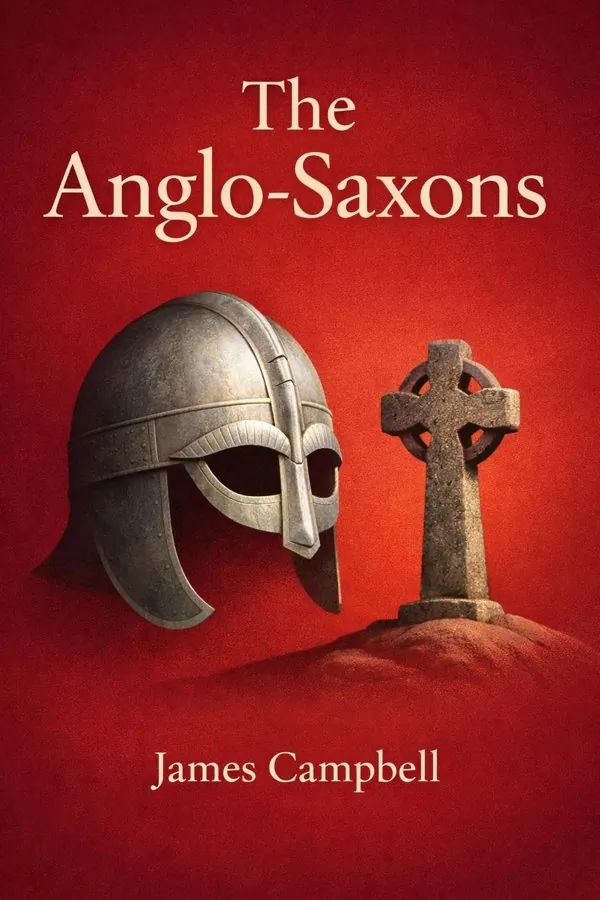
The Anglo-Saxons
James Campbell
10 min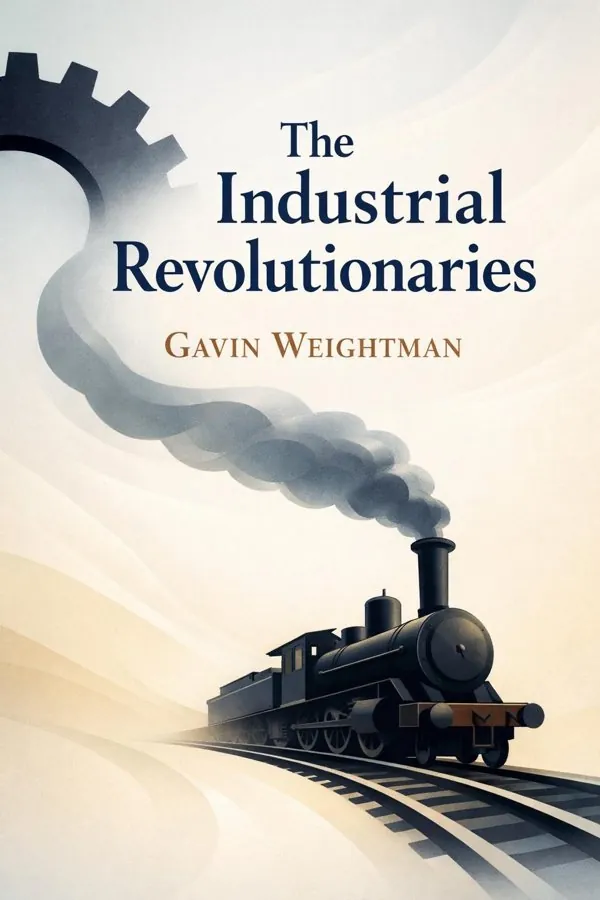
The Industrial Revolutionaries: The Making of the Modern World 1776–1914
Gavin Weightman
10 min
The Poison Squad: One Chemist's Single-Minded Crusade for Food Safety at the Turn of the Twentieth Century
Deborah Blum
10 minBrowse by Category
Ready to read The Boer War?
Get the full summary and 100K+ more books with Fizz Moment.