
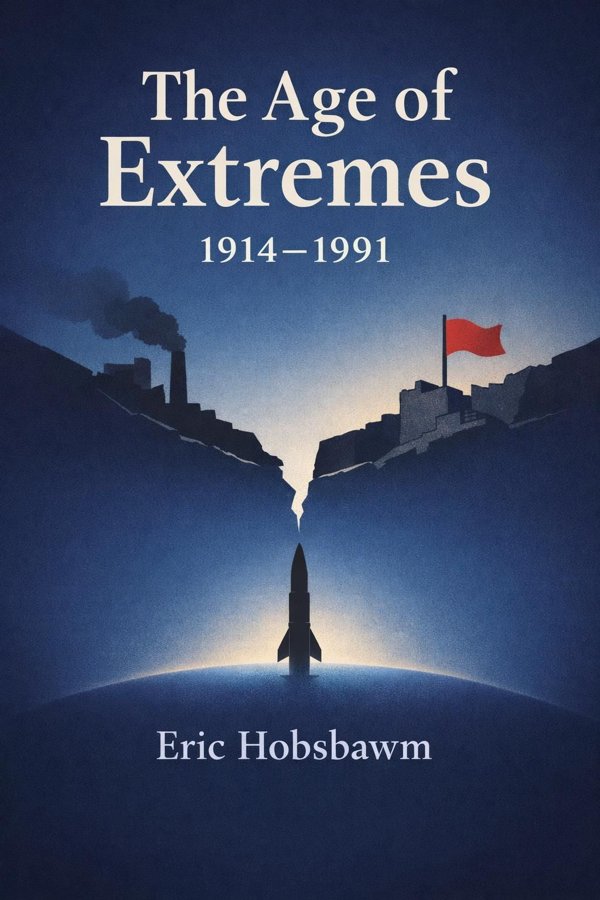
The Age of Extremes: 1914–1991: The Short Twentieth Century: Summary & Key Insights
 10 min9 chaptersAudio available
Key Takeaways from The Age of Extremes: 1914–1991: The Short Twentieth Century
History does not always obey the calendar.
Modern progress was built alongside modern destruction.
People do not fight only for territory or profit; they fight for visions of how the world should be organized.
Prosperity can be as revolutionary as war.
The twentieth century was not only a European story; it was the century in which the global imperial order unraveled.
What Is The Age of Extremes: 1914–1991: The Short Twentieth Century About?
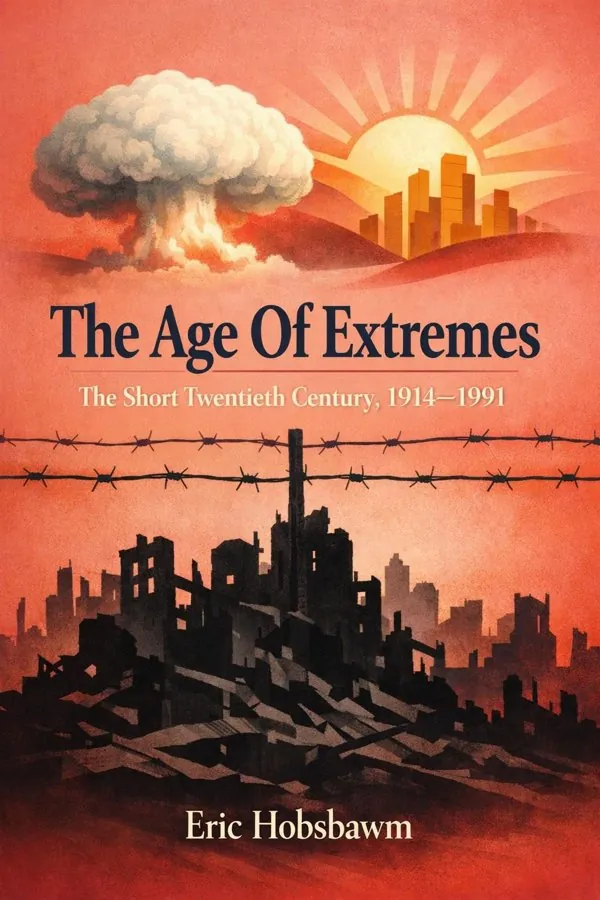
The Age of Extremes: 1914–1991: The Short Twentieth Century by Eric Hobsbawm is a general book. Eric Hobsbawm’s The Age of Extremes: 1914–1991: The Short Twentieth Century is one of the most ambitious histories ever written about the modern world. Instead of treating the twentieth century as a simple span from 1900 to 2000, Hobsbawm argues that its true historical arc runs from the outbreak of World War I in 1914 to the collapse of the Soviet Union in 1991. Within that compressed period, humanity experienced unprecedented catastrophe, astonishing economic growth, ideological conflict, decolonization, technological transformation, and deep cultural upheaval. The book matters because it helps readers see how wars, revolutions, capitalism, communism, nationalism, and globalization were not isolated developments but parts of a single interconnected drama. Hobsbawm writes with exceptional authority: he was one of the most influential historians of the twentieth century, a scholar of global social history, and a direct witness to many of the events he analyzes. This is not just a chronology of events. It is a powerful interpretation of why the modern world became so dynamic, so violent, and so unstable—and why many of its unresolved tensions still shape our lives today.
This FizzRead summary covers all 9 key chapters of The Age of Extremes: 1914–1991: The Short Twentieth Century in approximately 10 minutes, distilling the most important ideas, arguments, and takeaways from Eric Hobsbawm's work. Also available as an audio summary and Key Quotes Podcast.
The Age of Extremes: 1914–1991: The Short Twentieth Century
Eric Hobsbawm’s The Age of Extremes: 1914–1991: The Short Twentieth Century is one of the most ambitious histories ever written about the modern world. Instead of treating the twentieth century as a simple span from 1900 to 2000, Hobsbawm argues that its true historical arc runs from the outbreak of World War I in 1914 to the collapse of the Soviet Union in 1991. Within that compressed period, humanity experienced unprecedented catastrophe, astonishing economic growth, ideological conflict, decolonization, technological transformation, and deep cultural upheaval. The book matters because it helps readers see how wars, revolutions, capitalism, communism, nationalism, and globalization were not isolated developments but parts of a single interconnected drama. Hobsbawm writes with exceptional authority: he was one of the most influential historians of the twentieth century, a scholar of global social history, and a direct witness to many of the events he analyzes. This is not just a chronology of events. It is a powerful interpretation of why the modern world became so dynamic, so violent, and so unstable—and why many of its unresolved tensions still shape our lives today.
Who Should Read The Age of Extremes: 1914–1991: The Short Twentieth Century?
This book is perfect for anyone interested in general and looking to gain actionable insights in a short read. Whether you're a student, professional, or lifelong learner, the key ideas from The Age of Extremes: 1914–1991: The Short Twentieth Century by Eric Hobsbawm will help you think differently.
- ✓Readers who enjoy general and want practical takeaways
- ✓Professionals looking to apply new ideas to their work and life
- ✓Anyone who wants the core insights of The Age of Extremes: 1914–1991: The Short Twentieth Century in just 10 minutes
Want the full summary?
Get instant access to this book summary and 100K+ more with Fizz Moment.
Get Free SummaryAvailable on App Store • Free to download
Key Chapters
History does not always obey the calendar. One of Hobsbawm’s most striking ideas is that the twentieth century should not be understood as beginning in 1900 and ending in 1999. Instead, he defines a “short twentieth century” stretching from 1914 to 1991. His point is not rhetorical; it is analytical. The outbreak of World War I shattered the political, economic, and cultural order of the long nineteenth century, while the collapse of the Soviet Union brought to an end the ideological structure that had dominated global politics for decades.
This framing allows readers to see the period as a coherent era rather than a random sequence of crises. The old European imperial order, confidence in liberal progress, and assumptions about stable social hierarchy all broke down in 1914. What followed was a world shaped by total war, mass politics, economic instability, fascism, communism, decolonization, and Cold War rivalry. By 1991, the communist bloc had dissolved, the bipolar world ended, and a new phase of globalization emerged.
In practical terms, this idea changes how we read modern events. Instead of treating the First World War, the Russian Revolution, the Great Depression, the rise of Nazism, the welfare state, and the Cold War as separate units, we can understand them as linked responses to the same historical rupture. This is useful not only for students of history but also for leaders, policymakers, and citizens trying to recognize how one crisis can reorganize an entire era.
Actionable takeaway: When studying any period, identify the events that truly changed the underlying system, not just the dates on the calendar.
Modern progress was built alongside modern destruction. Hobsbawm calls the years from 1914 to 1945 the “Age of Catastrophe,” and the phrase captures his central argument: the first half of the short twentieth century was marked by war, depression, revolution, and political breakdown on a scale previously unimaginable. The belief that industrial civilization would naturally lead to peace and prosperity collapsed under the weight of trench warfare, mass death, inflation, dictatorship, and genocide.
The two world wars did more than destroy lives and cities. They transformed states into vast administrative and military machines, normalized mass mobilization, and gave governments unprecedented authority over economies and citizens. At the same time, the Great Depression undermined faith in laissez-faire capitalism and opened space for radical alternatives. Fascism, communism, and interventionist democracy all gained force because older certainties no longer seemed credible.
A practical lesson here is that social order can be more fragile than it appears. Economic collapse, political humiliation, and institutional weakness can create openings for extreme ideologies. Hobsbawm encourages readers to connect material conditions with political consequences rather than assuming that democratic norms are self-sustaining. We can see this dynamic today when financial shocks, inequality, or social dislocation fuel populism and polarization.
The period also reminds us that technological advancement is morally neutral. The same industrial capacity that improved production also enabled mechanized slaughter and bureaucratized extermination. Progress in science or organization does not guarantee ethical progress.
Actionable takeaway: Watch for moments when economic distress and political instability combine, because those are the conditions in which extremism often becomes thinkable.
People do not fight only for territory or profit; they fight for visions of how the world should be organized. Hobsbawm shows that the short twentieth century was defined by ideological conflict on a massive scale. Liberal capitalism, fascism, and communism were not abstract doctrines discussed only by intellectuals. They became organizing principles for states, armies, parties, and millions of ordinary people.
This matters because ideology gave the century its intensity. Fascism mobilized resentment, nationalism, hierarchy, and authoritarian unity. Communism promised revolution, equality, and collective ownership. Liberal democracy increasingly tied itself to constitutional government, individual rights, regulated markets, and social reform. These systems competed not only militarily but morally, each claiming to represent the future.
Hobsbawm’s insight is that ideology became powerful when it connected ideas to lived experiences. Economic suffering made anti-capitalist movements persuasive. National humiliation fed fascist narratives. Social insecurity made promises of order appealing. The lesson is that beliefs spread when they explain reality in emotionally compelling ways.
In everyday life, this helps us interpret political movements more clearly. When analyzing a campaign, protest wave, or online movement, it is not enough to ask whether its claims are true. We also have to ask why those claims resonate, what anxieties they address, and what social groups they mobilize. Successful ideologies offer identity, explanation, and direction all at once.
Hobsbawm does not ask readers to accept any ideology uncritically. He asks them to understand that mass politics cannot be explained without taking ideas seriously.
Actionable takeaway: When evaluating political movements, look beyond slogans and ask what social fears, hopes, and grievances give those ideas real power.
Prosperity can be as revolutionary as war. After the devastation of the first half of the century, Hobsbawm identifies the decades after 1945—especially roughly 1947 to 1973—as a “Golden Age” of exceptional economic growth in much of the industrial world. Productivity rose, wages improved, consumption expanded, welfare systems developed, and broad segments of the population experienced higher living standards than previous generations could have imagined.
This boom mattered not only because people became richer, but because it transformed assumptions about what normal life should include. Stable employment, home ownership, mass education, pensions, healthcare, consumer goods, and upward mobility became realistic expectations for millions. Governments learned to manage demand, businesses invested in large-scale production, and international institutions helped stabilize trade and finance. Even societies outside the richest countries were influenced by the model of planned development and state-led modernization.
Yet Hobsbawm also emphasizes that this prosperity was historically unusual, not permanent. It depended on specific conditions: reconstruction after war, strong productivity gains, regulated capitalism, demographic trends, and a geopolitical environment shaped by Cold War competition. When those conditions weakened in the 1970s, the era’s confidence began to fracture.
The practical lesson is that societies often mistake temporary success for a natural baseline. When institutions are built during good times, people may assume they will sustain themselves indefinitely. But growth periods have causes, and if those causes change, political and social expectations can become destabilized.
Actionable takeaway: Treat periods of prosperity as systems to be understood and maintained, not as automatic outcomes that will continue without deliberate policy and institutional support.
The twentieth century was not only a European story; it was the century in which the global imperial order unraveled. Hobsbawm shows how the collapse of empires reshaped politics across Asia, Africa, the Middle East, and beyond. European powers emerged weakened from war, colonial rule lost legitimacy, nationalist movements gained momentum, and new states entered international life at remarkable speed.
Decolonization was often presented as the triumph of self-determination, and in many ways it was. Peoples long subjected to imperial control claimed sovereignty, dignity, and political agency. But Hobsbawm insists that independence did not erase structural problems. Many new states inherited arbitrary borders, weak institutions, export-dependent economies, ethnic tensions, and Cold War pressures. Formal sovereignty often arrived without the stable foundations needed for social equality or durable democracy.
This insight remains highly relevant. Many contemporary conflicts cannot be understood without recognizing the legacies of imperial rule: disputed borders, centralized bureaucracies designed for control, military influence in politics, and economies oriented around external demand. Hobsbawm encourages readers to see postcolonial instability not as evidence of cultural failure but as the consequence of historical structures.
In practical terms, this means we should be cautious about simplistic narratives of national birth. Political independence is a beginning, not a completed achievement. Nation-building requires institutions, legitimacy, inclusive citizenship, and economic capacity.
Actionable takeaway: When trying to understand a modern state’s problems or possibilities, examine the imperial and colonial structures it inherited rather than judging its present in isolation.
Some of the world’s most dangerous decades were also strangely orderly. Hobsbawm presents the Cold War as a period of intense geopolitical tension that nonetheless produced a kind of global structure. The United States and the Soviet Union led rival blocs, accumulated enormous military power, and competed ideologically, technologically, and strategically. Yet precisely because both sides possessed nuclear weapons, direct war between them became too risky, creating a tense but recognizable equilibrium.
This “unstable stability” shaped everything from domestic policy to cultural life. Governments justified military spending, alliances, scientific research, propaganda, and interventions abroad through the logic of superpower rivalry. Regional conflicts in Korea, Vietnam, Afghanistan, Latin America, Africa, and the Middle East were often amplified by Cold War competition. At the same time, the fear of total annihilation encouraged caution at the highest levels. The world was divided, but division itself imposed a pattern.
Hobsbawm’s broader lesson is that order does not always mean peace. Systems can appear stable while depending on repression, proxy violence, or mutually assured destruction. This is useful when analyzing modern international politics. Strategic balance may reduce one kind of war while encouraging other forms of conflict, surveillance, arms races, or indirect intervention.
For individuals and institutions, the point is to distinguish visible calm from genuine resolution. A problem may seem contained because powerful actors have incentives to manage it, not because it has been solved.
Actionable takeaway: When assessing political stability, ask what hidden costs, suppressed conflicts, or structural risks are maintaining the appearance of order.
Systems endure not because they are flawless, but because they change under pressure. Hobsbawm’s account of the twentieth century shows that capitalism survived repeated crises not by remaining pure, but by adapting. After the disasters of depression and war, capitalist societies accepted regulation, welfare measures, labor protections, public investment, and macroeconomic management. In other words, capitalism persisted partly by incorporating reforms once seen as incompatible with it.
This adaptability was crucial in the ideological competition with communism. The existence of a rival system pushed many Western states to reduce inequality, expand public services, and present themselves as humane, democratic alternatives. The postwar settlement in many countries was therefore not simply an economic arrangement; it was also a political strategy and a response to social conflict.
Later, when growth slowed and inflation rose, capitalism changed again. Deregulation, privatization, financialization, and global integration became more prominent. Hobsbawm is attentive to both the resilience and the costs of these shifts. Flexibility can preserve a system, but it can also deepen insecurity, weaken solidarity, and widen inequality.
For modern readers, this is a powerful reminder that economic systems are historical constructions. Markets are always embedded in institutions, laws, and power relations. Debates over taxation, labor rights, industrial policy, and social spending are not peripheral—they shape what capitalism becomes.
Actionable takeaway: When judging any economic system, focus less on ideology alone and more on how institutions are designed, adjusted, and contested in practice.
Victories in history are often less complete than they seem. Hobsbawm ends the short twentieth century with the fall of the Soviet Union, but he does not portray that moment as the final triumph of a settled world order. Instead, he suggests that the disappearance of one pole in the global system removed a structure that, for all its dangers, had organized international life. What remained was not clarity, but uncertainty.
The end of communism appeared to validate liberal capitalism, yet Hobsbawm warns against triumphalism. Many of the forces that destabilized the century—inequality, nationalism, ethnic conflict, state fragility, economic volatility, and ecological strain—did not disappear in 1991. In some cases they intensified. The institutions and social compromises that had sustained the postwar order were already under pressure, and globalization introduced new winners, losers, and forms of dislocation.
This is one of the book’s deepest contributions: history does not move neatly toward resolution. The collapse of an ideological rival may expose weaknesses rather than eliminate them. For readers today, this is especially relevant. It helps explain why the post-Cold War decades brought both optimism and fragmentation, integration and backlash.
In practical terms, Hobsbawm teaches intellectual humility. We should be skeptical of claims that any political or economic model has ended history. Every order generates tensions, and every apparent settlement contains future crises.
Actionable takeaway: Resist narratives of final victory; instead, examine what unresolved problems remain hidden beneath moments of political celebration.
All Chapters in The Age of Extremes: 1914–1991: The Short Twentieth Century
About the Author
Eric Hobsbawm was a British historian and public intellectual widely regarded as one of the greatest interpreters of modern history. Born in 1917, he lived through many of the upheavals he later analyzed, including the Great Depression, World War II, the Cold War, and the collapse of the Soviet bloc. He taught for many years at Birkbeck, University of London, and became known for combining social, economic, political, and cultural analysis in sweeping historical narratives. Hobsbawm is especially famous for his works on the “long nineteenth century,” including The Age of Revolution, The Age of Capital, and The Age of Empire, as well as The Age of Extremes. His scholarship is admired for its global scope, interpretive boldness, and enduring influence on how readers understand modernity.
Get This Summary in Your Preferred Format
Read or listen to the The Age of Extremes: 1914–1991: The Short Twentieth Century summary by Eric Hobsbawm anytime, anywhere. FizzRead offers multiple formats so you can learn on your terms — all free.
Available formats: App · Audio · PDF · EPUB — All included free with FizzRead
Download The Age of Extremes: 1914–1991: The Short Twentieth Century PDF and EPUB Summary
Key Quotes from The Age of Extremes: 1914–1991: The Short Twentieth Century
“History does not always obey the calendar.”
“Modern progress was built alongside modern destruction.”
“People do not fight only for territory or profit; they fight for visions of how the world should be organized.”
“Prosperity can be as revolutionary as war.”
“The twentieth century was not only a European story; it was the century in which the global imperial order unraveled.”
Frequently Asked Questions about The Age of Extremes: 1914–1991: The Short Twentieth Century
The Age of Extremes: 1914–1991: The Short Twentieth Century by Eric Hobsbawm is a general book that explores key ideas across 9 chapters. Eric Hobsbawm’s The Age of Extremes: 1914–1991: The Short Twentieth Century is one of the most ambitious histories ever written about the modern world. Instead of treating the twentieth century as a simple span from 1900 to 2000, Hobsbawm argues that its true historical arc runs from the outbreak of World War I in 1914 to the collapse of the Soviet Union in 1991. Within that compressed period, humanity experienced unprecedented catastrophe, astonishing economic growth, ideological conflict, decolonization, technological transformation, and deep cultural upheaval. The book matters because it helps readers see how wars, revolutions, capitalism, communism, nationalism, and globalization were not isolated developments but parts of a single interconnected drama. Hobsbawm writes with exceptional authority: he was one of the most influential historians of the twentieth century, a scholar of global social history, and a direct witness to many of the events he analyzes. This is not just a chronology of events. It is a powerful interpretation of why the modern world became so dynamic, so violent, and so unstable—and why many of its unresolved tensions still shape our lives today.
More by Eric Hobsbawm
You Might Also Like
Duct Tape Marketing: The World's Most Practical Small Business Marketing Guide
John Jantsch
10 minDusk, Night, Dawn: On Revival and Courage
Anne Lamott
10 minFinish Big: How Great Entrepreneurs Exit Their Companies on Top
Bo Burlingham
10 minFirst As Tragedy, Then As Farce
Slavoj Zizek
10 minFirst Principles: What America's Founders Learned from the Greeks and Romans and How That Shaped Our Country
Thomas E. Ricks
10 minGood Habits, Bad Habits: The Science of Making Positive Changes That Stick
Wendy Wood
10 minBrowse by Category
Ready to read The Age of Extremes: 1914–1991: The Short Twentieth Century?
Get the full summary and 100K+ more books with Fizz Moment.