
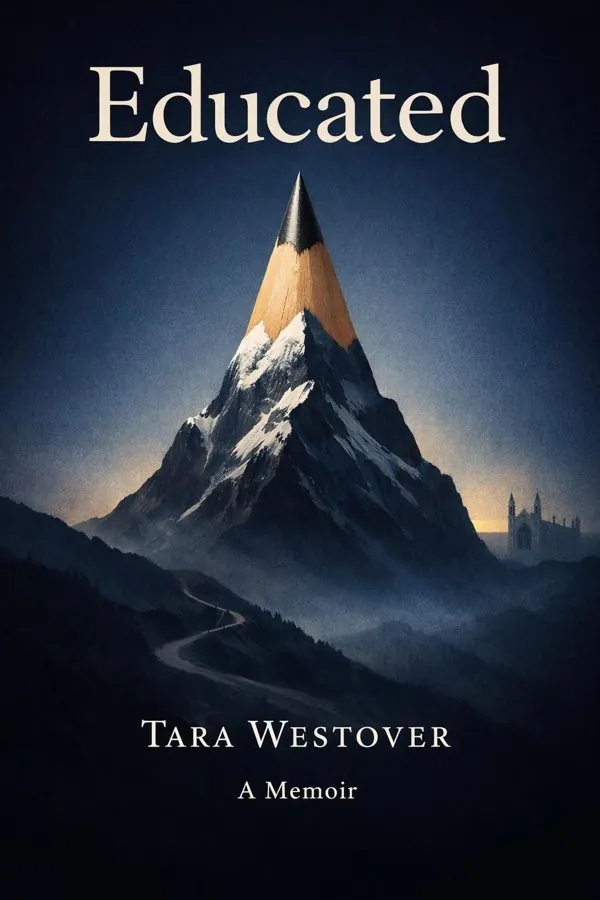
Educated: Summary & Key Insights
 10 min5 chaptersAudio available
Key Takeaways from Educated
Westover’s childhood at the foot of Buck’s Peak is the foundation of everything that follows.
In the junkyard, work becomes Westover’s first education in risk, hierarchy, and survival.
Westover’s move from her isolated upbringing to Brigham Young University marks one of the memoir’s most dramatic shifts.
Cambridge expands Westover’s world again, but this time the challenge is not simply academic.
By the end of Educated, Westover has moved far beyond the idea that education is merely institutional success.
What Is Educated About?
Educated by Tara Westover is a memoir book published in 2018 spanning 5 pages. What does it mean to educate yourself when everything around you teaches you to stay small, silent, and obedient? In Educated, Tara Westover answers that question through one of the most striking memoirs of recent years. Her story begins in rural Idaho, in a survivalist Mormon household cut off from mainstream institutions, where hospitals, schools, and the government were treated as threats rather than supports. From that unlikely starting point, Westover eventually makes her way to Brigham Young University and later earns a doctorate in history from the University of Cambridge. What makes this memoir so powerful is that it is not simply a success story about academic achievement. It is a deeply human account of how knowledge changes a person from the inside out. Westover shows that education is not just the accumulation of facts; it is the painful, liberating process of learning to question the stories that shaped you. Her memoir matters because it speaks to anyone who has ever struggled to separate love from control, loyalty from self-betrayal, or family truth from personal truth. With honesty, emotional precision, and hard-won insight, Westover turns her life into a profound meditation on identity, memory, and the cost of becoming yourself.
This FizzRead summary covers all 5 key chapters of Educated in approximately 10 minutes, distilling the most important ideas, arguments, and takeaways from Tara Westover's work. Also available as an audio summary and Key Quotes Podcast.
Educated: A Memoir
What does it mean to educate yourself when everything around you teaches you to stay small, silent, and obedient? In Educated, Tara Westover answers that question through one of the most striking memoirs of recent years. Her story begins in rural Idaho, in a survivalist Mormon household cut off from mainstream institutions, where hospitals, schools, and the government were treated as threats rather than supports. From that unlikely starting point, Westover eventually makes her way to Brigham Young University and later earns a doctorate in history from the University of Cambridge.
What makes this memoir so powerful is that it is not simply a success story about academic achievement. It is a deeply human account of how knowledge changes a person from the inside out. Westover shows that education is not just the accumulation of facts; it is the painful, liberating process of learning to question the stories that shaped you. Her memoir matters because it speaks to anyone who has ever struggled to separate love from control, loyalty from self-betrayal, or family truth from personal truth. With honesty, emotional precision, and hard-won insight, Westover turns her life into a profound meditation on identity, memory, and the cost of becoming yourself.
Who Should Read Educated?
This book is perfect for anyone interested in memoir and looking to gain actionable insights in a short read. Whether you're a student, professional, or lifelong learner, the key ideas from Educated by Tara Westover will help you think differently.
- ✓Readers who enjoy memoir and want practical takeaways
- ✓Professionals looking to apply new ideas to their work and life
- ✓Anyone who wants the core insights of Educated in just 10 minutes
Want the full summary?
Get instant access to this book summary and 100K+ more with Fizz Moment.
Get Free SummaryAvailable on App Store • Free to download
Key Chapters
Westover’s childhood at the foot of Buck’s Peak is the foundation of everything that follows. The mountain is more than a setting; it is a worldview. Her father frames the family’s isolation as righteousness, teaching his children that public schools corrupt, doctors deceive, and the federal government is a looming enemy. In that environment, ordinary protections vanish. The children are kept out of school, medical care is avoided, and dangerous labor becomes part of daily life. This is not neglect presented as chaos alone, but as conviction. That distinction matters, because it shows how deeply ideology can shape what a child accepts as normal.
The memoir’s early scenes are unforgettable precisely because they mix beauty with danger. Wild herbs, mountain light, and close family rituals coexist with untreated injuries, fear-driven preparation for apocalypse, and constant emotional pressure to conform. Westover captures how isolation can feel both protective and imprisoning. A key takeaway here is that harmful systems often survive by calling themselves pure, faithful, or strong. For readers, this section offers a practical insight: when a belief system forbids questions, cuts off outside perspectives, or demands silence in the face of harm, it may be protecting power rather than truth. Westover’s earliest doubts begin here, long before formal education enters the picture.
In the junkyard, work becomes Westover’s first education in risk, hierarchy, and survival. She learns by doing, but what she learns is not only mechanical skill. She learns that in her family, danger is normalized and pain is spiritualized. If someone is injured, the event is folded into a larger story about toughness, faith, and distrust of institutions. That framing makes it difficult to recognize abuse or negligence for what they are. The junkyard becomes a classroom in which obedience is rewarded and questioning is treated as weakness.
This section grows even more complex through Westover’s relationship with her brother Shawn, whose behavior is cruel and violent, yet often interwoven with moments of affection. That emotional whiplash is one reason abuse can be so hard to name. Westover shows that the mind does not awaken all at once. It often begins in fragments: a private discomfort, an unspoken comparison, a sentence in a book that opens a window. Her secret reading becomes revolutionary because it gives her language for realities she has felt but could not explain. An actionable lesson for readers is this: exposure to new ideas can be life-changing, especially when your environment has been tightly controlled. Books, mentors, and outside perspectives do not just inform us; they help us recognize what we are living through. In Westover’s story, reading becomes the first quiet act of self-ownership.
Westover’s move from her isolated upbringing to Brigham Young University marks one of the memoir’s most dramatic shifts. She arrives without the basic educational background many students take for granted, which means every lecture, assignment, and casual classroom reference can feel like a test she was never prepared to take. Her experience highlights a crucial truth: entering a new world is not only intellectually difficult, but emotionally disorienting. At BYU, she is not just catching up on math, grammar, and history; she is learning an entirely different social and moral language.
Some of the most revealing moments in this stage of her journey come from small embarrassments and misunderstandings. They show how education often begins with humiliation, confusion, and the willingness to keep going anyway. Rather than presenting academic growth as glamorous, Westover shows it as slow, uneven, and deeply vulnerable. She studies obsessively, fills in foundational gaps, and discovers that effort can compensate for ignorance when paired with discipline and curiosity. A practical lesson here is that being behind does not mean being incapable. Many readers who feel intimidated by elite spaces, higher education, or new professional environments will recognize themselves in this section. Westover’s progress at BYU demonstrates that transformation usually starts with a simple but radical act: admitting what you do not know and choosing to learn it anyway.
Cambridge expands Westover’s world again, but this time the challenge is not simply academic. It is existential. At an institution defined by intellectual rigor and global perspective, she gains the distance needed to reexamine her past more clearly. She encounters scholars, mentors, and ideas that ask her to question not just facts, but the narratives she has inherited about family, religion, authority, and herself. Education here becomes less about upward mobility and more about moral courage.
Yet with that clarity comes pain. The more Westover learns to trust her own perceptions, the harder it becomes to preserve the myths that once held her family together. The memoir shows that truth is rarely free. It can cost belonging, approval, and the illusion that love alone can repair deep harm. This is one of the book’s most mature insights: growth does not always produce reconciliation. Sometimes it produces grief. Westover’s time at Cambridge illustrates the psychological strain of becoming a new person while old loyalties still pull at you. For readers, the actionable insight is that personal development often requires boundaries, especially when relationships depend on your silence or self-erasure. Education can be breaking as well as making, because it forces you to live in alignment with what you now know.
By the end of Educated, Westover has moved far beyond the idea that education is merely institutional success. Degrees matter in her story, but they are not the deepest point. The real transformation lies in her ability to examine inherited beliefs, to trust her own memory, and to claim the right to define herself. Liberation, in this sense, is not a clean escape. It is a continuing process of disentangling love from loyalty, identity from obedience, and truth from fear.
One reason this idea resonates so strongly is that it applies far beyond Westover’s specific circumstances. Many people are educated in ways that have nothing to do with universities: by leaving controlling relationships, challenging inherited prejudices, confronting family myths, or learning to speak honestly about pain. Westover invites readers to see education as the expansion of consciousness. It is the moment when you realize that your life can be interpreted differently than you were taught. A useful takeaway is to ask yourself three questions: What beliefs did I inherit without choosing? Which of them still serve me? What would I need to learn, unlearn, or face in order to become more fully myself? In that sense, Educated is not just a memoir about one woman’s past. It is a guide to intellectual and emotional self-emancipation.
All Chapters in Educated
About the Author
Tara Westover is an American memoirist born in 1986 in Clifton, Idaho. Raised in a fundamentalist Mormon family, she grew up largely outside formal education and did not attend school until the age of seventeen. She later studied at Brigham Young University and earned a doctorate in history from the University of Cambridge. Westover is best known for her memoir Educated, which has received broad international recognition and been translated into many languages. Her life story and writing have drawn attention for their exploration of education, identity, family, and the struggle to define oneself beyond inherited beliefs.
Get This Summary in Your Preferred Format
Read or listen to the Educated summary by Tara Westover anytime, anywhere. FizzRead offers multiple formats so you can learn on your terms — all free.
Available formats: App · Audio · PDF · EPUB — All included free with FizzRead
Download Educated PDF and EPUB Summary
Key Quotes from Educated
“Westover’s childhood at the foot of Buck’s Peak is the foundation of everything that follows.”
“In the junkyard, work becomes Westover’s first education in risk, hierarchy, and survival.”
“Westover’s move from her isolated upbringing to Brigham Young University marks one of the memoir’s most dramatic shifts.”
“Cambridge expands Westover’s world again, but this time the challenge is not simply academic.”
“By the end of Educated, Westover has moved far beyond the idea that education is merely institutional success.”
Frequently Asked Questions about Educated
Educated by Tara Westover is a memoir book that explores key ideas across 5 chapters. What does it mean to educate yourself when everything around you teaches you to stay small, silent, and obedient? In Educated, Tara Westover answers that question through one of the most striking memoirs of recent years. Her story begins in rural Idaho, in a survivalist Mormon household cut off from mainstream institutions, where hospitals, schools, and the government were treated as threats rather than supports. From that unlikely starting point, Westover eventually makes her way to Brigham Young University and later earns a doctorate in history from the University of Cambridge. What makes this memoir so powerful is that it is not simply a success story about academic achievement. It is a deeply human account of how knowledge changes a person from the inside out. Westover shows that education is not just the accumulation of facts; it is the painful, liberating process of learning to question the stories that shaped you. Her memoir matters because it speaks to anyone who has ever struggled to separate love from control, loyalty from self-betrayal, or family truth from personal truth. With honesty, emotional precision, and hard-won insight, Westover turns her life into a profound meditation on identity, memory, and the cost of becoming yourself.
Compare Educated

You Might Also Like
Featured In
Bill Gates's Book Picks
Bill Gates' Reading List: The Books That Shaped a Visionary
Oprah Winfrey's Book Picks
Oprah's Book Club Favorites That Changed Millions of Lives
Barack Obama's Book Picks
Barack Obama's Reading List: Books That Shaped a President
Reese Witherspoon's Book Picks
Reese Witherspoon's Book Club: Stories That Captivated Millions
Sheryl Sandberg's Book Picks
Sheryl Sandberg's Must-Reads for Women in Leadership
Michelle Obama's Book Picks
Michelle Obama's Inspiring Reads
Trevor Noah's Book Picks
Trevor Noah's Thought-Provoking Reads
Curated's Book Picks
Best Biographies & Memoirs — Lives That Inspire
Curated's Book Picks
Best Books for Women — Empowering Reads
Browse by Category
Ready to read Educated?
Get the full summary and 100K+ more books with Fizz Moment.