
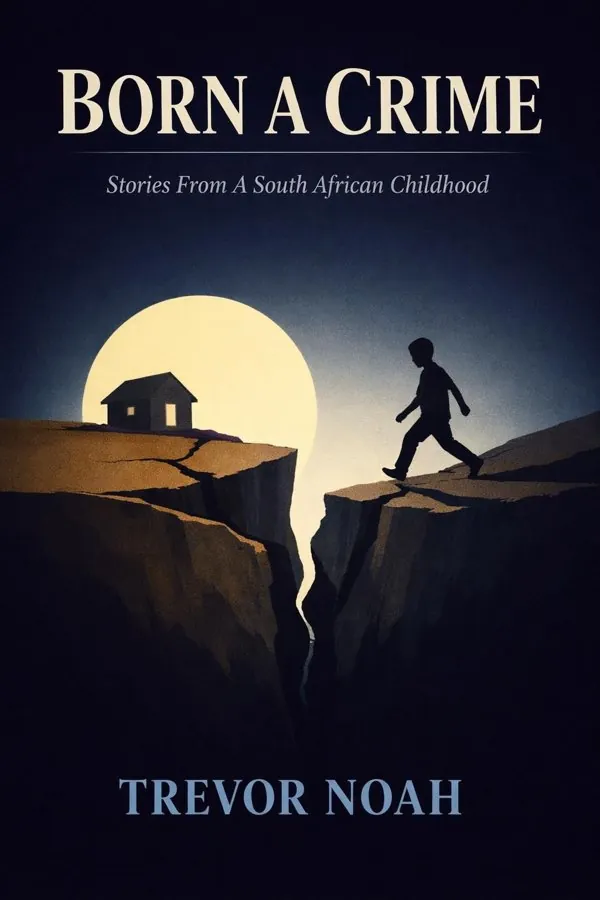
Born a Crime: Summary & Key Insights
by Trevor Noah
 10 min10 chaptersAudio available
Key Takeaways from Born a Crime
Sometimes the most powerful way to understand a political system is to see how it reaches into the smallest details of family life.
A child’s destiny is often altered by the courage of one person willing to refuse the script.
Belief becomes transformative when it moves from passive comfort to active discipline.
Language is more than communication; it is access, protection, and belonging.
Scarcity can crush initiative, but it can also sharpen ingenuity when people refuse to be defined by lack.
What Is Born a Crime About?
Born a Crime by Trevor Noah is a memoir book published in 2016 spanning 7 pages. Born a Crime is Trevor Noah’s sharply observed, deeply moving memoir about growing up in South Africa during and after apartheid as the son of a Black Xhosa mother and a white Swiss father. Because interracial relationships were illegal at the time of his birth, Noah’s very existence violated the law. That premise gives the book its title, but the memoir is about far more than legal absurdity. It is a vivid portrait of a boy learning how race, language, class, religion, violence, and love shape a life—and how humor can become a survival tool in the face of chaos. What makes the book so powerful is Noah’s ability to balance painful truth with wit. He writes not as a distant observer, but as someone who lived inside the contradictions of apartheid and its aftermath. His stories are personal, but they also illuminate larger social systems with unusual clarity. At the center of the memoir is his mother, Patricia Nombuyiselo Noah, whose intelligence, faith, defiance, and fierce devotion made his survival possible. Born a Crime matters because it turns history into lived experience and shows how resilience is built, one choice at a time.
This FizzRead summary covers all 10 key chapters of Born a Crime in approximately 10 minutes, distilling the most important ideas, arguments, and takeaways from Trevor Noah's work. Also available as an audio summary and Key Quotes Podcast.
Born a Crime
Born a Crime is Trevor Noah’s sharply observed, deeply moving memoir about growing up in South Africa during and after apartheid as the son of a Black Xhosa mother and a white Swiss father. Because interracial relationships were illegal at the time of his birth, Noah’s very existence violated the law. That premise gives the book its title, but the memoir is about far more than legal absurdity. It is a vivid portrait of a boy learning how race, language, class, religion, violence, and love shape a life—and how humor can become a survival tool in the face of chaos.
What makes the book so powerful is Noah’s ability to balance painful truth with wit. He writes not as a distant observer, but as someone who lived inside the contradictions of apartheid and its aftermath. His stories are personal, but they also illuminate larger social systems with unusual clarity. At the center of the memoir is his mother, Patricia Nombuyiselo Noah, whose intelligence, faith, defiance, and fierce devotion made his survival possible. Born a Crime matters because it turns history into lived experience and shows how resilience is built, one choice at a time.
Who Should Read Born a Crime?
This book is perfect for anyone interested in memoir and looking to gain actionable insights in a short read. Whether you're a student, professional, or lifelong learner, the key ideas from Born a Crime by Trevor Noah will help you think differently.
- ✓Readers who enjoy memoir and want practical takeaways
- ✓Professionals looking to apply new ideas to their work and life
- ✓Anyone who wants the core insights of Born a Crime in just 10 minutes
Want the full summary?
Get instant access to this book summary and 100K+ more with Fizz Moment.
Get Free SummaryAvailable on App Store • Free to download
Key Chapters
A child’s destiny is often altered by the courage of one person willing to refuse the script. Trevor Noah’s mother, Patricia, is the moral center of Born a Crime. She is not merely a loving parent; she is a force of resistance. In a society built on racial hierarchy, gender constraint, and fear, she insists on agency. She chooses to have Trevor, chooses to move through spaces not designed for her, chooses education, faith, discipline, and possibility even when circumstances offer very little.
Patricia does not raise Trevor to think of himself as a victim, though she never hides the truth from him. Instead, she teaches him to interpret the world critically. She is strict, resourceful, and sometimes shocking in her methods, but everything she does is rooted in a larger vision: her son must not be mentally imprisoned by the limits of his environment. Her parenting combines love with audacity. She exposes him to books, churches, neighborhoods, and ideas beyond his immediate reality because she understands that imagination is a form of freedom.
This idea has wide relevance. The people who influence us most are often those who refuse to normalize the constraints around them. A parent, teacher, mentor, or friend can change the arc of a life by expecting more than circumstances seem to allow. Patricia’s example also shows that love is not always soft. Sometimes it is demanding, inconvenient, and deeply strategic.
In practical terms, this key idea invites readers to think about how values are transmitted. Do you teach the people around you to accept limits, or to question them? Do you model fear, or possibility?
Actionable takeaway: Identify one limiting story you inherited about what is possible for you, and replace it with one concrete act of defiance—apply, ask, learn, or try where you once assumed no.
Belief becomes transformative when it moves from passive comfort to active discipline. In Born a Crime, Trevor Noah describes his mother’s Christianity not as blind ritual but as a deliberate source of strength. She takes faith seriously, sometimes to comic extremes, dragging Trevor to multiple church services in a single Sunday. Yet beneath the humor lies a profound insight: for Patricia, faith is not a retreat from reality. It is a way of confronting reality with courage.
Her religious practice gives structure to life in conditions that might otherwise feel random and crushing. It creates moral order, community, hope, and a sense of purpose. Importantly, Noah does not present faith sentimentally. He recognizes both the absurdities and the endurance it produces. The hours in church, the rules, the songs, the social performances—all become part of a larger lesson in discipline. His mother believes that if you trust only what is visible, you will eventually become trapped by your circumstances. Faith, in her hands, is a refusal to let the visible world define the whole truth.
This lesson applies even to readers who are not religious. The underlying principle is that resilience often depends on a practice that keeps you oriented beyond immediate chaos. That practice might be prayer, meditation, journaling, service, or a demanding weekly routine. What matters is that it reminds you who you are when life tries to reduce you to survival.
Noah’s story also suggests that children often inherit not just beliefs, but ways of responding to uncertainty. A disciplined inner life can be one of the greatest gifts a family passes down.
Actionable takeaway: Build one weekly practice that strengthens your inner stability—spiritual or secular—and treat it as non-negotiable training for difficult times, not as a luxury for easy ones.
Language is more than communication; it is access, protection, and belonging. One of Trevor Noah’s most memorable insights is that in South Africa, speaking someone’s language could instantly change how they saw you. Under apartheid and after it, racial identity often determined social boundaries, but language could loosen those boundaries. By learning multiple languages, Noah gained a kind of social mobility that money and status could not have given him.
He learned early that people may distrust what you look like, but they soften when you speak in a voice that feels familiar. Language helped him move between groups, avoid conflict, build friendships, and decode the unwritten rules of different communities. It also taught him that identity is rarely as fixed as society pretends. If race categorized people from the outside, language allowed Noah to connect from the inside.
This idea remains highly practical. In any environment—school, workplace, neighborhood, or global business—people respond differently when they feel seen on their own terms. Learning someone’s language, whether literal or cultural, communicates respect. It says, “I have made an effort to meet you where you are.” That can transform negotiation, leadership, customer relationships, teamwork, and friendship.
The broader application is not limited to multilingual ability. Every field has languages: the language of engineers, artists, executives, teenagers, immigrants, or online communities. The more fluently you move between them, the more trust and influence you can build.
Noah’s experience reminds us that fluency is not manipulation when it is grounded in genuine curiosity. It is an act of bridge-building in a fractured world.
Actionable takeaway: Learn one new language skill this year—literal or cultural—that helps you connect across a boundary you usually avoid, and use it to start one meaningful conversation.
Scarcity can crush initiative, but it can also sharpen ingenuity when people refuse to be defined by lack. In Born a Crime, Trevor Noah describes a childhood marked by financial instability, improvisation, and constant adaptation. He and his family navigate poverty not through passive endurance but through humor, hustle, and problem-solving. Whether he is selling CDs, DJing, repairing things, or finding ways to make social situations work in his favor, Noah develops an entrepreneurial mindset long before he has the language for it.
What makes these stories compelling is that they never romanticize poverty. Lack is stressful, limiting, and often humiliating. At the same time, Noah shows that resourcefulness is a skill forged in constraint. When formal systems fail you, you become attentive to opportunity, timing, and human behavior. You learn to make something from almost nothing.
This lesson matters because many readers think entrepreneurship begins with capital, credentials, or a polished plan. Noah’s life suggests otherwise. Entrepreneurship often starts with observation: What do people need? What can I provide? What assets do I already have—energy, knowledge, access, relationships, humor, adaptability? Even in small, informal, or temporary efforts, these instincts build confidence and capability.
There is also an emotional lesson here. Humor in Noah’s world is not denial; it is a way of preserving dignity. Smiling, joking, and storytelling become methods of reclaiming power in situations meant to diminish him.
Applied practically, this key idea encourages readers to treat constraints as design challenges. That does not erase hardship, but it can shift your response from paralysis to experimentation.
Actionable takeaway: List three limitations you are facing right now, then ask for each one, “What skill could this force me to develop?” Turn one answer into a small side project, test, or solution this week.
Laughter can reveal truths that anger alone cannot carry. One of Trevor Noah’s greatest strengths as a writer is his ability to make readers laugh at stories that are, underneath the surface, deeply painful. In Born a Crime, humor is not decoration. It is a survival tool, a narrative strategy, and a moral lens. It allows Noah to confront racism, poverty, family dysfunction, and violence without becoming emotionally numb or preachy.
Humor works in the memoir because it creates distance without denial. Noah can revisit frightening or humiliating experiences and translate them into stories that expose absurdity. Apartheid itself was absurd, not because it was harmless, but because its logic was both brutal and ridiculous. By making that absurdity visible, Noah helps readers understand oppression more clearly. Comedy becomes a way of telling the truth sharply enough that people can actually hear it.
This is useful well beyond memoir. In leadership, teaching, activism, and personal relationships, humor can lower defensiveness and open space for honesty. It can help people process difficult experiences and connect across difference. But Noah also shows that effective humor requires precision. It should illuminate, not evade. The joke must carry truth, not bury it.
For individuals, this idea suggests a healthier relationship to hardship. Reframing an experience through humor can reduce shame and restore perspective. It does not erase pain, but it can make pain speakable.
Readers can apply this by noticing the stories they tell about adversity. Are they trapped in bitterness, or can they identify the absurd, human, strangely revealing parts of what happened?
Actionable takeaway: Rewrite one frustrating recent experience as a short story you would tell a friend to make them laugh, and notice what new perspective becomes available when shame loses its grip.
The most devastating forms of violence often become invisible when they are repeated often enough. In Born a Crime, Trevor Noah writes with painful clarity about domestic abuse and the damage it does inside families. His mother’s relationship with Abel, Trevor’s stepfather, reveals how violence can escalate gradually, how fear reshapes daily life, and how communities often fail to intervene until the damage is undeniable. These chapters are among the most sobering in the memoir because they expose the limits of resilience narratives. Courage matters, but courage alone does not make someone safe.
Noah’s treatment of this subject is important because he neither sensationalizes nor simplifies it. He shows how economic dependency, social norms, masculinity, and institutional weakness can trap people in dangerous situations. He also shows the psychological complexity involved: hope, denial, love, habit, faith, and fear are often intertwined. Patricia remains astonishingly strong, but the memoir refuses to pretend strength eliminates vulnerability.
This idea has urgent practical relevance. Many readers know someone navigating emotional or physical abuse, even if they do not realize it. Noah’s story reminds us that abuse is not a private issue in the moral sense. It is a community issue, a legal issue, and a human issue. Listening carefully, taking warning signs seriously, and offering concrete support matter more than abstract sympathy.
The memoir’s most unforgettable example of endurance is Patricia surviving being shot. Her survival is extraordinary, but Noah does not present it as a miracle that excuses the violence. Instead, it underscores her unbreakable spirit and the unacceptable reality she endured.
Actionable takeaway: Learn the warning signs of abuse and identify one local resource—hotline, shelter, legal aid, counseling service—so that if someone confides in you, you can offer practical help rather than helpless concern.
When society insists on rigid categories, people who live between them become experts in adaptation. Trevor Noah’s life as a mixed-race child in South Africa forced him to confront identity as something unstable, contextual, and often imposed from the outside. In one setting he was too Black, in another too white, in another too foreign, and in another too local. He belonged everywhere and nowhere. That tension becomes one of the memoir’s deepest themes.
Rather than searching for a single pure identity, Noah learns to navigate multiple worlds. He studies how people see him and adjusts accordingly, but he also gradually claims the right to define himself. This is not easy. Social acceptance often depends on performance, and the pressure to fit can lead people to fragment themselves. Noah’s insight is that identity is partly inherited, partly assigned, and partly chosen. Maturity comes from understanding those layers without becoming imprisoned by any one of them.
This idea resonates strongly in modern life. Many people live across categories—racial, national, linguistic, religious, generational, or professional. They may feel pressure to “pick a side” or present a simplified self. Noah’s memoir offers a more honest framework: identity can be plural. It can shift by context while still remaining real.
In practical terms, this helps readers approach both self-understanding and social interaction with more flexibility. Instead of demanding that people fit neat labels, we can ask how their identities have been shaped by history, place, and necessity. For ourselves, we can stop confusing complexity with inauthenticity.
Actionable takeaway: Write down three identities you carry in different settings, then ask which parts are chosen, which are inherited, and which are reactions to other people’s expectations. Use that answer to define yourself more consciously.
Political liberation means little if you remain trapped by internalized limits. As Trevor Noah grows older in Born a Crime, the memoir shifts from childhood survival toward self-creation. South Africa is changing, apartheid has ended, and new possibilities are emerging, but Noah still has to decide who he will become. That requires more than talent. It requires separating himself from the assumptions that shaped his upbringing—about race, money, masculinity, relationships, and destiny.
This is where the book becomes especially relevant for readers outside South Africa. Most people are born into conditions they did not choose: family patterns, economic constraints, cultural scripts, and social labels. Freedom begins when they recognize those influences without surrendering to them. Noah experiments, makes mistakes, pursues work, builds friendships, and develops his comic voice. Through that process, he learns that selfhood is not discovered once and for all. It is built through repeated acts of choice.
The memoir also emphasizes that choosing yourself is not selfishness. It is responsibility. If you do not define your life, someone else will gladly do it for you—through prejudice, convenience, fear, or expectation. Noah’s eventual path into entertainment and storytelling grows out of his ability to observe systems, connect across groups, and trust his own perspective.
Applied practically, this key idea asks readers to notice where they are living by default rather than design. Are you following a script because it fits you, or because it was handed to you? Growth often begins with small declarations of independence, not dramatic reinventions.
Actionable takeaway: Identify one area of your life where you are living by inherited expectation—career, relationship, identity, or routine—and make one deliberate change this month that reflects your own values instead.
The deepest lesson of Born a Crime is that survival is rarely sustained by grit alone; it is carried by love, meaning, and the ability to keep laughing. By the end of the memoir, readers understand that Trevor Noah’s life was shaped not simply by apartheid or poverty, but by the emotional and moral ecosystem his mother created around him. Faith gave structure, discipline gave direction, language created access, and humor made pain bearable. But love is the force binding all of it together.
This love is not sentimental or idealized. It is demanding, stubborn, flawed, and often expressed through sacrifice rather than words. Patricia’s choices communicate to Trevor that his life has value in a society that repeatedly tells him otherwise. That message becomes foundational. When people are loved with conviction, they gain a reference point that can outlast humiliation and fear.
Laughter, in turn, prevents love from becoming heavy-handed. It introduces play, relief, and perspective. In Noah’s telling, the family’s hardest moments often coexist with absurd comedy. That mixture feels true to life. Human beings rarely experience suffering in pure form; even in chaos, someone makes a joke, misses a cue, says the wrong thing, or creates an unexpected moment of grace.
For readers, this final idea offers a practical framework for resilience. Hard times are easier to endure when you consciously cultivate three things: people who remind you of your worth, practices that anchor you, and stories that help you laugh without lying about reality.
Actionable takeaway: Strengthen your resilience system by naming one person, one practice, and one perspective that help you endure difficulty, then invest in each of them deliberately before the next crisis arrives.
All Chapters in Born a Crime
About the Author
Trevor Noah is a South African comedian, writer, producer, and television host whose work often blends political insight with personal storytelling. Born in Johannesburg during apartheid to a Black Xhosa mother and a white Swiss father, he grew up navigating the racial and social contradictions that later became the basis of his memoir Born a Crime. Noah first gained recognition as a stand-up comedian in South Africa before building an international career. He became globally famous as the host of The Daily Show, where he was known for his sharp commentary on politics, culture, and global affairs. Across his work, Noah is admired for using humor to explore serious subjects such as race, inequality, identity, and power with intelligence, empathy, and wit.
Get This Summary in Your Preferred Format
Read or listen to the Born a Crime summary by Trevor Noah anytime, anywhere. FizzRead offers multiple formats so you can learn on your terms — all free.
Available formats: App · Audio · PDF · EPUB — All included free with FizzRead
Download Born a Crime PDF and EPUB Summary
Key Quotes from Born a Crime
“Sometimes the most powerful way to understand a political system is to see how it reaches into the smallest details of family life.”
“A child’s destiny is often altered by the courage of one person willing to refuse the script.”
“Belief becomes transformative when it moves from passive comfort to active discipline.”
“Language is more than communication; it is access, protection, and belonging.”
“Scarcity can crush initiative, but it can also sharpen ingenuity when people refuse to be defined by lack.”
Frequently Asked Questions about Born a Crime
Born a Crime by Trevor Noah is a memoir book that explores key ideas across 10 chapters. Born a Crime is Trevor Noah’s sharply observed, deeply moving memoir about growing up in South Africa during and after apartheid as the son of a Black Xhosa mother and a white Swiss father. Because interracial relationships were illegal at the time of his birth, Noah’s very existence violated the law. That premise gives the book its title, but the memoir is about far more than legal absurdity. It is a vivid portrait of a boy learning how race, language, class, religion, violence, and love shape a life—and how humor can become a survival tool in the face of chaos. What makes the book so powerful is Noah’s ability to balance painful truth with wit. He writes not as a distant observer, but as someone who lived inside the contradictions of apartheid and its aftermath. His stories are personal, but they also illuminate larger social systems with unusual clarity. At the center of the memoir is his mother, Patricia Nombuyiselo Noah, whose intelligence, faith, defiance, and fierce devotion made his survival possible. Born a Crime matters because it turns history into lived experience and shows how resilience is built, one choice at a time.
Compare Born a Crime
You Might Also Like

Featured In
Browse by Category
Ready to read Born a Crime?
Get the full summary and 100K+ more books with Fizz Moment.