
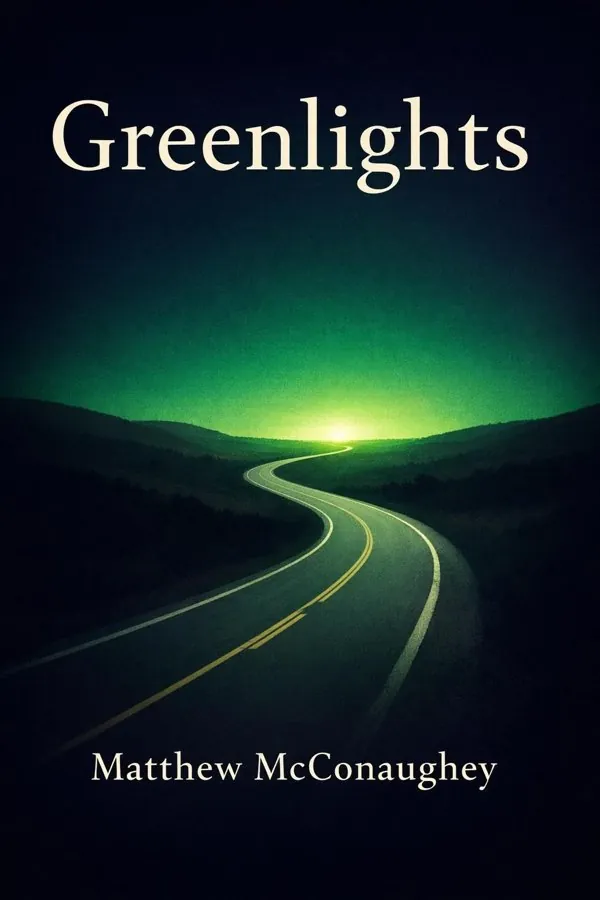
Greenlights: Summary & Key Insights
 10 min8 chaptersAudio available
Key Takeaways from Greenlights
Character is often shaped long before ambition has a name.
Many life-changing decisions begin as detours, not master plans.
Success can be just as disorienting as failure.
The heart rarely grows through comfort alone.
Sometimes you have to leave your life to see it clearly.
What Is Greenlights About?
Greenlights by Matthew McConaughey is a memoir book published in 2020 spanning 6 pages. Greenlights is Matthew McConaughey’s unconventional memoir, a mix of personal history, travel journal, spiritual reflection, comic storytelling, and hard-earned life philosophy. Drawn from decades of diaries he kept through fame, failure, love, wild adventures, and private reckoning, the book asks a simple but powerful question: how do we recognize the moments when life is telling us to move forward? McConaughey calls those moments “greenlights.” More importantly, he argues that even red lights and yellow lights can eventually become green if we meet them with courage, patience, humor, and honesty. That idea gives the memoir its emotional core. This is not a celebrity tell-all built on gossip or image management. It is a deeply personal account of family chaos, artistic ambition, romantic detours, grief, faith, reinvention, and the search for self-trust. McConaughey writes with the swagger and rhythm that made him famous, but beneath the charm is a serious philosophy about resilience and authenticity. The result is a memoir that entertains while also offering a practical mindset for navigating uncertainty, setbacks, success, and the long road toward a life that feels truly your own.
This FizzRead summary covers all 8 key chapters of Greenlights in approximately 10 minutes, distilling the most important ideas, arguments, and takeaways from Matthew McConaughey's work. Also available as an audio summary and Key Quotes Podcast.
Greenlights
Greenlights is Matthew McConaughey’s unconventional memoir, a mix of personal history, travel journal, spiritual reflection, comic storytelling, and hard-earned life philosophy. Drawn from decades of diaries he kept through fame, failure, love, wild adventures, and private reckoning, the book asks a simple but powerful question: how do we recognize the moments when life is telling us to move forward? McConaughey calls those moments “greenlights.” More importantly, he argues that even red lights and yellow lights can eventually become green if we meet them with courage, patience, humor, and honesty. That idea gives the memoir its emotional core. This is not a celebrity tell-all built on gossip or image management. It is a deeply personal account of family chaos, artistic ambition, romantic detours, grief, faith, reinvention, and the search for self-trust. McConaughey writes with the swagger and rhythm that made him famous, but beneath the charm is a serious philosophy about resilience and authenticity. The result is a memoir that entertains while also offering a practical mindset for navigating uncertainty, setbacks, success, and the long road toward a life that feels truly your own.
Who Should Read Greenlights?
This book is perfect for anyone interested in memoir and looking to gain actionable insights in a short read. Whether you're a student, professional, or lifelong learner, the key ideas from Greenlights by Matthew McConaughey will help you think differently.
- ✓Readers who enjoy memoir and want practical takeaways
- ✓Professionals looking to apply new ideas to their work and life
- ✓Anyone who wants the core insights of Greenlights in just 10 minutes
Want the full summary?
Get instant access to this book summary and 100K+ more with Fizz Moment.
Get Free SummaryAvailable on App Store • Free to download
Key Chapters
Character is often shaped long before ambition has a name. In Greenlights, McConaughey begins in Uvalde, Texas, where family life was loud, volatile, affectionate, and deeply formative. His childhood was filled with discipline, rough humor, storytelling, religious faith, and parents who loved fiercely even when that love looked messy. His mother was dramatic, expressive, and socially sharp. His father was physically tough, emotionally intense, and guided by a strong code. Together, they created a home where conflict and loyalty lived side by side. McConaughey learned early that life would not always be gentle, and that toughness means more than force; it means staying standing through contradiction.
These early years matter because they gave him a framework he would carry into adulthood. He absorbed a belief in personal responsibility, self-reliance, boldness, and the value of owning his choices. He also learned that identity is not polished into existence; it is forged through friction. The Texas setting becomes more than a backdrop. It represents a worldview rooted in grit, humor, pride, and the instinct to keep going even when things turn chaotic.
For readers, this idea has practical value. Our beginnings may be imperfect, but they still contain clues to our strengths. Family patterns can wound us, but they can also teach resilience, loyalty, and perspective. Instead of rejecting your roots entirely or romanticizing them, study them. Ask what habits, beliefs, and survival skills came from where you started. The actionable takeaway: identify three lessons your upbringing gave you that still serve you today, and use them consciously as anchors when life feels uncertain.
Many life-changing decisions begin as detours, not master plans. McConaughey went to the University of Texas intending to pursue law, largely because it seemed respectable, stable, and smart. Like many young adults, he followed a path that made sense on paper before he discovered what actually made him feel alive. The shift toward film and acting did not arrive as one dramatic revelation. It emerged through curiosity, exposure, and the slow recognition that his inner pull was stronger than his inherited script.
That transition captures one of the memoir’s recurring truths: clarity often comes from paying attention to what energizes you, not just what impresses others. McConaughey did not stumble into acting because it promised glamour. He found it because it connected with something more authentic in him. He was learning to trust instinct over convention. That choice required risk, especially because changing direction can look irresponsible from the outside. Yet Greenlights repeatedly argues that misalignment is a greater danger than uncertainty.
This lesson applies far beyond career choice. People stay in majors, jobs, relationships, and routines that win approval but drain their spirit. McConaughey’s story encourages a different kind of listening. Notice when your curiosity keeps returning to the same place. Notice where effort feels meaningful instead of merely obligatory. A practical application is to compare the activities that leave you energized with the ones that leave you numb. The actionable takeaway: make one concrete move toward what consistently draws your interest, even if it starts small, because real direction is often discovered through movement rather than overthinking.
Success can be just as disorienting as failure. Once McConaughey became a rising star, he entered a world that rewarded image, repetition, and commercial predictability. Fame brought money, validation, access, and visibility, but it also introduced pressure to keep delivering the same version of himself. Greenlights shows that public success can become a private trap when the industry wants a brand while the person inside keeps evolving. McConaughey became known for romantic comedies and easy charisma, yet over time he felt that the roles no longer matched the actor he wanted to become.
What makes this section compelling is that he does not frame reinvention as glamorous. It was costly. Saying no to familiar roles meant risking income, status, momentum, and relevance. He stepped away from parts that would have kept him safely visible in order to wait for work that felt more honest. That patience eventually led to a creative resurgence and some of his strongest performances. The deeper lesson is that authenticity often requires a period of strategic absence. Sometimes you have to disappoint expectations in order to stop performing a version of yourself that no longer fits.
This idea is highly practical for anyone who feels boxed in by earlier success. A promotion, a reputation, or even a personality label can quietly become a cage. Growth may require refusing opportunities that look good but move you further from yourself. The actionable takeaway: identify one role, habit, or expectation you maintain mainly because others expect it, and consider what boundary or pause would create space for a more truthful next chapter.
The heart rarely grows through comfort alone. Throughout Greenlights, McConaughey reflects on romance, family bonds, friendship, fatherhood, and grief as forces that strip away illusion. Love, in his telling, is not merely emotional sweetness; it is commitment, vulnerability, timing, sacrifice, and attention. Relationships reveal who we are when charm is gone and control disappears. They also expose how much of life cannot be managed through ambition alone.
Loss plays an equally important role. The death of his father is one of the memoir’s defining moments, not only because of the pain but because of the perspective it forced. Grief sharpened his understanding of legacy, masculinity, and what it means to inherit both strength and burden from those who raised us. Fatherhood later deepened this inquiry by moving him from being a son shaped by family history to becoming a man responsible for shaping it. In these passages, Greenlights becomes less about career and more about tenderness, memory, and the emotional accountability that comes with real connection.
For readers, the practical lesson is that relationships cannot be treated as side notes to achievement. The people we love often become our clearest mirrors. They reveal our fears, selfishness, patience, and capacity for grace. They also remind us that time is not endless. Instead of waiting for ideal conditions to express affection or repair distance, act while the moment is available. The actionable takeaway: reach out to one person who matters to you and say clearly what you appreciate, what you regret, or what you want to rebuild before another season passes.
Sometimes you have to leave your life to see it clearly. McConaughey’s travels through places like Australia, Mali, Peru, and the Amazon are not included merely to entertain. They function as tests of identity. In unfamiliar environments, stripped of comfort and routine, he confronts fear, ego, loneliness, privilege, and wonder. Adventure becomes a tool for self-knowledge. When the usual markers of status disappear, you meet the person underneath the performance.
Greenlights treats risk as more than thrill-seeking. Adventure can be physical, spiritual, creative, or relational. It means entering spaces where outcomes are not guaranteed and where control is limited. McConaughey repeatedly finds that discomfort can sharpen presence. Foreign cultures, dangerous situations, and solitary experiences all challenge him to adapt, listen, and trust intuition. The result is a broader philosophy: growth often comes when we stop trying to make every environment familiar and instead allow ourselves to be changed by what we encounter.
Readers do not need to travel across continents to apply this lesson. Adventure can mean taking a class outside your expertise, spending time alone without distraction, starting a project with no certainty of success, or immersing yourself in a community unlike your own. The point is to interrupt autopilot. Routine creates efficiency, but too much of it can shrink perception. The actionable takeaway: choose one manageable but meaningful discomfort this month—something that stretches your assumptions or abilities—and approach it not as a disruption, but as training for a larger, freer life.
A life philosophy matters most when things stop making sense. McConaughey’s spirituality is eclectic, personal, and grounded less in rigid doctrine than in reverence, gratitude, faith, and attention to signs. He writes as someone who believes life is not random noise, even when it feels chaotic. The idea of greenlights emerges from this worldview: obstacles may contain instruction, delays may hold timing, and struggle may become useful if interpreted with enough patience and humility.
What gives this perspective weight is that it does not deny difficulty. McConaughey does not suggest that pain is pleasant or that everything works out neatly. Instead, he argues that our relationship to events shapes what they become. A red light can remain frustration, or it can become preparation. A wrong turn can become experience. Gratitude, in this framework, is not naive positivity. It is a discipline of seeing value before circumstances fully confirm it. This helps explain the memoir’s tone: buoyant, yes, but also forged through trial.
For modern readers surrounded by distraction, cynicism, and speed, this lesson offers practical grounding. Spirituality need not mean certainty about everything. It can mean cultivating a habit of reflection strong enough to transform reaction into meaning. Journaling, prayer, meditation, solitude, and daily gratitude all help create that inner space. The actionable takeaway: at the end of each day, write down one challenge you faced and one way it may be helping you grow, even if the answer is incomplete. Meaning often appears when we give experience enough room to speak.
Memory is selective, but journals keep receipts. One of the most distinctive features of Greenlights is that it draws from decades of McConaughey’s personal notebooks. These journals preserve his ambitions, mistakes, adventures, beliefs, quotes, poems, prayers, and observations across many stages of life. They allow him to look back and find patterns he could not fully see while living through them. In that sense, journaling becomes more than self-expression. It becomes evidence, perspective, and self-confrontation.
This matters because many people move through life without a reliable record of who they were, what they wanted, or what they learned. Without reflection, experiences pile up but wisdom does not always form. McConaughey’s journals help him notice recurring fears, values, desires, and turning points. They also reveal how often confusion later becomes coherence. What looked random in the moment sometimes becomes understandable in hindsight. That is one reason the memoir feels both spontaneous and intentional: the journals gave him a map of his own becoming.
You do not need to be a writer to use this practice well. A journal can hold a few honest lines a day: what happened, how you felt, what you learned, what you are avoiding, what you are grateful for. Over time, these entries become a mirror more accurate than mood alone. They can show where you betray yourself, where you thrive, and what keeps repeating until it is faced. The actionable takeaway: start a simple daily journal for two weeks with three prompts—What happened? What mattered? What am I learning?—and review it at the end for patterns.
Not every breakthrough comes from pushing harder; some come from waiting longer. A major theme in Greenlights is McConaughey’s willingness to step back when his life or career no longer aligned with his values. Instead of clinging to visibility, he accepted uncertainty in order to create space for something truer. That kind of reinvention is difficult because the world tends to reward momentum, not pause. Yet the memoir insists that strategic patience is often a form of courage.
McConaughey’s career transition demonstrates this vividly. He turned down lucrative, familiar work and endured a period when it was not clear whether Hollywood would invite him back on new terms. This was not passive waiting. It was active refusal: refusing to settle, refusing to keep repeating a successful formula, refusing to confuse popularity with purpose. Eventually, that patience made room for more complex roles and a deeper artistic identity. The same principle appears in his personal life. Whether in love, fatherhood, or self-understanding, maturation often required restraint rather than immediate gratification.
This lesson is especially relevant in a culture obsessed with constant output. Sometimes the next right move is not acceleration but discernment. If your current path is profitable, impressive, or familiar but increasingly false, speed will not fix it. You may need to tolerate silence, ambiguity, or temporary irrelevance while a better direction takes shape. The actionable takeaway: choose one area where you feel pressured to act fast, and ask whether a deliberate pause, a clear no, or a season of preparation might actually be the move that leads to your next true greenlight.
All Chapters in Greenlights
About the Author
Matthew McConaughey is an Academy Award-winning American actor, producer, and author born in Uvalde, Texas, in 1969. He studied at the University of Texas at Austin before pursuing acting and rose to fame in the 1990s with roles that showcased his charm and screen presence. Over time, he expanded beyond romantic leads into acclaimed dramatic performances in films such as Dallas Buyers Club, Mud, and Interstellar, as well as the television series True Detective. Known for his distinctive voice, laid-back confidence, and reflective worldview, McConaughey has built a reputation as both a performer and a storyteller. In Greenlights, he draws on decades of personal journals to share the experiences and beliefs that shaped his life, career, and philosophy.
Get This Summary in Your Preferred Format
Read or listen to the Greenlights summary by Matthew McConaughey anytime, anywhere. FizzRead offers multiple formats so you can learn on your terms — all free.
Available formats: App · Audio · PDF · EPUB — All included free with FizzRead
Download Greenlights PDF and EPUB Summary
Key Quotes from Greenlights
“Character is often shaped long before ambition has a name.”
“Many life-changing decisions begin as detours, not master plans.”
“Success can be just as disorienting as failure.”
“The heart rarely grows through comfort alone.”
“Sometimes you have to leave your life to see it clearly.”
Frequently Asked Questions about Greenlights
Greenlights by Matthew McConaughey is a memoir book that explores key ideas across 8 chapters. Greenlights is Matthew McConaughey’s unconventional memoir, a mix of personal history, travel journal, spiritual reflection, comic storytelling, and hard-earned life philosophy. Drawn from decades of diaries he kept through fame, failure, love, wild adventures, and private reckoning, the book asks a simple but powerful question: how do we recognize the moments when life is telling us to move forward? McConaughey calls those moments “greenlights.” More importantly, he argues that even red lights and yellow lights can eventually become green if we meet them with courage, patience, humor, and honesty. That idea gives the memoir its emotional core. This is not a celebrity tell-all built on gossip or image management. It is a deeply personal account of family chaos, artistic ambition, romantic detours, grief, faith, reinvention, and the search for self-trust. McConaughey writes with the swagger and rhythm that made him famous, but beneath the charm is a serious philosophy about resilience and authenticity. The result is a memoir that entertains while also offering a practical mindset for navigating uncertainty, setbacks, success, and the long road toward a life that feels truly your own.
Compare Greenlights

You Might Also Like
Featured In
Browse by Category
Ready to read Greenlights?
Get the full summary and 100K+ more books with Fizz Moment.