
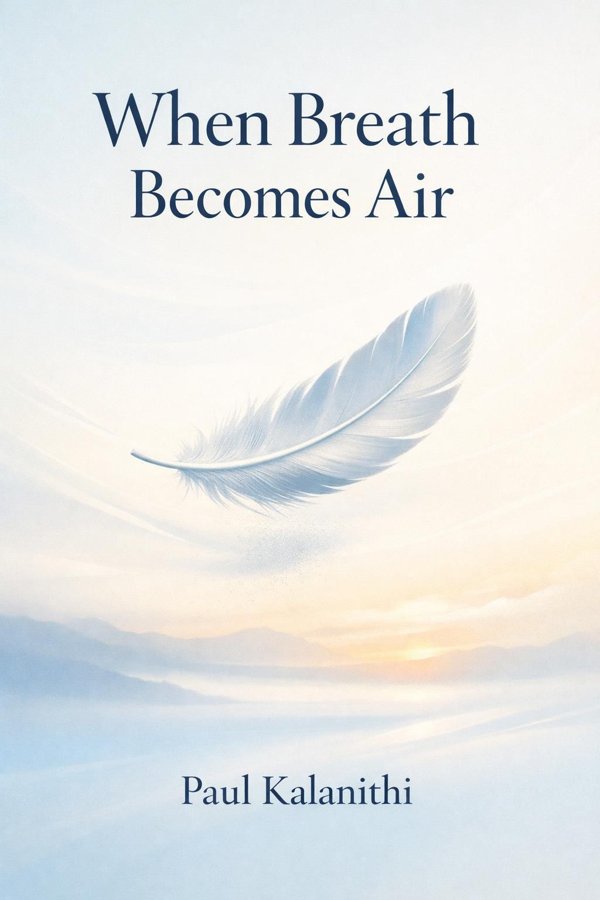
When Breath Becomes Air: Summary & Key Insights
 10 min7 chaptersAudio available
Key Takeaways from When Breath Becomes Air
Kalanithi’s early life in the Arizona desert becomes the first lens through which he learns to think about vastness, solitude, and human smallness.
At Cambridge, Kalanithi deepens the intellectual search that had already shaped his life.
In medicine, and especially in neurosurgery, Kalanithi finds the place where his intellectual and moral questions become real.
The memoir’s emotional center arrives when Kalanithi, after years of diagnosing others, becomes a patient himself.
As illness advances, Kalanithi is forced to rebuild his sense of self around realities he did not choose.
What Is When Breath Becomes Air About?
When Breath Becomes Air by Paul Kalanithi is a memoir book published in 2016 spanning 7 pages. What do you do when the future you spent years building suddenly disappears? In *When Breath Becomes Air*, Paul Kalanithi confronts that question with unusual honesty, intelligence, and grace. This memoir is far more than a cancer narrative. It is a profound meditation on mortality, identity, purpose, and the fragile line between doctor and patient. As a neurosurgeon, Kalanithi devoted his life to operating on the organ that creates thought, memory, personality, and selfhood. As a writer and lifelong reader, he also understood that science alone cannot answer the deepest human questions. That rare combination gives this book its power. Kalanithi brings together medicine, philosophy, literature, and lived experience to ask what makes life meaningful when time is limited. His reflections resonate with anyone facing uncertainty, loss, ambition, or the search for a life worth living. Because he writes from both sides of the hospital bed, his insights feel especially hard-won. *When Breath Becomes Air* matters because it reminds us that death is not only a medical event. It is also a mirror, showing us how we choose to live.
This FizzRead summary covers all 7 key chapters of When Breath Becomes Air in approximately 10 minutes, distilling the most important ideas, arguments, and takeaways from Paul Kalanithi's work. Also available as an audio summary and Key Quotes Podcast.
When Breath Becomes Air
What do you do when the future you spent years building suddenly disappears? In *When Breath Becomes Air*, Paul Kalanithi confronts that question with unusual honesty, intelligence, and grace. This memoir is far more than a cancer narrative. It is a profound meditation on mortality, identity, purpose, and the fragile line between doctor and patient. As a neurosurgeon, Kalanithi devoted his life to operating on the organ that creates thought, memory, personality, and selfhood. As a writer and lifelong reader, he also understood that science alone cannot answer the deepest human questions. That rare combination gives this book its power. Kalanithi brings together medicine, philosophy, literature, and lived experience to ask what makes life meaningful when time is limited. His reflections resonate with anyone facing uncertainty, loss, ambition, or the search for a life worth living. Because he writes from both sides of the hospital bed, his insights feel especially hard-won. *When Breath Becomes Air* matters because it reminds us that death is not only a medical event. It is also a mirror, showing us how we choose to live.
Who Should Read When Breath Becomes Air?
This book is perfect for anyone interested in memoir and looking to gain actionable insights in a short read. Whether you're a student, professional, or lifelong learner, the key ideas from When Breath Becomes Air by Paul Kalanithi will help you think differently.
- ✓Readers who enjoy memoir and want practical takeaways
- ✓Professionals looking to apply new ideas to their work and life
- ✓Anyone who wants the core insights of When Breath Becomes Air in just 10 minutes
Want the full summary?
Get instant access to this book summary and 100K+ more with Fizz Moment.
Get Free SummaryAvailable on App Store • Free to download
Key Chapters
Kalanithi’s early life in the Arizona desert becomes the first lens through which he learns to think about vastness, solitude, and human smallness. The landscape around him was stark and expansive, and that setting seems to have planted the central question that follows him throughout the memoir: how do finite lives create enduring meaning? Books became one answer. His mother’s belief in education gave him access to literature that pushed him far beyond ordinary childhood concerns. He was not simply reading for entertainment; he was training himself to examine suffering, beauty, morality, and identity.
At Stanford, that curiosity split into two equally powerful loves: English literature and human biology. Rather than choosing one over the other, Kalanithi treated both as necessary tools for understanding life. Literature gave him language for inner experience; biology explained the physical systems that make experience possible. That pairing is a useful model for readers today. We often separate technical competence from emotional depth, but Kalanithi shows that wisdom requires both. One practical lesson here is to resist false choices in your own life. If you care about art and analysis, compassion and rigor, meaning and achievement, you may not need to choose. His path suggests that the richest vocations often emerge where disciplines meet.
At Cambridge, Kalanithi deepens the intellectual search that had already shaped his life. He turns to the philosophy of science and, especially, the mystery of consciousness: how can matter give rise to mind, self-awareness, and the sense of being alive? This is not abstract curiosity for its own sake. For Kalanithi, the question matters because any attempt to understand death must first wrestle with what life actually is. If consciousness is central to personhood, then illness, injury, and mortality become more than biological problems; they become existential ones.
His study of philosophy helps him see that death gives shape to human meaning. We do not live despite finitude but within it. That insight is deeply practical. Many readers spend energy trying to avoid the thought of death, as if ignoring it will make life feel safer. Kalanithi suggests the opposite: awareness of mortality can clarify priorities. It can strip away vanity, urgency without purpose, and borrowed ambitions. A useful takeaway is to ask a version of his central question in everyday life: if time is limited, what deserves my attention now? Cambridge does not give him final answers, but it refines his method. When ideas reach their limits, he realizes he must enter a field where mortality is encountered directly. That realization sends him toward medicine.
In medicine, and especially in neurosurgery, Kalanithi finds the place where his intellectual and moral questions become real. The operating room is not just a site of technical performance. It is where decisions can determine whether a person wakes up able to speak, move, remember, or remain themselves. Neurosurgery demands precision, stamina, and emotional discipline, but Kalanithi makes clear that it also demands humility. A surgeon does not merely treat tissue; he intervenes in the physical basis of identity.
This chapter’s core insight is that vocation is built not only from talent but from responsibility. Kalanithi is drawn to neurosurgery because it sits at the intersection of meaning and matter. Each patient forces him to balance hope with honesty, skill with uncertainty, compassion with clinical judgment. One especially valuable lesson for readers is how he approaches difficult work: not by pretending it is easy, but by accepting its stakes. In any profession, there are moments when expertise alone is not enough and character must carry the burden. Kalanithi also shows that meaningful work often involves proximity to suffering. Rather than avoiding hard realities, he learns to stand beside them. That is what transforms medicine from a career into a calling.
The memoir’s emotional center arrives when Kalanithi, after years of diagnosing others, becomes a patient himself. The shift is abrupt and devastating. Symptoms that might once have been clinical data now carry personal terror. Scans, consultations, prognoses, and treatment plans are no longer part of his professional environment; they are the new structure of his own life. This reversal exposes how fragile identity can be when it is tied too tightly to competence, control, and future plans.
As a doctor, he had learned to manage uncertainty in others. As a patient, he must endure uncertainty from the inside. That distinction changes everything. Time becomes unstable. Career milestones lose their old logic. The body that once enabled his work now sets the limits. One of the most powerful lessons here is that crisis often strips life down to essentials. Kalanithi can no longer ask, “What will I achieve over decades?” Instead he must ask, “What is worth doing with the time I have?” That is an actionable question for anyone, not only those facing illness. His experience also deepens empathy. He sees more clearly how vulnerable patients feel and how much careful communication matters. The chapter reminds us that expertise does not exempt anyone from fear, and that dignity often begins with acknowledging dependence.
As illness advances, Kalanithi is forced to rebuild his sense of self around realities he did not choose. The old markers of progress, training, productivity, status, and professional momentum can no longer serve as the sole measure of a life. In their place, he turns more fully toward relationship, belief, and the deeper purpose beneath work. This is one of the memoir’s most humane insights: when circumstances strip away what we do, we are left to discover who we are and what we owe others.
Faith in this book is not presented as easy certainty. It is closer to a way of holding meaning when answers remain incomplete. Family, especially his relationship with his wife, becomes a place of courage, tenderness, and truth-telling. Vocation also changes form. Even when illness threatens his ability to practice medicine in the old way, his desire to serve does not vanish. Instead it evolves. He begins to see that usefulness is not identical with productivity, and purpose can survive even when performance is reduced.
A practical takeaway is to build identity on more than achievement. Careers can be interrupted, bodies can fail, plans can collapse. But love, integrity, and presence remain available forms of purpose. Kalanithi shows that a meaningful life is not measured only by duration or output, but by fidelity to what matters most.
One of the memoir’s most moving turns is Kalanithi’s decision to become a father even while facing terminal illness. On the surface, the choice seems paradoxical. Why welcome new life when your own is ending? Yet this decision captures the book’s deepest refusal: the refusal to let death dictate the full meaning of life. Fatherhood becomes an act of hope, continuity, and love, not denial. It reflects Kalanithi’s belief that meaning is not erased by finitude; it is often intensified by it.
His reflections on parenthood are especially powerful because they reject the fantasy of perfect timing. Modern life often encourages us to wait until circumstances are fully secure before we commit to love, family, or purpose. Kalanithi’s situation reveals that certainty is rarely available. The question is not whether life is risk-free, but whether something is meaningful enough to embrace despite risk. That insight applies well beyond parenting. Important decisions, marriage, creative work, service, reconciliation, are often made without guarantees.
Becoming a father also reorients his attention from legacy in the abstract to love in the concrete. A child does not solve mortality, but she gives shape to what remains. The lesson is simple and profound: even at the edge of loss, human beings can still choose generativity.
Writing becomes Kalanithi’s final form of practice, a way to keep serving others when medicine is no longer fully possible. The title itself, *When Breath Becomes Air*, captures the transition from embodied life to absence, from speech to silence, from animation to memory. Yet the book does not feel defeated. Through writing, Kalanithi transforms private suffering into shared meaning. He offers readers not instructions for dying, but a language for living honestly in the face of death.
This final chapter underscores the power of narrative. Facts explain what happened; story helps us understand what it meant. Kalanithi writes with the discipline of a physician and the sensitivity of a literary mind, which allows him to bridge clinical reality and emotional truth. For readers, this is an invitation to reflect on their own lives through language. Journaling, letters, conversations, and memoir are not only creative exercises; they can become tools for clarifying values and preserving what matters.
Perhaps the most enduring insight here is that meaning can outlast the body through witness. Kalanithi cannot control the ending, but he can shape his response to it. In doing so, he leaves behind something generous: a reminder that even when life narrows, our capacity to tell the truth, love others, and create significance remains.
All Chapters in When Breath Becomes Air
About the Author
Paul Kalanithi (1977–2015) was an American neurosurgeon and writer whose work bridged medicine, literature, and philosophy. He earned degrees in English literature and human biology from Stanford University, a Master of Philosophy from Cambridge, and a medical degree from Yale School of Medicine. His unusual academic path gave him a rare ability to explore both the scientific and human sides of mortality. Kalanithi wrote *When Breath Becomes Air* during the final stage of his life after being diagnosed with terminal lung cancer. The memoir was published posthumously and became widely admired for its clarity, compassion, and profound reflections on what makes life meaningful.
Get This Summary in Your Preferred Format
Read or listen to the When Breath Becomes Air summary by Paul Kalanithi anytime, anywhere. FizzRead offers multiple formats so you can learn on your terms — all free.
Available formats: App · Audio · PDF · EPUB — All included free with FizzRead
Download When Breath Becomes Air PDF and EPUB Summary
Key Quotes from When Breath Becomes Air
“Kalanithi’s early life in the Arizona desert becomes the first lens through which he learns to think about vastness, solitude, and human smallness.”
“At Cambridge, Kalanithi deepens the intellectual search that had already shaped his life.”
“In medicine, and especially in neurosurgery, Kalanithi finds the place where his intellectual and moral questions become real.”
“The memoir’s emotional center arrives when Kalanithi, after years of diagnosing others, becomes a patient himself.”
“As illness advances, Kalanithi is forced to rebuild his sense of self around realities he did not choose.”
Frequently Asked Questions about When Breath Becomes Air
When Breath Becomes Air by Paul Kalanithi is a memoir book that explores key ideas across 7 chapters. What do you do when the future you spent years building suddenly disappears? In *When Breath Becomes Air*, Paul Kalanithi confronts that question with unusual honesty, intelligence, and grace. This memoir is far more than a cancer narrative. It is a profound meditation on mortality, identity, purpose, and the fragile line between doctor and patient. As a neurosurgeon, Kalanithi devoted his life to operating on the organ that creates thought, memory, personality, and selfhood. As a writer and lifelong reader, he also understood that science alone cannot answer the deepest human questions. That rare combination gives this book its power. Kalanithi brings together medicine, philosophy, literature, and lived experience to ask what makes life meaningful when time is limited. His reflections resonate with anyone facing uncertainty, loss, ambition, or the search for a life worth living. Because he writes from both sides of the hospital bed, his insights feel especially hard-won. *When Breath Becomes Air* matters because it reminds us that death is not only a medical event. It is also a mirror, showing us how we choose to live.
Compare When Breath Becomes Air




You Might Also Like


Featured In
Oprah Winfrey's Book Picks
Oprah's Book Club Favorites That Changed Millions of Lives
Barack Obama's Book Picks
Barack Obama's Reading List: Books That Shaped a President
Brené Brown's Book Picks
Brené Brown's Bookshelf: Reads on Courage, Vulnerability, and Connection
Curated's Book Picks
Best Biographies & Memoirs — Lives That Inspire
Curated's Book Picks
Best Books for Women — Empowering Reads
Browse by Category
Ready to read When Breath Becomes Air?
Get the full summary and 100K+ more books with Fizz Moment.