
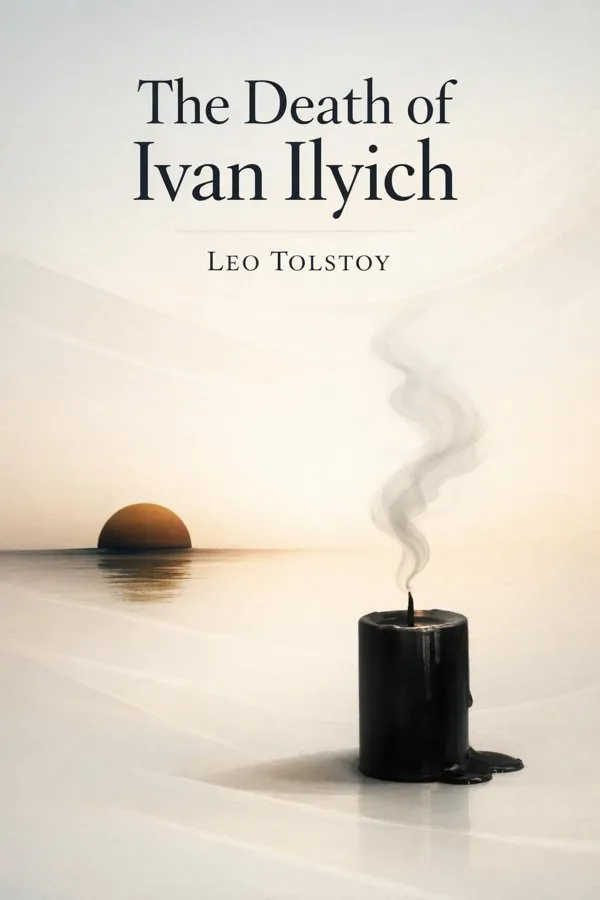
The Death of Ivan Ilyich: Summary & Key Insights
by Leo Tolstoy
 10 min9 chaptersAudio available
Key Takeaways from The Death of Ivan Ilyich
One of Tolstoy’s most unsettling insights is that a life can look completely successful from the outside and still be spiritually empty within.
Tolstoy shows that relationships built on convenience rather than tenderness can become emotionally corrosive long before they visibly fail.
A prestigious profession can provide identity, distraction, and self-respect, but it can also become a shelter from deeper moral questions.
Nothing reveals the fragility of human certainty faster than the body’s refusal to obey.
One of the most painful aspects of Ivan’s suffering is not only the illness itself but the falsehood surrounding it.
What Is The Death of Ivan Ilyich About?
The Death of Ivan Ilyich by Leo Tolstoy is a fiction book published in 2008 spanning 11 pages. The Death of Ivan Ilyich is Leo Tolstoy’s piercing novella about a successful judge whose ordinary, respectable life is shattered by terminal illness. At first glance, Ivan Ilyich appears to have done everything right: he has pursued a proper education, advanced in his career, married appropriately, furnished his home tastefully, and secured social approval. Yet when death approaches, he is forced to confront a devastating question: what if the life he considered proper was not truly meaningful at all? Tolstoy transforms this private crisis into a profound meditation on mortality, self-deception, suffering, and spiritual awakening. The novella matters because it strips away the comforting illusions people often build around status, routine, and external success, revealing how easily a socially admirable life can conceal emotional emptiness and moral compromise. Few writers have examined death with such psychological precision and moral seriousness. Tolstoy, one of literature’s greatest novelists and a thinker deeply preoccupied with ethics and faith, brings rare authority to this subject. The result is a short work of fiction that feels uncomfortably personal, enduringly wise, and urgently relevant to anyone who has ever wondered what it means to live well before it is too late.
This FizzRead summary covers all 9 key chapters of The Death of Ivan Ilyich in approximately 10 minutes, distilling the most important ideas, arguments, and takeaways from Leo Tolstoy's work. Also available as an audio summary and Key Quotes Podcast.
The Death of Ivan Ilyich
The Death of Ivan Ilyich is Leo Tolstoy’s piercing novella about a successful judge whose ordinary, respectable life is shattered by terminal illness. At first glance, Ivan Ilyich appears to have done everything right: he has pursued a proper education, advanced in his career, married appropriately, furnished his home tastefully, and secured social approval. Yet when death approaches, he is forced to confront a devastating question: what if the life he considered proper was not truly meaningful at all? Tolstoy transforms this private crisis into a profound meditation on mortality, self-deception, suffering, and spiritual awakening. The novella matters because it strips away the comforting illusions people often build around status, routine, and external success, revealing how easily a socially admirable life can conceal emotional emptiness and moral compromise. Few writers have examined death with such psychological precision and moral seriousness. Tolstoy, one of literature’s greatest novelists and a thinker deeply preoccupied with ethics and faith, brings rare authority to this subject. The result is a short work of fiction that feels uncomfortably personal, enduringly wise, and urgently relevant to anyone who has ever wondered what it means to live well before it is too late.
Who Should Read The Death of Ivan Ilyich?
This book is perfect for anyone interested in fiction and looking to gain actionable insights in a short read. Whether you're a student, professional, or lifelong learner, the key ideas from The Death of Ivan Ilyich by Leo Tolstoy will help you think differently.
- ✓Readers who enjoy fiction and want practical takeaways
- ✓Professionals looking to apply new ideas to their work and life
- ✓Anyone who wants the core insights of The Death of Ivan Ilyich in just 10 minutes
Want the full summary?
Get instant access to this book summary and 100K+ more with Fizz Moment.
Get Free SummaryAvailable on App Store • Free to download
Key Chapters
One of Tolstoy’s most unsettling insights is that a life can look completely successful from the outside and still be spiritually empty within. Ivan Ilyich is not a villain, nor is he a spectacularly immoral man. He is, in many ways, ordinary. He studies, advances in the legal profession, behaves according to convention, and takes pride in his respectability. This is precisely what makes Tolstoy’s portrait so powerful. Ivan’s tragedy is not that he chose obvious evil, but that he uncritically accepted society’s definition of a good life: comfort, promotion, decorum, and approval.
Throughout his early and middle years, Ivan is guided less by inner conviction than by what is considered proper. He learns to value appearances, administrative order, and social ease. Even his pleasures are safe, conventional, and curated to reinforce his identity as a successful man. Tolstoy suggests that moral danger often enters quietly through imitation. We do not need to commit a dramatic wrongdoing to lose ourselves; we need only drift into a life built on habit, status, and external validation.
This idea remains sharply relevant. Many people pursue prestigious careers, attractive homes, polished relationships, or public recognition without ever asking whether those things express their deepest values. A life assembled according to other people’s expectations can feel stable for years, until crisis exposes the absence at its center.
Tolstoy is not arguing against ambition or order themselves. He is asking whether our choices are truly ours. The essential question is whether success reflects genuine purpose or merely social compliance. Actionable takeaway: identify one area of your life where you are following convention by default, and ask whether it genuinely reflects what you believe matters most.
Tolstoy shows that relationships built on convenience rather than tenderness can become emotionally corrosive long before they visibly fail. Ivan’s marriage to Praskovya begins not in deep mutual understanding but in social suitability. She is an acceptable match, and marriage fits naturally into the kind of life Ivan believes he should be building. At first, the arrangement seems manageable, even pleasant. But when irritation, pregnancy, financial pressures, and mutual disappointments emerge, the lack of real intimacy becomes impossible to ignore.
Instead of turning toward one another with honesty, Ivan and Praskovya settle into roles. He retreats into work and formal habits. She becomes demanding, resentful, and focused on domestic grievances. Their household is maintained not by affection but by protocol. Tolstoy is not merely criticizing one unhappy marriage; he is illustrating how social institutions can become empty shells when people use them for security, image, or convenience rather than shared truth.
The practical relevance is broad. Many relationships survive through logistics, duty, and appearance while emotional connection quietly disappears. People may continue to function as a family in public while privately living in defensiveness, disappointment, and avoidance. The cost of such arrangements often becomes clearest during illness or suffering, when superficial bonds offer little comfort.
What gives this theme its force is that Tolstoy does not present domestic unhappiness as exceptional. He presents it as a predictable result of emotional dishonesty. A relationship cannot nourish the soul if both people are more committed to appearances than vulnerability.
Actionable takeaway: in one important relationship, replace polite performance with one honest conversation about fear, resentment, or longing. Genuine closeness begins where social role-playing ends.
A prestigious profession can provide identity, distraction, and self-respect, but it can also become a shelter from deeper moral questions. Ivan Ilyich thrives in the judicial world because it rewards exactly the qualities he has cultivated: formality, restraint, procedural competence, and the ability to separate personal feeling from official duty. He enjoys the power of his position, the rhythm of administrative life, and the satisfaction of being recognized as capable and proper.
Tolstoy’s critique is subtle. He does not suggest that Ivan’s work is inherently corrupt. Rather, he shows how professional success can encourage a kind of inner numbness. Ivan learns to value efficiency over empathy, correctness over conscience, and advancement over reflection. His role gives him a framework within which everything appears orderly, controlled, and rational. That sense of control becomes central to his self-understanding.
This dynamic is highly recognizable today. A demanding career can become more than employment; it can become an emotional strategy. Work can protect us from examining unhappiness at home, uncertainty about our values, or anxiety about mortality. Promotions and titles can feel like proof that life is meaningful, even if they do not answer the deeper question of whether we are becoming wise, compassionate, or alive.
Tolstoy asks us to consider the difference between being professionally accomplished and being spiritually awake. These are not the same achievement. A person may be admired in institutions and still remain estranged from truth.
The key lesson is not to reject work, but to refuse to let career define the whole self. If our worth depends entirely on our role, then illness, retirement, or failure can collapse our identity overnight. Actionable takeaway: examine whether your work serves your values, or whether your values have quietly been rearranged to serve your work.
Nothing reveals the fragility of human certainty faster than the body’s refusal to obey. Ivan’s illness begins with what seems like a minor physical issue, but it gradually deepens into chronic pain, weakness, and dread. At first he responds as he has always responded to problems: with practical thinking, social normalcy, and confidence in systems. He assumes that medicine, diagnosis, and proper procedure will restore order. But illness does not behave like a courtroom case or a domestic inconvenience. It interrupts every category by which he has organized his life.
Tolstoy captures the psychological violence of becoming a patient. Ivan is no longer the competent official managing events; he is now an object of examination, speculation, and decline. The habits that once protected him from uncertainty no longer work. Illness exposes the limits of status, intelligence, and etiquette. Pain makes abstraction impossible.
This theme speaks far beyond Ivan’s specific condition. Modern life often encourages the fantasy that health, planning, and professional systems can secure us against vulnerability. We optimize schedules, finances, careers, and lifestyles as if existence can be stabilized through management. Then a diagnosis, accident, or personal loss reveals that much of what we call control is temporary coordination.
Tolstoy does not present this revelation as merely cruel. It is also clarifying. When the illusion of control collapses, more fundamental questions come forward: What have I loved? What have I avoided? What remains when competence fails?
Actionable takeaway: do not wait for crisis to ask what matters beyond control. Build some regular practice now, such as reflection, prayer, journaling, or honest conversation, that helps you live meaningfully even when certainty disappears.
Pain becomes nearly unbearable when it is joined by emotional abandonment. As Ivan’s condition worsens, he discovers that his deepest torment is not only physical agony but isolation. Those around him are impatient, uncomfortable, or self-interested. His wife worries about inconvenience and appearances. Colleagues have already mentally moved on. Even the medical establishment treats him more as a case than as a soul. Ivan is left trapped between terror and silence.
Tolstoy shows that suffering creates a desperate need to be seen truthfully. Ivan longs for someone to recognize not just his symptoms but his fear, helplessness, and humanity. Without that recognition, pain becomes dehumanizing. This is why the novella remains so psychologically acute: it understands that loneliness often intensifies suffering more than the original wound.
The lesson reaches beyond literal illness. People facing burnout, grief, depression, job loss, aging, or moral crisis often feel similarly unseen. Others may offer advice, evaluation, or surface sympathy, while never entering the person’s actual experience. Institutions are especially prone to this failure because they prioritize management over encounter.
Tolstoy invites us to ask what true accompaniment looks like. It requires patience, humility, and the willingness to remain near another person’s distress without turning away or making the situation about ourselves. To accompany someone is not to solve everything; it is to refuse abandonment.
This theme also challenges our self-image. We may think of ourselves as caring people while still avoiding the vulnerability real compassion demands. Actionable takeaway: choose one person currently going through hardship and support them in a concrete, sustained way, such as regular visits, practical help, or simply the gift of attentive, non-defensive listening.
In a story full of evasion, Gerasim stands out as a startling presence of honesty and compassion. He is a young peasant servant, socially insignificant by the standards that govern Ivan’s world, yet morally and spiritually superior to almost everyone around him. Gerasim does not pretend that Ivan is getting better. He does not cloak death in artificial politeness. Instead, he cares for Ivan directly, physically, and tenderly, helping him with the humiliations of illness without disgust or resentment.
What makes Gerasim extraordinary is the simplicity of his goodness. He accepts suffering as part of human life and therefore meets it without panic. Because he is not trapped in the same culture of status and pretense, he is free to be present. His compassion is not sentimental. It is practical, steady, and embodied. He lifts Ivan’s legs, sits with him at night, and offers comfort through service rather than speechmaking.
Tolstoy uses Gerasim to challenge conventional hierarchies. The educated, refined, respectable people around Ivan are emotionally impoverished, while the humble servant possesses clarity, courage, and love. This reversal reflects Tolstoy’s broader moral vision: truth is often found not in sophistication but in sincerity.
In modern terms, Gerasim represents the rare person who can remain grounded in the presence of another’s pain. Caregivers, nurses, aides, friends, and family members often perform this sacred work with little recognition. Their value lies not in prestige but in faithful humanity.
Actionable takeaway: when you want to help someone in distress, imitate Gerasim. Do something concrete, honest, and consistent. Small acts of embodied care often mean more than impressive words or polished intentions.
As death approaches, Ivan’s greatest struggle becomes an inner one: he begins to suspect that his whole life has been wrong. This realization does not come easily or all at once. He resists it with anger, fear, and desperate reasoning. Surely he has lived as one should. Surely he has followed respectable standards. Yet the closer he comes to death, the less convincing those defenses become. He starts to feel that the life he called good was shaped by vanity, conformity, and emotional falseness.
This is the novella’s spiritual center. Tolstoy portrays self-deception not as a minor flaw but as a barrier between the soul and truth. Ivan’s terror is intensified because he cannot simply blame bad luck; he must confront the possibility that he has participated in his own emptiness. The suffering here is moral and existential. He is not just dying; he is awakening too late.
This theme carries enormous practical force. Most people do not think of themselves as self-deceived. Yet we rationalize harmful routines, justify emotional cowardice, and confuse social legitimacy with ethical depth. Crisis often reveals what comfort concealed. A divorce, loss, illness, or failure can expose patterns we spent years avoiding.
The mercy in Tolstoy’s vision is that recognition, though painful, is still possible. Truth wounds Ivan, but it also opens the possibility of transformation. He can no longer hide, and that honesty becomes the beginning of redemption.
Actionable takeaway: practice small acts of self-examination before life forces larger ones upon you. Ask regularly: where am I pretending, where am I numb, and what truth am I resisting because it threatens the identity I have constructed?
Tolstoy’s final insight is that peace does not come through defeating death but through surrendering falsehood. After long resistance, Ivan reaches a decisive inner shift. He stops asking only why he must suffer and begins to see how his own life has been ordered around self-concern and appearance. Most importantly, he glimpses the pain of others, especially his family, and feels compassion rather than resentment. In that movement outward, his fear begins to loosen.
The ending of the novella is not simplistic consolation. Ivan still dies. His body still fails. Yet his experience of death changes because his relation to truth changes. What had been darkness becomes, in his final moment, something like light. Tolstoy suggests that redemption is possible even at the edge of death, not by erasing past mistakes but by yielding to love, humility, and reality.
This has profound implications beyond religious interpretation. Acceptance here does not mean passive resignation or denial of pain. It means ceasing to fight for the preservation of a false self. Many forms of suffering become more destructive when we cling to image, entitlement, or control. A freer, more compassionate consciousness can emerge when we let those defenses collapse.
In ordinary life, this may look like admitting we were wrong, reconciling with someone, releasing the need to appear strong, or choosing presence over self-importance. Tolstoy’s hope is severe but real: transformation remains possible as long as truth can still be embraced.
Actionable takeaway: consider what you are still defending that no longer serves life or love. Acceptance begins when you stop protecting the version of yourself that keeps you from becoming more honest, merciful, and fully human.
All Chapters in The Death of Ivan Ilyich
About the Author
Leo Tolstoy (1828–1910) was a Russian novelist, essayist, and moral philosopher widely regarded as one of the greatest writers in literary history. Born into an aristocratic family, he drew on his experiences in society, war, family life, and spiritual crisis to create works of extraordinary psychological and philosophical depth. He is best known for War and Peace and Anna Karenina, but his shorter fiction, including The Death of Ivan Ilyich, is equally celebrated for its moral clarity and emotional power. In his later years, Tolstoy became increasingly concerned with religion, nonviolence, simplicity, and the ethical failures of modern civilization. His writings influenced not only literature but also political and spiritual thinkers around the world. Tolstoy remains a towering figure because he combined narrative brilliance with a relentless search for truth.
Get This Summary in Your Preferred Format
Read or listen to the The Death of Ivan Ilyich summary by Leo Tolstoy anytime, anywhere. FizzRead offers multiple formats so you can learn on your terms — all free.
Available formats: App · Audio · PDF · EPUB — All included free with FizzRead
Download The Death of Ivan Ilyich PDF and EPUB Summary
Key Quotes from The Death of Ivan Ilyich
“One of Tolstoy’s most unsettling insights is that a life can look completely successful from the outside and still be spiritually empty within.”
“Tolstoy shows that relationships built on convenience rather than tenderness can become emotionally corrosive long before they visibly fail.”
“A prestigious profession can provide identity, distraction, and self-respect, but it can also become a shelter from deeper moral questions.”
“Nothing reveals the fragility of human certainty faster than the body’s refusal to obey.”
“One of the most painful aspects of Ivan’s suffering is not only the illness itself but the falsehood surrounding it.”
Frequently Asked Questions about The Death of Ivan Ilyich
The Death of Ivan Ilyich by Leo Tolstoy is a fiction book that explores key ideas across 9 chapters. The Death of Ivan Ilyich is Leo Tolstoy’s piercing novella about a successful judge whose ordinary, respectable life is shattered by terminal illness. At first glance, Ivan Ilyich appears to have done everything right: he has pursued a proper education, advanced in his career, married appropriately, furnished his home tastefully, and secured social approval. Yet when death approaches, he is forced to confront a devastating question: what if the life he considered proper was not truly meaningful at all? Tolstoy transforms this private crisis into a profound meditation on mortality, self-deception, suffering, and spiritual awakening. The novella matters because it strips away the comforting illusions people often build around status, routine, and external success, revealing how easily a socially admirable life can conceal emotional emptiness and moral compromise. Few writers have examined death with such psychological precision and moral seriousness. Tolstoy, one of literature’s greatest novelists and a thinker deeply preoccupied with ethics and faith, brings rare authority to this subject. The result is a short work of fiction that feels uncomfortably personal, enduringly wise, and urgently relevant to anyone who has ever wondered what it means to live well before it is too late.
Compare The Death of Ivan Ilyich

More by Leo Tolstoy

You Might Also Like
Featured In
Browse by Category
Ready to read The Death of Ivan Ilyich?
Get the full summary and 100K+ more books with Fizz Moment.