
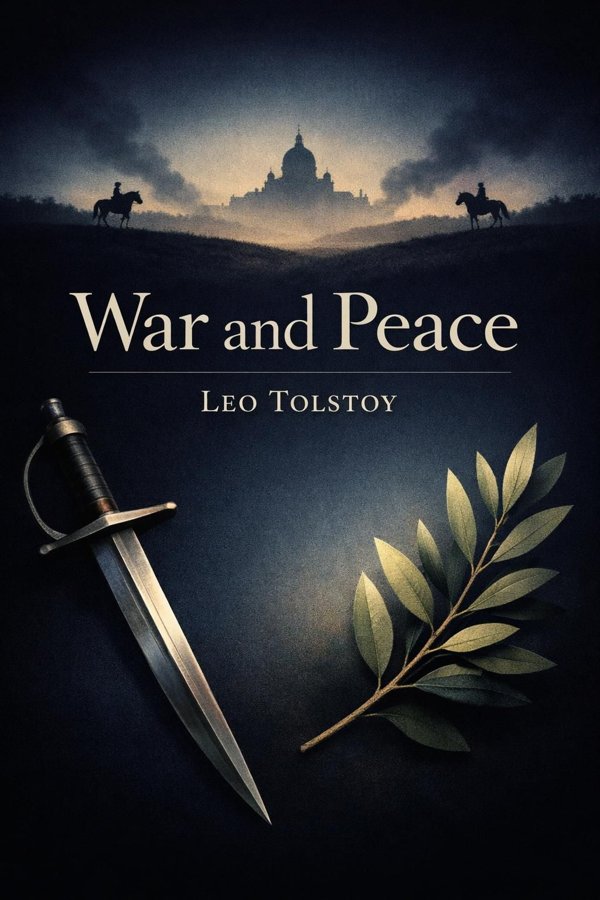
War and Peace: Summary & Key Insights
by Leo Tolstoy
 10 min10 chaptersAudio available
Key Takeaways from War and Peace
A polished surface can hide a hollow center.
Nothing strips away illusion faster than reality.
Material abundance often sharpens, rather than solves, the problem of meaning.
Innocence is powerful, but it is not the same as wisdom.
History looks orderly from a distance, but lived experience is chaos.
What Is War and Peace About?
War and Peace by Leo Tolstoy is a classics book spanning 10 pages. War and Peace is Leo Tolstoy’s vast, unforgettable portrait of human life under the pressure of history. First published in 1869, the novel follows several Russian aristocratic families during the Napoleonic Wars, especially the Bezukhovs, Bolkonskys, Rostovs, and Kuragins. Yet its true subject is larger than any battle or household drama. Tolstoy asks how people find meaning in a world shaped by love, ambition, suffering, chance, and forces far beyond individual control. Through Pierre’s spiritual searching, Andrei’s disillusionment, Natasha’s emotional growth, and the endurance of ordinary soldiers and citizens, the novel becomes both intimate and epic at once. What makes War and Peace enduring is its rare combination of psychological insight, historical scope, and philosophical depth. Tolstoy does not simply recount the Napoleonic invasion of Russia; he challenges conventional ideas about heroism, power, and the making of history itself. Few writers have matched his ability to move from ballroom conversation to battlefield terror, from family grief to national destiny. The result is not just a classic of Russian literature, but one of the most ambitious and humane novels ever written.
This FizzRead summary covers all 10 key chapters of War and Peace in approximately 10 minutes, distilling the most important ideas, arguments, and takeaways from Leo Tolstoy's work. Also available as an audio summary and Key Quotes Podcast.
War and Peace
War and Peace is Leo Tolstoy’s vast, unforgettable portrait of human life under the pressure of history. First published in 1869, the novel follows several Russian aristocratic families during the Napoleonic Wars, especially the Bezukhovs, Bolkonskys, Rostovs, and Kuragins. Yet its true subject is larger than any battle or household drama. Tolstoy asks how people find meaning in a world shaped by love, ambition, suffering, chance, and forces far beyond individual control. Through Pierre’s spiritual searching, Andrei’s disillusionment, Natasha’s emotional growth, and the endurance of ordinary soldiers and citizens, the novel becomes both intimate and epic at once.
What makes War and Peace enduring is its rare combination of psychological insight, historical scope, and philosophical depth. Tolstoy does not simply recount the Napoleonic invasion of Russia; he challenges conventional ideas about heroism, power, and the making of history itself. Few writers have matched his ability to move from ballroom conversation to battlefield terror, from family grief to national destiny. The result is not just a classic of Russian literature, but one of the most ambitious and humane novels ever written.
Who Should Read War and Peace?
This book is perfect for anyone interested in classics and looking to gain actionable insights in a short read. Whether you're a student, professional, or lifelong learner, the key ideas from War and Peace by Leo Tolstoy will help you think differently.
- ✓Readers who enjoy classics and want practical takeaways
- ✓Professionals looking to apply new ideas to their work and life
- ✓Anyone who wants the core insights of War and Peace in just 10 minutes
Want the full summary?
Get instant access to this book summary and 100K+ more with Fizz Moment.
Get Free SummaryAvailable on App Store • Free to download
Key Chapters
A polished surface can hide a hollow center. Tolstoy opens War and Peace in the drawing rooms and salons of Russian aristocracy, where conversation is elegant, manners are refined, and status is everything. Princes, countesses, officers, and social climbers move through a world of dinners, dances, alliances, and whispered judgments. Yet beneath the sparkle, many of these lives are marked by vanity, boredom, calculation, and emotional isolation.
This contrast is central to the novel’s moral vision. Pierre Bezukhov enters society awkwardly, wealthy but spiritually unformed. Prince Andrei Bolkonsky, intelligent and disciplined, already finds the social world deadening and false. Natasha Rostova, by contrast, begins with an almost unspoiled vitality that exposes how artificial aristocratic etiquette can be. Tolstoy shows that social success does not equal inner fulfillment. The people best trained to impress others are often the least equipped to understand themselves.
The novel’s upper-class setting is not merely decorative; it is diagnostic. Tolstoy uses salon talk and family ritual to show how easily people confuse performance with substance. That insight remains contemporary. Many modern environments—corporate cultures, elite schools, online personal branding—reward polish over sincerity. We may appear connected, accomplished, and admired while feeling inwardly directionless.
Tolstoy’s lesson is not that refinement is worthless, but that life becomes empty when reputation replaces truth. The characters who grow are those who stop living for display and begin confronting their own motives, attachments, and illusions.
Actionable takeaway: Examine one area of your life where appearances may be guiding your choices more than genuine conviction, and replace performance with one honest act of self-definition.
Nothing strips away illusion faster than reality. Prince Andrei goes to war longing for greatness. He admires Napoleon, imagines heroic distinction, and believes the battlefield may offer the meaning denied him by domestic life and empty society. Like many ambitious people, he mistakes public recognition for inner purpose. Then comes Austerlitz.
On the battlefield, Andrei encounters not noble clarity but confusion, fear, noise, pain, and absurdity. His moment beneath the vast sky after being wounded becomes one of the novel’s most famous revelations. Looking upward, he sees how small human vanity is compared with the silent, indifferent grandeur above him. The glory he pursued suddenly appears trivial. Napoleon, once his ideal, seems diminished. The experience does not instantly make Andrei wise, but it breaks something essential: his faith in heroic self-mythology.
Tolstoy uses Andrei’s arc to challenge romantic notions of achievement. We often imagine that success, promotion, recognition, or victory will redeem our lives. Yet when pursued as substitutes for meaning, these goals can collapse under pressure. Andrei’s disillusionment is painful because it forces him to confront a deeper question: if fame cannot satisfy, what can?
This is one of the novel’s recurring patterns. Characters are transformed not when their ambitions succeed, but when life exposes the poverty of ambitions built on ego. Such moments can come through failure, illness, heartbreak, or unexpected stillness.
Actionable takeaway: Identify one ambition you are pursuing mainly for admiration or status, and ask what deeper need it is trying to answer—purpose, dignity, belonging, or love—so you can pursue the real thing instead.
Material abundance often sharpens, rather than solves, the problem of meaning. Pierre begins as an awkward, illegitimate young man with little direction. When he unexpectedly inherits a vast fortune, he becomes one of the richest men in Russia and instantly attractive to fortune hunters, flatterers, and schemers. His marriage to Hélène, beautiful and socially dazzling, is less a union of souls than a trap laid by the logic of status. Wealth gives Pierre freedom in theory, but in practice it amplifies his confusion.
Tolstoy traces Pierre’s search through error, credulity, idealism, and moral dissatisfaction. He turns to Freemasonry, philanthropy, self-reform, and grand schemes of virtue. Again and again, he discovers how difficult it is to translate lofty principles into lived reality. He wants goodness, but he lacks discipline. He seeks truth, but is vulnerable to illusion. His spiritual restlessness makes him one of the novel’s most modern characters.
Pierre’s journey matters because it reveals that transformation is rarely linear. People often move from one framework to another—career, ideology, religion, self-help, activism—hoping to find a complete answer. Tolstoy neither mocks this hunger nor romanticizes it. He suggests that sincerity matters, but sincerity alone is not enough; wisdom grows through humility, suffering, and patient correction.
In everyday life, Pierre’s struggle resembles the experience of people who achieve comfort or outward success but remain haunted by emptiness. Possessions and options do not tell us how to live. The real challenge is learning what deserves commitment.
Actionable takeaway: If you feel restless despite external success, stop adding new distractions and spend time naming the values you want your daily life—not just your aspirations—to reflect.
Innocence is powerful, but it is not the same as wisdom. Natasha Rostova enters the novel as a figure of spontaneity, warmth, music, and emotional truth. She feels life intensely and expresses herself without the careful calculations of society. Her energy makes her immediately lovable, and Tolstoy presents her as one of the clearest embodiments of natural human vitality. But vitality alone does not protect a person from error.
As Natasha grows, she becomes vulnerable to illusion, especially in matters of love. Her engagement to Andrei is delayed, creating emotional strain and uncertainty. Into that gap steps Anatole Kuragin, whose charm and recklessness nearly lead her into ruin. Natasha’s near-elopement is one of the novel’s most painful episodes because it shows how innocence can be manipulated when feeling outruns judgment. Her shame afterward is devastating, yet it becomes a turning point.
Tolstoy does not reduce Natasha to either saint or fool. Instead, he allows her to mature through suffering. She learns that love is not merely excitement or romantic intensity, but loyalty, care, and sacrifice. By the end of the novel, her emotional life has deepened. She has lost illusions, but not her humanity.
This arc remains deeply relevant. Many people confuse authenticity with acting on every feeling. Tolstoy shows that sincerity is essential, yet without steadiness and discernment it can become self-destructive. Growth means retaining aliveness while learning responsibility.
Actionable takeaway: When strong emotion pushes you toward a major decision, pause long enough to test the feeling against character, timing, and consequences before treating intensity as truth.
History looks orderly from a distance, but lived experience is chaos. One of Tolstoy’s greatest achievements is his portrayal of war not as a sequence of clean strategic moves, but as confusion shaped by fatigue, fear, weather, bad information, accident, and ordinary human limitation. Officers issue commands that never arrive, generals claim control they do not possess, and soldiers endure realities no speech can dignify.
Through battles such as Schöngrabern, Austerlitz, and Borodino, Tolstoy dismantles the myth that history is made by isolated great men acting with perfect intention. Napoleon and other commanders become symbols of a larger delusion: the belief that authority equals mastery. In reality, events emerge from countless small actions, misunderstandings, pressures, and responses. Even leaders are caught inside systems they barely control.
This idea extends beyond warfare. In organizations, governments, markets, and families, we often overestimate how much any one person directs outcomes. Plans matter, but so do contingency, morale, timing, and the behavior of people far from the center. Tolstoy’s realism is not fatalistic; it simply insists that wisdom begins with humility.
The novel also contrasts official narratives with lived truth. Public accounts celebrate heroism and strategy, while individuals on the ground remember smoke, terror, comradeship, and survival. That gap between abstraction and experience is crucial in all large systems.
Actionable takeaway: When facing a complex challenge, replace fantasies of total control with better preparation, flexible thinking, and attention to the many small factors that actually shape results.
Some truths enter only after the collapse of comfort. As the war deepens, War and Peace moves from social comedy and private ambition into zones of endurance, loss, captivity, and moral testing. Pierre’s experience during the French occupation of Moscow and his imprisonment become especially important. Stripped of privilege, certainty, and ordinary identity, he encounters suffering not as an abstract idea but as a condition shared by countless others.
In captivity, Pierre meets Platon Karataev, a peasant whose simplicity, patience, and quiet acceptance leave a lasting mark on him. Karataev is not presented as intellectually sophisticated, yet he embodies a mode of being Pierre has never achieved: grounded, present, undivided. Through him, Tolstoy suggests that peace may come not from mastering life conceptually, but from inhabiting it humbly and compassionately.
This is not a sentimental celebration of pain. Tolstoy never suggests suffering is good in itself. Rather, he shows that suffering can strip away false priorities and reveal what comfort concealed. Pierre emerges changed not because hardship is noble, but because he has been brought closer to dependence, gratitude, mortality, and the shared human condition.
Many readers recognize this pattern from real life. Illness, loss, burnout, failure, or upheaval can reorder values. We may become less impressed by prestige and more attentive to presence, kindness, and inner steadiness.
Actionable takeaway: Instead of asking only how to escape a difficult season, ask what illusions it is exposing and what deeper capacities—patience, gratitude, compassion, clarity—it may be forcing you to develop.
The deepest victories in the novel are moral, not military. Prince Andrei’s final movement toward forgiveness is among the most profound parts of War and Peace. After his wounding at Borodino, Andrei’s spiritual life changes once again. Having lived through ambition, disillusionment, love, bitterness, and renewed hope, he is brought to the edge of death with a widened vision of human fragility.
His response to Natasha is especially significant. Earlier, her betrayal had wounded his pride and trust. Yet in his final illness, resentment begins to loosen. Tolstoy presents forgiveness not as denial of harm, but as a release from the ego’s demand to remain injured forever. Andrei’s suffering opens him to a love less possessive and less proud than before.
This matters because many people think forgiveness belongs to idealized morality rather than lived reality. Tolstoy shows it emerging from pain, not innocence. It is difficult precisely because the injury is real. But without some form of forgiveness, people remain trapped inside the logic of grievance. Their suffering continues long after the original wound.
Forgiveness in the novel is linked to mortality. When life is seen in its full vulnerability, pride begins to look smaller. That does not erase accountability, but it changes proportion. We recognize that everyone is limited, confused, and capable of causing pain.
Actionable takeaway: Consider one resentment you continue to rehearse, and take a first concrete step toward release—whether through honest reflection, conversation, or simply refusing to let the wound define your identity any longer.
The fate of a country is not carried by famous names alone. One of Tolstoy’s boldest claims is that Russia’s endurance during the Napoleonic invasion depends less on grand commanders than on the collective will, sacrifice, and resilience of ordinary people. Soldiers, peasants, families fleeing Moscow, servants, laborers, and nameless citizens all become part of the national story.
Kutuzov, unlike Napoleon, is compelling partly because he seems to understand the limits of command. He does not imagine that history bends neatly to his ego. His patience and receptivity contrast with the theatrical self-certainty of leaders who mistake motion for wisdom. In Tolstoy’s telling, strength often lies in endurance, timing, and alignment with reality rather than brilliant self-assertion.
The burning and abandonment of Moscow further deepen this theme. National survival comes through painful sacrifice and a broad social response that no single individual engineers. Tolstoy presents historical life as collective, not merely personal. The people endure, adapt, retreat, resist, and continue.
This insight remains highly practical. In workplaces, communities, and public life, success is often credited upward while effort is carried from below. Healthy leadership recognizes dependence on ordinary contributors rather than claiming sole authorship. Likewise, cultures survive through shared habits and mutual responsibility, not only through symbolic figures.
Actionable takeaway: In any group you belong to, deliberately notice and honor the overlooked people whose steady work sustains the whole, and model leadership that shares credit rather than hoards it.
After catastrophe, the real test is how life is rebuilt. The later movements of War and Peace turn from war’s devastation toward recovery, domestic life, and the possibility of durable happiness. Pierre and Natasha, once marked by confusion, grief, and instability, gradually move toward a more grounded union. Their future is not glamorous in the way young ambition imagines, but it carries emotional substance, mutual care, and moral maturity.
Tolstoy’s treatment of peace is striking because it is not dramatic. It consists of family life, conversation, memory, responsibility, and the ongoing labor of relationship. This can disappoint readers expecting a triumphant ending in heroic terms. But that is precisely the point. Peace is not the absence of difficulty; it is the presence of meaning within ordinary existence.
The novel suggests that renewal does not mean returning to innocence. The characters who survive are changed by death, failure, and history. Their peace is therefore more modest and more real. They know what can be lost. They value what once seemed unremarkable.
This idea has strong modern resonance. After periods of crisis—personal or collective—people often expect recovery to feel exhilarating. More often, healing arrives through routine: sleep, conversation, work, care, trust, and time. Tolstoy dignifies this process.
Actionable takeaway: If you are rebuilding after a hard season, stop waiting for one dramatic breakthrough and invest instead in small, repeatable habits of stability, care, and connection that slowly make peace livable.
The biggest events in history are often explained too simply. In the philosophical sections and epilogues of War and Peace, Tolstoy directly argues against the idea that historical change is caused mainly by exceptional individuals. He challenges the habit of assigning wars, revolutions, and national destinies to the genius or will of a few celebrated figures. For Tolstoy, this is an illusion created after the fact.
What actually drives history, he suggests, is the combined movement of innumerable human choices, conditions, accidents, pressures, traditions, and necessities. Leaders are visible, but visibility is not the same as causation. They stand at the intersection of forces far larger than themselves. This is why historical explanation so often becomes misleading: we turn complexity into biography because it feels easier to understand.
Tolstoy’s theory also carries a moral implication. If no single person wholly controls events, then humility is more appropriate than triumphalism. We should be cautious in both worshipping leaders and blaming them as though history were a stage for isolated heroes and villains. Agency exists, but it is distributed, constrained, and entangled.
This perspective is useful far beyond nineteenth-century warfare. In business, politics, culture, and technology, people still search for singular masterminds behind massive change. Tolstoy reminds us to look at systems, incentives, timing, collective behavior, and invisible labor.
Actionable takeaway: The next time you explain a major event, resist the easy hero-centered story and ask what larger networks of people, conditions, and unintended consequences made it possible.
All Chapters in War and Peace
About the Author
Leo Tolstoy (1828–1910) was a Russian novelist, essayist, and moral philosopher whose work reshaped world literature. Born into an aristocratic family, he served in the military before turning seriously to writing. His major novels, War and Peace and Anna Karenina, are widely considered among the greatest achievements in fiction for their psychological realism, social scope, and philosophical depth. In his later years, Tolstoy experienced a profound spiritual crisis that led him to write extensively on ethics, religion, education, poverty, and nonviolence. His moral thought influenced figures such as Mahatma Gandhi and helped extend his impact far beyond literature. Tolstoy remains enduringly important because he united narrative brilliance with an intense, lifelong search for truth, justice, and the meaning of human life.
Get This Summary in Your Preferred Format
Read or listen to the War and Peace summary by Leo Tolstoy anytime, anywhere. FizzRead offers multiple formats so you can learn on your terms — all free.
Available formats: App · Audio · PDF · EPUB — All included free with FizzRead
Download War and Peace PDF and EPUB Summary
Key Quotes from War and Peace
“A polished surface can hide a hollow center.”
“Nothing strips away illusion faster than reality.”
“Material abundance often sharpens, rather than solves, the problem of meaning.”
“Innocence is powerful, but it is not the same as wisdom.”
“History looks orderly from a distance, but lived experience is chaos.”
Frequently Asked Questions about War and Peace
War and Peace by Leo Tolstoy is a classics book that explores key ideas across 10 chapters. War and Peace is Leo Tolstoy’s vast, unforgettable portrait of human life under the pressure of history. First published in 1869, the novel follows several Russian aristocratic families during the Napoleonic Wars, especially the Bezukhovs, Bolkonskys, Rostovs, and Kuragins. Yet its true subject is larger than any battle or household drama. Tolstoy asks how people find meaning in a world shaped by love, ambition, suffering, chance, and forces far beyond individual control. Through Pierre’s spiritual searching, Andrei’s disillusionment, Natasha’s emotional growth, and the endurance of ordinary soldiers and citizens, the novel becomes both intimate and epic at once. What makes War and Peace enduring is its rare combination of psychological insight, historical scope, and philosophical depth. Tolstoy does not simply recount the Napoleonic invasion of Russia; he challenges conventional ideas about heroism, power, and the making of history itself. Few writers have matched his ability to move from ballroom conversation to battlefield terror, from family grief to national destiny. The result is not just a classic of Russian literature, but one of the most ambitious and humane novels ever written.
More by Leo Tolstoy
You Might Also Like

Browse by Category
Ready to read War and Peace?
Get the full summary and 100K+ more books with Fizz Moment.