
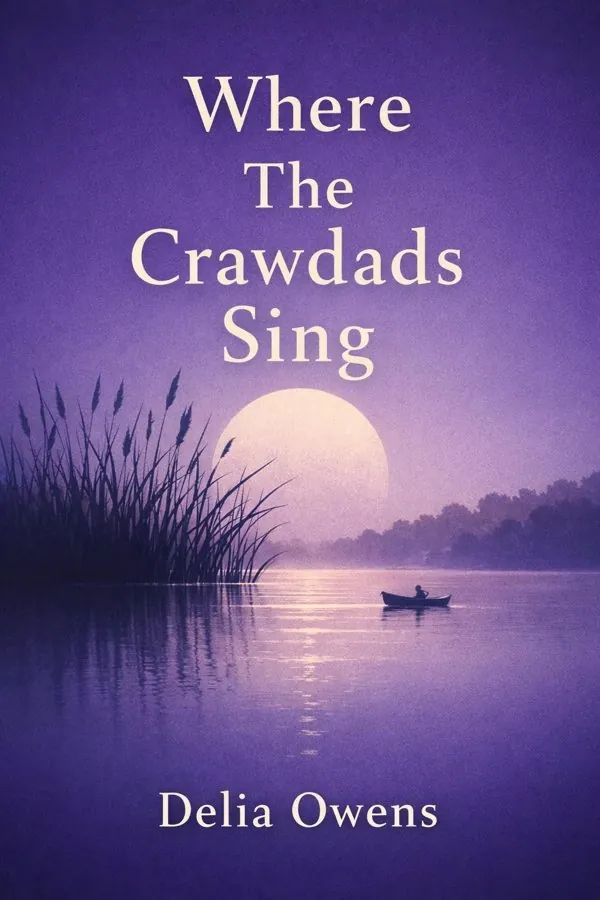
Where the Crawdads Sing: Summary & Key Insights
by Delia Owens
 10 min4 chaptersAudio available
Key Takeaways from Where the Crawdads Sing
Her mother leaves first, escaping an abusive marriage; then her siblings disappear one by one; eventually even her father, who remains only intermittently reliable, vanishes too.
Tate Walker changes Kya’s life because he offers something no one else has consistently given her: patient recognition.
Chase Andrews represents a very different kind of relationship from Tate, and through him the novel explores what happens when desire, social status, and vulnerability collide.
As the murder investigation unfolds, Where the Crawdads Sing shifts from intimate character study into courtroom suspense, but it never becomes just a whodunit.
What Is Where the Crawdads Sing About?
Where the Crawdads Sing by Delia Owens is a fiction book published in 2018 spanning 4 pages. What makes a person who they are: the people who raise them, the place that shapes them, or the wounds they learn to survive? Where the Crawdads Sing answers that question through one of modern fiction’s most unforgettable heroines, Kya Clark, a girl abandoned by nearly everyone except the wild marsh she calls home. First published in 2018, Delia Owens’s bestselling novel blends coming-of-age drama, love story, courtroom suspense, and murder mystery into a deeply atmospheric reading experience. But what gives the book its lasting emotional power is its portrait of loneliness, prejudice, and the human need to belong. Set against the coastal wetlands of North Carolina, the novel asks readers to look beyond labels like “Marsh Girl” and see the full humanity of someone society has dismissed. Owens, an American author and zoologist, brings extraordinary sensory detail to the natural world, making the marsh feel as alive and important as any character in the story. That scientific eye, paired with an intimate emotional lens, gives the novel its signature strength. If you’re drawn to stories about resilience, nature, heartbreak, and hidden truths, this book offers all of that—and more.
This FizzRead summary covers all 4 key chapters of Where the Crawdads Sing in approximately 10 minutes, distilling the most important ideas, arguments, and takeaways from Delia Owens's work. Also available as an audio summary and Key Quotes Podcast.
Where The Crawdads Sing
What makes a person who they are: the people who raise them, the place that shapes them, or the wounds they learn to survive? Where the Crawdads Sing answers that question through one of modern fiction’s most unforgettable heroines, Kya Clark, a girl abandoned by nearly everyone except the wild marsh she calls home. First published in 2018, Delia Owens’s bestselling novel blends coming-of-age drama, love story, courtroom suspense, and murder mystery into a deeply atmospheric reading experience. But what gives the book its lasting emotional power is its portrait of loneliness, prejudice, and the human need to belong.
Set against the coastal wetlands of North Carolina, the novel asks readers to look beyond labels like “Marsh Girl” and see the full humanity of someone society has dismissed. Owens, an American author and zoologist, brings extraordinary sensory detail to the natural world, making the marsh feel as alive and important as any character in the story. That scientific eye, paired with an intimate emotional lens, gives the novel its signature strength. If you’re drawn to stories about resilience, nature, heartbreak, and hidden truths, this book offers all of that—and more.
Who Should Read Where the Crawdads Sing?
This book is perfect for anyone interested in fiction and looking to gain actionable insights in a short read. Whether you're a student, professional, or lifelong learner, the key ideas from Where the Crawdads Sing by Delia Owens will help you think differently.
- ✓Readers who enjoy fiction and want practical takeaways
- ✓Professionals looking to apply new ideas to their work and life
- ✓Anyone who wants the core insights of Where the Crawdads Sing in just 10 minutes
Want the full summary?
Get instant access to this book summary and 100K+ more with Fizz Moment.
Get Free SummaryAvailable on App Store • Free to download
Key Chapters
Kya Clark’s childhood is shaped by repeated abandonment, and the novel makes clear that this isn’t a single traumatic event but a pattern that teaches her how fragile human attachment can be. Her mother leaves first, escaping an abusive marriage; then her siblings disappear one by one; eventually even her father, who remains only intermittently reliable, vanishes too. For a child, that kind of loss would normally mean complete collapse. Instead, Kya adapts. She learns to feed herself, trade mussels for supplies, and read weather, tides, and animal behavior with almost scientific precision. These aren’t romantic survival skills—they are the basic tools that keep her alive.
What’s especially powerful is how the marsh becomes more than scenery. It acts as teacher, shelter, and emotional anchor. Kya studies gulls, shells, feathers, and insects with a care that replaces the education and affection she’s denied elsewhere. In practical terms, her life shows how resilience often starts with observation: paying attention to what the environment is telling you and using what’s available rather than waiting to be rescued. Readers can take from this an important insight: hardship can shrink a person, but it can also sharpen resourcefulness. Society sees only “the Marsh Girl,” a stereotype built from gossip and distance. The novel asks us to question how often communities turn vulnerable people into myths instead of offering compassion.
Tate Walker changes Kya’s life because he offers something no one else has consistently given her: patient recognition. He doesn’t just notice her beauty or mystery; he sees her intelligence. By teaching her to read, Tate opens a door that transforms Kya’s entire relationship to the world. Reading gives her language for what she already senses in the marsh and allows her curiosity to become knowledge she can organize, deepen, and eventually share. This matters because literacy in the novel is more than education—it is dignity, self-expression, and entry into a larger human conversation.
Their relationship also shows how love can be both healing and destabilizing. For Kya, trusting Tate means risking the kind of hurt she has spent years learning to avoid. When he leaves for college and fails to return as promised, that wound cuts deeper than ordinary heartbreak because it confirms her oldest fear: everyone leaves. The emotional lesson is painful but realistic. Past abandonment makes future intimacy harder, and even good people can cause damage through hesitation, silence, or broken promises.
A useful takeaway here is that growth often comes through a mix of connection and disappointment. Tate helps Kya discover books, confidence, and possibility, even though he also becomes part of her pain. The novel suggests that love doesn’t stop mattering just because it fails in one form. It can still awaken parts of us that remain long after the relationship changes.
Chase Andrews represents a very different kind of relationship from Tate, and through him the novel explores what happens when desire, social status, and vulnerability collide. Chase is charismatic, popular, and fully embedded in the town that has long rejected Kya. His attention offers her something emotionally seductive: the possibility of being chosen not from pity or curiosity, but from desire. For someone who has spent most of her life excluded, that kind of recognition can feel like belonging. Yet the relationship is built on uneven power from the start. Chase moves easily between worlds; Kya does not. He can risk secrecy and return to social safety, while she bears the emotional and physical consequences.
This is where the novel sharpens into a critique of gender and class. Kya’s isolation makes her a target because she lacks the social protection many women rely on. She has no family network, no institutional trust, and no reputation the town is willing to defend. Chase, by contrast, benefits from status and assumption. The collision between them is not just romantic drama—it is a study in how communities often believe the polished insider over the marginalized outsider.
Readers can take an important practical insight from this section: attention is not the same as respect, and promises are not the same as commitment. The book quietly warns against confusing longing with safety. Kya’s experience shows how badly people can misread risk when they are hungry for connection. In that sense, Chase embodies one of the novel’s darkest truths: loneliness can make dangerous situations look like hope.
As the murder investigation unfolds, Where the Crawdads Sing shifts from intimate character study into courtroom suspense, but it never becomes just a whodunit. The legal case forces the town to confront its own prejudices, especially its quickness to cast Kya as guilty because she is different, solitary, and already half-myth in local imagination. The question at the heart of the trial is not only whether she committed the crime, but whether someone like Kya was ever going to receive the benefit of the doubt. In that way, the novel examines how justice is shaped by class, gender, reputation, and fear.
Redemption in the story is also more layered than simple innocence or vindication. Kya’s life cannot be repaired by a verdict alone. What matters just as much is that she creates meaning through her work, her knowledge of the marsh, and the private integrity she maintains despite public scorn. The ending preserves a measure of mystery, reminding readers that truth and legal proof are not always identical. That ambiguity is part of the novel’s power. It asks us to sit with uncomfortable questions about survival, morality, and what people are capable of when cornered.
An actionable takeaway for readers is to pay attention to first impressions and inherited narratives. Communities often confuse familiarity with goodness and strangeness with guilt. The novel encourages a more careful kind of judgment—one rooted in evidence, empathy, and the recognition that every person contains hidden depths.
All Chapters in Where the Crawdads Sing
About the Author
Delia Owens is an American author and zoologist whose work is deeply influenced by her lifelong connection to the natural world. She is best known for her bestselling debut novel, Where the Crawdads Sing, which brought her vivid, nature-rich storytelling to a wide fiction audience. Before turning to novels, Owens co-authored nonfiction books about wildlife research in Africa, including Cry of the Kalahari. Her background in zoology helps give her writing its distinctive attention to ecosystems, animal behavior, and landscape. Across both nonfiction and fiction, Owens is known for exploring the relationship between survival, habitat, and human emotion.
Get This Summary in Your Preferred Format
Read or listen to the Where the Crawdads Sing summary by Delia Owens anytime, anywhere. FizzRead offers multiple formats so you can learn on your terms — all free.
Available formats: App · Audio · PDF · EPUB — All included free with FizzRead
Download Where the Crawdads Sing PDF and EPUB Summary
Key Quotes from Where the Crawdads Sing
“Kya Clark’s childhood is shaped by repeated abandonment, and the novel makes clear that this isn’t a single traumatic event but a pattern that teaches her how fragile human attachment can be.”
“Tate Walker changes Kya’s life because he offers something no one else has consistently given her: patient recognition.”
“Chase Andrews represents a very different kind of relationship from Tate, and through him the novel explores what happens when desire, social status, and vulnerability collide.”
“As the murder investigation unfolds, Where the Crawdads Sing shifts from intimate character study into courtroom suspense, but it never becomes just a whodunit.”
Frequently Asked Questions about Where the Crawdads Sing
Where the Crawdads Sing by Delia Owens is a fiction book that explores key ideas across 4 chapters. What makes a person who they are: the people who raise them, the place that shapes them, or the wounds they learn to survive? Where the Crawdads Sing answers that question through one of modern fiction’s most unforgettable heroines, Kya Clark, a girl abandoned by nearly everyone except the wild marsh she calls home. First published in 2018, Delia Owens’s bestselling novel blends coming-of-age drama, love story, courtroom suspense, and murder mystery into a deeply atmospheric reading experience. But what gives the book its lasting emotional power is its portrait of loneliness, prejudice, and the human need to belong. Set against the coastal wetlands of North Carolina, the novel asks readers to look beyond labels like “Marsh Girl” and see the full humanity of someone society has dismissed. Owens, an American author and zoologist, brings extraordinary sensory detail to the natural world, making the marsh feel as alive and important as any character in the story. That scientific eye, paired with an intimate emotional lens, gives the novel its signature strength. If you’re drawn to stories about resilience, nature, heartbreak, and hidden truths, this book offers all of that—and more.
Compare Where the Crawdads Sing


You Might Also Like

Featured In
Oprah Winfrey's Book Picks
Oprah's Book Club Favorites That Changed Millions of Lives
Barack Obama's Book Picks
Barack Obama's Reading List: Books That Shaped a President
Reese Witherspoon's Book Picks
Reese Witherspoon's Book Club: Stories That Captivated Millions
Curated's Book Picks
Best Fiction Books — Stories That Will Stay with You
Browse by Category
Ready to read Where the Crawdads Sing?
Get the full summary and 100K+ more books with Fizz Moment.