
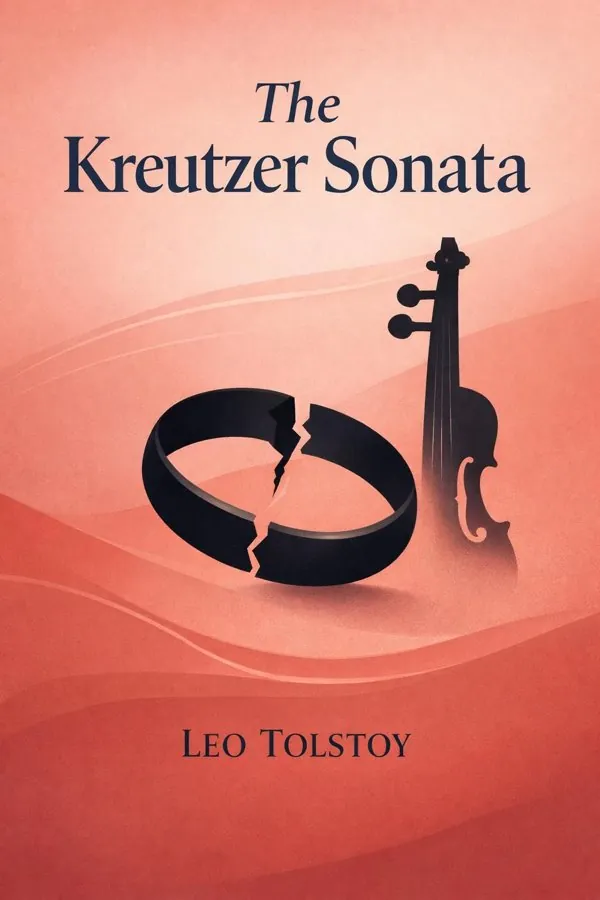
The Kreutzer Sonata: Summary & Key Insights
by Leo Tolstoy
 10 min9 chaptersAudio available
Key Takeaways from The Kreutzer Sonata
A disturbing confession often reveals not only an individual crime but the moral atmosphere that made it possible.
What destroys many relationships is not open hatred at first, but the collapse of expectations that were never honest to begin with.
Intense desire is often praised as proof of depth, but Tolstoy suggests that passion can conceal domination, ego, and fear.
Art can unite souls, but it can also stir emotions that exceed judgment.
Few forces are more destructive than a mind that begins treating suspicion as certainty.
What Is The Kreutzer Sonata About?
The Kreutzer Sonata by Leo Tolstoy is a classics book spanning 7 pages. The Kreutzer Sonata is Leo Tolstoy’s fierce, unsettling novella about jealousy, marriage, desire, and the moral confusion hidden beneath respectable society. First published in 1889, it unfolds as a confession from Pozdnyshev, a man who recounts how suspicion and rage led him to murder his wife. Yet the book is far more than a crime story. Through Pozdnyshev’s feverish monologue, Tolstoy examines the gap between romantic ideals and the realities of sexual desire, domestic life, and social hypocrisy. He asks whether what people call love is often only vanity, possession, or appetite disguised in beautiful language. What makes the novella endure is its ability to provoke. Tolstoy does not offer comfortable conclusions, and Pozdnyshev is not a reliable moral guide, but the intensity of his voice forces readers to confront difficult questions about intimacy, power, gender, and self-deception. Written during Tolstoy’s later moral and religious phase, the work carries the authority of a writer who had turned from grand social realism toward spiritual and ethical inquiry. The result is a short classic that remains psychologically penetrating, morally disturbing, and impossible to dismiss.
This FizzRead summary covers all 9 key chapters of The Kreutzer Sonata in approximately 10 minutes, distilling the most important ideas, arguments, and takeaways from Leo Tolstoy's work. Also available as an audio summary and Key Quotes Podcast.
The Kreutzer Sonata
The Kreutzer Sonata is Leo Tolstoy’s fierce, unsettling novella about jealousy, marriage, desire, and the moral confusion hidden beneath respectable society. First published in 1889, it unfolds as a confession from Pozdnyshev, a man who recounts how suspicion and rage led him to murder his wife. Yet the book is far more than a crime story. Through Pozdnyshev’s feverish monologue, Tolstoy examines the gap between romantic ideals and the realities of sexual desire, domestic life, and social hypocrisy. He asks whether what people call love is often only vanity, possession, or appetite disguised in beautiful language.
What makes the novella endure is its ability to provoke. Tolstoy does not offer comfortable conclusions, and Pozdnyshev is not a reliable moral guide, but the intensity of his voice forces readers to confront difficult questions about intimacy, power, gender, and self-deception. Written during Tolstoy’s later moral and religious phase, the work carries the authority of a writer who had turned from grand social realism toward spiritual and ethical inquiry. The result is a short classic that remains psychologically penetrating, morally disturbing, and impossible to dismiss.
Who Should Read The Kreutzer Sonata?
This book is perfect for anyone interested in classics and looking to gain actionable insights in a short read. Whether you're a student, professional, or lifelong learner, the key ideas from The Kreutzer Sonata by Leo Tolstoy will help you think differently.
- ✓Readers who enjoy classics and want practical takeaways
- ✓Professionals looking to apply new ideas to their work and life
- ✓Anyone who wants the core insights of The Kreutzer Sonata in just 10 minutes
Want the full summary?
Get instant access to this book summary and 100K+ more with Fizz Moment.
Get Free SummaryAvailable on App Store • Free to download
Key Chapters
A disturbing confession often reveals not only an individual crime but the moral atmosphere that made it possible. Pozdnyshev begins his story by presenting himself as a man shaped by a culture that normalizes male indulgence while preserving a false language of honor and purity. He describes a youth formed by privilege, idleness, and sexual license, in which men are encouraged to seek pleasure but still expect women to embody innocence. This contradiction lies at the root of the novella: society condemns the consequences of desire while quietly endorsing its habits.
Tolstoy uses Pozdnyshev’s background to show how moral corruption can seem respectable when it is widespread. The problem is not simply that Pozdnyshev made bad choices; it is that he inherited a worldview in which lust, vanity, and social performance were treated as ordinary aspects of adult life. In such a world, conscience becomes weak because everyone participates in the same deception. A person can call himself decent while living in a way that damages others and himself.
This insight still feels modern. Many people criticize the effects of shallow relationships, exploitation, or emotional manipulation while continuing to reward the attitudes that produce them. We may condemn betrayal but celebrate conquest, condemn objectification but encourage people to value appearance above character, or speak of commitment while treating relationships as status symbols.
Tolstoy’s point is not merely to accuse society. It is to show that personal disaster often begins long before the visible catastrophe. It begins in habits, assumptions, and excuses. The actionable takeaway is to examine the moral contradictions you accept as normal in your own environment, because what feels socially permissible may still be spiritually destructive.
What destroys many relationships is not open hatred at first, but the collapse of expectations that were never honest to begin with. When Pozdnyshev reflects on his marriage, he shows how quickly romantic hope curdles into resentment once everyday life replaces courtship. He entered marriage expecting passion, social respectability, and emotional harmony to coexist naturally. Instead, he encountered fatigue, conflict, pride, wounded vanity, and mutual incomprehension. Tolstoy treats this disillusionment not as an accident, but as the predictable result of building marriage on physical attraction and social convention rather than moral clarity.
The novella strips away sentimental ideals. Marriage is not portrayed as automatically ennobling, and love is not shown as a stable force simply because it is intense. Once children, finances, domestic pressures, and differing temperaments enter the picture, the couple’s hidden selfishness becomes visible. Everyday disagreements become loaded with humiliation and rivalry. The home, which should be a place of trust, turns into a battlefield of accusation and silent contempt.
Modern readers may not agree with all of Tolstoy’s moral conclusions, but his psychological observation remains sharp. Many couples still confuse compatibility with excitement, commitment with possession, and intimacy with emotional fusion. They may begin a relationship with idealized images of one another and then feel betrayed when reality appears.
A practical application is simple but demanding: before expecting a relationship to save loneliness or validate identity, ask what values actually sustain it. Shared discipline, honesty, patience, and the ability to endure disappointment matter more than romantic intensity. The actionable takeaway is to test your expectations of love against reality, because relationships built on illusion eventually turn ordinary strain into bitterness.
Intense desire is often praised as proof of depth, but Tolstoy suggests that passion can conceal domination, ego, and fear. In Pozdnyshev’s account, marital conflict is inseparable from sexuality. He comes to believe that what society calls romantic love is often merely a refined version of appetite, one that binds people together physically while leaving them morally estranged. The result is not peace, but repeated collisions between bodies, expectations, and wills.
This argument is central to the novella’s scandalous power. Tolstoy refuses to idealize sexual attraction as inherently redemptive. Instead, he presents it as morally unstable when detached from self-restraint and spiritual purpose. For Pozdnyshev, passion does not deepen tenderness; it inflames irritability, possessiveness, and disgust. Periods of closeness are followed by revulsion, guilt, or renewed quarrels. What looked like intimacy turns out to be dependence mixed with rivalry.
One need not accept Tolstoy’s asceticism to recognize the insight. Many relationships become volatile when attraction is mistaken for trust or when desire is used to avoid unresolved emotional fractures. People may confuse intensity with compatibility, or use sex to repair conflict that actually requires conversation, repentance, or change in behavior. In those cases, closeness temporarily masks deeper problems rather than healing them.
Tolstoy invites readers to ask a difficult question: does what we call love increase freedom, dignity, and responsibility, or does it sharpen anxiety and control? That question applies not only to marriage but to all forms of attachment. The actionable takeaway is to notice whether passion in your life leads to clarity and kindness or to control and resentment, because desire without moral discipline can become a disguised struggle for power.
Art can unite souls, but it can also stir emotions that exceed judgment. The arrival of the violinist and the performance of Beethoven’s Kreutzer Sonata mark the novella’s most charged turning point. For Pozdnyshev, music becomes intolerably dangerous because it creates an atmosphere of feeling that he cannot control or interpret with certainty. Watching his wife perform with another man, he senses not simply technical collaboration but a current of intimacy that bypasses ordinary social restraints. Whether his perception is accurate matters less than the effect: music gives shape to his fear that emotions can become physically and morally contagious.
Tolstoy’s use of Beethoven is brilliant because music here symbolizes the power of aesthetic experience itself. It can elevate, intensify, seduce, and destabilize. Unlike rational argument, it enters directly into the nerves and imagination. Pozdnyshev suspects that this immediacy makes art morally ambiguous. It may awaken tenderness, but it may just as easily inflame desire, fantasy, or illusion. In his mind, the sonata becomes the soundtrack of betrayal before any betrayal is proven.
This idea remains relevant. People are often moved by films, songs, performances, and social experiences that generate emotional intensity without offering moral clarity. A shared artistic moment can produce real connection, but it can also create projections: we may mistake a surge of feeling for deep understanding, or interpret emotional resonance as personal destiny.
Tolstoy does not ask us to reject art. He asks us to respect its force. Art is never neutral simply because it is beautiful. The actionable takeaway is to pay attention to what art awakens in you and how you act afterward, because the emotions stirred by beauty need wisdom if they are not to become fuel for self-deception.
Few forces are more destructive than a mind that begins treating suspicion as certainty. Pozdnyshev’s jealousy grows not from direct knowledge but from interpretation, repetition, and emotional escalation. A glance, a shared rehearsal, a remembered phrase, a social detail that once seemed harmless—everything becomes reclassified as proof. Tolstoy shows jealousy as a self-feeding mental system. Once it gains authority, it no longer depends on facts. It uses imagination to generate evidence and then uses that evidence to justify rage.
This is why the novella remains such a powerful psychological study. Pozdnyshev is not merely angry; he is trapped in a pattern of thought that narrows reality until only threat remains visible. He replays scenes, invents motives, and converts uncertainty into conviction. The more he broods, the more morally entitled he feels. By the time violence arrives, it appears to him not as madness but as inevitable resolution.
The pattern is tragically familiar today. Jealousy is often intensified by overanalysis, surveillance, digital communication, and emotional insecurity. A delayed reply, a social media interaction, or an ambiguous tone can become the seed of a whole narrative. Without self-control, the mind starts living inside its own courtroom, acting as prosecutor, witness, and judge.
Tolstoy’s warning is severe: emotions become dangerous when they are granted the status of truth. The remedy is not passivity but disciplined interruption. Ask what you actually know, what you are inferring, and what fear may be adding to the picture. Speak before you accuse; pause before you conclude. The actionable takeaway is to challenge suspicious narratives early, because jealousy becomes lethal when imagination is allowed to masquerade as fact.
The murder at the heart of The Kreutzer Sonata is shocking, but Tolstoy insists that violence does not begin in the instant a weapon is raised. It begins much earlier in habits of contempt, emotional cruelty, entitlement, and moral self-justification. Pozdnyshev’s confession reveals a long interior preparation for the final act. He had already turned his wife into an object of accusation in his mind. He had already nourished anger, indulged fantasies, and treated his suffering as a license. The physical crime is only the last stage of an internal collapse.
This is one of the novella’s deepest insights. Extreme acts are often preceded by ordinary tolerated forms of harm: humiliating speech, possessiveness, domination, retaliatory silence, and the belief that another person exists to satisfy one’s emotional needs. Such patterns may appear domestic, private, or minor, yet they establish the moral logic of violence by denying the full humanity of the other.
In contemporary life, this lesson extends beyond marriage. Workplaces, families, friendships, and political cultures all become dangerous when resentment is cultivated, opponents are dehumanized, or emotional pain is treated as sufficient justification for aggression. People rarely move from peace to destruction in a single leap. They practice the smaller forms first.
Tolstoy does not excuse Pozdnyshev by explaining him. Instead, he reveals how self-pity and righteousness can cooperate in the making of brutality. That insight demands vigilance. The actionable takeaway is to treat contempt, humiliation, and possessiveness as warning signs rather than harmless emotional episodes, because violence begins where empathy is repeatedly denied.
One of Tolstoy’s boldest claims is that society often condemns vice in language while rewarding it in practice. Throughout Pozdnyshev’s reflections, respectable culture appears deeply dishonest. Courtship rituals, fashion, flirtation, and social manners present themselves as refined, but he sees beneath them a marketplace of desire, vanity, and mutual manipulation. Men seek pleasure while praising virtue; women are encouraged to attract attention while being judged for the very system they must navigate. Public morality becomes performance, not truth.
The novella’s critique is uncomfortable because it targets not isolated sinners but entire social arrangements. Tolstoy suggests that many institutions surrounding romance and marriage are designed less to promote moral seriousness than to make appetites look elegant. That is why scandal fascinates polite society: it denounces what it secretly sensationalizes.
Even readers who reject Pozdnyshev’s harsh generalizations can see the continuing relevance of the critique. Modern culture often packages desire through commercial images, status competition, self-branding, and idealized lifestyles. Relationships may be shaped by external display as much as by inner conviction. People curate attractiveness, perform intimacy, and compare private lives to public fantasies, all while speaking the language of authenticity.
Tolstoy’s challenge is to ask whether social forms help people become truthful or simply make falsehood more graceful. Do the norms around dating, partnership, and attraction encourage responsibility, or do they merely manage appearances? This question is useful not only morally but practically. The actionable takeaway is to separate what is genuinely good in relationships from what is socially glamorous, because respectability can hide desires that erode sincerity and trust.
Perhaps the novella’s most unsettling proposal is that what people commonly call love may be little more than disguised ownership. Pozdnyshev does not trust the language of romance because he believes it often expresses appetite, vanity, or dependency rather than genuine concern for another’s good. In his darkest reflections, love as society defines it is inseparable from wanting to be chosen, satisfied, admired, and obeyed. Once that expectation is frustrated, tenderness easily hardens into grievance.
Tolstoy is pressing toward a spiritual distinction. Real love, in his moral universe, must involve self-restraint, compassion, and reverence for the soul of the other person. Anything less remains unstable. If I love you mainly because of how you make me feel, what I cherish may not be you at all, but my own pleasure, reassurance, or status. Such attachment can become intensely emotional while still being fundamentally selfish.
This insight applies far beyond marriage. Parents can seek control in the name of care. Friends can demand loyalty as proof of affection. Partners can confuse closeness with entitlement. Even acts of generosity can carry hidden expectations of repayment, recognition, or emotional dependency.
Tolstoy’s view may seem severe, but it offers a useful diagnostic question: does my love enlarge the freedom and dignity of the other person, or does it bind them more tightly to my needs? Relationships become healthier when affection includes boundaries, humility, and responsibility. The actionable takeaway is to test your attachments by sacrifice rather than intensity, because love becomes real not when it feels strongest, but when it seeks the good of another without trying to possess them.
Tolstoy’s final reflections in The Kreutzer Sonata are often read only as a condemnation of sexuality, but they also express a broader demand for moral wakefulness. By purity, he does not simply mean social innocence or bodily restraint. He means a state of inner clarity in which a person no longer lives by impulse, vanity, or self-deception. After catastrophe, Pozdnyshev speaks as someone who has seen where unexamined desire can lead. His conclusions are extreme, but the spiritual question behind them is serious: what kind of life allows the soul to remain truthful?
For Tolstoy, modern people are often asleep within their own habits. They call indulgence natural, romanticize obsession, and excuse cruelty as emotional honesty. Purity, in contrast, requires discipline of attention. It asks a person to notice motives, resist harmful appetites, and refuse the cultural scripts that glamorize what degrades. In that sense, the novella belongs to Tolstoy’s larger late-career pursuit of simplicity, chastity, nonviolence, and ethical consistency.
A modern reader may not follow him to his ascetic conclusions, yet the call to wakefulness remains powerful. We live amid constant stimulation, emotional impulsiveness, and public performances of desire. The challenge is not withdrawal from life, but the cultivation of conscience strong enough to withstand confusion.
Practical moral wakefulness might look like pausing before acting on anger, questioning the stories ego tells, consuming art and media more consciously, or choosing honesty over performative charm. The actionable takeaway is to treat self-examination as a daily discipline, because purity in Tolstoy’s deepest sense begins when we stop flattering our impulses and start telling the truth about them.
All Chapters in The Kreutzer Sonata
About the Author
Leo Tolstoy (1828–1910) was a Russian novelist, essayist, and moral philosopher whose work transformed world literature. Born into an aristocratic family, he first gained fame through autobiographical writings and later achieved lasting greatness with War and Peace and Anna Karenina. In the second half of his life, Tolstoy underwent a profound spiritual crisis that led him toward religious and ethical inquiry, simplicity, and social criticism. His later works, including The Kreutzer Sonata, reflect his concerns with violence, sexuality, marriage, hypocrisy, and the search for moral truth. Beyond literature, his ideas influenced reformers and thinkers across the world, including Mahatma Gandhi. Tolstoy remains one of the most powerful interpreters of human conscience, inner conflict, and the struggle to live honestly.
Get This Summary in Your Preferred Format
Read or listen to the The Kreutzer Sonata summary by Leo Tolstoy anytime, anywhere. FizzRead offers multiple formats so you can learn on your terms — all free.
Available formats: App · Audio · PDF · EPUB — All included free with FizzRead
Download The Kreutzer Sonata PDF and EPUB Summary
Key Quotes from The Kreutzer Sonata
“A disturbing confession often reveals not only an individual crime but the moral atmosphere that made it possible.”
“What destroys many relationships is not open hatred at first, but the collapse of expectations that were never honest to begin with.”
“Intense desire is often praised as proof of depth, but Tolstoy suggests that passion can conceal domination, ego, and fear.”
“Art can unite souls, but it can also stir emotions that exceed judgment.”
“Few forces are more destructive than a mind that begins treating suspicion as certainty.”
Frequently Asked Questions about The Kreutzer Sonata
The Kreutzer Sonata by Leo Tolstoy is a classics book that explores key ideas across 9 chapters. The Kreutzer Sonata is Leo Tolstoy’s fierce, unsettling novella about jealousy, marriage, desire, and the moral confusion hidden beneath respectable society. First published in 1889, it unfolds as a confession from Pozdnyshev, a man who recounts how suspicion and rage led him to murder his wife. Yet the book is far more than a crime story. Through Pozdnyshev’s feverish monologue, Tolstoy examines the gap between romantic ideals and the realities of sexual desire, domestic life, and social hypocrisy. He asks whether what people call love is often only vanity, possession, or appetite disguised in beautiful language. What makes the novella endure is its ability to provoke. Tolstoy does not offer comfortable conclusions, and Pozdnyshev is not a reliable moral guide, but the intensity of his voice forces readers to confront difficult questions about intimacy, power, gender, and self-deception. Written during Tolstoy’s later moral and religious phase, the work carries the authority of a writer who had turned from grand social realism toward spiritual and ethical inquiry. The result is a short classic that remains psychologically penetrating, morally disturbing, and impossible to dismiss.
More by Leo Tolstoy
You Might Also Like






Browse by Category
Ready to read The Kreutzer Sonata?
Get the full summary and 100K+ more books with Fizz Moment.