
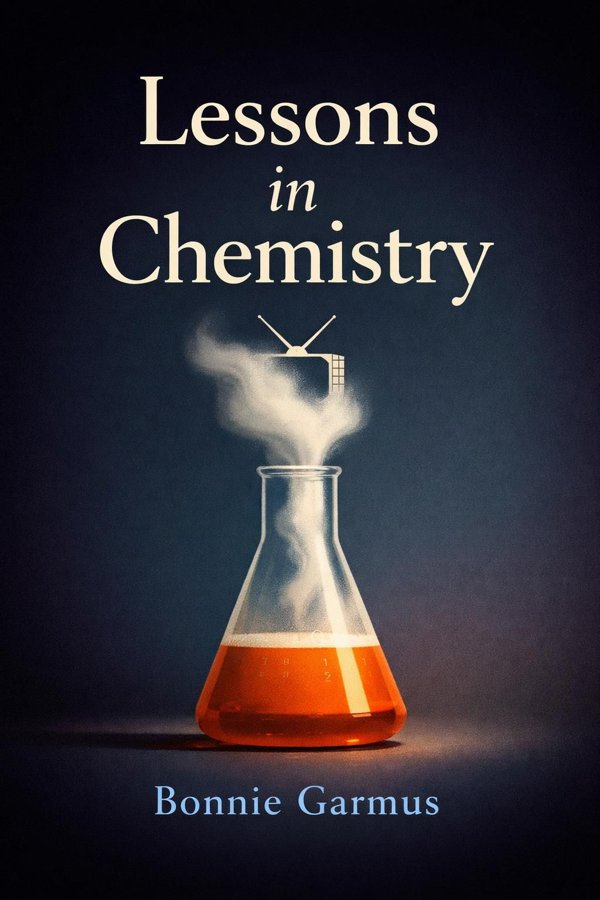
Lessons in Chemistry: Summary & Key Insights
 10 min9 chaptersAudio available
Key Takeaways from Lessons in Chemistry
A brilliant mind is often tested less by complexity than by the people determined to ignore it.
The most painful transformations are the ones we never chose.
Sometimes the most subversive act is speaking plainly to people who have been trained to underestimate themselves.
Identity is rarely inherited in a straight line; it is assembled from fragments, absences, and the stories people are willing to tell.
A person’s vocation is not simply a job; it is often the clearest expression of how they make meaning.
What Is Lessons in Chemistry About?
Lessons in Chemistry by Bonnie Garmus is a fiction book published in 2022 spanning 5 pages. Set in early-1960s America, Lessons in Chemistry follows Elizabeth Zott, a fiercely intelligent chemist whose life is repeatedly derailed by sexism, grief, and institutions determined to keep women in supporting roles. When a series of personal and professional setbacks pushes her out of the lab and onto television as the host of a cooking show, Elizabeth does something radical: she treats cooking as chemistry and speaks to women as if they are capable of rigorous thought, self-respect, and ambition. The result is a novel that is funny, moving, and sharply observant about the hidden costs of a culture that underestimates women. Bonnie Garmus uses a vivid cast, emotional storytelling, and satirical bite to explore motherhood, scientific thinking, love, resilience, and identity. Although it is fiction, the novel feels grounded in historical truth, capturing how talent is often suppressed by prejudice and how ordinary acts of defiance can change lives. Lessons in Chemistry matters because it turns one woman’s struggle into a larger argument for dignity, intellectual freedom, and the right to define your own future.
This FizzRead summary covers all 9 key chapters of Lessons in Chemistry in approximately 10 minutes, distilling the most important ideas, arguments, and takeaways from Bonnie Garmus's work. Also available as an audio summary and Key Quotes Podcast.
Lessons in Chemistry
Set in early-1960s America, Lessons in Chemistry follows Elizabeth Zott, a fiercely intelligent chemist whose life is repeatedly derailed by sexism, grief, and institutions determined to keep women in supporting roles. When a series of personal and professional setbacks pushes her out of the lab and onto television as the host of a cooking show, Elizabeth does something radical: she treats cooking as chemistry and speaks to women as if they are capable of rigorous thought, self-respect, and ambition. The result is a novel that is funny, moving, and sharply observant about the hidden costs of a culture that underestimates women. Bonnie Garmus uses a vivid cast, emotional storytelling, and satirical bite to explore motherhood, scientific thinking, love, resilience, and identity. Although it is fiction, the novel feels grounded in historical truth, capturing how talent is often suppressed by prejudice and how ordinary acts of defiance can change lives. Lessons in Chemistry matters because it turns one woman’s struggle into a larger argument for dignity, intellectual freedom, and the right to define your own future.
Who Should Read Lessons in Chemistry?
This book is perfect for anyone interested in fiction and looking to gain actionable insights in a short read. Whether you're a student, professional, or lifelong learner, the key ideas from Lessons in Chemistry by Bonnie Garmus will help you think differently.
- ✓Readers who enjoy fiction and want practical takeaways
- ✓Professionals looking to apply new ideas to their work and life
- ✓Anyone who wants the core insights of Lessons in Chemistry in just 10 minutes
Want the full summary?
Get instant access to this book summary and 100K+ more with Fizz Moment.
Get Free SummaryAvailable on App Store • Free to download
Key Chapters
A brilliant mind is often tested less by complexity than by the people determined to ignore it. Elizabeth Zott begins her journey at Hastings Research Institute, where her scientific gifts are obvious but her gender makes her suspect in the eyes of male colleagues. She is exacting, disciplined, and deeply committed to truth, which means she has little patience for social games or condescension. In that environment, she meets Calvin Evans, a celebrated chemist who recognizes what others refuse to see: Elizabeth is not exceptional “for a woman”; she is exceptional, full stop. Their relationship becomes one of the novel’s most important experiments in mutual respect.
What makes their bond so meaningful is that it is built on intellectual equality rather than romantic cliché. They challenge each other, admire each other’s work, and create a private world shaped by honesty and curiosity. In a society that treats women’s ambitions as temporary or decorative, Calvin’s recognition offers Elizabeth not rescue but partnership. Yet the novel is careful not to suggest that love solves structural injustice. Even in moments of personal happiness, the institutions around Elizabeth remain hostile.
This idea has practical resonance beyond fiction. Many people know what it is like to work in environments where talent is overlooked because of bias, status, or personality. The lesson is that healthy relationships—romantic, professional, or platonic—should expand your sense of possibility, not shrink it. A good collaborator sees your strengths clearly and refuses to benefit from your diminishment.
Actionable takeaway: Pay attention to the people who respect your mind, not just your role, and build your life around relationships grounded in genuine recognition and equality.
The most painful transformations are the ones we never chose. After Calvin’s sudden death, Elizabeth is forced into a life she did not plan: raising their daughter, Madeline, alone while carrying grief that has no neat timeline. This shift is not framed as sentimental uplift. Instead, Bonnie Garmus presents single motherhood as a brutal, exhausting, and often invisible labor made even harder by a culture eager to judge women and slow to support them.
Elizabeth approaches motherhood the way she approaches chemistry: with focus, honesty, and a refusal to pretend that things are simpler than they are. She does not become a conventional mother, and the novel does not punish her for that. She loves Madeline deeply, but love does not erase fatigue, financial pressure, or the loneliness of carrying too much alone. In this way, the book rejects idealized narratives of maternal sacrifice and replaces them with something truer: motherhood as improvisation under pressure.
Madeline herself becomes evidence that children absorb more than adults realize. She inherits Elizabeth’s curiosity and directness, and through her questions the novel reveals how identity is formed not only through affection but through what children witness about power, injustice, and resilience. The home becomes a laboratory of adaptation, where grief and growth occur side by side.
Readers can apply this insight by recognizing that life rarely unfolds according to plan, and strength often looks less like confidence than persistence. Whether facing bereavement, caregiving, or sudden responsibility, it helps to let go of perfection and focus on what can be sustained today.
Actionable takeaway: In periods of upheaval, stop measuring yourself against idealized roles and instead ask what honest, workable care looks like right now.
Sometimes the most subversive act is speaking plainly to people who have been trained to underestimate themselves. When Elizabeth becomes the host of the television cooking show Supper at Six, the premise seems almost absurd: a serious chemist explaining emulsions, molecular interactions, and precision measurements to a daytime audience. Yet what begins as a career compromise turns into a platform for cultural disruption.
Elizabeth refuses to perform the soft, pleasing femininity expected of TV hosts. She does not flirt with the camera, simplify herself for comfort, or treat the audience like passive homemakers. Instead, she assumes that women are intelligent and capable of understanding complex ideas. Cooking, in her hands, becomes more than meal preparation; it becomes a lesson in causality, confidence, and agency. If you can understand a reaction in the kitchen, the novel suggests, perhaps you can also understand the systems shaping your life and decide to alter them.
The practical power of this idea is enormous. Elizabeth changes lives not by preaching ideology but by changing the terms of attention. Viewers tune in for recipes and leave with a new vocabulary for self-respect. She models what leadership looks like when it refuses both condescension and spectacle. In modern terms, this resembles educators, creators, or managers who elevate others by expecting more from them rather than less.
The broader lesson is that communication shapes identity. People often rise or shrink according to what is expected of them. When leaders speak as though others are capable, those others often begin to believe it themselves.
Actionable takeaway: In your own work, stop dumbing down your message to gain approval; instead, communicate with respect and invite people to grow into higher expectations.
Identity is rarely inherited in a straight line; it is assembled from fragments, absences, and the stories people are willing to tell. Madeline, Elizabeth’s daughter, grows up bright, observant, and unusually self-possessed, yet she also carries unanswered questions about her father and her family history. Her storyline expands the novel beyond Elizabeth’s struggle and shows how the consequences of secrecy, loss, and social judgment ripple across generations.
Madeline’s curiosity mirrors Elizabeth’s scientific instincts, but her emotional quest is different. She is not only trying to understand how the world works; she is trying to understand where she fits within it. Through her, the novel explores the tension between what children know intuitively and what adults think they are protecting them from. Madeline notices inconsistencies, senses pain, and reaches for connection even when the grown-ups around her are guarded. Her search is not melodramatic; it is patient, persistent, and deeply human.
This key idea matters because many readers know some version of this experience. Families often contain missing information, inherited silence, or identities shaped by what cannot yet be named. The novel suggests that belonging does not require perfect origins. It grows through truth, relationships, and the courage to ask difficult questions.
In practical life, this can mean being more open in family conversations, creating room for children to ask real questions, or acknowledging that emotional clarity matters as much as material care. The book argues that understanding oneself is not selfish; it is foundational.
Actionable takeaway: If there is a silence shaping your family or sense of self, begin with one honest question and allow truth to become a source of connection rather than fear.
A person’s vocation is not simply a job; it is often the clearest expression of how they make meaning. For Elizabeth, chemistry is not a hobby or status marker but the language through which she understands the world. That is why her exclusion from scientific institutions wounds her so deeply. She is not merely denied promotion; she is denied full participation in the work that defines her intellect and identity.
As the novel unfolds, Elizabeth’s path back to science is uneven and unconventional. She cannot simply reenter the professional world as if the harm never happened. Instead, she must reassemble a life in which her knowledge is still alive, even when the official gatekeepers refuse to validate it. This becomes one of the book’s most important themes: institutions do not have final authority over human worth. A person may be sidelined, underestimated, or mislabeled without losing the substance of who they are.
The idea applies broadly to anyone whose talents have been overlooked because of bias, caregiving burdens, class barriers, age, or interruption. Many people internalize institutional rejection and begin to doubt their own abilities. Lessons in Chemistry pushes against that reflex. Elizabeth remains a scientist whether or not others grant her the title in the way she deserves.
This does not mean credentials are irrelevant; it means self-definition matters too. Sometimes reclaiming yourself begins by practicing your craft outside the systems that excluded you, building evidence of your value until the world catches up—or until you no longer need its permission.
Actionable takeaway: If a gatekeeping system has made you question your identity, return to the work itself and let practice remind you who you are.
Injustice is often most powerful when it presents itself as routine. One of Bonnie Garmus’s sharpest achievements is showing that sexism in Elizabeth’s world is not always dramatic or openly villainous. More often, it is embedded in hiring practices, workplace assumptions, social etiquette, and the unspoken belief that male ambition is serious while female ambition is selfish, odd, or threatening.
Elizabeth is judged not only for being talented but for failing to package that talent in an acceptable way. She is too direct, too committed, too uninterested in smoothing male egos. The novel makes clear that women are often asked to perform competence and likability simultaneously, while men are permitted to focus on one. By dramatizing these double standards, the story reveals how discrimination survives through repetition rather than declaration.
This insight remains highly relevant. In many workplaces today, bias still appears in subtle forms: who gets interrupted, who gets credit, whose confidence is called arrogance, whose family obligations are treated as normal, and whose are treated as liabilities. The novel encourages readers to notice patterns rather than waiting for a single glaring offense.
Practically, this means becoming more precise in how we evaluate fairness. Instead of asking whether a system is openly hostile, we can ask who benefits from the default settings. Are standards applied consistently? Are contributions recognized equally? Are some people expected to absorb emotional labor without acknowledgment?
Actionable takeaway: Start observing the “normal” rules in your environment and ask who they consistently disadvantage; naming a pattern is often the first step toward changing it.
Not all resistance looks solemn; sometimes wit is what allows truth to land. Lessons in Chemistry deals with grief, exclusion, harassment, and loneliness, yet it is also unexpectedly funny. The humor is dry, character-driven, and often rooted in the absurdity of social expectations. Elizabeth’s literal-mindedness exposes the irrationality of the world around her, especially when people defend customs that make no logical sense.
This humor is not decorative. It performs an important narrative function by preventing the novel from collapsing into despair. More importantly, it reveals that ridicule can weaken oppressive norms. When a sexist assumption is treated as ordinary, it can feel immovable. But when its contradictions become visible—when we see how foolish, fragile, or performative it really is—it loses some of its authority.
There is a practical lesson here for readers navigating difficult environments. Humor, used carefully, can create emotional distance from demeaning treatment and help people see that a problem belongs to the system, not to their own inadequacy. In leadership, teaching, activism, and daily life, a well-timed reframing can puncture pomposity and invite others to think differently.
Of course, humor is not a substitute for structural change, and the novel never suggests otherwise. But it can be a survival strategy and a communication strategy. It helps people stay human while confronting dehumanizing conditions.
Actionable takeaway: When facing irrational norms, try naming the absurdity with clarity or wit; reframing a problem can reduce its power and help others see it more honestly.
Human resilience rarely emerges in isolation; it is usually supported by unexpected networks of care. Although Elizabeth is often portrayed as self-sufficient, the novel repeatedly shows that survival depends on connection. Her life is shaped not only by Calvin and Madeline but by an expanding circle of people who, despite their flaws, offer companionship, practical help, loyalty, or recognition. These relationships form a kind of chosen family that counterbalances the indifference of formal institutions.
What makes this theme compelling is that none of these bonds are idealized. People misunderstand one another, arrive late, carry their own pain, and sometimes fail before they help. Yet the novel argues that imperfect support can still be transformative. In a world where many official structures—workplaces, media, social expectations—undervalue Elizabeth, interpersonal connection becomes a site of repair.
This is a useful reminder for modern readers, many of whom are navigating fractured communities, relocation, caregiving strain, or careers that reward independence while quietly increasing loneliness. Chosen family does not require dramatic declarations. It may look like a neighbor who shows up consistently, a colleague who shares credit, a friend who tells the truth, or a mentor who opens one meaningful door.
The novel suggests that pride can sometimes prevent people from accepting the care they deserve. Elizabeth’s strength is real, but so is her need for others. That combination is not weakness; it is reality.
Actionable takeaway: Identify the people who reliably bring honesty, help, or steadiness into your life, and invest in those relationships as seriously as you invest in work or ambition.
One of the novel’s most hopeful claims is that knowledge should not belong to elites alone. Elizabeth’s approach to television rests on a simple but radical premise: ordinary people are capable of understanding serious ideas if those ideas are explained with respect. By connecting chemistry to cooking, she breaks down the false divide between expert knowledge and everyday life.
This matters because gatekeeping often depends on mystique. When fields like science are treated as inaccessible, only certain people are seen as entitled to authority. Elizabeth challenges that model. She does not dilute science into empty slogans; she translates it without surrendering its rigor. In doing so, she expands who gets to feel intellectually included.
This principle applies across education, media, and leadership. The best teachers, writers, and communicators do not protect knowledge by making it obscure; they strengthen it by making it usable. Whether explaining finance, health, technology, history, or public policy, respectful clarity can empower people to make better decisions and participate more fully in society.
For readers, the lesson is twofold. First, never assume a subject is beyond your reach simply because it has been packaged as specialized. Second, if you possess expertise, treat accessibility as a responsibility, not a compromise. The goal is not to impress people with complexity but to help them think more clearly.
Actionable takeaway: Choose one area of knowledge you care about and practice explaining it in plain, accurate language; real expertise is proven by clarity, not obscurity.
All Chapters in Lessons in Chemistry
About the Author
Bonnie Garmus is an American novelist and former copywriter whose debut book, Lessons in Chemistry, became a global bestseller. Before turning to fiction, she worked across several industries, including technology, medicine, and education, experiences that helped shape her sharp understanding of professional culture, communication, and institutional power. Her writing is known for its wit, emotional clarity, and ability to combine social criticism with highly readable storytelling. Lessons in Chemistry introduced readers to a distinctive literary voice and earned widespread acclaim for its portrayal of a brilliant woman navigating sexism, grief, and reinvention in the 1960s. The novel’s success led to an international readership and a television adaptation, establishing Garmus as a major contemporary fiction author from her very first book.
Get This Summary in Your Preferred Format
Read or listen to the Lessons in Chemistry summary by Bonnie Garmus anytime, anywhere. FizzRead offers multiple formats so you can learn on your terms — all free.
Available formats: App · Audio · PDF · EPUB — All included free with FizzRead
Download Lessons in Chemistry PDF and EPUB Summary
Key Quotes from Lessons in Chemistry
“A brilliant mind is often tested less by complexity than by the people determined to ignore it.”
“The most painful transformations are the ones we never chose.”
“Sometimes the most subversive act is speaking plainly to people who have been trained to underestimate themselves.”
“Identity is rarely inherited in a straight line; it is assembled from fragments, absences, and the stories people are willing to tell.”
“A person’s vocation is not simply a job; it is often the clearest expression of how they make meaning.”
Frequently Asked Questions about Lessons in Chemistry
Lessons in Chemistry by Bonnie Garmus is a fiction book that explores key ideas across 9 chapters. Set in early-1960s America, Lessons in Chemistry follows Elizabeth Zott, a fiercely intelligent chemist whose life is repeatedly derailed by sexism, grief, and institutions determined to keep women in supporting roles. When a series of personal and professional setbacks pushes her out of the lab and onto television as the host of a cooking show, Elizabeth does something radical: she treats cooking as chemistry and speaks to women as if they are capable of rigorous thought, self-respect, and ambition. The result is a novel that is funny, moving, and sharply observant about the hidden costs of a culture that underestimates women. Bonnie Garmus uses a vivid cast, emotional storytelling, and satirical bite to explore motherhood, scientific thinking, love, resilience, and identity. Although it is fiction, the novel feels grounded in historical truth, capturing how talent is often suppressed by prejudice and how ordinary acts of defiance can change lives. Lessons in Chemistry matters because it turns one woman’s struggle into a larger argument for dignity, intellectual freedom, and the right to define your own future.
Compare Lessons in Chemistry




You Might Also Like


Featured In
Browse by Category
Ready to read Lessons in Chemistry?
Get the full summary and 100K+ more books with Fizz Moment.