
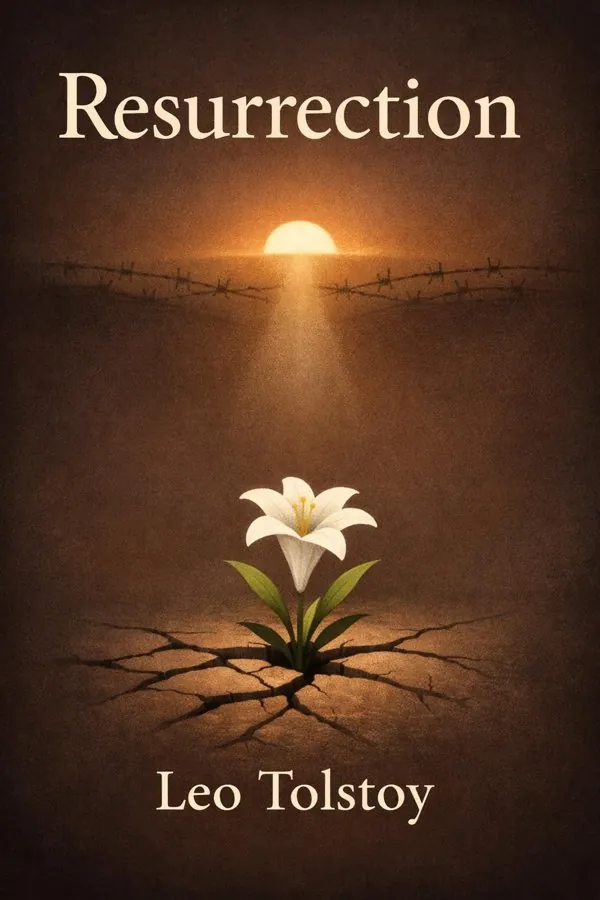
Resurrection: Summary & Key Insights
by Leo Tolstoy
 10 min8 chaptersAudio available
Key Takeaways from Resurrection
A human life can change in an instant when a buried truth suddenly becomes impossible to ignore.
Feeling bad is easy; accepting responsibility is rare.
One of the most chilling lessons of Resurrection is that cruelty often wears the face of procedure.
Sometimes love begins not with possession but with accompaniment.
Tolstoy’s deepest argument is that true renewal does not come from punishment, success, or social respectability, but from a transformed way of seeing other people.
What Is Resurrection About?
Resurrection by Leo Tolstoy is a classics book spanning 4 pages. Resurrection, first published in 1899, is Leo Tolstoy’s final novel and one of his fiercest moral works. At its center is Prince Dmitri Nekhlyudov, a privileged nobleman who serves on a jury and is shocked to recognize the defendant: Katusha Maslova, a woman he once seduced, abandoned, and helped ruin. Her unjust conviction forces him to confront not only his personal guilt but also the cruelty of the social order that protected him and destroyed her. What begins as one man’s attempt to make amends grows into a sweeping indictment of class privilege, legal hypocrisy, prison brutality, and spiritual emptiness. Yet Resurrection is not only a novel of accusation. It is also a story of conscience awakening—of what can happen when a person stops hiding behind status, custom, and self-deception. Tolstoy wrote the book after his own profound religious and ethical transformation, and it carries the authority of a writer no longer content merely to describe society, but determined to challenge it. The result is a classic that remains urgent wherever institutions fail compassion and people seek a more honest, humane way to live.
This FizzRead summary covers all 8 key chapters of Resurrection in approximately 10 minutes, distilling the most important ideas, arguments, and takeaways from Leo Tolstoy's work. Also available as an audio summary and Key Quotes Podcast.
Resurrection
Resurrection, first published in 1899, is Leo Tolstoy’s final novel and one of his fiercest moral works. At its center is Prince Dmitri Nekhlyudov, a privileged nobleman who serves on a jury and is shocked to recognize the defendant: Katusha Maslova, a woman he once seduced, abandoned, and helped ruin. Her unjust conviction forces him to confront not only his personal guilt but also the cruelty of the social order that protected him and destroyed her. What begins as one man’s attempt to make amends grows into a sweeping indictment of class privilege, legal hypocrisy, prison brutality, and spiritual emptiness. Yet Resurrection is not only a novel of accusation. It is also a story of conscience awakening—of what can happen when a person stops hiding behind status, custom, and self-deception. Tolstoy wrote the book after his own profound religious and ethical transformation, and it carries the authority of a writer no longer content merely to describe society, but determined to challenge it. The result is a classic that remains urgent wherever institutions fail compassion and people seek a more honest, humane way to live.
Who Should Read Resurrection?
This book is perfect for anyone interested in classics and looking to gain actionable insights in a short read. Whether you're a student, professional, or lifelong learner, the key ideas from Resurrection by Leo Tolstoy will help you think differently.
- ✓Readers who enjoy classics and want practical takeaways
- ✓Professionals looking to apply new ideas to their work and life
- ✓Anyone who wants the core insights of Resurrection in just 10 minutes
Want the full summary?
Get instant access to this book summary and 100K+ more with Fizz Moment.
Get Free SummaryAvailable on App Store • Free to download
Key Chapters
A human life can change in an instant when a buried truth suddenly becomes impossible to ignore. That is the force that drives Resurrection. Prince Dmitri Nekhlyudov enters the courtroom believing himself respectable, educated, and morally decent. But when he recognizes Katusha Maslova among the accused, the story strips away the illusions he has built around his identity. He remembers seducing her years earlier, then abandoning her to shame, hardship, and social ruin. The trial does not simply expose her situation; it exposes his soul.
Tolstoy’s insight is that conscience often awakens not through abstract reflection but through direct encounter with the consequences of our actions. Nekhlyudov had moved on with his life because society allowed him to. His rank, habits, and comforts dulled moral memory. But seeing Katusha as a prisoner forces him to understand that past wrongs do not disappear just because the guilty party becomes busy, successful, or socially accepted.
This idea matters beyond the novel. Many people live with softened versions of the same blindness: an exploitative choice at work, a betrayal in a relationship, indifference to someone harmed by our convenience. We tell ourselves that time has passed, that everyone makes mistakes, that life is complicated. Tolstoy asks a harder question: what if conscience is the beginning of life, not an interruption of it?
Nekhlyudov’s awakening is painful because it destroys his self-image. Yet that pain is also liberating. It begins his movement from vanity toward moral responsibility. The first step in transformation is not self-improvement but truthful recognition.
Actionable takeaway: Identify one unresolved wrong you have minimized, and replace vague regret with one concrete act of acknowledgment, repair, or restitution.
Feeling bad is easy; accepting responsibility is rare. Tolstoy draws a sharp distinction between emotional guilt and moral action. Once Nekhlyudov realizes what he has done to Katusha, he could have responded in a familiar way: private remorse, charitable donations, or sentimental self-condemnation. Instead, he chooses the harder path of involvement. He follows her case, seeks legal appeals, gives up comforts, and attempts to reorder his life around accountability.
This is one of the novel’s most practical insights. Guilt can become another form of self-absorption if it remains focused on our feelings. A person who says, “I feel terrible about what happened,” may still avoid the cost of repair. Tolstoy shows that moral seriousness begins when guilt turns outward—toward the harmed person, the damaged situation, and the structures that allowed the harm.
Nekhlyudov’s efforts are imperfect. He cannot erase the past, and some of his attempts to help Katusha are mixed with pride, romantic fantasy, and the desire to redeem himself. Tolstoy does not idealize repentance. Real responsibility is clumsy, humbling, and often misunderstood. But it is still necessary. Moral growth is not measured by purity of intention alone; it is measured by willingness to bear consequences and remain present.
In everyday life, this applies to broken trust, family conflicts, workplace mistakes, and social privilege. If you have benefited from an unfair arrangement, apology alone is not enough. Responsibility asks: What can I return? What burden can I share? What pattern must I stop reproducing?
Tolstoy’s point is severe but hopeful. We may not control the full outcome of our efforts, but we are still obligated to act.
Actionable takeaway: Convert one regret into a plan with three parts—admit the harm clearly, ask what repair is needed, and commit to a sustained follow-through.
One of the most chilling lessons of Resurrection is that cruelty often wears the face of procedure. As Nekhlyudov tries to help Katusha, he enters the Russian legal and penal system and discovers a world governed not by justice but by habit, bureaucracy, class prejudice, and moral indifference. People suffer not only because individuals are wicked, but because institutions normalize carelessness. Papers are misplaced, officials protect themselves, laws are applied mechanically, and human beings become cases.
Tolstoy’s criticism is larger than any single courtroom error. He portrays a society in which the privileged are shielded from consequences while the vulnerable are judged harshly and discarded. Katusha’s downfall is tied not merely to one seduction, but to a whole structure that punishes women, the poor, and the socially abandoned while excusing aristocratic men. The legal system appears orderly, yet it perpetuates disorder at the level of human life.
This remains strikingly modern. Many systems today—legal, corporate, educational, administrative—still confuse efficiency with justice. A policy can be technically followed and morally wrong. An institution can call itself neutral while reproducing inequality. Tolstoy urges readers to ask not whether a system looks legitimate from above, but what it does to those trapped inside it.
For practical application, this means paying attention to process and outcomes at once. In a workplace, for example, a formal grievance procedure may exist, yet employees without power may still be silenced. In schools or hospitals, rules may be necessary, but they can become inhuman if no one asks how they affect real people.
Tolstoy’s warning is simple: systems become monstrous when responsibility is diffused.
Actionable takeaway: Examine one institution you participate in and ask a neglected question: who bears the hidden cost of its convenience, order, or reputation?
Sometimes love begins not with possession but with accompaniment. After Katusha is sentenced, Nekhlyudov chooses to follow her into the world of imprisonment and exile. This decision is one of the novel’s turning points because it represents more than devotion to a person. It is a rejection of the insulated life that once allowed him to remain morally asleep. To follow Katusha is to enter discomfort, uncertainty, and public humiliation voluntarily.
Tolstoy uses this movement to explore renunciation. Nekhlyudov gradually loosens his attachment to wealth, status, and social approval. He sees that his former life was built on unexamined privilege and that his possessions were connected to the exploitation of others. Renunciation, in this sense, is not theatrical self-denial. It is the practical consequence of seeing clearly. Once a person recognizes that comfort has depended on injustice, simplicity becomes a moral necessity.
Yet Tolstoy avoids making this path sentimental. Nekhlyudov’s sacrifice does not instantly solve Katusha’s suffering, nor does it guarantee that she will accept him or his help on his terms. Renunciation is not a transaction. It does not buy forgiveness. It simply removes the excuses that luxury and vanity provide.
This idea can be applied today wherever people sense a conflict between values and lifestyle. A person may realize their success depends on exploitative labor, manipulative business practices, or emotional neglect of others. Renunciation may mean giving up prestige, changing careers, reducing consumption, or stepping away from environments that reward moral compromise.
Tolstoy suggests that the good life may require less comfort and more solidarity than modern ambition allows.
Actionable takeaway: Choose one convenience, status symbol, or habit that shields you from others’ suffering, and practice a deliberate form of reduction or relinquishment.
Tolstoy’s deepest argument is that true renewal does not come from punishment, success, or social respectability, but from a transformed way of seeing other people. As Nekhlyudov’s journey continues, he begins to move beyond personal guilt into a broader spiritual awakening shaped by humility, compassion, and the teachings of the Gospels. Tolstoy presents Christianity not as doctrine enforced by church or state, but as a lived ethic of love, nonviolence, forgiveness, and truthfulness.
This matters because the novel sharply distinguishes religion from institutional religion. Priests, officials, and respectable society often bless the very systems that crush the weak. Tolstoy therefore relocates spiritual authority in conscience and in direct moral practice. To love one’s neighbor is not a pious phrase; it is a revolutionary demand that undermines hierarchy, coercion, and self-interest.
Nekhlyudov does not become perfect. What changes is the direction of his life. He stops treating morality as reputation management and starts treating it as relation: how he sees prisoners, peasants, officials, strangers, and Katusha herself. Spiritual renewal, in Tolstoy’s vision, is less about mystical feeling than about releasing domination. It asks us to stop using others for pleasure, status, security, or self-redemption.
In practical terms, this can reshape daily life. Radical love might mean listening without defensiveness, refusing to humiliate a subordinate, forgiving without denying truth, or choosing service over image. It can also mean challenging systems that make love seem naive.
Tolstoy insists that love is not weakness. It is the only force capable of interrupting the endless cycle of injury and retaliation.
Actionable takeaway: Practice one act of undeserved respect or mercy toward someone you are tempted to judge, control, or dismiss.
A society reveals its soul in how it names and treats the people it has cast aside. Katusha Maslova begins the novel in the eyes of the world as a fallen woman, a defendant, a prisoner, and a social failure. Yet Tolstoy steadily restores her complexity. She is not merely an object of Nekhlyudov’s guilt or a symbol of innocence corrupted. She is wounded, proud, practical, suspicious, intelligent, and capable of change. Her dignity survives even after society has tried to reduce her to a label.
This is one of the novel’s most important achievements. Tolstoy forces readers to confront the violence of simplification. Once a person is categorized—criminal, immoral, difficult, ruined—others feel less obligated to imagine their history. But Katusha’s condition emerges from betrayal, class vulnerability, gendered judgment, and institutional neglect. Tolstoy does not deny her flaws; he refuses to let flaws erase humanity.
Nekhlyudov’s growth depends partly on learning to see Katusha as a person independent of his own narrative. At first, he is tempted to cast himself as savior. Over time, he must confront her agency. She does not exist to complete his moral drama. This is a powerful lesson for anyone trying to help others. Genuine compassion means respecting the other person’s reality, not scripting their recovery to fit our conscience.
Today, this insight applies to addiction, incarceration, poverty, scandal, and social stigma. People are often reduced to their worst moment or most visible wound. Tolstoy asks us to recover personhood before judgment.
Actionable takeaway: The next time you form an instant opinion about a “difficult” or stigmatized person, pause and ask what history, vulnerability, or betrayal might be invisible from the surface.
Respectability can be one of the most effective disguises for corruption. Throughout Resurrection, Tolstoy exposes the polished manners, elegant speech, and social rituals of the upper classes as morally hollow when they are detached from truth and compassion. Nekhlyudov’s world is filled with people who appear decent because they follow convention, attend ceremonies, and maintain appearances. Yet many of them are complicit in exploitation, hypocrisy, and emotional cowardice.
Tolstoy’s criticism is not aimed at etiquette itself, but at the way outward correctness can replace inner honesty. A person may be considered honorable because they belong to the right circles, speak in measured tones, and avoid scandal, while still living off injustice or ignoring the suffering of others. By contrast, people judged disreputable may possess more sincerity and moral clarity than those officially admired.
This is a timeless warning. Modern life still rewards image management. Organizations promote values they do not practice. Individuals curate virtue publicly while behaving selfishly in private. Families maintain a facade of harmony by suppressing uncomfortable truths. Tolstoy reminds us that social approval is a poor test of moral worth.
Nekhlyudov’s awakening requires him to distrust the standards of his class. He must choose between being thought respectable and becoming genuinely honest. That choice remains difficult because social belonging often depends on silence. To challenge the accepted order may mean embarrassment, exclusion, or loss.
The novel therefore invites readers to inspect the difference between appearing good and doing good. Character is revealed where reputation offers no reward.
Actionable takeaway: Identify one area where you are protecting appearances more than truth, and take a small step toward honesty even if it complicates your image.
Tolstoy suggests that the deepest prisons are not only built of stone but of self-deception. Nekhlyudov’s external journey through courts, prisons, and exile is matched by an internal struggle to stop lying to himself. Before his awakening, he lives according to fragmented excuses: youthful passion, social custom, male entitlement, noble obligation, and cultivated indifference. These rationalizations allow him to function without facing the moral meaning of his life.
Inner honesty is difficult because it threatens comfort. To tell the truth about oneself may require admitting cowardice, vanity, exploitation, or emotional laziness. Tolstoy knows that human beings are skilled at disguising selfishness as duty, romance, practicality, or realism. Resurrection becomes powerful because it shows self-knowledge not as introspective style, but as ethical necessity.
The more honest Nekhlyudov becomes, the freer he is to act differently. This freedom is not the freedom to do whatever he wants. It is freedom from illusion. He is less controlled by desire for status, less dependent on flattering social narratives, and less willing to call evil by softer names. In Tolstoy’s moral universe, truth is liberating because it reconnects us to responsibility.
This applies in ordinary life with surprising force. Inner honesty may mean recognizing that a career choice is driven by vanity, that generosity is mixed with control, or that resentment masks guilt. Such realizations can be painful, but they open the possibility of change.
Tolstoy’s lesson is that a human being cannot be morally resurrected while still committed to flattering lies.
Actionable takeaway: Write down one self-justifying story you often tell about your behavior, then rewrite it in plainer, more uncomfortable, and more truthful language.
All Chapters in Resurrection
About the Author
Leo Tolstoy (1828–1910) was a Russian novelist, essayist, and moral philosopher whose work transformed world literature. Born into an aristocratic family, he drew on his experience of war, privilege, family life, and spiritual crisis to create fiction of extraordinary psychological and social depth. He is best known for War and Peace, Anna Karenina, and Resurrection, novels that combine intimate human drama with sweeping reflections on history, morality, and society. In his later years, Tolstoy became increasingly critical of wealth, state power, violence, and institutional religion, advocating instead for simplicity, compassion, nonviolence, and a return to the ethical teachings of Jesus. His ideas influenced major figures such as Gandhi and Martin Luther King Jr., extending his legacy far beyond literature.
Get This Summary in Your Preferred Format
Read or listen to the Resurrection summary by Leo Tolstoy anytime, anywhere. FizzRead offers multiple formats so you can learn on your terms — all free.
Available formats: App · Audio · PDF · EPUB — All included free with FizzRead
Download Resurrection PDF and EPUB Summary
Key Quotes from Resurrection
“A human life can change in an instant when a buried truth suddenly becomes impossible to ignore.”
“Feeling bad is easy; accepting responsibility is rare.”
“One of the most chilling lessons of Resurrection is that cruelty often wears the face of procedure.”
“Sometimes love begins not with possession but with accompaniment.”
“Tolstoy’s deepest argument is that true renewal does not come from punishment, success, or social respectability, but from a transformed way of seeing other people.”
Frequently Asked Questions about Resurrection
Resurrection by Leo Tolstoy is a classics book that explores key ideas across 8 chapters. Resurrection, first published in 1899, is Leo Tolstoy’s final novel and one of his fiercest moral works. At its center is Prince Dmitri Nekhlyudov, a privileged nobleman who serves on a jury and is shocked to recognize the defendant: Katusha Maslova, a woman he once seduced, abandoned, and helped ruin. Her unjust conviction forces him to confront not only his personal guilt but also the cruelty of the social order that protected him and destroyed her. What begins as one man’s attempt to make amends grows into a sweeping indictment of class privilege, legal hypocrisy, prison brutality, and spiritual emptiness. Yet Resurrection is not only a novel of accusation. It is also a story of conscience awakening—of what can happen when a person stops hiding behind status, custom, and self-deception. Tolstoy wrote the book after his own profound religious and ethical transformation, and it carries the authority of a writer no longer content merely to describe society, but determined to challenge it. The result is a classic that remains urgent wherever institutions fail compassion and people seek a more honest, humane way to live.
More by Leo Tolstoy




You Might Also Like






Browse by Category
Ready to read Resurrection?
Get the full summary and 100K+ more books with Fizz Moment.