
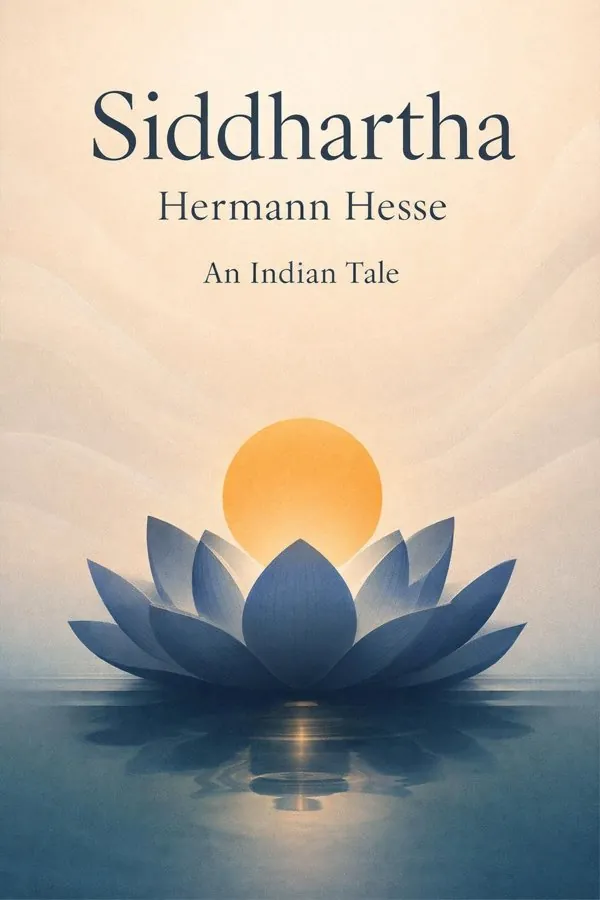
Siddhartha: Summary & Key Insights
 10 min9 chaptersAudio available
Key Takeaways from Siddhartha
A privileged life can still feel empty when the soul remains unanswered.
Escaping the world is not the same as understanding it.
Even perfect teaching cannot spare us from having to live our own path.
The most radical step in Siddhartha’s journey is not leaving home or rejecting asceticism; it is realizing that he must stop trying to become someone else.
What we condemn from afar may hold lessons we can learn nowhere else.
What Is Siddhartha About?
Siddhartha by Hermann Hesse is a classics book published in 1922 spanning 5 pages. Siddhartha is Hermann Hesse’s luminous 1922 novel about a young man’s search for enlightenment in ancient India, during the era of the Buddha. What begins as the story of a gifted Brahmin’s son quickly becomes a universal exploration of dissatisfaction, desire, suffering, love, loss, and inner awakening. Siddhartha is not content to inherit wisdom secondhand. He wants truth that is lived, not merely taught, and that longing drives him through extreme asceticism, sensual pleasure, wealth, despair, and finally a quiet, profound reconciliation with life itself. The novel matters because it speaks to a question that remains urgent today: how do we find meaning in a world full of advice, ideologies, and distractions? Hesse’s answer is subtle and enduring. Real understanding cannot be borrowed from doctrines alone; it must be discovered through experience, reflection, and attention. Drawing on Indian spiritual traditions while writing for a modern Western audience, Hesse created a work that bridges cultures without losing psychological depth. A Nobel Prize-winning author celebrated for his insight into self-realization, Hesse makes Siddhartha both a spiritual parable and a deeply human coming-of-age story.
This FizzRead summary covers all 9 key chapters of Siddhartha in approximately 10 minutes, distilling the most important ideas, arguments, and takeaways from Hermann Hesse's work. Also available as an audio summary and Key Quotes Podcast.
Siddhartha
Siddhartha is Hermann Hesse’s luminous 1922 novel about a young man’s search for enlightenment in ancient India, during the era of the Buddha. What begins as the story of a gifted Brahmin’s son quickly becomes a universal exploration of dissatisfaction, desire, suffering, love, loss, and inner awakening. Siddhartha is not content to inherit wisdom secondhand. He wants truth that is lived, not merely taught, and that longing drives him through extreme asceticism, sensual pleasure, wealth, despair, and finally a quiet, profound reconciliation with life itself.
The novel matters because it speaks to a question that remains urgent today: how do we find meaning in a world full of advice, ideologies, and distractions? Hesse’s answer is subtle and enduring. Real understanding cannot be borrowed from doctrines alone; it must be discovered through experience, reflection, and attention. Drawing on Indian spiritual traditions while writing for a modern Western audience, Hesse created a work that bridges cultures without losing psychological depth. A Nobel Prize-winning author celebrated for his insight into self-realization, Hesse makes Siddhartha both a spiritual parable and a deeply human coming-of-age story.
Who Should Read Siddhartha?
This book is perfect for anyone interested in classics and looking to gain actionable insights in a short read. Whether you're a student, professional, or lifelong learner, the key ideas from Siddhartha by Hermann Hesse will help you think differently.
- ✓Readers who enjoy classics and want practical takeaways
- ✓Professionals looking to apply new ideas to their work and life
- ✓Anyone who wants the core insights of Siddhartha in just 10 minutes
Want the full summary?
Get instant access to this book summary and 100K+ more with Fizz Moment.
Get Free SummaryAvailable on App Store • Free to download
Key Chapters
A privileged life can still feel empty when the soul remains unanswered. At the beginning of Siddhartha, we meet a brilliant, admired young Brahmin who seems to possess everything a spiritual seeker should want: intelligence, discipline, social standing, and access to sacred learning. He knows rituals, recites holy verses, and earns the love of his father and the loyalty of his friend Govinda. Yet beneath this ideal surface lies a quiet but relentless dissatisfaction. Siddhartha senses that repeating prayers and studying doctrines do not guarantee true awakening. He can speak about holiness, but he has not yet become whole.
This tension is one of the novel’s first and most important insights: outer success and inner certainty are not the same thing. Many people recognize this in modern life. A student may earn top grades yet feel directionless. A professional may appear accomplished yet secretly wonder whether they are living someone else’s idea of success. Siddhartha’s unrest is not immaturity; it is the beginning of genuine inquiry. He is unwilling to accept inherited truth simply because respected elders teach it.
Hesse shows that spiritual growth often begins with holy discontent, the painful recognition that borrowed answers no longer satisfy. Siddhartha’s departure from home is therefore not rebellion for its own sake. It is a courageous refusal to confuse knowledge with wisdom.
In practical terms, this idea asks us to examine where we may be performing understanding instead of living it. Are we following a path because it feels true, or because it is expected? Are our beliefs tested by experience, or merely repeated?
Actionable takeaway: Identify one area of your life where you are following inherited expectations, and ask what direct experience would help you discover what is truly yours.
Escaping the world is not the same as understanding it. After leaving home, Siddhartha joins the Samanas, wandering ascetics who practice extreme renunciation. He learns to fast, endure pain, empty the self, and detach from bodily desire. These disciplines strengthen his will and teach him mastery over hunger, comfort, and fear. In one sense, this period is a genuine achievement: Siddhartha learns that the human being is not merely a servant of appetite. He becomes capable of stillness and self-command.
But Hesse’s deeper point is that discipline, while valuable, has limits. Siddhartha gradually realizes that escaping the self through trance, deprivation, or spiritual exercises may only be another form of avoidance. The ego can hide even inside holiness. One can become proud of purity, attached to detachment, or dependent on practices that promise transcendence without delivering lasting freedom.
This insight remains relevant. Many modern people turn self-improvement into a subtle identity performance. Strict diets, productivity systems, digital detoxes, meditation streaks, or minimalist lifestyles can be useful, but they can also become ways to control life rather than understand it. Siddhartha learns that denying desire is not identical with wisdom. If suffering is merely suppressed, it returns in another form.
His life with the Samanas is therefore essential not because it gives him the final answer, but because it exposes a partial truth. Self-discipline matters. Renunciation can sharpen perception. But no technique, however impressive, can replace lived insight.
Actionable takeaway: Practice one discipline that strengthens your attention, but regularly ask whether it is making you more awake to life or simply more attached to an identity of control.
Even perfect teaching cannot spare us from having to live our own path. One of the most memorable moments in Siddhartha occurs when he meets Gotama, the Buddha. Siddhartha recognizes immediately that the Buddha is the real thing: serene, complete, free from striving. Unlike other teachers, Gotama’s peace is not theoretical. It radiates from his very presence. Govinda, moved by this authenticity, becomes one of the Buddha’s followers.
Siddhartha, however, makes a surprising choice. He deeply respects the Buddha, but he refuses to remain as a disciple. His reasoning is not arrogant dismissal. Rather, he understands that while teachings can point toward liberation, they cannot transfer enlightenment like an object. The Buddha’s doctrine may be flawless, yet the experience that produced it cannot simply be handed over. To imitate another person’s awakening is still to live secondhand.
This is one of Hesse’s boldest insights. Spiritual authority has value, but it cannot replace personal realization. In everyday terms, we encounter this whenever we consume books, podcasts, mentors, or philosophies hoping they will settle our lives for us. Guidance matters, but if we never test ideas through experience, they remain abstractions.
Siddhartha’s choice also clarifies the difference between respect and dependence. He honors the Buddha without surrendering his responsibility to seek directly. That balance is difficult. Some people reject all teachers out of ego; others cling to teachers out of fear. Siddhartha does neither.
Actionable takeaway: Learn from wise people, but do not outsource your deepest questions. Choose one belief you hold because it sounds wise, and examine how you might verify it in your own life.
The most radical step in Siddhartha’s journey is not leaving home or rejecting asceticism; it is realizing that he must stop trying to become someone else. After parting ways with Govinda and the Buddha’s community, Siddhartha experiences the world as if for the first time. He sees nature freshly, hears birds and water, and senses his own individuality with new wonder. This moment marks a shift from spiritual ambition to self-recognition. He no longer wants to dissolve himself into borrowed ideals. He wants to discover what his own life is saying.
Hesse suggests that many seekers remain trapped because they pursue enlightenment as another identity project. They strive to become holy, disciplined, enlightened, successful, or admired, but they rarely pause to ask who is doing the striving. Siddhartha’s breakthrough is subtle: he begins to trust experience over imitation. He understands that the path forward must include his own desires, confusion, strengths, and limits, not just his concepts of perfection.
In modern life, this idea applies far beyond spirituality. A person may choose a career because it looks meaningful, adopt political or moral views because their community values them, or build a lifestyle modeled on influencers, family, or tradition. The result may appear admirable yet feel strangely unreal. Becoming oneself is not selfishness; it is honesty. It means listening carefully enough to distinguish authentic conviction from social performance.
This phase also prepares Siddhartha for mistakes. Once he claims his own path, he can no longer blame doctrine, family, or teachers. He must live with the consequences of direct experience, and that responsibility is what makes transformation possible.
Actionable takeaway: Notice one place where you are imitating an admired model, and experiment with a small choice that reflects your own values more honestly.
What we condemn from afar may hold lessons we can learn nowhere else. Siddhartha’s entry into worldly life, guided by the courtesan Kamala and the merchant Kamaswami, seems at first like a fall from spiritual seriousness. He learns the arts of love, business, wealth, comfort, and social power. He dresses elegantly, earns money, gambles, calculates, desires, and eventually becomes entangled in the pleasures and anxieties of ordinary life. The seeker who once fasted in the forest now chases success in the city.
Yet Hesse does not portray this period as meaningless. It is spiritually dangerous, but necessary. Siddhartha had previously looked at desire from the outside. Now he experiences it from within. He learns how charm, luxury, sensuality, and ambition seduce the self. More importantly, he sees how repetition and indulgence can deaden the soul. What begins as curiosity becomes habit; what feels exciting becomes empty. Through worldly life, Siddhartha gains compassion for those who are caught in cycles of wanting, fearing, and possessing.
This is a powerful reminder that life’s detours are not always failures. Many people spend years in careers, relationships, or social roles that seem to pull them away from their deeper values. Looking back, they may feel ashamed. Hesse suggests a more generous interpretation: if lived consciously enough, even periods of confusion can mature us. Experience can reveal the insufficiency of pleasures more effectively than lectures ever could.
The danger, of course, is forgetting oneself completely. Siddhartha nearly does. His spiritual sensitivity becomes dull, and his life turns mechanical. That is why this chapter is both warning and wisdom.
Actionable takeaway: Reflect on one pleasure or ambition you pursue repeatedly, and ask whether it is truly nourishing you or merely keeping you occupied.
Sometimes transformation begins only after the life we built becomes unbearable. After years of wealth and sensuality, Siddhartha falls into exhaustion and self-disgust. The pleasures that once fascinated him now taste stale. He sees that he has become spiritually numb, trapped in habits he once would have pitied. At the edge of a river, overwhelmed by despair, he contemplates ending his life. This is the novel’s darkest turning point, but also one of its most profound.
In the moment of collapse, Siddhartha hears the sacred syllable Om and falls into restorative sleep. When he awakens, he is not magically finished with suffering, but he has been interrupted. The old self has cracked. Hesse portrays despair not as noble in itself, but as revelatory. It strips away illusions. When a person can no longer pretend that their current way of living is meaningful, something new becomes possible.
Many readers connect deeply with this passage because it mirrors modern crises of burnout, addiction, disillusionment, or identity loss. A person may wake up after years of overwork and realize they no longer know what matters. Another may succeed externally yet feel inwardly deadened. These moments are painful, but they can become thresholds if they lead to honesty rather than denial.
Siddhartha’s awakening by the river shows that recovery often begins not with a grand solution but with a pause, a breath, a return to what is fundamental. He does not immediately gain enlightenment. He regains the capacity to listen.
Actionable takeaway: If you feel trapped in a life that no longer feels alive, resist the urge to numb out. Create one deliberate pause today, through silence, journaling, or time in nature, and listen for what your exhaustion is trying to tell you.
Wisdom arrives when we stop forcing life into linear explanations. After his crisis, Siddhartha remains by the river and meets the ferryman Vasudeva, whose quiet presence embodies a form of understanding deeper than doctrine. Under Vasudeva’s guidance, Siddhartha learns to listen to the river. This is not sentimental nature worship; it is one of the novel’s central spiritual metaphors. The river is always changing and always itself. It moves, returns, deepens, speaks, and contains many voices at once.
By listening, Siddhartha discovers a new relationship to time. Human beings typically divide life into past regret, present struggle, and future desire. The river suggests another truth: all moments coexist within a larger unity. Childhood, ambition, shame, longing, grief, and peace are not isolated compartments but interwoven expressions of a single life. The river laughs at the illusion that we are separate fragments moving toward completion. In a deeper sense, we already belong to the whole.
This idea has practical power. People often suffer by over-identifying with one chapter of their story: a failure, a wound, a success, a role. The river perspective softens this rigidity. You are not only your current confusion, nor only your past mistakes. Life is dynamic, layered, and relational. Listening, rather than controlling, can reveal patterns that force cannot.
Modern applications might include contemplative walking, observing natural rhythms, or simply learning to sit with conflicting feelings without demanding immediate resolution. The river teaches that meaning emerges through receptivity.
Actionable takeaway: Spend ten minutes in silent observation of something living or moving, such as water, trees, or breath, and practice noticing change without immediately trying to judge or fix it.
We understand others most deeply when life humbles our judgments. Late in the novel, Siddhartha reunites briefly with Kamala and becomes the father of a young son. After Kamala’s death, the boy remains with him, but the relationship is painful. Siddhartha loves his son intensely, yet the child is proud, resentful, and unwilling to accept the quiet life by the river. Eventually, the boy runs away, and Siddhartha is left with grief he cannot control.
This episode matters because it completes Siddhartha’s education in human suffering. Earlier in life, he observed ordinary people with a certain distance. Even when he lived among them, part of him stood apart as a seeker. Through his son, however, he feels attachment, helplessness, and heartbreak directly. He wants to protect, guide, and keep what he loves, and he learns that love does not grant possession. One cannot spare another person from their own journey.
For parents, partners, and friends, this lesson is painfully familiar. We may know intellectually that each person must make their own choices, but love tempts us to control, rescue, or hold on. Siddhartha’s sorrow teaches compassion. He finally understands his own father’s pain when he himself left home as a young man. The circle closes, and with it comes deeper tenderness toward all human beings.
Hesse does not reject love as illusion. Instead, he shows that love becomes wiser when it releases domination. To care truly is not to arrange another’s path but to remain open even when their path wounds us.
Actionable takeaway: Think of someone you love whom you are trying to control, fix, or hold too tightly, and ask how you might replace one act of pressure with one act of patient presence.
The final lesson of Siddhartha is that wisdom cannot be reduced to concepts without losing its essence. By the end of the novel, Siddhartha has passed through religion, asceticism, sensuality, business, despair, love, grief, and contemplation. What he gains is not a system but a way of seeing: every experience belongs, every life is interconnected, and reality is richer than the oppositions the mind creates. Sin and holiness, suffering and joy, time and eternity are not neatly separable when viewed from the deepest level.
This culminates in Siddhartha’s final encounter with Govinda. Govinda has spent his life faithfully following teachings, yet he still seeks the peace he once saw in others. Siddhartha tries to explain that wisdom cannot truly be taught, only knowledge can. Words divide what experience reveals as whole. When Govinda finally perceives Siddhartha’s transformed presence, he glimpses the unity his friend has discovered.
This is not anti-intellectualism. Hesse does not say teachings are useless. He says they are limited. Language can guide, describe, and inspire, but lived reality always exceeds explanation. This insight matters in a world saturated with information. We can collect endless theories about happiness, spirituality, relationships, and purpose while remaining untouched at the level that actually changes us.
The novel’s enduring contribution is this invitation to integration. Nothing in Siddhartha’s life is wasted, not even error. The whole path becomes wisdom when it is embraced without denial.
Actionable takeaway: Choose one important idea you admire, such as compassion, simplicity, or presence, and translate it into one concrete daily practice so it becomes experience rather than theory.
All Chapters in Siddhartha
About the Author
Hermann Hesse (1877–1962) was a German-Swiss novelist, poet, and painter whose work explores self-realization, spirituality, alienation, and the search for inner freedom. Born in Calw, Germany, into a family shaped by religious scholarship and missionary work, Hesse developed an early interest in philosophy, literature, and Eastern traditions. His fiction often centers on individuals who feel estranged from social expectations and must undertake difficult inner journeys toward wholeness. Among his most celebrated books are Siddhartha, Steppenwolf, Narcissus and Goldmund, and The Glass Bead Game. In 1946, he received the Nobel Prize in Literature for his inspired writings, which combine lyrical beauty with psychological and spiritual depth. Hesse remains one of the most widely read modern authors for readers drawn to introspective, transformative literature.
Get This Summary in Your Preferred Format
Read or listen to the Siddhartha summary by Hermann Hesse anytime, anywhere. FizzRead offers multiple formats so you can learn on your terms — all free.
Available formats: App · Audio · PDF · EPUB — All included free with FizzRead
Download Siddhartha PDF and EPUB Summary
Key Quotes from Siddhartha
“A privileged life can still feel empty when the soul remains unanswered.”
“Escaping the world is not the same as understanding it.”
“Even perfect teaching cannot spare us from having to live our own path.”
“The most radical step in Siddhartha’s journey is not leaving home or rejecting asceticism; it is realizing that he must stop trying to become someone else.”
“What we condemn from afar may hold lessons we can learn nowhere else.”
Frequently Asked Questions about Siddhartha
Siddhartha by Hermann Hesse is a classics book that explores key ideas across 9 chapters. Siddhartha is Hermann Hesse’s luminous 1922 novel about a young man’s search for enlightenment in ancient India, during the era of the Buddha. What begins as the story of a gifted Brahmin’s son quickly becomes a universal exploration of dissatisfaction, desire, suffering, love, loss, and inner awakening. Siddhartha is not content to inherit wisdom secondhand. He wants truth that is lived, not merely taught, and that longing drives him through extreme asceticism, sensual pleasure, wealth, despair, and finally a quiet, profound reconciliation with life itself. The novel matters because it speaks to a question that remains urgent today: how do we find meaning in a world full of advice, ideologies, and distractions? Hesse’s answer is subtle and enduring. Real understanding cannot be borrowed from doctrines alone; it must be discovered through experience, reflection, and attention. Drawing on Indian spiritual traditions while writing for a modern Western audience, Hesse created a work that bridges cultures without losing psychological depth. A Nobel Prize-winning author celebrated for his insight into self-realization, Hesse makes Siddhartha both a spiritual parable and a deeply human coming-of-age story.
Compare Siddhartha

You Might Also Like






Featured In
Naval Ravikant's Book Picks
Naval Ravikant on Wealth and Wisdom: Essential Reads
Tim Ferriss's Book Picks
Tim Ferriss's Toolkit: Books for Peak Performance
Jay Shetty's Book Picks
Jay Shetty's Mindful Reading List
Ryan Holiday's Book Picks
Ryan Holiday's Stoic Reading List: Ancient Wisdom for Modern Life
James Clear's Book Picks
James Clear's Reading List: Books That Build Better Habits
Paulo Coelho's Book Picks
Paulo Coelho's Spiritual Reading Journey
Matthew McConaughey's Book Picks
Matthew McConaughey's Life Philosophy Books
Curated's Book Picks
Best Classic Novels Everyone Should Read
Curated's Book Picks
Must-Read Books Before You Die — The Essential List
Browse by Category
Ready to read Siddhartha?
Get the full summary and 100K+ more books with Fizz Moment.