
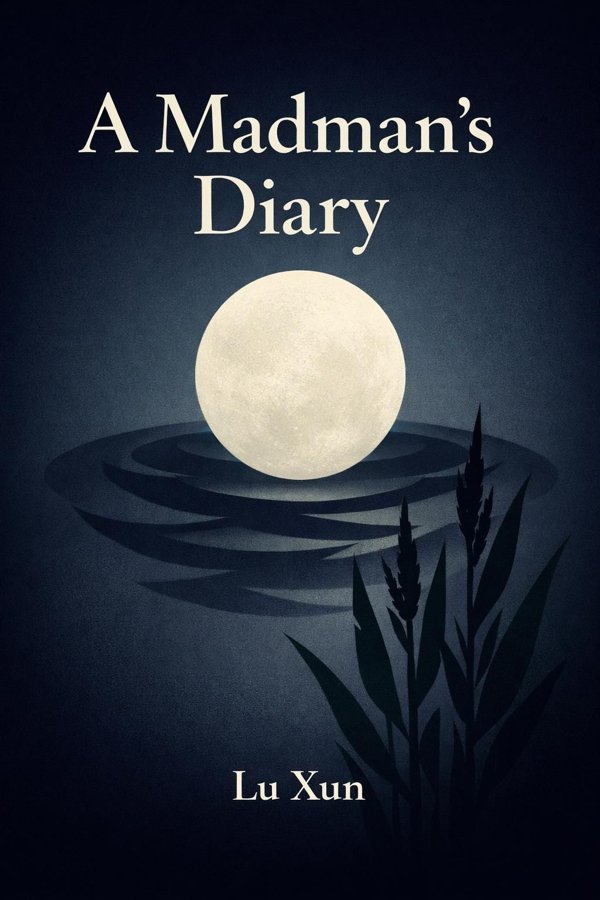
A Madman's Diary: Summary & Key Insights
by Lu Xun
 10 min8 chaptersAudio available
Key Takeaways from A Madman's Diary
Sometimes the person labeled irrational is the only one willing to say what everyone else is hiding.
The most shocking images in literature often endure because they describe ordinary life in unbearable terms.
What a culture praises as order can sometimes be a method of control.
Before people can change a broken world, they need words that make its brokenness visible.
Oppression becomes more powerful when it convinces people they are alone.
What Is A Madman's Diary About?
A Madman's Diary by Lu Xun is a classics book. What if the greatest madness in society is not the fear of persecution, but the refusal to see the cruelty everyone else accepts as normal? Lu Xun’s A Madman’s Diary, first published in 1918 in New Youth, is widely regarded as the first major work of modern Chinese literature written in the vernacular. On the surface, it is the unsettling journal of a man who becomes convinced that the people around him are cannibals. Beneath that disturbing premise lies a fierce moral and political critique of a society built on oppression, hypocrisy, and inherited violence. Lu Xun uses the voice of a paranoid narrator not merely to tell a strange story, but to expose how customs, moral codes, and social hierarchies can consume human beings spiritually and emotionally. The story matters because it captures a historic turning point in Chinese intellectual life while also speaking to any culture that normalizes injustice. Lu Xun’s authority comes from his role as one of modern China’s most influential writers and social critics, whose fiction challenged readers to confront uncomfortable truths and imagine a more humane future.
This FizzRead summary covers all 8 key chapters of A Madman's Diary in approximately 10 minutes, distilling the most important ideas, arguments, and takeaways from Lu Xun's work. Also available as an audio summary and Key Quotes Podcast.
A Madman's Diary
What if the greatest madness in society is not the fear of persecution, but the refusal to see the cruelty everyone else accepts as normal? Lu Xun’s A Madman’s Diary, first published in 1918 in New Youth, is widely regarded as the first major work of modern Chinese literature written in the vernacular. On the surface, it is the unsettling journal of a man who becomes convinced that the people around him are cannibals. Beneath that disturbing premise lies a fierce moral and political critique of a society built on oppression, hypocrisy, and inherited violence. Lu Xun uses the voice of a paranoid narrator not merely to tell a strange story, but to expose how customs, moral codes, and social hierarchies can consume human beings spiritually and emotionally. The story matters because it captures a historic turning point in Chinese intellectual life while also speaking to any culture that normalizes injustice. Lu Xun’s authority comes from his role as one of modern China’s most influential writers and social critics, whose fiction challenged readers to confront uncomfortable truths and imagine a more humane future.
Who Should Read A Madman's Diary?
This book is perfect for anyone interested in classics and looking to gain actionable insights in a short read. Whether you're a student, professional, or lifelong learner, the key ideas from A Madman's Diary by Lu Xun will help you think differently.
- ✓Readers who enjoy classics and want practical takeaways
- ✓Professionals looking to apply new ideas to their work and life
- ✓Anyone who wants the core insights of A Madman's Diary in just 10 minutes
Want the full summary?
Get instant access to this book summary and 100K+ more with Fizz Moment.
Get Free SummaryAvailable on App Store • Free to download
Key Chapters
The most shocking images in literature often endure because they describe ordinary life in unbearable terms. In A Madman’s Diary, cannibalism is not simply horror for horror’s sake. Lu Xun uses it as a metaphor for a society in which people survive by consuming one another’s dignity, freedom, and humanity. The madman sees signs everywhere that people are ready to devour him, and this exaggerated fear exposes a deeper reality: social systems can be predatory even when they appear respectable.
The brilliance of the metaphor is that it transforms abstract criticism into something visceral. Instead of saying that tradition can be oppressive, Lu Xun suggests it eats people alive. Instead of arguing that social hierarchy harms the vulnerable, he imagines a world where the weak literally become food for the strong. This gives readers an unforgettable way to think about moral complicity. Cannibalism in the story stands for any system where human beings are used as means rather than treated as ends.
Modern readers can apply this metaphor carefully to contemporary life. A business culture that glorifies burnout may be described as cannibalistic because it feeds on workers’ health. Online outrage can become cannibalistic when people turn another person’s suffering into entertainment. Even personal relationships can take this form when one person’s needs always erase another’s.
The value of the metaphor is not in being dramatic for its own sake, but in asking a hard question: where do our institutions demand sacrifice while pretending to uphold virtue? Once we ask that question, we can begin to identify exploitation hidden behind noble language.
Actionable takeaway: Examine one institution in your life and ask where it may be consuming people’s well-being under the cover of duty, tradition, or success.
What a culture praises as order can sometimes be a method of control. One of Lu Xun’s central targets in A Madman’s Diary is not tradition in a simple or blanket sense, but the way inherited moral systems can legitimize cruelty. The madman believes that even the classics contain the message to “eat people,” suggesting that violence is woven into the very language of social respectability. Lu Xun is attacking the use of tradition as a shield for domination.
This was a radical idea in the story’s historical context. In early twentieth-century China, many intellectuals were reexamining old institutions, social values, and Confucian family hierarchies. Lu Xun dramatizes that crisis by showing a narrator who begins to read beneath the surface of accepted wisdom. Once he suspects that moral teachings have been used to justify oppression, everything around him becomes suspect. The village, the family, and even history itself appear complicit.
This idea remains relevant because appeals to tradition still carry enormous persuasive power. People often defend harmful expectations by saying, “This is how it has always been done.” That phrase can excuse abusive parenting, rigid gender roles, discriminatory customs, or workplace hierarchies that silence criticism. Respect for the past becomes dangerous when it prevents ethical judgment in the present.
A practical application is to separate continuity from righteousness. Something can be old and still be wrong. Institutions deserve evaluation not because they are ancient, but because they shape real lives. Healthy traditions cultivate belonging and dignity; unhealthy ones demand obedience at the cost of human flourishing.
Actionable takeaway: The next time you hear a practice defended as traditional, ask what human cost it imposes and who benefits from keeping it unchanged.
Before people can change a broken world, they need words that make its brokenness visible. A Madman’s Diary is historically important not only for its content but also for its form. Lu Xun wrote it in vernacular Chinese rather than in the classical style long associated with elite learning. That choice was literary, political, and moral. It signaled that literature could speak directly to living people rather than remain locked inside inherited conventions.
Within the story, language is itself part of the struggle. The madman reads ordinary expressions, glances, and historical texts as evidence of cannibalism. Whether or not his interpretation is stable, Lu Xun shows that social reality is mediated through language. The words a culture uses can either reveal injustice or hide it. Euphemisms make exploitation seem natural. Moral slogans can disguise violence. But fresh language can also shatter complacency.
This insight matters in daily life. Consider how terms like “downsizing,” “collateral damage,” or “tough love” can sanitize real harm. By contrast, naming an experience accurately can be liberating. Calling manipulation manipulation, rather than concern, changes how a relationship is understood. Calling exclusion discrimination, rather than fit, forces accountability. Lu Xun understood that reform begins when language stops flattering power.
Readers can use this lesson by paying attention to the gap between words and consequences. Ask whether a phrase clarifies reality or protects those in control. The goal is not cynical suspicion toward every tradition of speech, but careful listening for how language frames what seems acceptable.
Actionable takeaway: Choose one vague or respectable phrase you hear often and translate it into plain language to see what reality it may be hiding.
Oppression becomes more powerful when it convinces people they are alone. In A Madman’s Diary, the narrator’s terror grows because he cannot find trustworthy solidarity. He suspects his neighbors, fears his brother, and reads every social interaction as a sign of conspiracy. Whether his perceptions are entirely accurate or distorted by illness, the emotional truth is unmistakable: isolation magnifies danger. A person cut off from support loses the ability to test reality, resist pressure, or imagine alternatives.
Lu Xun uses this isolation to intensify both the psychological and political dimensions of the story. The madman is not simply one frightened individual. He represents what happens when a society leaves no safe space for dissent. If everyone around you appears complicit, even basic communication becomes impossible. Silence then strengthens the system, because each person assumes resistance is futile.
This pattern is easy to recognize in contemporary settings. Toxic organizations often isolate critics by making them seem uniquely difficult. Abusive relationships thrive when the harmed person is disconnected from friends or family. Authoritarian environments encourage self-censorship by making individuals feel no one else shares their concerns. In all of these cases, isolation is not accidental; it is part of how control works.
The practical lesson is to build networks of trust before crisis arrives. Community does not solve every problem, but it helps people reality-check their fears, gather evidence, and act with more courage. Even one honest conversation can weaken the power of intimidation.
Actionable takeaway: Identify at least one person or community with whom you can speak candidly about difficult realities, and strengthen that connection before you need it most.
History is not only a record of what happened; it is also a story societies tell to justify themselves. In A Madman’s Diary, one of the most memorable moments comes when the narrator believes he can read between the lines of history and discover the hidden command to “eat people.” Lu Xun uses this disturbing interpretation to show that moral insight sometimes begins when we stop accepting official narratives at face value.
The madman’s reading may be extreme, but it dramatizes an essential intellectual habit: asking whose suffering has been omitted from the story. Civilizations often celebrate order, harmony, and continuity while minimizing the people crushed to sustain them. Historical achievements can rest on exploitation, exclusion, or violence that later generations politely ignore. Lu Xun insists that confronting this reality is not disrespectful to the past; it is necessary for ethical honesty.
This lesson has wide application. In education, students can ask not only what reforms or empires accomplished, but who paid the price. In organizations, people can examine founding myths and question whether success depended on unfair labor or exclusionary practices. In personal life, families also create selective histories, remembering sacrifice and forgetting harm.
To read history courageously is not to reduce everything to guilt. It is to refuse innocence built on forgetting. Once we identify the costs hidden inside glorious narratives, we can make better choices about what to preserve and what to change.
Actionable takeaway: Revisit a historical or family story you admire and ask whose perspective is missing, what suffering was normalized, and what truth has been left between the lines.
After all the fear, suspicion, and horror in A Madman’s Diary, Lu Xun ends with a plea that is startlingly simple: “Save the children.” This closing line is one of the most famous in modern literature because it shifts the story from diagnosis to responsibility. If society is cannibalistic, then the urgent task is to stop passing that cruelty on to the next generation. The final appeal transforms private madness into public ethics.
Children matter in the story not just as individuals to be protected, but as symbols of possibility. Adults in the narrative seem trapped inside inherited structures of violence, but children represent the chance that learned brutality might be interrupted. Lu Xun implies that social reform requires more than criticizing institutions; it requires changing the moral education through which people become participants in those institutions.
This is a profoundly practical insight. Harmful systems endure because they are taught early, often subtly. Children absorb lessons about power, obedience, prejudice, and empathy from the adults around them. If they are raised to accept humiliation, scapegoating, or blind conformity, society reproduces its worst habits. If they are raised to question cruelty and value human dignity, renewal becomes possible.
Readers can apply this lesson broadly, whether or not they are parents. Teachers, mentors, leaders, and citizens all shape the moral environment young people inherit. Protecting children means more than offering physical safety. It also means resisting narratives and systems that train them to normalize dehumanization.
Actionable takeaway: Consider one belief or behavior your environment teaches young people, and choose a concrete way to model greater empathy, honesty, and moral courage.
All Chapters in A Madman's Diary
About the Author
Lu Xun, born Zhou Shuren in 1881, is widely considered the founding figure of modern Chinese literature. Trained initially in medicine, he turned to writing after concluding that China needed moral and cultural awakening as much as physical healing. His fiction and essays sharply criticized social oppression, empty tradition, and national complacency, often using irony, satire, and psychological intensity. A Madman’s Diary, first published in 1918, became a landmark work for its use of vernacular Chinese and its bold attack on dehumanizing social structures. Lu Xun’s influence extended far beyond literature; he became a central intellectual voice in debates about reform, identity, and modernity in twentieth-century China. He died in 1936, but his work remains deeply studied and widely read around the world.
Get This Summary in Your Preferred Format
Read or listen to the A Madman's Diary summary by Lu Xun anytime, anywhere. FizzRead offers multiple formats so you can learn on your terms — all free.
Available formats: App · Audio · PDF · EPUB — All included free with FizzRead
Download A Madman's Diary PDF and EPUB Summary
Key Quotes from A Madman's Diary
“Sometimes the person labeled irrational is the only one willing to say what everyone else is hiding.”
“The most shocking images in literature often endure because they describe ordinary life in unbearable terms.”
“What a culture praises as order can sometimes be a method of control.”
“Before people can change a broken world, they need words that make its brokenness visible.”
“Oppression becomes more powerful when it convinces people they are alone.”
Frequently Asked Questions about A Madman's Diary
A Madman's Diary by Lu Xun is a classics book that explores key ideas across 8 chapters. What if the greatest madness in society is not the fear of persecution, but the refusal to see the cruelty everyone else accepts as normal? Lu Xun’s A Madman’s Diary, first published in 1918 in New Youth, is widely regarded as the first major work of modern Chinese literature written in the vernacular. On the surface, it is the unsettling journal of a man who becomes convinced that the people around him are cannibals. Beneath that disturbing premise lies a fierce moral and political critique of a society built on oppression, hypocrisy, and inherited violence. Lu Xun uses the voice of a paranoid narrator not merely to tell a strange story, but to expose how customs, moral codes, and social hierarchies can consume human beings spiritually and emotionally. The story matters because it captures a historic turning point in Chinese intellectual life while also speaking to any culture that normalizes injustice. Lu Xun’s authority comes from his role as one of modern China’s most influential writers and social critics, whose fiction challenged readers to confront uncomfortable truths and imagine a more humane future.
More by Lu Xun
You Might Also Like
Browse by Category
Ready to read A Madman's Diary?
Get the full summary and 100K+ more books with Fizz Moment.