
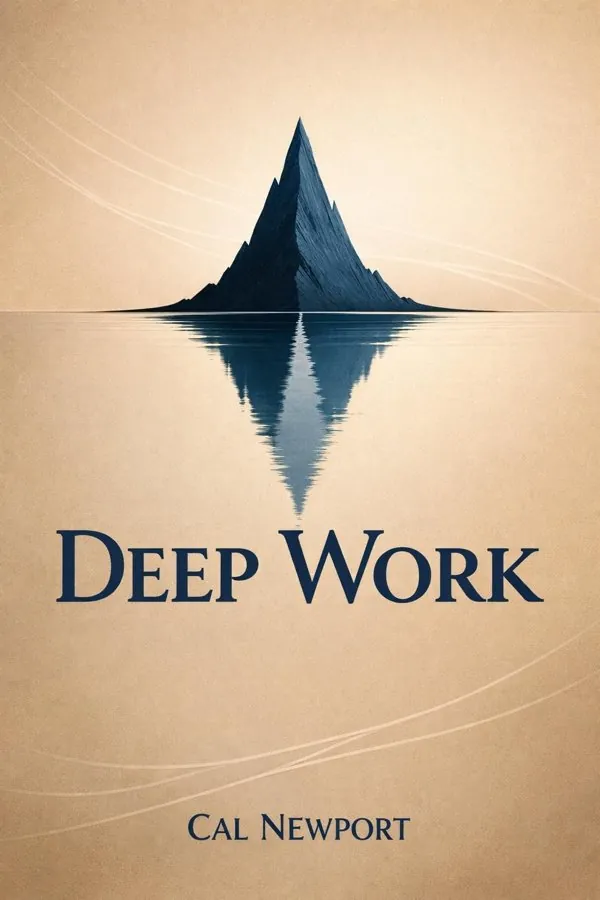
Deep Work: Summary & Key Insights
by Cal Newport
 10 min9 chaptersAudio available
Key Takeaways from Deep Work
The modern economy rewards people who can learn hard things quickly and produce at an elite level, yet both abilities depend on one foundational skill: sustained concentration.
One of the most dangerous illusions in modern work is that being active is the same as being effective.
Deep focus is not something you either naturally have or permanently lack.
Willpower is unreliable, especially in environments designed to interrupt you.
Most people lose focus not because they lack ambition, but because they leave their attention unassigned.
What Is Deep Work About?
Deep Work by Cal Newport is a productivity book. In a world ruled by notifications, open-plan offices, endless email threads, and the pressure to always appear available, the ability to focus has become both rare and incredibly valuable. Deep Work by Cal Newport argues that the people who thrive in today’s economy are not necessarily the busiest or the most connected, but the ones who can concentrate intensely on meaningful tasks without distraction. This book is about cultivating that increasingly uncommon skill and using it to produce better results in less time. Newport makes the case that deep, undistracted concentration is a superpower for the knowledge age. He contrasts it with “shallow work,” the reactive, fragmented activity that fills many calendars but creates little lasting value. Drawing from neuroscience, business, academic research, and real-world examples, he shows why focus matters, why it is so hard to maintain, and how anyone can train it. Cal Newport is particularly credible on this subject because he has built a career as a computer science professor, writer, and researcher while famously avoiding much of the digital noise that consumes modern workers. Deep Work is not just a theory of productivity. It is a practical philosophy for doing your best thinking in a distracted age.
This FizzRead summary covers all 9 key chapters of Deep Work in approximately 10 minutes, distilling the most important ideas, arguments, and takeaways from Cal Newport's work. Also available as an audio summary and Key Quotes Podcast.
Deep Work
In a world ruled by notifications, open-plan offices, endless email threads, and the pressure to always appear available, the ability to focus has become both rare and incredibly valuable. Deep Work by Cal Newport argues that the people who thrive in today’s economy are not necessarily the busiest or the most connected, but the ones who can concentrate intensely on meaningful tasks without distraction. This book is about cultivating that increasingly uncommon skill and using it to produce better results in less time.
Newport makes the case that deep, undistracted concentration is a superpower for the knowledge age. He contrasts it with “shallow work,” the reactive, fragmented activity that fills many calendars but creates little lasting value. Drawing from neuroscience, business, academic research, and real-world examples, he shows why focus matters, why it is so hard to maintain, and how anyone can train it.
Cal Newport is particularly credible on this subject because he has built a career as a computer science professor, writer, and researcher while famously avoiding much of the digital noise that consumes modern workers. Deep Work is not just a theory of productivity. It is a practical philosophy for doing your best thinking in a distracted age.
Who Should Read Deep Work?
This book is perfect for anyone interested in productivity and looking to gain actionable insights in a short read. Whether you're a student, professional, or lifelong learner, the key ideas from Deep Work by Cal Newport will help you think differently.
- ✓Readers who enjoy productivity and want practical takeaways
- ✓Professionals looking to apply new ideas to their work and life
- ✓Anyone who wants the core insights of Deep Work in just 10 minutes
Want the full summary?
Get instant access to this book summary and 100K+ more with Fizz Moment.
Get Free SummaryAvailable on App Store • Free to download
Key Chapters
The modern economy rewards people who can learn hard things quickly and produce at an elite level, yet both abilities depend on one foundational skill: sustained concentration. Newport’s central insight is that deep work is not simply a nice productivity technique; it is an economic advantage. As routine tasks become automated and global competition increases, the workers who stand out are those who can master complex systems, solve difficult problems, and create high-value output. None of that happens in a constant state of interruption.
Deep work refers to professional activity performed in a state of distraction-free concentration that pushes your cognitive capabilities to their limit. This kind of effort creates new value, improves skill, and is hard to replicate. By contrast, shallow work consists of logistical tasks, surface-level communication, and low-intensity activity that often feels urgent but rarely moves the needle.
Consider a software engineer trying to understand a demanding codebase, a lawyer preparing a nuanced argument, or a student learning advanced mathematics. In each case, fragmented attention leads to slower progress and weaker results. The person who can protect long periods of uninterrupted thinking gains a measurable edge.
The challenge is that many workplaces celebrate responsiveness over depth. Quick replies, packed calendars, and visible busyness can look productive even when they prevent meaningful progress. Newport asks readers to rethink that assumption and evaluate work by value created, not activity displayed.
Actionable takeaway: Identify the one or two high-value activities in your work that truly improve your career, then block regular, distraction-free time to do them before shallow demands take over.
One of the most dangerous illusions in modern work is that being active is the same as being effective. Newport warns that shallow work is seductive because it provides immediate feedback, a sense of motion, and social visibility. Answering messages, attending meetings, updating documents, checking dashboards, and reacting to minor requests can fill an entire day while leaving your most important goals untouched.
Shallow work is not always useless. Every profession includes administrative obligations and coordination tasks. The problem begins when shallow work becomes the default mode. Because it is easier than concentrated thinking, it gradually expands to consume the time and energy needed for more demanding efforts. Over time, this weakens your ability to focus and makes your days feel crowded but strangely unaccomplished.
Imagine a manager who spends eight hours switching between Slack, email, and back-to-back calls. At the end of the day, the inbox is cleaner, but strategic decisions remain unmade. Or think of a writer who constantly edits formatting, responds to comments, and researches endlessly instead of drafting original ideas. Shallow work often disguises avoidance.
Newport encourages readers to audit their tasks honestly. Which activities create lasting value? Which could be reduced, batched, delegated, or eliminated? In many cases, we overestimate the necessity of constant communication simply because the culture around us expects it.
Actionable takeaway: Track your work for one week and label each activity as deep or shallow. Then reduce, batch, or confine low-value tasks to specific windows so they no longer dominate your best hours.
Deep focus is not something you either naturally have or permanently lack. Newport argues that concentration is trainable, much like physical strength or endurance. In a distracted environment, however, most people unintentionally train the opposite habit: rapid context-switching. Every time you check your phone during a pause, glance at social media between tasks, or split your attention across multiple screens, you reinforce a mind that expects novelty and resists effort.
This matters because deep work demands comfort with cognitive strain. When a task becomes difficult, your brain often seeks relief in distraction. If you regularly give in, your capacity for sustained thought weakens. The result is not just less output, but less tolerance for the very mental discomfort that high-value work requires.
Newport recommends practicing focus deliberately. That may mean setting a timer for uninterrupted work, resisting the urge to check messages, or even scheduling time to be bored rather than instantly reaching for stimulation. Boredom, in this framework, is not a problem to eliminate but a skill-building opportunity. Learning to stay with your thoughts improves your ability to remain present during difficult intellectual work.
For example, a student might begin with 30 minutes of distraction-free reading and gradually increase to 90. A knowledge worker might work in 50-minute intervals with devices silenced and browser tabs closed. Over time, longer periods of concentration become more natural.
Actionable takeaway: Start a daily focus practice by working on one demanding task for a fixed, uninterrupted block, and increase the duration gradually as your concentration improves.
Willpower is unreliable, especially in environments designed to interrupt you. Newport’s answer is to build rituals that reduce the need for constant self-control. Deep work happens more consistently when you decide in advance where you will work, when you will work, how long you will work, and what rules you will follow. Rituals turn focus from a vague intention into a repeatable system.
A useful deep work ritual answers practical questions. What location supports concentration: a private office, a library, a quiet room, or a specific desk? What time of day is your mind strongest? What tools are allowed? What distractions are banned? Some people thrive on a fixed daily routine, while others prefer longer weekly blocks or occasional retreats for major projects.
Newport describes different philosophies of deep work scheduling. The monastic approach eliminates most distractions entirely. The bimodal approach splits time into long periods of depth and periods of accessibility. The rhythmic approach relies on a regular daily habit, such as working deeply every morning. The journalistic approach fits deep work wherever time appears, though this requires practice and mental agility.
Imagine a designer who begins every weekday from 8:00 to 10:30 in airplane mode, working only on concept development. Or a researcher who reserves two full afternoons each week for analysis and writing. The exact method matters less than the consistency.
Actionable takeaway: Create one repeatable deep work ritual this week by choosing a time, place, duration, and distraction rules for your most important cognitive task.
Most people lose focus not because they lack ambition, but because they leave their attention unassigned. Newport proposes a disciplined planning habit: schedule your day in blocks. This does not mean every plan will unfold perfectly. It means you decide in advance what each period is for, then revise as needed rather than drifting into reactivity.
Time blocking forces clarity. If you want to write a report, study a topic, build a strategy, or solve a problem, you must give that work a specific place on your calendar. Otherwise, shallow obligations will almost always crowd it out. The schedule becomes a visual statement of priorities.
This method also reveals uncomfortable truths. If your calendar is filled with meetings, email, and fragmented tasks, there may be no room left for meaningful creation. Time blocking exposes that mismatch and creates pressure to redesign your workday.
For example, an entrepreneur might block 9:00 to 11:00 for product development, 11:30 to 12:00 for email, 1:00 to 2:00 for meetings, and 3:00 to 4:30 for strategy. If an urgent task appears, the schedule can be adjusted, but the day remains intentional rather than chaotic. Newport emphasizes that flexibility is built into the process. You can rework the plan as reality changes.
Far from being restrictive, structured scheduling can feel liberating. It reduces decision fatigue, protects your attention, and ensures that important work receives your best energy.
Actionable takeaway: At the start of each day, assign your working hours to time blocks and reserve at least one protected block for deep work before checking low-priority communications.
A restless mind struggles to do meaningful work. Newport argues that one of the hidden costs of constant digital stimulation is that it destroys our tolerance for boredom, and with it, our ability to concentrate. When every spare moment is filled by scrolling, tapping, or checking notifications, the brain becomes conditioned to expect instant novelty. Deep work, by contrast, requires you to stay engaged even when progress is slow, difficult, or mentally uncomfortable.
The key insight is that focus is not only shaped during work sessions. It is also shaped during the moments between them. If you instantly reach for your phone while waiting in line, sitting in a taxi, or taking a short break, you train your mind to avoid stillness. Then, when it is time to think deeply, your attention rebels.
Newport recommends practicing productive boredom. Leave some spaces in your day unfilled. Take walks without audio. Delay checking your phone. Set specific times for internet use instead of dipping into it impulsively. These small acts rebuild attentional control.
A practical example: instead of checking social media every time you hit a difficult paragraph while studying, remain with the difficulty for a few more minutes. Or during lunch, avoid digital input and let your mind wander. This can improve both concentration and creative insight.
The larger message is countercultural: not every moment needs stimulation. Protecting emptiness is part of producing excellence.
Actionable takeaway: Choose one daily period, even 15 to 30 minutes, where you allow no phone, no scrolling, and no entertainment, using the time to strengthen your tolerance for undistracted thought.
Many ambitious people assume that constant availability and long mental carryover are signs of dedication. Newport argues the opposite: true productivity improves when intense work is paired with genuine downtime. Deliberate rest is not laziness; it is part of the system that makes deep work possible. The brain needs time away from professional demands to recover, consolidate learning, and make unconscious connections.
A key practice in the book is the shutdown ritual. At the end of the workday, you review open loops, capture unfinished tasks, plan the next steps, and then mentally declare work finished. This creates confidence that nothing important will be forgotten, allowing your mind to release job-related concerns during the evening.
Without a shutdown habit, work bleeds into every hour. You may stop typing, but you continue rehearsing emails, worrying about projects, and half-working in your head. That state feels responsible, yet it often leads to fatigue and reduced focus the next day.
Consider a consultant who ends each day by updating task lists, checking the calendar, and noting the first priority for tomorrow. After that, they stop work-related messaging and protect family time, exercise, reading, or sleep. The result is greater mental freshness for the next deep session.
Downtime also supports creativity. Many insights emerge when the conscious mind relaxes. By stepping away fully, you make better use of both work and rest.
Actionable takeaway: Build a 10-minute end-of-day shutdown routine that captures unfinished tasks, defines tomorrow’s first priority, and marks a clear boundary between work time and personal time.
Beyond productivity, Newport makes a philosophical argument: depth is a path to a more meaningful life. The ability to devote full attention to something worthwhile changes not only what you produce, but how you experience your days. Shallow busyness creates a sense of fragmentation. Deep engagement creates satisfaction, craftsmanship, and a stronger connection to purpose.
When you become absorbed in a challenging task, whether writing, coding, studying, designing, or solving a complex problem, you enter a state of intensity that can feel intrinsically rewarding. This resembles what psychologists describe as flow: a state in which skill meets challenge and self-consciousness fades. Newport suggests that work becomes more fulfilling when it is approached with this kind of serious commitment.
This idea applies outside the office as well. Depth can shape reading, conversation, hobbies, and family life. The same habits that help you focus professionally can also help you listen more carefully, learn more deeply, and live less reactively. In that sense, Deep Work is not just about getting more done. It is about resisting a culture of fragmentation and choosing a richer mode of attention.
For example, a teacher who prepares lessons with concentration may feel greater pride in the craft. A parent who puts away devices during family time experiences deeper presence. A student who studies without distraction learns not only the material but the value of disciplined effort.
Actionable takeaway: Define one area of work or life where deeper attention would improve both your results and your sense of meaning, then create a boundary that protects it from distraction.
All Chapters in Deep Work
About the Author
Cal Newport is an American author, professor of computer science at Georgetown University, and one of the leading voices on focus, productivity, and meaningful work in the digital age. His writing explores how people can produce valuable work and live more intentionally in a world dominated by distraction. Newport became widely known for combining academic rigor with practical advice, drawing from research in technology, cognition, and professional performance. In addition to Deep Work, he is the author of several influential books, including Digital Minimalism, So Good They Can’t Ignore You, and A World Without Email. What makes his perspective especially compelling is that he applies many of his own principles in his career, maintaining high output while resisting the culture of constant connectivity.
Get This Summary in Your Preferred Format
Read or listen to the Deep Work summary by Cal Newport anytime, anywhere. FizzRead offers multiple formats so you can learn on your terms — all free.
Available formats: App · Audio · PDF · EPUB — All included free with FizzRead
Download Deep Work PDF and EPUB Summary
Key Quotes from Deep Work
“The modern economy rewards people who can learn hard things quickly and produce at an elite level, yet both abilities depend on one foundational skill: sustained concentration.”
“One of the most dangerous illusions in modern work is that being active is the same as being effective.”
“Deep focus is not something you either naturally have or permanently lack.”
“Willpower is unreliable, especially in environments designed to interrupt you.”
“Most people lose focus not because they lack ambition, but because they leave their attention unassigned.”
Frequently Asked Questions about Deep Work
Deep Work by Cal Newport is a productivity book that explores key ideas across 9 chapters. In a world ruled by notifications, open-plan offices, endless email threads, and the pressure to always appear available, the ability to focus has become both rare and incredibly valuable. Deep Work by Cal Newport argues that the people who thrive in today’s economy are not necessarily the busiest or the most connected, but the ones who can concentrate intensely on meaningful tasks without distraction. This book is about cultivating that increasingly uncommon skill and using it to produce better results in less time. Newport makes the case that deep, undistracted concentration is a superpower for the knowledge age. He contrasts it with “shallow work,” the reactive, fragmented activity that fills many calendars but creates little lasting value. Drawing from neuroscience, business, academic research, and real-world examples, he shows why focus matters, why it is so hard to maintain, and how anyone can train it. Cal Newport is particularly credible on this subject because he has built a career as a computer science professor, writer, and researcher while famously avoiding much of the digital noise that consumes modern workers. Deep Work is not just a theory of productivity. It is a practical philosophy for doing your best thinking in a distracted age.
Compare Deep Work


More by Cal Newport

You Might Also Like


Featured In
James Clear's Book Picks
James Clear's Reading List: Books That Build Better Habits
Cal Newport's Book Picks
Cal Newport's Deep Work Reading List
Curated's Book Picks
Best Productivity Books — Work Smarter, Not Harder
Curated's Book Picks
Books About Habits — Build Better Routines
Psychology's Book Picks
Inside Your Mind: Psychology Books That Change Everything
Browse by Category
Ready to read Deep Work?
Get the full summary and 100K+ more books with Fizz Moment.