
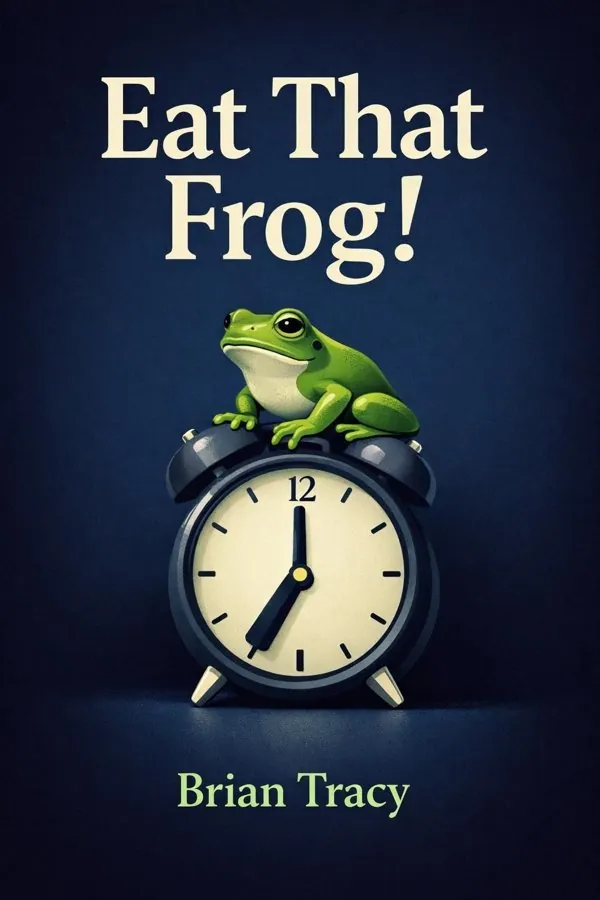
Eat That Frog: Summary & Key Insights
by Brian Tracy
 10 min9 chaptersAudio available
Key Takeaways from Eat That Frog
Productivity begins long before you start working; it begins the moment you decide what truly matters.
A day without a plan rarely becomes a productive day.
Not all tasks deserve equal treatment, yet many people organize their days as if they do.
Every role contains a small number of responsibilities that determine most of your success.
A small fraction of your efforts often creates the majority of your results.
What Is Eat That Frog About?
Eat That Frog by Brian Tracy is a productivity book published in 2007 spanning 5 pages. Why do so many capable people stay busy all day yet make too little progress on the things that matter most? In Eat That Frog, Brian Tracy argues that the real problem is not a lack of time, but a lack of clarity, prioritization, and disciplined action. The book’s memorable metaphor comes from the idea that if your first task each morning is to eat a live frog, you can go through the rest of the day knowing the worst is behind you. In practical terms, the “frog” is your most important, highest-impact task—the one you are most tempted to delay. Tracy turns this simple idea into a complete system for beating procrastination. Drawing on decades of work as a speaker, business trainer, and self-development author, he offers direct, actionable methods for setting goals, planning days, choosing priorities, and staying focused in a world full of distractions. The book matters because procrastination is rarely just a time-management issue; it is often a hidden barrier to success, confidence, and peace of mind. For anyone overwhelmed by competing demands or stuck in cycles of avoidance, Eat That Frog provides a practical toolkit for getting meaningful work done consistently.
This FizzRead summary covers all 9 key chapters of Eat That Frog in approximately 10 minutes, distilling the most important ideas, arguments, and takeaways from Brian Tracy's work. Also available as an audio summary and Key Quotes Podcast.
Eat That Frog
Why do so many capable people stay busy all day yet make too little progress on the things that matter most? In Eat That Frog, Brian Tracy argues that the real problem is not a lack of time, but a lack of clarity, prioritization, and disciplined action. The book’s memorable metaphor comes from the idea that if your first task each morning is to eat a live frog, you can go through the rest of the day knowing the worst is behind you. In practical terms, the “frog” is your most important, highest-impact task—the one you are most tempted to delay.
Tracy turns this simple idea into a complete system for beating procrastination. Drawing on decades of work as a speaker, business trainer, and self-development author, he offers direct, actionable methods for setting goals, planning days, choosing priorities, and staying focused in a world full of distractions. The book matters because procrastination is rarely just a time-management issue; it is often a hidden barrier to success, confidence, and peace of mind. For anyone overwhelmed by competing demands or stuck in cycles of avoidance, Eat That Frog provides a practical toolkit for getting meaningful work done consistently.
Who Should Read Eat That Frog?
This book is perfect for anyone interested in productivity and looking to gain actionable insights in a short read. Whether you're a student, professional, or lifelong learner, the key ideas from Eat That Frog by Brian Tracy will help you think differently.
- ✓Readers who enjoy productivity and want practical takeaways
- ✓Professionals looking to apply new ideas to their work and life
- ✓Anyone who wants the core insights of Eat That Frog in just 10 minutes
Want the full summary?
Get instant access to this book summary and 100K+ more with Fizz Moment.
Get Free SummaryAvailable on App Store • Free to download
Key Chapters
Productivity begins long before you start working; it begins the moment you decide what truly matters. One of Brian Tracy’s central arguments is that unclear goals create hesitation, confusion, and wasted effort. Many people are not lazy at all—they are simply reacting to whatever appears urgent because they have never defined what success looks like. When your goals are vague, every task feels equally important, and procrastination becomes almost inevitable.
Tracy encourages readers to develop absolute clarity about what they want in their work and personal lives. That means writing down goals, making them specific, and turning them into concrete targets with deadlines. A written goal has power because it forces thinking. Instead of saying, “I want to be more successful,” a productive person says, “I want to increase sales by 15% in six months,” or “I will complete my professional certification by December.” Once a goal is clear, it becomes much easier to identify the tasks that move it forward.
This principle applies everywhere. A manager who wants a stronger team can define measurable objectives such as reducing turnover, improving weekly communication, or completing quarterly training. A student who wants better grades can break that desire into actions like attending review sessions and studying two focused hours daily. Clarity reduces emotional resistance because the next step is obvious.
The deeper lesson is that your goals determine your priorities, and your priorities determine your daily behavior. Without goals, the day fills up with noise. With goals, you can distinguish motion from progress.
Actionable takeaway: Write down your top 10 goals, choose the single most important one, and ask yourself what one task today would move it forward the fastest.
A day without a plan rarely becomes a productive day. Tracy emphasizes that every minute spent planning can save many more in execution because planning reduces uncertainty, prevents drift, and lowers the chances of getting trapped in low-value work. People often think they are too busy to plan, but in reality, busyness without structure is one of the main causes of procrastination.
The core habit Tracy recommends is simple: make a written list before you start. Ideally, prepare it the night before so your subconscious can begin organizing priorities while you sleep. Then review the list in the morning and decide what must be done, what should be done, and what can wait. This turns an overwhelming day into a sequence of visible actions. Crossing completed items off the list also creates momentum and satisfaction, which helps sustain focus.
Planning also helps you estimate time and energy more realistically. For example, if you know you have a 90-minute presentation to prepare, two meetings, and several emails, you can block time for the presentation first instead of hoping to “fit it in later.” A freelancer might plan outreach in the morning, client work in the afternoon, and admin tasks at the end of the day. A parent balancing family and work might identify one crucial professional task to finish before errands and household demands take over.
Tracy’s broader point is that plans protect your attention. When distractions appear, a written plan reminds you what deserves your effort. It gives your day a structure strong enough to resist impulse and interruption.
Actionable takeaway: Before ending today, make tomorrow’s task list, identify your top three priorities, and schedule the most important task first.
Not all tasks deserve equal treatment, yet many people organize their days as if they do. Tracy’s ABCDE Method is a straightforward system for separating the vital few from the trivial many. Its power lies in forcing honest judgment. Instead of asking, “What do I feel like doing?” you ask, “What are the consequences if this task is done—or not done?”
In this method, an A task is something very important, with serious consequences if neglected. A B task matters, but the consequences are mild. A C task would be nice to do, but it carries no real penalty. A D task is something you can delegate. An E task is something you can eliminate entirely. Once you categorize your list, you then number your A tasks by importance: A-1, A-2, A-3, and so on. The rule is strict: never work on a B task while an A task remains unfinished.
This approach is especially useful when your to-do list feels endless. Imagine a team leader with 15 tasks on a Monday morning. Preparing a board update due at noon might be A-1. Calling a vendor about office supplies may be C. Forwarding routine data entry could be D. Deleting an unnecessary recurring report could be E. The method quickly restores order and reduces stress because it gives you a logical sequence.
The ABCDE Method also exposes a major productivity trap: doing easy tasks to feel productive while avoiding meaningful ones. Answering low-stakes emails may create movement, but it does not create results. Prioritization means choosing discomfort now for greater reward later.
Actionable takeaway: Label every item on your current task list A through E, rank your A tasks, and commit to finishing A-1 before touching anything else.
Every role contains a small number of responsibilities that determine most of your success. Tracy calls these your key result areas—the essential outputs for which you are personally accountable. If you neglect them, no amount of activity elsewhere can compensate. This is why some people work long hours yet remain stuck: they spend too much time on support tasks and not enough on the areas that truly define performance.
To apply this idea, you must first identify the handful of outcomes that matter most in your position. For a salesperson, key result areas might include prospecting, presenting, closing, and client follow-up. For a manager, they may involve hiring, delegation, coaching, decision-making, and team communication. For a student, the equivalents might be attending lectures, understanding core concepts, producing assignments, and preparing for exams. Once you know these areas, you can evaluate yourself honestly: where are you strongest, and where are you weakest?
Tracy argues that weakness in a key result area can become a bottleneck for everything else. A business owner may be excellent at vision and strategy but poor at financial review. A writer may have strong ideas but weak revision habits. Often, the task we resist most is linked to a skill gap, not just laziness. Improving that weak area can produce disproportionate gains in confidence and output.
This chapter also challenges the common habit of confusing responsiveness with effectiveness. Being available, replying quickly, and attending meetings are not the same as producing meaningful results. You become more valuable when you consistently invest time in the work only you can do best.
Actionable takeaway: List your three to five key result areas, rate yourself from 1 to 10 in each, and spend focused time this week strengthening your weakest high-impact area.
A small fraction of your efforts often creates the majority of your results. Tracy uses the 80/20 Principle, also known as the Pareto Principle, to show that 20% of tasks typically account for 80% of value. The challenge is that these high-value tasks are often more difficult, more mentally demanding, and easier to postpone than low-value activities. That is exactly why so many people stay busy without becoming effective.
Applying the 80/20 rule means constantly asking which activities produce the greatest return. In a business context, a few clients may generate most revenue. In studying, a few core concepts may determine most exam performance. In health, a small number of habits—sleep, diet, exercise—may influence most outcomes. The principle helps you stop treating everything as equally important.
This way of thinking can transform decision-making. Suppose you have ten tasks for the day. Two of them may significantly improve revenue, advance a major project, or solve an important problem. The other eight may be routine, administrative, or cosmetic. If you spend the day clearing the easy eight, you may feel accomplished but still fail where it counts. Effective people reverse this pattern: they identify the crucial 20% and protect time for it first.
The 80/20 Principle also encourages elimination. If a recurring task contributes almost nothing, why keep doing it? If one meeting rarely leads to action, why attend weekly? If one platform consumes hours with little benefit, why not reduce it? High productivity is as much about subtraction as addition.
Actionable takeaway: Review your current projects and ask which 20% of tasks will create 80% of the results, then schedule those tasks during your peak energy hours.
People do not usually procrastinate because work is impossible; they procrastinate because it feels too big, too unclear, or too unpleasant to begin. Tracy addresses this by recommending that large tasks be broken into smaller, manageable parts. When a project is reduced to visible next steps, resistance falls and momentum becomes possible.
This idea is powerful because the mind often exaggerates the difficulty of unfinished work. Writing a report, launching a website, preparing for an exam, or organizing a home office can feel overwhelming when viewed as a single giant commitment. But each becomes more approachable when divided into pieces: gather materials, outline, draft one section, review data, make revisions, and submit. A task that once felt emotionally heavy now has an entry point.
Tracy often suggests focusing on just one slice at a time. Start with the first page, the first phone call, the first ten minutes, or the first item in the pile. This is not merely a planning technique; it is a psychological strategy. Action reduces fear. Once you begin, the imagined burden usually shrinks, and progress becomes self-reinforcing.
This method works especially well for creative and strategic work, where ambiguity can trigger delay. A product manager can break a major launch into research, stakeholder alignment, design review, and testing. A job seeker can split the process into resume updates, company research, networking outreach, and applications. By finishing one step, you create evidence that the larger goal is achievable.
Actionable takeaway: Choose one project you have been avoiding, write the next five concrete steps, and complete the first step immediately—no matter how small.
The modern world rewards constant switching, but meaningful work usually requires sustained concentration. Tracy insists that one of the most effective ways to beat procrastination is to work on a single important task until it is complete. Multitasking feels efficient, yet it often fragments attention, increases errors, and keeps difficult work in a permanent state of partial progress.
Single-tasking matters because important tasks have a threshold. It takes time to understand the problem, enter the flow of work, and produce quality output. If you interrupt yourself every few minutes to check messages, browse updates, or jump between projects, you repeatedly restart the mental engine. This drains energy and makes hard tasks feel even harder.
Tracy’s “handle every task as if your future depends on it” mindset encourages full engagement. For instance, if you are preparing a proposal, shut down unnecessary tabs, silence notifications, and work solely on the proposal for a set block of time. If you are studying, do not mix reading with messaging and video clips. A programmer debugging code, a teacher designing a lesson, or a founder planning strategy all benefit from uninterrupted focus.
There is also emotional value in finishing things. Partial work creates lingering mental clutter, while completed work creates confidence. Every finished important task strengthens your identity as someone who follows through. Over time, this becomes a habit of personal reliability.
Actionable takeaway: Set a timer for 30 to 60 minutes, remove all distractions, and work on one meaningful task only until the timer ends or the task is finished.
Willpower alone is rarely enough to sustain productivity. Tracy emphasizes that high performers deliberately shape their environment so important work becomes easier to start and easier to finish. In other words, productivity is not just about inner discipline; it is also about outer design.
This means preparing tools, reducing friction, and arranging your workspace for concentration. If your desk is cluttered, your materials are missing, and your phone is constantly lighting up, starting a difficult task requires repeated acts of resistance. But if the documents are ready, the workspace is clear, and interruptions are limited, beginning feels more natural. This is especially important for work that demands thought rather than simple reaction.
Tracy also stresses the importance of adequate energy. Focus is affected by sleep, nutrition, exercise, and recovery. Someone who is exhausted at midday may interpret fatigue as lack of motivation, when the real problem is physical depletion. A professional who schedules difficult thinking early in the day, takes short restorative breaks, and protects sleep will often outperform someone with more raw ambition but poorer habits.
Practical environmental design can be simple. Keep your most important files visible. Use website blockers during focused sessions. Schedule meetings after deep work periods rather than before them. Work in a quiet room for analytical tasks and leave shallow tasks, such as routine emails, for lower-energy periods. These adjustments reduce the constant negotiation that fuels procrastination.
Actionable takeaway: Make one immediate change to your environment today—clear your workspace, mute notifications, or prepare tomorrow’s materials—so starting your most important task becomes frictionless.
At the heart of Eat That Frog is a simple but demanding truth: success often depends on doing what is important whether you feel like it or not. Tracy treats self-discipline not as a personality trait reserved for a few exceptional people, but as a learnable habit built through repetition. Each time you choose a meaningful task over an easy distraction, you strengthen that habit.
This matters because motivation is unreliable. Some mornings you will feel energized; many days you will not. If action depends on mood, your best work will be inconsistent. Self-discipline closes the gap between intention and execution. It trains you to act from commitment rather than emotion. Over time, this creates a powerful identity shift: you stop seeing yourself as someone trying to be productive and start seeing yourself as someone who does important things first.
Tracy also connects discipline with self-respect. Finishing a hard task brings more than external results—it builds trust in yourself. You become less anxious because you know you can handle discomfort. A salesperson who makes difficult calls early, a founder who reviews finances weekly, or a student who studies before entertainment is not just managing time better; each is becoming more dependable.
Importantly, discipline does not mean harsh perfectionism. It means returning to the right task quickly, even after distraction or delay. Consistency matters more than heroic bursts. Small daily acts of follow-through compound into major long-term gains.
Actionable takeaway: Choose one discipline rule for the next seven days—such as finishing your top task before checking social media—and keep it long enough to prove to yourself that you can be trusted.
All Chapters in Eat That Frog
About the Author
Brian Tracy is a Canadian-American motivational speaker, author, and self-development expert known for his work on productivity, personal achievement, sales, leadership, and business success. Over the course of his career, he has written dozens of books and spoken to millions of people through seminars, workshops, and corporate training programs. His teaching style is practical and results-focused, emphasizing goal setting, self-discipline, time management, and personal responsibility. Tracy built his reputation by translating success principles into concrete habits that professionals can use immediately in their daily lives. Books such as Eat That Frog have made him especially influential in the field of personal effectiveness, where he is recognized for offering clear, actionable strategies for overcoming procrastination and accomplishing meaningful goals.
Get This Summary in Your Preferred Format
Read or listen to the Eat That Frog summary by Brian Tracy anytime, anywhere. FizzRead offers multiple formats so you can learn on your terms — all free.
Available formats: App · Audio · PDF · EPUB — All included free with FizzRead
Download Eat That Frog PDF and EPUB Summary
Key Quotes from Eat That Frog
“Productivity begins long before you start working; it begins the moment you decide what truly matters.”
“A day without a plan rarely becomes a productive day.”
“Not all tasks deserve equal treatment, yet many people organize their days as if they do.”
“Every role contains a small number of responsibilities that determine most of your success.”
“A small fraction of your efforts often creates the majority of your results.”
Frequently Asked Questions about Eat That Frog
Eat That Frog by Brian Tracy is a productivity book that explores key ideas across 9 chapters. Why do so many capable people stay busy all day yet make too little progress on the things that matter most? In Eat That Frog, Brian Tracy argues that the real problem is not a lack of time, but a lack of clarity, prioritization, and disciplined action. The book’s memorable metaphor comes from the idea that if your first task each morning is to eat a live frog, you can go through the rest of the day knowing the worst is behind you. In practical terms, the “frog” is your most important, highest-impact task—the one you are most tempted to delay. Tracy turns this simple idea into a complete system for beating procrastination. Drawing on decades of work as a speaker, business trainer, and self-development author, he offers direct, actionable methods for setting goals, planning days, choosing priorities, and staying focused in a world full of distractions. The book matters because procrastination is rarely just a time-management issue; it is often a hidden barrier to success, confidence, and peace of mind. For anyone overwhelmed by competing demands or stuck in cycles of avoidance, Eat That Frog provides a practical toolkit for getting meaningful work done consistently.
Compare Eat That Frog
More by Brian Tracy
Maximum Achievement: Proven System of Strategies and Skills That Will Unlock Your Hidden Powers to Succeed
Brian Tracy
10 min
No Excuses!: The Power of Self-Discipline
Brian Tracy
10 min
The Psychology of Selling: Increase Your Sales Faster and Easier Than You Ever Thought Possible
Brian Tracy
10 min
Million Dollar Habits: Proven Power Practices to Double and Triple Your Income
Brian Tracy
10 minYou Might Also Like

Featured In
Browse by Category
Ready to read Eat That Frog?
Get the full summary and 100K+ more books with Fizz Moment.