
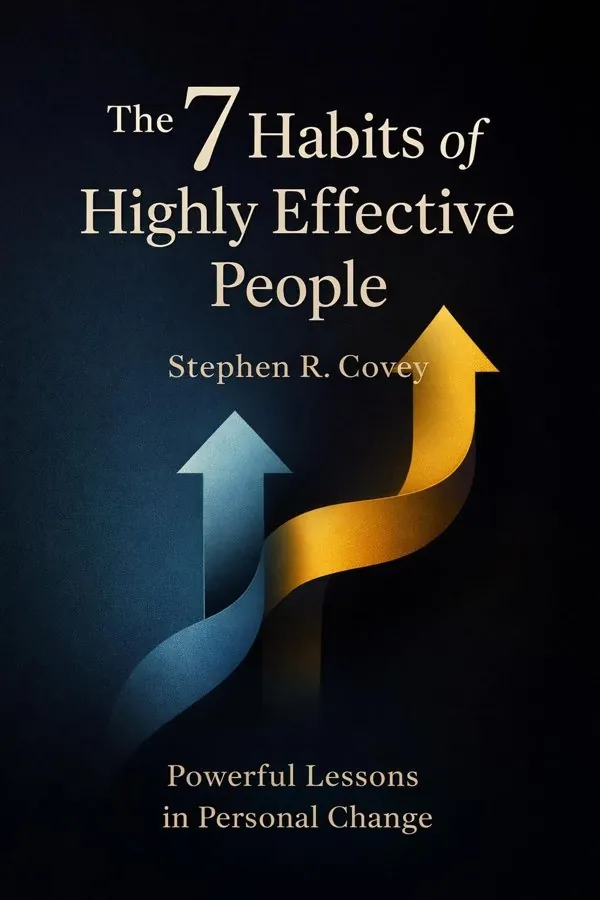
The 7 Habits of Highly Effective People: Summary & Key Insights
 10 min7 chapters
Key Takeaways from The 7 Habits of Highly Effective People
Covey’s first habit is the foundation for everything that follows: effective people do not surrender their behavior to mood, pressure, or circumstances.
The second habit asks a deceptively simple question: what are you really building your life around?
If Habit 2 is about deciding what matters, Habit 3 is about making time for it in the real world.
Covey’s fourth habit marks the move from personal effectiveness to relationship effectiveness.
Most people listen with the intention to reply, defend, advise, or fix.
What Is The 7 Habits of Highly Effective People About?
The 7 Habits of Highly Effective People by Stephen Covey is a productivity book published in 1989 spanning 7 pages. What if lasting success has less to do with hustle, hacks, and charisma—and more to do with character? That’s the enduring promise of *The 7 Habits of Highly Effective People*, one of the most influential productivity and personal development books ever written. Rather than offering quick fixes, Stephen R. Covey presents a principle-centered framework for becoming the kind of person who can create meaningful results over the long term. His argument is simple but powerful: effectiveness begins on the inside, with how you think, choose, prioritize, and relate to others. This book matters because it speaks to challenges that never go out of date: feeling busy but misaligned, struggling with relationships, reacting emotionally under pressure, or achieving outward success without inner fulfillment. Covey shows that real progress comes from timeless habits grounded in integrity, responsibility, and mutual respect. As an educator, leadership thinker, and co-founder of FranklinCovey, Covey built his reputation on helping individuals and organizations improve performance through principle-based action. The result is a practical guide that remains deeply relevant for anyone who wants to lead themselves better, work more intentionally, and build stronger personal and professional relationships.
This FizzRead summary covers all 7 key chapters of The 7 Habits of Highly Effective People in approximately 10 minutes, distilling the most important ideas, arguments, and takeaways from Stephen Covey's work.
The 7 Habits of Highly Effective People: Powerful Lessons in Personal Change
What if lasting success has less to do with hustle, hacks, and charisma—and more to do with character? That’s the enduring promise of *The 7 Habits of Highly Effective People*, one of the most influential productivity and personal development books ever written. Rather than offering quick fixes, Stephen R. Covey presents a principle-centered framework for becoming the kind of person who can create meaningful results over the long term. His argument is simple but powerful: effectiveness begins on the inside, with how you think, choose, prioritize, and relate to others.
This book matters because it speaks to challenges that never go out of date: feeling busy but misaligned, struggling with relationships, reacting emotionally under pressure, or achieving outward success without inner fulfillment. Covey shows that real progress comes from timeless habits grounded in integrity, responsibility, and mutual respect. As an educator, leadership thinker, and co-founder of FranklinCovey, Covey built his reputation on helping individuals and organizations improve performance through principle-based action. The result is a practical guide that remains deeply relevant for anyone who wants to lead themselves better, work more intentionally, and build stronger personal and professional relationships.
Who Should Read The 7 Habits of Highly Effective People?
This book is perfect for anyone interested in productivity and looking to gain actionable insights in a short read. Whether you're a student, professional, or lifelong learner, the key ideas from The 7 Habits of Highly Effective People by Stephen Covey will help you think differently.
- ✓Readers who enjoy productivity and want practical takeaways
- ✓Professionals looking to apply new ideas to their work and life
- ✓Anyone who wants the core insights of The 7 Habits of Highly Effective People in just 10 minutes
Want the full summary?
Get instant access to this book summary and 100K+ more with Fizz Moment.
Get Free SummaryAvailable on App Store • Free to download
Key Chapters
Covey’s first habit is the foundation for everything that follows: effective people do not surrender their behavior to mood, pressure, or circumstances. They recognize that between what happens to them and how they respond, there is a space for choice. That choice is where personal power lives. Being proactive does not mean pretending problems don’t exist or forcing positivity. It means accepting responsibility for your response instead of blaming your boss, your upbringing, your schedule, or the market.
A practical way to apply this habit is to notice your language. Reactive language sounds like: “I can’t do anything,” “They ruined my day,” or “I have to.” Proactive language sounds like: “Let’s look at my options,” “I choose,” and “Here’s what I can influence.” That shift may seem small, but it changes behavior. For example, if a manager gives vague feedback, a reactive employee feels resentful; a proactive one asks clarifying questions and proposes next steps.
Covey also distinguishes between your circle of concern and your circle of influence. Worrying constantly about politics, office gossip, or other people’s decisions drains energy. Focusing on your preparation, attitude, communication, and habits expands your influence over time. Proactivity is leadership in its most personal form: the decision to act from values rather than impulse.
The second habit asks a deceptively simple question: what are you really building your life around? Covey argues that many people stay busy for years without defining success for themselves. They chase promotions, approval, income, or status, only to realize later that they were moving quickly in the wrong direction. To begin with the end in mind is to create a clear picture of the person you want to be and the principles you want to live by before making major decisions.
Covey’s most famous exercise here is imagining your own funeral and considering what you would want family, friends, colleagues, and community members to say about you. It’s a confronting exercise because it cuts through superficial goals. Do you want to be remembered as reliable, kind, courageous, disciplined, wise? Those answers reveal your real priorities. From there, Covey encourages readers to write a personal mission statement—a short expression of values, roles, and long-term purpose.
This habit becomes practical when used in everyday planning. A parent may decide that being emotionally present matters more than answering one more email at dinner. A professional may reject an attractive opportunity that clashes with core values. The key idea is intentional design: when your destination is clear, your calendar, commitments, and choices become more coherent.
If Habit 2 is about deciding what matters, Habit 3 is about making time for it in the real world. Covey frames this as self-management: organizing your days around priorities instead of urgency. Many people live in constant reaction mode, jumping between emails, meetings, notifications, and minor crises. That feels productive, but it often leaves little room for the work that actually changes lives—planning, relationship building, prevention, learning, and meaningful progress on important goals.
Covey’s time-management matrix is central here. He divides activity into four quadrants: urgent and important, not urgent but important, urgent but not important, and neither urgent nor important. Highly effective people spend more time in Quadrant II—the not urgent but important category. This includes exercise, strategic thinking, deep work, family time, preparation, and personal development. These tasks rarely scream for attention, but neglecting them creates future problems.
A practical example: instead of waiting for a health scare to start exercising, you schedule three weekly workouts now. Instead of letting team conflict simmer until it becomes a crisis, you hold a thoughtful conversation early. Habit 3 also means learning to say no to lower-value demands. The discipline to protect what matters most is what turns values into visible behavior.
Covey’s fourth habit marks the move from personal effectiveness to relationship effectiveness. Think Win-Win means seeking solutions where all parties benefit, rather than approaching life as a competition with only one possible winner. Covey argues that many people operate from a scarcity mindset—the belief that another person’s success somehow diminishes their own. That mindset fuels envy, defensiveness, office politics, and shallow compromise. Win-Win, by contrast, grows out of abundance: the belief that it is often possible to create outcomes that respect both your needs and others’ needs.
This habit is not about being nice, passive, or avoiding hard conversations. In fact, Win-Win requires courage as much as consideration. You must be honest about what matters to you while also respecting the interests of others. For example, a manager and employee negotiating workload can move beyond “take it or leave it” thinking by discussing priorities, support, deadlines, and trade-offs. In a family setting, a Win-Win approach might mean designing routines that protect a parent’s work time and a child’s need for attention.
Covey emphasizes that Win-Win depends on character, relationships, and agreements. Trust matters. Clarity matters. When people feel respected rather than manipulated, collaboration becomes stronger. Over time, this habit creates healthier teams, stronger partnerships, and decisions that people actually commit to.
Most people listen with the intention to reply, defend, advise, or fix. Covey challenges that pattern by arguing that true communication begins with understanding. Habit 5 teaches empathic listening—the discipline of entering another person’s frame of reference before trying to present your own view. This is harder than it sounds because people often assume they already know what someone means, especially in close relationships or familiar workplace conflicts.
Empathic listening does not mean agreeing with everything you hear. It means listening deeply enough that the other person feels seen and accurately understood. In practice, that may involve asking open-ended questions, reflecting back what you hear, and resisting the urge to interrupt with solutions. For example, when a colleague says, “I’m overwhelmed,” an ineffective response is immediate advice. A more empathic response is: “It sounds like the volume and uncertainty are hitting you at the same time—what feels heaviest right now?” That kind of listening lowers defensiveness and creates trust.
Only after understanding should you seek to be understood. At that point, your words land differently because the relationship has emotional credibility. Covey’s insight is especially useful in leadership, parenting, negotiation, and conflict resolution. People become far more open to your ideas when they first feel genuinely heard.
Synergy is one of Covey’s most distinctive ideas: the whole can become greater than the sum of its parts when people value differences rather than merely tolerate them. Habit 6 is about creative cooperation. Instead of treating disagreement as a threat, effective people use it as raw material for better solutions. When individuals bring different experiences, strengths, temperaments, and perspectives to a problem, they can produce outcomes no single person would have created alone.
This habit only works when Habits 4 and 5 are in place. Without mutual respect and empathic listening, differences quickly turn into conflict or compromise. With trust, however, disagreement becomes generative. Imagine a product team where one person prioritizes speed, another quality, another customer experience, and another cost control. A weak team argues over whose agenda wins. A synergistic team explores the tensions and designs a solution that improves the whole system.
Covey’s point is practical as much as philosophical: if everyone thinks the same way, innovation stalls. In personal life, synergy might mean a couple combining very different planning styles to create a more balanced household. In organizations, it means building environments where people can challenge ideas without attacking each other. Real synergy is not uniformity—it is disciplined collaboration that turns diversity into strength.
The seventh habit is the one that keeps all the others alive. Sharpen the Saw means regularly renewing yourself so that you can remain effective over the long term. Covey warns against the trap of nonstop output. If you never pause to restore your capacity, your thinking becomes dull, your relationships strained, and your energy depleted. Renewal is not a luxury reward after the work is done; it is part of the work.
Covey describes renewal across four dimensions: physical, mental, social/emotional, and spiritual. Physical renewal includes sleep, exercise, nutrition, and stress management. Mental renewal may involve reading, writing, planning, or learning new skills. Social and emotional renewal comes through trust-building, service, and meaningful connection. Spiritual renewal can include reflection, prayer, meditation, or time in nature—anything that reconnects you to purpose and principle.
A helpful example is the classic image behind the habit: if you spend all your time sawing and never stop to sharpen the blade, your effort becomes less effective no matter how hard you work. In a modern setting, this might look like scheduling downtime before burnout hits, blocking time for learning instead of operating on autopilot, or protecting one evening a week for family and reflection. Habit 7 ensures that effectiveness becomes sustainable rather than exhausting.
All Chapters in The 7 Habits of Highly Effective People
About the Author
Stephen R. Covey (1932–2012) was an American educator, author, businessman, and keynote speaker best known for his work in leadership and personal development. He gained worldwide recognition through *The 7 Habits of Highly Effective People*, a bestselling book that shaped how individuals and organizations think about effectiveness, character, and leadership. Covey also served as a professor at Brigham Young University, where he taught and influenced students in areas related to management and human development. In addition to his writing and speaking, he co-founded FranklinCovey, a global professional services firm focused on leadership, execution, and organizational effectiveness. His work continues to influence readers, managers, and teams around the world.
Get This Summary in Your Preferred Format
Read or listen to the The 7 Habits of Highly Effective People summary by Stephen Covey anytime, anywhere. FizzRead offers multiple formats so you can learn on your terms — all free.
Available formats: App · Audio · PDF · EPUB — All included free with FizzRead
Download The 7 Habits of Highly Effective People PDF and EPUB Summary
Key Quotes from The 7 Habits of Highly Effective People
“Covey’s first habit is the foundation for everything that follows: effective people do not surrender their behavior to mood, pressure, or circumstances.”
“The second habit asks a deceptively simple question: what are you really building your life around?”
“If Habit 2 is about deciding what matters, Habit 3 is about making time for it in the real world.”
“Covey’s fourth habit marks the move from personal effectiveness to relationship effectiveness.”
“Most people listen with the intention to reply, defend, advise, or fix.”
Frequently Asked Questions about The 7 Habits of Highly Effective People
The 7 Habits of Highly Effective People by Stephen Covey is a productivity book that explores key ideas across 7 chapters. What if lasting success has less to do with hustle, hacks, and charisma—and more to do with character? That’s the enduring promise of *The 7 Habits of Highly Effective People*, one of the most influential productivity and personal development books ever written. Rather than offering quick fixes, Stephen R. Covey presents a principle-centered framework for becoming the kind of person who can create meaningful results over the long term. His argument is simple but powerful: effectiveness begins on the inside, with how you think, choose, prioritize, and relate to others. This book matters because it speaks to challenges that never go out of date: feeling busy but misaligned, struggling with relationships, reacting emotionally under pressure, or achieving outward success without inner fulfillment. Covey shows that real progress comes from timeless habits grounded in integrity, responsibility, and mutual respect. As an educator, leadership thinker, and co-founder of FranklinCovey, Covey built his reputation on helping individuals and organizations improve performance through principle-based action. The result is a practical guide that remains deeply relevant for anyone who wants to lead themselves better, work more intentionally, and build stronger personal and professional relationships.
Compare The 7 Habits of Highly Effective People



You Might Also Like
Featured In
Browse by Category
Ready to read The 7 Habits of Highly Effective People?
Get the full summary and 100K+ more books with Fizz Moment.