
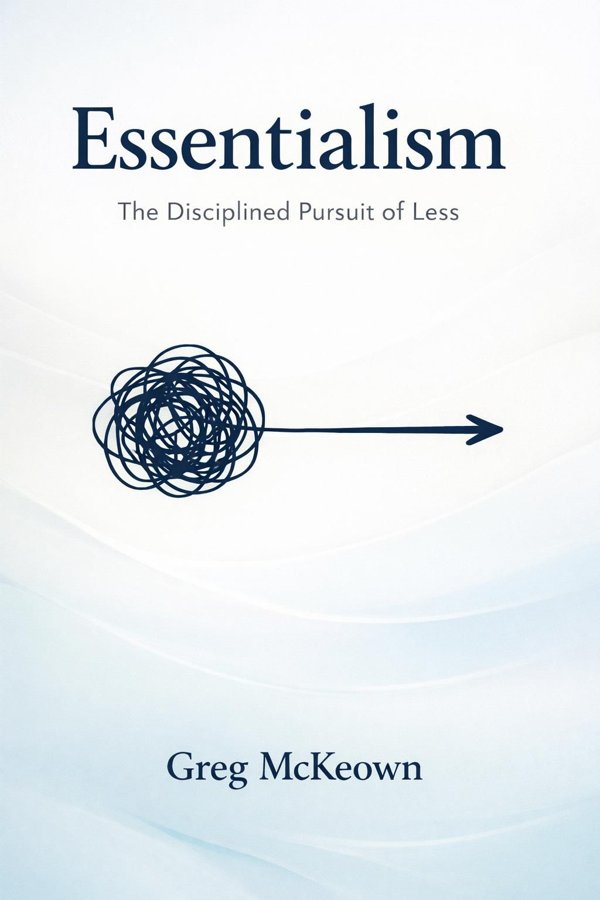
Essentialism: Summary & Key Insights
by Greg McKeown
 10 min9 chaptersAudio available
Key Takeaways from Essentialism
One of the most dangerous beliefs in modern life is the idea that we have no choice.
If you try to make everything important, nothing truly is.
Many people exhaust themselves trying to avoid trade-offs.
Busyness can feel productive, but it often destroys the very clarity we need most.
A tired, depleted mind rarely makes wise decisions.
What Is Essentialism About?
Essentialism by Greg McKeown is a productivity book published in 2014 spanning 8 pages. Essentialism by Greg McKeown is a practical philosophy for anyone who feels trapped by constant demands, endless notifications, and the pressure to do everything at once. At its core, the book argues that success does not come from cramming more into our days; it comes from identifying the few things that matter most and giving them our fullest attention. McKeown calls this disciplined pursuit of less but better “Essentialism.” Rather than offering vague inspiration, he provides a clear framework for deciding what is truly important, eliminating what is not, and creating systems that make focused living possible. The book matters because modern life rewards responsiveness, busyness, and visible activity, even when those habits drain our energy and dilute our best work. McKeown, a leadership consultant and researcher who has advised major organizations and studied strategy and decision-making, writes with both credibility and clarity. Essentialism is especially valuable for professionals, leaders, creatives, and anyone who wants to stop living by default and start living by design.
This FizzRead summary covers all 9 key chapters of Essentialism in approximately 10 minutes, distilling the most important ideas, arguments, and takeaways from Greg McKeown's work. Also available as an audio summary and Key Quotes Podcast.
Essentialism
Essentialism by Greg McKeown is a practical philosophy for anyone who feels trapped by constant demands, endless notifications, and the pressure to do everything at once. At its core, the book argues that success does not come from cramming more into our days; it comes from identifying the few things that matter most and giving them our fullest attention. McKeown calls this disciplined pursuit of less but better “Essentialism.” Rather than offering vague inspiration, he provides a clear framework for deciding what is truly important, eliminating what is not, and creating systems that make focused living possible. The book matters because modern life rewards responsiveness, busyness, and visible activity, even when those habits drain our energy and dilute our best work. McKeown, a leadership consultant and researcher who has advised major organizations and studied strategy and decision-making, writes with both credibility and clarity. Essentialism is especially valuable for professionals, leaders, creatives, and anyone who wants to stop living by default and start living by design.
Who Should Read Essentialism?
This book is perfect for anyone interested in productivity and looking to gain actionable insights in a short read. Whether you're a student, professional, or lifelong learner, the key ideas from Essentialism by Greg McKeown will help you think differently.
- ✓Readers who enjoy productivity and want practical takeaways
- ✓Professionals looking to apply new ideas to their work and life
- ✓Anyone who wants the core insights of Essentialism in just 10 minutes
Want the full summary?
Get instant access to this book summary and 100K+ more with Fizz Moment.
Get Free SummaryAvailable on App Store • Free to download
Key Chapters
If you try to make everything important, nothing truly is. A central principle of Essentialism is that only a few things are exceptionally valuable, while most are merely good, acceptable, or distracting. Nonessentialists treat many options as equally worthy and then spread themselves thin. Essentialists develop the discipline of discernment: they pause, evaluate, and distinguish the trivial many from the vital few.
This sounds obvious, but it is rarely practiced. Many people make decisions based on urgency, social pressure, or fear of missing out. McKeown encourages a much higher standard. Instead of asking, “Is this a good opportunity?” ask, “Is this the most important use of my time and resources right now?” That single change in question radically raises the bar.
Discernment requires more than instinct. It requires criteria. If you do not know what matters most, you will be seduced by whatever is loudest. For example, a professional deciding whether to join a new initiative can assess it against three clear standards: Does it align with my top goals? Does it use my unique strengths? Is the upside so strong that it justifies what I must give up? If the answer is weak on any front, the opportunity may not be essential.
McKeown’s point is not that most things are bad. The point is that many good things compete with the best things. Essentialists therefore become selective, not because they are rigid, but because they respect the cost of attention.
Actionable takeaway: Write down your top three priorities for this season of life. Evaluate every new request against them, and if it does not strongly support at least one, treat it as nonessential.
Many people exhaust themselves trying to avoid trade-offs. They want career advancement without sacrifice, deep work without saying no, family presence without reducing commitments, and health without protecting time for rest. McKeown insists that trade-offs are not a problem to be eliminated; they are a reality to be faced honestly. The question is not whether you will make trade-offs. The question is whether you will make them deliberately or let them be made for you.
The nonessentialist mindset asks, “How can I do both?” The essentialist asks, “Which problem do I want?” or “What is the better choice?” This is a mature and liberating stance. It replaces fantasy with clarity. Every yes consumes time, energy, attention, and often emotional bandwidth. To say yes to one thing is to say no to something else, even if that “something else” is quiet, long-term, and deeply important.
Think of a leader who tries to be available to everyone at all times. It may feel generous, but the hidden trade-off is shallow thinking, fragmented execution, and exhaustion. Or consider a student who takes on too many extracurricular activities. The visible gain is a fuller résumé; the invisible loss may be depth, learning, and peace of mind. Essentialism teaches that excellence often requires exclusion.
Trade-offs become easier when you name them clearly. Instead of vaguely resisting decisions, identify what you gain and what you surrender. This prevents self-deception and makes priorities visible. A focused life is not one without limits; it is one shaped by chosen limits.
Actionable takeaway: The next time you face a commitment decision, complete this sentence: “If I say yes to this, I am saying no to ______.” Let that hidden cost guide your choice.
Busyness can feel productive, but it often destroys the very clarity we need most. McKeown emphasizes that essentialists do not merely react faster; they create space to think, observe, and explore. Without space, everything feels equally urgent. With space, patterns emerge. You begin to notice what energizes you, what actually moves the needle, and what is simply noise.
This idea is especially important in a culture that treats every empty moment as waste. Essentialism reframes space as strategic. Reflection, solitude, reading, journaling, walks, and unstructured thinking time are not luxuries reserved for the fortunate. They are tools for discernment. If your calendar is packed from morning to night, you may be efficient at executing other people’s priorities while remaining unclear about your own.
Exploration also widens perception. McKeown encourages readers to look beyond the obvious and gather information before committing. A team leader might spend time observing where bottlenecks actually occur before launching another initiative. An entrepreneur might test assumptions through small experiments rather than rushing into expansion. A parent might notice that the most meaningful family moments are not the heavily planned ones, but the simple recurring rituals.
Creating space does not always require a retreat or dramatic life change. It can begin with a daily 20-minute thinking block, a walk without your phone, or a weekly review of what truly mattered. The goal is to stop confusing motion with progress. Essentialists build margin because insight rarely appears in frenzy.
Actionable takeaway: Schedule one recurring block each week for uninterrupted reflection. Use it to review commitments, identify what matters most, and remove one unnecessary obligation.
A tired, depleted mind rarely makes wise decisions. Yet many people treat rest as optional and play as childish, as though seriousness alone produces results. McKeown argues the opposite: renewal is not a break from productivity, but a condition for it. Essentialists understand that sleep, recovery, and play sharpen judgment, creativity, resilience, and focus. Neglecting them may create the illusion of dedication, but it usually leads to lower-quality work and poorer choices.
Sleep is especially powerful because it protects one of our scarcest resources: the ability to prioritize. When exhausted, we default to urgency, impulse, and reactivity. We become less able to distinguish the essential from the trivial. A leader running on too little sleep may fill the day with quick responses while missing strategic issues. A knowledge worker who sacrifices rest may work longer hours but produce weaker thinking. Rest is not lost time if it improves the quality of every waking hour.
Play has a similar effect. It broadens the mind, encourages experimentation, and restores energy. Children learn through play, but adults also solve problems better when they loosen rigid thinking. Teams that build room for curiosity often become more innovative. Families that make space for fun often become more connected. Play reminds us that not all value is immediate or measurable.
The essentialist does not worship exhaustion. Instead, they protect the biological and emotional conditions that make meaningful contribution possible. Renewal is not indulgence. It is intelligent stewardship.
Actionable takeaway: Protect a consistent sleep window for the next seven days and schedule one playful activity with no productivity goal. Observe how your focus and mood change.
The ability to say no is one of the most practical and most emotionally difficult essentialist skills. Many people overcommit not because they lack intelligence, but because they fear disappointing others, missing opportunities, or appearing selfish. McKeown shows that without deliberate elimination, your life becomes crowded with low-value commitments that consume the space needed for high-value ones. Saying no is therefore not a rejection of people; it is a protection of purpose.
The challenge is that every request arrives wrapped in social pressure. A colleague says a task will only take a minute. A friend invites you to something you do not want to attend. A manager presents a project as exciting when it is really misaligned with your priorities. Nonessentialists tend to answer too quickly. Essentialists pause. They know that a graceful no now prevents resentment later.
McKeown encourages both selectivity and tact. You can decline with respect: “I’m honored you asked, but I can’t commit to this right now.” You can buy time: “Let me check my current priorities and get back to you.” You can offer a narrow alternative instead of open-ended availability. The point is not bluntness for its own sake. It is to stop making unconscious promises you do not truly intend to keep.
Boundaries reinforce this discipline. If your calendar has no buffer, if your inbox controls your day, or if others assume instant access to you, no becomes harder. Systems matter. Office hours, meeting-free blocks, and pre-decided criteria for commitments all reduce decision fatigue.
Actionable takeaway: Prepare two polite default phrases for declining requests. Use them this week before agreeing to anything that is not clearly aligned with your top priorities.
Knowing what matters is not enough. Many people achieve moments of clarity and still fail to follow through because their environment is designed for distraction, friction, and interruption. McKeown argues that once you identify the essential, your next task is to make its execution as easy as possible. Instead of relying on heroic willpower, essentialists build systems, routines, and structures that support consistent progress.
This is where Essentialism becomes highly practical. If writing is essential, create a recurring time and space for writing before messages and meetings consume the day. If strategic thinking matters, protect blocks of uninterrupted work and remove digital clutter. If family presence is essential, establish rituals such as device-free dinners or evening walks. Small design choices reduce the energy required to do what you already know is important.
McKeown also highlights the importance of removing obstacles. Teams often assume the answer to slow execution is more effort, when the real problem is process friction. A manager can improve results by eliminating unnecessary approvals, clarifying ownership, or sequencing work more intelligently. Individuals can do the same by preparing the night before, automating routine tasks, or batching shallow work into specific windows.
Execution improves when the next step is visible. Vague intentions like “work on health” or “focus more” rarely produce action. Essentialists translate priorities into concrete behaviors. What gets scheduled, simplified, and protected gets done. The goal is not intensity for a few days, but sustainable momentum over time.
Actionable takeaway: Choose one essential priority and reduce the friction around it today. Pre-schedule it, prepare the needed tools, and remove one predictable distraction before it begins.
Life rarely falls apart because of one dramatic mistake. More often, it gets diluted through constant small interruptions, preventable emergencies, and scattered attention. McKeown teaches that essentialists anticipate this reality. They do not assume the day will unfold perfectly. Instead, they protect focus by building routines, buffers, and margins that absorb chaos without derailing what matters most.
Buffers are especially powerful because most people plan as if everything will go according to schedule. Meetings run long, traffic happens, tasks take longer than expected, and other people introduce urgent requests. If your day is packed to full capacity, any disruption creates stress and forces essential work to be postponed. By contrast, if you leave margin between commitments, you preserve flexibility and maintain composure.
Routines serve a similar purpose. They turn repeated choices into default behaviors, which reduces cognitive load. Morning routines can anchor attention before the outside world begins making demands. Weekly planning routines can reveal overload before it becomes crisis. Team routines such as agendas, meeting limits, and regular check-ins can prevent confusion and wasted time.
This approach is not about becoming rigid. It is about respecting reality. Focus is fragile, and meaningful work often requires continuity. A consultant who batches client communication instead of checking messages constantly will think more clearly. A family that prepares for the week on Sunday will face fewer daily scrambles. A student who starts projects early with interim milestones is less likely to collapse into last-minute panic.
Actionable takeaway: Add 15-minute buffers between your main commitments for the next three days and create one simple weekly planning routine to protect your most important priorities.
Essentialism is not just a personal productivity method; it is also a leadership philosophy. Leaders shape what others believe matters through what they reward, tolerate, and model. If a leader constantly responds instantly, glorifies overwork, adds priorities without removing old ones, and treats everything as urgent, the team will become scattered and exhausted. McKeown argues that essentialist leadership creates clarity, focus, and trust by making deliberate choices visible.
The first leadership task is to define what is truly important. Teams struggle when they are given too many goals, vague objectives, or conflicting instructions. An essentialist leader narrows the field. They identify the handful of outcomes that matter most and communicate them repeatedly. This does not limit ambition; it increases the chance of meaningful achievement.
The second task is subtraction. Great leaders do not only assign work; they remove obstacles and eliminate low-value activity. They question unnecessary meetings, reduce bureaucracy, and ask whether a task deserves attention at all. This is especially valuable in organizations where busyness can masquerade as contribution.
Finally, essentialist leaders model boundaries and renewal. When they respect focused time, encourage thoughtful no’s, and avoid performative overwork, they give others permission to do the same. A team becomes healthier and more effective when its members know that excellence matters more than constant availability.
Actionable takeaway: If you lead others, identify your team’s top two priorities for the next month and stop, postpone, or simplify one recurring activity that does not clearly support them.
All Chapters in Essentialism
About the Author
Greg McKeown is a British author, public speaker, and leadership consultant best known for his work on Essentialism and intentional productivity. He has advised executives and organizations around the world on strategy, leadership, and focused execution, and has worked with major companies including Apple, Google, and Facebook. McKeown is recognized for translating complex ideas about priorities and decision-making into practical frameworks that people can apply immediately in work and life. He has also been associated with research and teaching in leadership and organizational behavior, including work connected to Stanford University. Through his writing, speaking, and consulting, McKeown has become a leading voice on the discipline of doing less, but better, helping readers and teams cut through noise and concentrate on what matters most.
Get This Summary in Your Preferred Format
Read or listen to the Essentialism summary by Greg McKeown anytime, anywhere. FizzRead offers multiple formats so you can learn on your terms — all free.
Available formats: App · Audio · PDF · EPUB — All included free with FizzRead
Download Essentialism PDF and EPUB Summary
Key Quotes from Essentialism
“One of the most dangerous beliefs in modern life is the idea that we have no choice.”
“If you try to make everything important, nothing truly is.”
“Many people exhaust themselves trying to avoid trade-offs.”
“Busyness can feel productive, but it often destroys the very clarity we need most.”
“A tired, depleted mind rarely makes wise decisions.”
Frequently Asked Questions about Essentialism
Essentialism by Greg McKeown is a productivity book that explores key ideas across 9 chapters. Essentialism by Greg McKeown is a practical philosophy for anyone who feels trapped by constant demands, endless notifications, and the pressure to do everything at once. At its core, the book argues that success does not come from cramming more into our days; it comes from identifying the few things that matter most and giving them our fullest attention. McKeown calls this disciplined pursuit of less but better “Essentialism.” Rather than offering vague inspiration, he provides a clear framework for deciding what is truly important, eliminating what is not, and creating systems that make focused living possible. The book matters because modern life rewards responsiveness, busyness, and visible activity, even when those habits drain our energy and dilute our best work. McKeown, a leadership consultant and researcher who has advised major organizations and studied strategy and decision-making, writes with both credibility and clarity. Essentialism is especially valuable for professionals, leaders, creatives, and anyone who wants to stop living by default and start living by design.
Compare Essentialism
More by Greg McKeown
You Might Also Like
Featured In
Browse by Category
Ready to read Essentialism?
Get the full summary and 100K+ more books with Fizz Moment.