
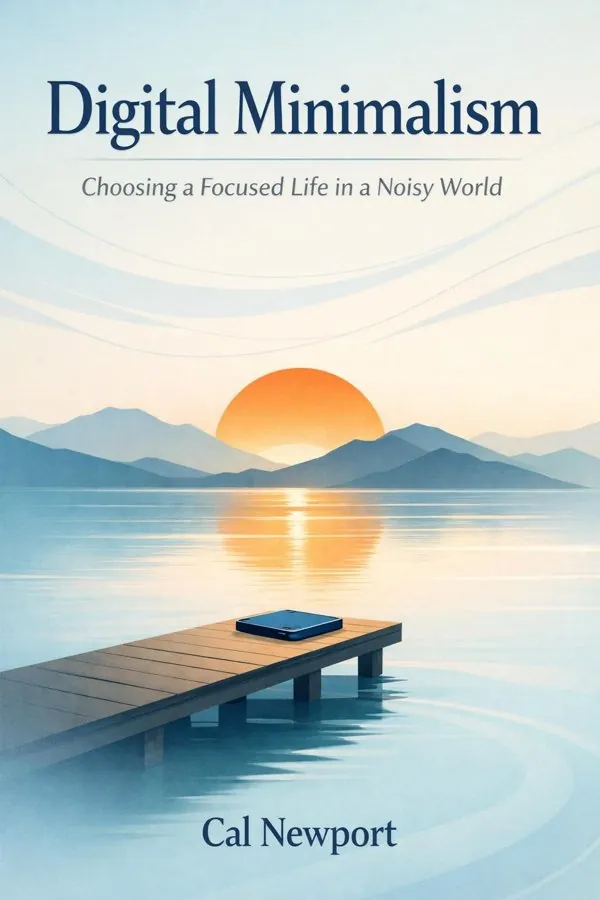
Digital Minimalism: Summary & Key Insights
by Cal Newport
 10 min8 chaptersAudio available
Key Takeaways from Digital Minimalism
The central problem of modern digital life is not that we use technology, but that we rarely use it on purpose.
Digital clutter is easy to underestimate because it does not pile up visibly on a desk or floor.
Change is difficult when old habits remain constantly available.
One of Newport’s most compelling ideas is that solitude is not isolation; it is freedom from input from other minds.
Digital communication gives us more ways to contact each other, yet often leaves us feeling less connected.
What Is Digital Minimalism About?
Digital Minimalism by Cal Newport is a self-help book. Digital Minimalism by Cal Newport is a timely and persuasive guide to living well in a world designed to hijack your attention. Rather than arguing that technology is inherently bad, Newport asks a more important question: how can we use digital tools in ways that genuinely support our values instead of quietly undermining them? The book explores how social media, endless notifications, and constant connectivity fragment our focus, weaken our relationships, and leave us feeling oddly busy yet unfulfilled. In response, Newport offers a practical philosophy of technology use built on intentionality, selectivity, and depth. What makes this book especially valuable is that it goes beyond vague advice to “use your phone less.” Newport combines cultural critique, behavioral insights, and real-life case studies to show readers how to conduct a digital declutter, rebuild meaningful leisure, and reclaim solitude. As a computer science professor and bestselling author known for Deep Work, Newport brings credibility, analytical rigor, and a clear voice to the discussion. Digital Minimalism matters because it addresses one of the defining challenges of modern life: learning to control our tools before they control us.
This FizzRead summary covers all 8 key chapters of Digital Minimalism in approximately 10 minutes, distilling the most important ideas, arguments, and takeaways from Cal Newport's work. Also available as an audio summary and Key Quotes Podcast.
Digital Minimalism
Digital Minimalism by Cal Newport is a timely and persuasive guide to living well in a world designed to hijack your attention. Rather than arguing that technology is inherently bad, Newport asks a more important question: how can we use digital tools in ways that genuinely support our values instead of quietly undermining them? The book explores how social media, endless notifications, and constant connectivity fragment our focus, weaken our relationships, and leave us feeling oddly busy yet unfulfilled. In response, Newport offers a practical philosophy of technology use built on intentionality, selectivity, and depth.
What makes this book especially valuable is that it goes beyond vague advice to “use your phone less.” Newport combines cultural critique, behavioral insights, and real-life case studies to show readers how to conduct a digital declutter, rebuild meaningful leisure, and reclaim solitude. As a computer science professor and bestselling author known for Deep Work, Newport brings credibility, analytical rigor, and a clear voice to the discussion. Digital Minimalism matters because it addresses one of the defining challenges of modern life: learning to control our tools before they control us.
Who Should Read Digital Minimalism?
This book is perfect for anyone interested in self-help and looking to gain actionable insights in a short read. Whether you're a student, professional, or lifelong learner, the key ideas from Digital Minimalism by Cal Newport will help you think differently.
- ✓Readers who enjoy self-help and want practical takeaways
- ✓Professionals looking to apply new ideas to their work and life
- ✓Anyone who wants the core insights of Digital Minimalism in just 10 minutes
Want the full summary?
Get instant access to this book summary and 100K+ more with Fizz Moment.
Get Free SummaryAvailable on App Store • Free to download
Key Chapters
The central problem of modern digital life is not that we use technology, but that we rarely use it on purpose. Most people adopt apps, platforms, and devices because they are available, socially expected, or mildly convenient. Over time, these small, unexamined choices accumulate into a lifestyle of constant distraction. Newport’s core insight is that a better relationship with technology begins not with rejection, but with intentionality. Digital minimalism is the philosophy that you should focus your online time on a small number of carefully selected activities that strongly support things you value, while happily missing out on everything else.
This is a major shift from the common “maximalist” mindset, in which any small benefit justifies adding another tool. A minimalist asks a tougher question: does this technology significantly support something deeply important to me, and is it the best way to do so? For example, if staying close to family matters, perhaps occasional video calls serve that value better than passive social media scrolling. If professional growth matters, a few targeted online resources may help more than being active on every platform.
This approach also reduces the mental clutter created by low-value digital habits. Instead of allowing dozens of apps to compete for attention, you create a simpler operating system for your life. The goal is not austerity for its own sake. It is alignment. Technology should serve your priorities, not dictate them.
Actionable takeaway: Make a list of your top three values, then audit your digital tools one by one and keep only those that meaningfully support those values.
Digital clutter is easy to underestimate because it does not pile up visibly on a desk or floor. Yet its effects are real and often severe. Newport argues that every app, notification stream, and optional digital commitment carries a hidden cognitive cost. Even if a tool offers some benefit, that benefit may be outweighed by the attention it consumes, the anxiety it generates, or the habits it normalizes. This is why simply asking whether a technology is useful is not enough. The better question is whether it is worth what it takes from you.
A cluttered digital life creates fragmentation. Your mind is trained to expect interruptions, your downtime fills with shallow stimulation, and your ability to sustain concentration weakens. The cost also extends to mood and relationships. Many people feel perpetually behind, yet rarely deeply engaged. They check messages during meals, skim articles instead of reading books, and reflexively reach for their phones in moments that could have been restful or reflective.
Newport compares this to physical decluttering. If your home is packed with objects you “might use,” your space becomes less functional and less calm. The same principle applies to your digital environment. A small number of high-value tools can outperform a chaotic collection of marginal ones. Consider a person who removes five social apps, disables most notifications, and keeps only email, maps, and one messaging service. That reduction does not make life narrower; it often makes it more livable.
Actionable takeaway: Identify your top five sources of digital interruption and remove, disable, or limit them for two weeks to measure the difference in focus and peace.
Change is difficult when old habits remain constantly available. That is why Newport proposes the digital declutter, a structured thirty-day break from optional technologies. The purpose is not merely detox or temporary relief. It is a reset. By stepping away from nonessential digital tools, you create the space to rediscover what you actually value, what you miss, and what you never needed in the first place.
During the declutter, you remove optional apps, websites, and digital services that do not play a critical role in your personal or professional life. Essential tools can stay, but only in limited, carefully defined ways. For instance, you may keep texting for logistical communication or use a work platform only during office hours. The key is clarity. Ambiguous exceptions weaken the process because they allow old compulsions to slip back in.
What makes the declutter powerful is that it reveals the role technology has been playing emotionally. Many people discover that they use their phones not because they are necessary, but because they are bored, lonely, anxious, or uncomfortable with empty moments. Without easy digital escape, these feelings surface. That can be uncomfortable, but it is also instructive. It gives you the opportunity to build better alternatives, such as exercise, reading, conversation, hobbies, or deliberate rest.
At the end of the thirty days, you reintroduce technologies selectively. Each one must pass a strict test: does it support something I deeply value, and can I use it under specific rules that maximize benefit and minimize harm? This turns passive consumption into conscious design.
Actionable takeaway: Schedule a thirty-day digital declutter and write exact rules in advance for what you will remove, what counts as essential, and what offline activities you will use to replace old habits.
One of Newport’s most compelling ideas is that solitude is not isolation; it is freedom from input from other minds. In a hyperconnected age, many people spend very little time truly alone with their own thoughts. Even when physically by themselves, they fill every pause with podcasts, feeds, texts, and updates. Newport argues that this erosion of solitude has serious consequences. Solitude supports self-reflection, emotional processing, creativity, and a stable sense of self. Without it, we become reactive, mentally noisy, and dependent on constant stimulation.
The book points to the value of activities such as long walks, journaling, quiet commuting, or simply sitting without a device. These moments allow ideas to connect, concerns to settle, and inner clarity to emerge. Historically, many thinkers, artists, and leaders depended on solitude to generate insight. Today, however, the phone often eliminates the very conditions that make reflection possible. A line at the grocery store, a few minutes before bed, or a walk around the neighborhood becomes another opportunity for input rather than thought.
Solitude deprivation also affects mental well-being. When people never pause to process their experiences, emotions can accumulate in confusing ways. Constant connection may create the illusion of engagement while reducing the depth of self-understanding. Reintroducing solitude can feel strange at first because your brain has grown accustomed to interruption. But over time it becomes restorative.
Practical examples include taking device-free walks, keeping a notebook instead of opening an app, or setting aside ten minutes daily to think without consuming content. These are small practices, but they rebuild an essential capacity.
Actionable takeaway: Create one daily solitude ritual, such as a twenty-minute walk without your phone, and protect it as seriously as any appointment.
Digital communication gives us more ways to contact each other, yet often leaves us feeling less connected. Newport distinguishes between low-bandwidth connection, such as likes, comments, and brief messages, and high-quality interaction, such as real conversation. His argument is not that texting or social media are useless, but that they should not replace richer forms of human contact. Human relationships are built through voice, presence, nuance, and sustained attention, not just frequent pings.
A culture of constant contact can create the illusion of closeness while reducing actual intimacy. You may exchange dozens of messages with friends each week and still rarely have a meaningful conversation. Quick digital touchpoints are often efficient for logistics, but they are poor substitutes for the emotional depth of talking on the phone, meeting for coffee, or spending unstructured time together.
Newport suggests practical ways to rebalance this. Use text mainly to set up conversations or coordinate plans. Call people more often. Prioritize face-to-face meetings when possible. If you live far from someone important, schedule regular video or phone conversations instead of relying solely on social feeds to stay updated. Even in professional settings, some issues are resolved faster and with more trust through direct conversation than through endless message threads.
This principle also improves attention. When communication becomes more intentional, you are less likely to live in a state of perpetual partial response, always checking for the next notification. Relationships become less frequent but more meaningful.
Actionable takeaway: Choose three important relationships and replace casual digital contact this week with one real conversation each, by phone, video, or in person.
A major reason people struggle to reduce screen time is that they have not rebuilt what the screens replaced. Newport argues that the solution to digital excess is not just removing bad habits, but restoring high-quality leisure. When free time lacks structure or meaning, the path of least resistance is passive consumption: scrolling feeds, watching random videos, and refreshing apps. These activities may be briefly stimulating, but they rarely satisfy. By contrast, demanding and meaningful leisure creates energy, skill, pride, and connection.
Newport distinguishes between passive and active leisure. Passive leisure asks little from you and leaves little behind. Active leisure involves doing something with your hands, mind, or body. Examples include woodworking, cooking, gardening, playing music, running, volunteering, drawing, or joining a club. The best leisure often has a tangible outcome, a social dimension, or a built-in challenge. It gives shape to time and creates a sense of progress.
This is one of the book’s most practical contributions. If you remove hours of casual digital use without replacing them, boredom will push you back to the phone. But if you fill that space with activities that are engaging and rewarding, the attraction of mindless scrolling weakens naturally. A person who takes up evening walks, weekend hiking, reading, and community classes is not just using technology less. They are building a richer life that makes low-value digital distraction less appealing.
The deeper point is that attention thrives when directed toward worthwhile effort. Leisure is not merely recovery from work. It is part of a good life.
Actionable takeaway: Make a leisure plan for the next seven days with at least three active, offline activities scheduled in advance, including one that is social and one that builds a skill.
At the heart of Digital Minimalism is a moral and practical claim: your attention is too valuable to be treated casually. What you pay attention to shapes your days, your work, your relationships, and ultimately your life. In an economy built on engagement, your attention is constantly being extracted, measured, and resold. Newport wants readers to recognize that distraction is not just an inconvenience. It is a form of dispossession. When your mental life is fragmented by design, it becomes harder to think deeply, create meaningful work, or be fully present with others.
This idea connects the book to Newport’s broader work on focus and depth. High-quality life outcomes often depend on sustained concentration: solving problems, learning difficult things, writing, building, listening carefully, or simply noticing what matters. Yet many digital systems train the opposite habit. They reward rapid response, novelty seeking, and compulsive checking. Over time, this can erode patience and make depth feel uncomfortable.
Protecting attention therefore requires boundaries. These might include scheduled times for email, no-phone mornings, notification reduction, website blockers, or device-free meals. The exact system can vary, but the principle remains the same: if you do not consciously defend your attention, something else will claim it.
This is not only about productivity. It is also about dignity. A person who can choose where their mind goes is more autonomous than one who is constantly pulled by external prompts. Attention is the gateway through which you experience your life.
Actionable takeaway: Create one daily attention-protection rule today, such as no notifications except calls or no phone use during the first hour after waking.
All Chapters in Digital Minimalism
About the Author
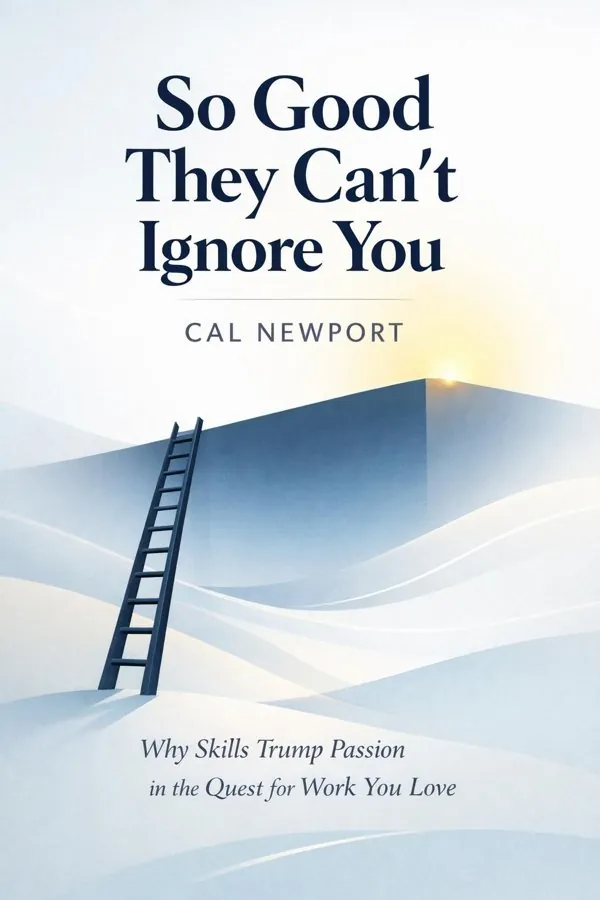
Cal Newport is an American author, professor of computer science at Georgetown University, and leading voice on focus, productivity, and meaningful work. He is widely known for translating complex cultural and behavioral problems into practical strategies for modern life. Newport’s books, including Deep Work, So Good They Can’t Ignore You, and A World Without Email, have made him a prominent critic of distraction and shallow busyness. His writing combines academic thinking, real-world examples, and a strong emphasis on disciplined habits. One reason readers trust Newport is that he approaches technology with nuance: he is neither anti-tech nor blindly enthusiastic. Instead, he encourages people to adopt tools selectively and thoughtfully. In Digital Minimalism, he applies that philosophy to the challenge of living intentionally in an age of constant connectivity.
Get This Summary in Your Preferred Format
Read or listen to the Digital Minimalism summary by Cal Newport anytime, anywhere. FizzRead offers multiple formats so you can learn on your terms — all free.
Available formats: App · Audio · PDF · EPUB — All included free with FizzRead
Download Digital Minimalism PDF and EPUB Summary
Key Quotes from Digital Minimalism
“The central problem of modern digital life is not that we use technology, but that we rarely use it on purpose.”
“Digital clutter is easy to underestimate because it does not pile up visibly on a desk or floor.”
“Change is difficult when old habits remain constantly available.”
“One of Newport’s most compelling ideas is that solitude is not isolation; it is freedom from input from other minds.”
“Digital communication gives us more ways to contact each other, yet often leaves us feeling less connected.”
Frequently Asked Questions about Digital Minimalism
Digital Minimalism by Cal Newport is a self-help book that explores key ideas across 8 chapters. Digital Minimalism by Cal Newport is a timely and persuasive guide to living well in a world designed to hijack your attention. Rather than arguing that technology is inherently bad, Newport asks a more important question: how can we use digital tools in ways that genuinely support our values instead of quietly undermining them? The book explores how social media, endless notifications, and constant connectivity fragment our focus, weaken our relationships, and leave us feeling oddly busy yet unfulfilled. In response, Newport offers a practical philosophy of technology use built on intentionality, selectivity, and depth. What makes this book especially valuable is that it goes beyond vague advice to “use your phone less.” Newport combines cultural critique, behavioral insights, and real-life case studies to show readers how to conduct a digital declutter, rebuild meaningful leisure, and reclaim solitude. As a computer science professor and bestselling author known for Deep Work, Newport brings credibility, analytical rigor, and a clear voice to the discussion. Digital Minimalism matters because it addresses one of the defining challenges of modern life: learning to control our tools before they control us.
More by Cal Newport
You Might Also Like


Browse by Category
Ready to read Digital Minimalism?
Get the full summary and 100K+ more books with Fizz Moment.