
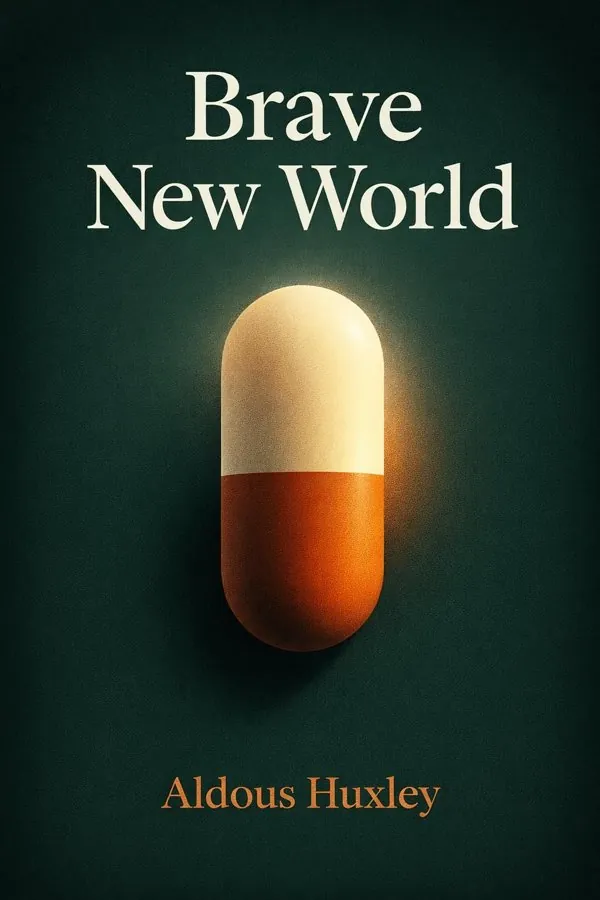
Brave New World: Summary & Key Insights
 10 min9 chaptersAudio available
Key Takeaways from Brave New World
A society reveals its deepest values by the way it creates and trains its children.
Inequality becomes hardest to challenge when people are trained to love the place assigned to them.
A society does not need to silence dissent by force if it can teach people to medicate every uncomfortable feeling away.
When intimacy is stripped of vulnerability, it becomes easier to manage but harder to make meaningful.
The first cracks in a controlled society often appear not through revolution, but through private discomfort.
What Is Brave New World About?
Brave New World by Aldous Huxley is a fiction book published in 2006 spanning 6 pages. What if the greatest threat to freedom were not violence or tyranny, but comfort? In Brave New World, Aldous Huxley imagines a future society that has solved many of humanity’s oldest problems: war is minimized, suffering is medicated, desire is managed, and social conflict is engineered away before it begins. Yet beneath this polished surface lies a terrifying question: what remains of a human being when individuality, family, love, grief, ambition, and spiritual longing have all been sacrificed for stability? Set in the technologically advanced World State, the novel follows characters who begin to sense the emptiness hidden inside a perfectly organized civilization. Through genetic design, psychological conditioning, casual pleasure, and relentless consumption, Huxley presents a world in which people are kept happy precisely by being kept shallow. The book is both a gripping dystopian story and a profound philosophical warning. First published in 1932, Brave New World remains startlingly relevant in an age shaped by entertainment, pharmaceuticals, social engineering, and algorithmic influence. Huxley, one of the twentieth century’s sharpest literary and social critics, wrote a novel that still challenges readers to ask whether a painless life is worth the loss of freedom, depth, and truth.
This FizzRead summary covers all 9 key chapters of Brave New World in approximately 10 minutes, distilling the most important ideas, arguments, and takeaways from Aldous Huxley's work. Also available as an audio summary and Key Quotes Podcast.
Brave New World
What if the greatest threat to freedom were not violence or tyranny, but comfort? In Brave New World, Aldous Huxley imagines a future society that has solved many of humanity’s oldest problems: war is minimized, suffering is medicated, desire is managed, and social conflict is engineered away before it begins. Yet beneath this polished surface lies a terrifying question: what remains of a human being when individuality, family, love, grief, ambition, and spiritual longing have all been sacrificed for stability?
Set in the technologically advanced World State, the novel follows characters who begin to sense the emptiness hidden inside a perfectly organized civilization. Through genetic design, psychological conditioning, casual pleasure, and relentless consumption, Huxley presents a world in which people are kept happy precisely by being kept shallow. The book is both a gripping dystopian story and a profound philosophical warning.
First published in 1932, Brave New World remains startlingly relevant in an age shaped by entertainment, pharmaceuticals, social engineering, and algorithmic influence. Huxley, one of the twentieth century’s sharpest literary and social critics, wrote a novel that still challenges readers to ask whether a painless life is worth the loss of freedom, depth, and truth.
Who Should Read Brave New World?
This book is perfect for anyone interested in fiction and looking to gain actionable insights in a short read. Whether you're a student, professional, or lifelong learner, the key ideas from Brave New World by Aldous Huxley will help you think differently.
- ✓Readers who enjoy fiction and want practical takeaways
- ✓Professionals looking to apply new ideas to their work and life
- ✓Anyone who wants the core insights of Brave New World in just 10 minutes
Want the full summary?
Get instant access to this book summary and 100K+ more with Fizz Moment.
Get Free SummaryAvailable on App Store • Free to download
Key Chapters
A society reveals its deepest values by the way it creates and trains its children. In Brave New World, the Hatchery and Conditioning Centre is not merely a scientific facility; it is the heart of the World State’s ideology. Human life no longer begins with intimacy, family, or chance. Instead, it is manufactured, sorted, and optimized. Embryos are engineered in bottles, divided through the Bokanovsky Process, and chemically manipulated so each future citizen fits a predetermined social role. Intelligence, physical capacity, and even emotional tendencies are not discovered over time; they are designed in advance.
The significance of this system goes beyond biological control. It eliminates the unpredictability that comes with natural human life. Mothers, fathers, birth, and family ties are treated as obscene relics because they produce loyalties stronger than loyalty to the state. After birth, children are subjected to conditioning techniques, including hypnopaedia, or sleep-teaching, which repeats slogans until they become instinctive beliefs. People do not simply obey social rules; they are conditioned to desire them.
Huxley’s insight is unsettling because it shows how power can become strongest when it shapes people before they are capable of resisting it. Modern readers can see echoes of this idea in systems that standardize behavior early: highly managed schooling, targeted media exposure, consumer branding aimed at children, and social pressures that reward conformity over curiosity.
The practical lesson is not that science is dangerous by nature, but that human development should never be reduced to efficiency alone. Whenever institutions try to eliminate uncertainty by controlling identity too early, they risk destroying individuality. Actionable takeaway: examine the beliefs and habits you absorbed automatically from childhood, culture, or media, and ask which ones are truly yours.
A society does not need to silence dissent by force if it can teach people to medicate every uncomfortable feeling away. In Brave New World, soma is the state-sanctioned drug that keeps citizens calm, cheerful, and detached from pain. Whenever sadness, anxiety, frustration, or existential doubt appears, soma provides immediate relief with no apparent hangover or cost. It is presented as one of the great achievements of civilization because it removes suffering without requiring reflection, maturity, or change.
But Huxley’s point is not simply about drugs. Soma symbolizes every mechanism people use to escape reality rather than confront it. In the World State, emotional difficulty is treated as a technical glitch, not a meaningful part of human experience. As a result, grief cannot deepen compassion, loneliness cannot provoke self-understanding, and dissatisfaction cannot become the beginning of reform. People remain pleasant, but they also remain shallow.
This idea feels especially modern. Today, discomfort is often managed through endless entertainment, compulsive scrolling, shopping, overwork, or substances that dull stress without addressing its causes. Not all relief is harmful, of course. Rest, medicine, and pleasure can be healthy. Huxley’s warning is more precise: when a culture becomes obsessed with removing all pain, it may also remove resilience, honesty, and inner life.
The novel suggests that suffering, while difficult, can carry moral and psychological value. To feel deeply is risky, but it is also part of being fully human. Actionable takeaway: the next time you feel boredom, anxiety, or sadness, pause before escaping it immediately. Ask what that discomfort might be trying to teach you about your needs, values, or relationships.
When intimacy is stripped of vulnerability, it becomes easier to manage but harder to make meaningful. One of the most provocative features of Brave New World is its treatment of sex and relationships. The World State encourages constant sexual activity while rejecting exclusivity, deep attachment, and long-term emotional bonds. Citizens are taught from childhood that “everyone belongs to everyone else,” and lasting commitment is considered antisocial. Love, jealousy, devotion, and family loyalty are seen as dangerous because they create private allegiances and unpredictable emotions.
At first glance, this system appears liberated. Shame has been removed, desire is openly acknowledged, and pleasure is abundant. Yet Huxley reveals its emptiness. Sex in this society is not an expression of intimacy or self-giving; it is a social lubricant that prevents emotional depth. Relationships are kept deliberately light so no one develops needs that the state cannot control. By eliminating attachment, the World State eliminates heartbreak, but it also eliminates tenderness, sacrifice, and the possibility of profound connection.
This theme remains strikingly relevant in cultures where convenience, novelty, and image sometimes outweigh commitment. Modern readers may recognize versions of this dynamic in relationships shaped by performance, disposability, or fear of emotional risk. Huxley does not argue for repression. Rather, he shows that pleasure alone cannot satisfy the human longing for meaning.
Healthy freedom includes the ability to choose commitment, not just avoid it. A life organized entirely around stimulation may leave people emotionally unformed. Actionable takeaway: reflect on whether your closest relationships are built mainly on convenience and validation, or on trust, responsibility, and genuine mutual care.
The first cracks in a controlled society often appear not through revolution, but through private discomfort. Bernard Marx and Lenina Crowne embody two different ways of responding to the World State’s values. Bernard, an Alpha who feels physically and socially out of step with his peers, experiences alienation from the system long before he fully understands why. He dislikes the mindless pleasures others embrace, resents his own insecurity, and senses that something essential is missing from a life built entirely on consumption and conformity.
Lenina, by contrast, is largely a product of conditioning. She is attractive, socially successful, and sincerely committed to the norms of her world. Yet her interactions with Bernard reveal small but significant tensions. She is curious, unsettled by difference, and occasionally drawn toward experiences that her conditioning cannot fully explain. Together, they create a subtle emotional drama: one character resists society without moral clarity, while the other belongs to it yet cannot suppress all signs of human complexity.
Huxley avoids making either figure a simple hero. Bernard’s dissatisfaction is mixed with vanity and resentment. When he gains social prestige, much of his rebellion evaporates. Lenina’s conformity, meanwhile, is not stupidity but the outcome of total cultural programming. Their relationship shows how difficult authentic awakening can be when people lack the language, courage, or emotional maturity to sustain it.
In practical terms, this idea applies whenever people sense that a successful life still feels hollow. Discomfort is not always wisdom, but it can be a beginning. Actionable takeaway: if something in your life feels misaligned, do not dismiss that feeling just because you cannot yet explain it clearly. Explore it through reading, honest conversation, or solitude before the system teaches you to ignore it.
Sometimes an outsider sees a civilization more clearly than those who live comfortably inside it. John, often called “the Savage,” is one of the novel’s most important figures because he stands between worlds. Raised on a reservation outside the World State, he has experienced birth, motherhood, religion, suffering, exclusion, and longing. He has also absorbed the language of Shakespeare, which gives him a passionate vocabulary for love, honor, beauty, and tragedy. When he enters the World State, he becomes both a spectacle and a moral mirror.
John is initially fascinated by this advanced society, but he quickly recognizes its spiritual emptiness. To him, the absence of pain is inseparable from the absence of meaning. He is horrified by the trivialization of sex, the casual use of soma, and the destruction of family and faith. Yet Huxley does not present John as wholly ideal either. He is rigid, conflicted, and sometimes unable to reconcile his ideals with reality. His tragedy lies partly in the fact that he can diagnose what is wrong but cannot find a livable alternative.
John’s role matters because he makes visible what insiders no longer notice. In any era, cultures normalize their assumptions so thoroughly that people stop questioning them. Outsiders, dissenters, artists, and readers of older traditions can expose what a society has lost while chasing progress.
The practical application is clear: seek perspectives beyond your immediate environment. Different cultures, historical texts, and uncomfortable voices can reveal hidden assumptions in your own life. Actionable takeaway: regularly engage with viewpoints that challenge your normal standards of success, pleasure, and progress, and ask what they expose about your society’s blind spots.
The most dangerous defenders of oppressive systems are often the ones who understand their costs perfectly well. Mustapha Mond, one of the World Controllers, is not a crude tyrant or a blind bureaucrat. He is intelligent, articulate, and fully aware that the World State has sacrificed truth, beauty, religion, high art, and freedom in exchange for stability. His power comes from his ability to justify those sacrifices with chilling rationality.
In his conversations with John and others, Mond explains that civilization has chosen comfort over greatness, predictability over discovery, and social peace over moral depth. Shakespeare is banned because intense literature stirs passions. science is restricted because genuine inquiry can destabilize order. Religion declines because people no longer need metaphysical consolation once suffering has been chemically and socially reduced. Mond’s argument is persuasive precisely because it is practical: if the goal is preventing conflict and maximizing manageable happiness, then the World State is successful.
Huxley’s brilliance lies in making this argument hard to dismiss. The novel does not oppose the regime with easy sentimentality. Instead, it forces readers to ask what they themselves would trade for security and convenience. Modern societies face similar tensions when freedom is limited in the name of safety, when speech is softened to avoid discomfort, or when complex truths are sacrificed for emotional manageability.
Mond shows that control often arrives as a reasonable compromise. That is why it is so seductive. Actionable takeaway: whenever a leader, institution, or system promises comfort, safety, or efficiency, ask what forms of truth, freedom, creativity, or dissent are being quietly given up in return.
A life without suffering may sound ideal, but Huxley asks whether the elimination of pain also eliminates the conditions for dignity. One of the novel’s most memorable philosophical moments comes when John insists on “the right to be unhappy.” This is not a romantic celebration of misery. It is a defense of the full human range: the right to love deeply and lose, to seek truth and be unsettled, to make mistakes, to struggle, and to choose one’s values rather than inherit prefabricated contentment.
The World State offers safety from emotional extremes, but it achieves this by shrinking the soul. Citizens are protected from despair, but also from transcendence. They avoid heartbreak, but also devotion. They escape anxiety, but also moral courage. John understands that freedom includes the possibility of suffering because meaningful life requires risk. Without that risk, people may remain comfortable, but they no longer become fully human.
This idea has practical significance well beyond dystopian fiction. Parents, schools, workplaces, and governments often face the temptation to eliminate all difficulty. Yet resilience, character, and wisdom usually grow through challenge. A child protected from every frustration may never mature. An adult who avoids all vulnerability may never love well. A society that suppresses all conflict may also suppress conscience.
The goal is not to glorify pain or reject progress. It is to recognize that some forms of discomfort are inseparable from growth, freedom, and truth. Actionable takeaway: identify one area of your life where you have chosen comfort over integrity or growth, and take a small step toward the harder but more meaningful path.
When a society has no room for conscience, even resistance can become spectacle. The final movement of Brave New World is devastating because John’s attempt to live authentically collapses under the pressure of a culture incapable of understanding him. Repulsed by the World State’s values and by his own inner conflict, he retreats in search of purification, solitude, and moral discipline. He tries to reclaim agency through suffering and self-denial, as if pain might restore the seriousness that his surrounding culture has destroyed.
But even this effort is consumed by the logic of mass entertainment. Instead of leaving him in peace, people turn his withdrawal into a public event. Curiosity, voyeurism, and shallow excitement transform spiritual struggle into spectacle. In the end, John cannot sustain his ideals in a world that converts everything, even rebellion, into consumption.
Huxley’s ending is tragic not because freedom fails, but because freedom requires cultural conditions that the World State has erased. Individual resistance becomes nearly impossible when language, institutions, and desires have all been engineered against it. This remains one of the novel’s most unsettling insights. In modern life, outrage, rebellion, and authenticity can also be quickly absorbed into branding, content, and performance.
The lesson is sobering but important: preserving freedom requires more than private conviction. It also requires communities, traditions, and practices that protect seriousness from trivialization. Actionable takeaway: if you care about truth, depth, or conscience, do not try to sustain them alone. Build habits and relationships that support reflection, moral courage, and resistance to a culture of distraction.
All Chapters in Brave New World
About the Author
Aldous Huxley (1894–1963) was an English writer, essayist, and philosopher best known for his sharp critiques of modern civilization. Born into a prominent intellectual family, he was educated at Eton and Oxford, and he developed a lifelong interest in literature, science, politics, and spirituality. Huxley’s most famous novel, Brave New World, published in 1932, remains one of the defining works of dystopian fiction for its chilling portrayal of a society ruled by pleasure, conditioning, and technological control. Beyond fiction, he wrote influential essays and books such as The Doors of Perception and Island, exploring consciousness, ethics, and human potential. His work consistently examined how societies shape freedom, truth, and the inner life, making him one of the twentieth century’s most enduring cultural critics.
Get This Summary in Your Preferred Format
Read or listen to the Brave New World summary by Aldous Huxley anytime, anywhere. FizzRead offers multiple formats so you can learn on your terms — all free.
Available formats: App · Audio · PDF · EPUB — All included free with FizzRead
Download Brave New World PDF and EPUB Summary
Key Quotes from Brave New World
“A society reveals its deepest values by the way it creates and trains its children.”
“Inequality becomes hardest to challenge when people are trained to love the place assigned to them.”
“A society does not need to silence dissent by force if it can teach people to medicate every uncomfortable feeling away.”
“When intimacy is stripped of vulnerability, it becomes easier to manage but harder to make meaningful.”
“The first cracks in a controlled society often appear not through revolution, but through private discomfort.”
Frequently Asked Questions about Brave New World
Brave New World by Aldous Huxley is a fiction book that explores key ideas across 9 chapters. What if the greatest threat to freedom were not violence or tyranny, but comfort? In Brave New World, Aldous Huxley imagines a future society that has solved many of humanity’s oldest problems: war is minimized, suffering is medicated, desire is managed, and social conflict is engineered away before it begins. Yet beneath this polished surface lies a terrifying question: what remains of a human being when individuality, family, love, grief, ambition, and spiritual longing have all been sacrificed for stability? Set in the technologically advanced World State, the novel follows characters who begin to sense the emptiness hidden inside a perfectly organized civilization. Through genetic design, psychological conditioning, casual pleasure, and relentless consumption, Huxley presents a world in which people are kept happy precisely by being kept shallow. The book is both a gripping dystopian story and a profound philosophical warning. First published in 1932, Brave New World remains startlingly relevant in an age shaped by entertainment, pharmaceuticals, social engineering, and algorithmic influence. Huxley, one of the twentieth century’s sharpest literary and social critics, wrote a novel that still challenges readers to ask whether a painless life is worth the loss of freedom, depth, and truth.
Compare Brave New World
More by Aldous Huxley
You Might Also Like

Featured In
Browse by Category
Ready to read Brave New World?
Get the full summary and 100K+ more books with Fizz Moment.