
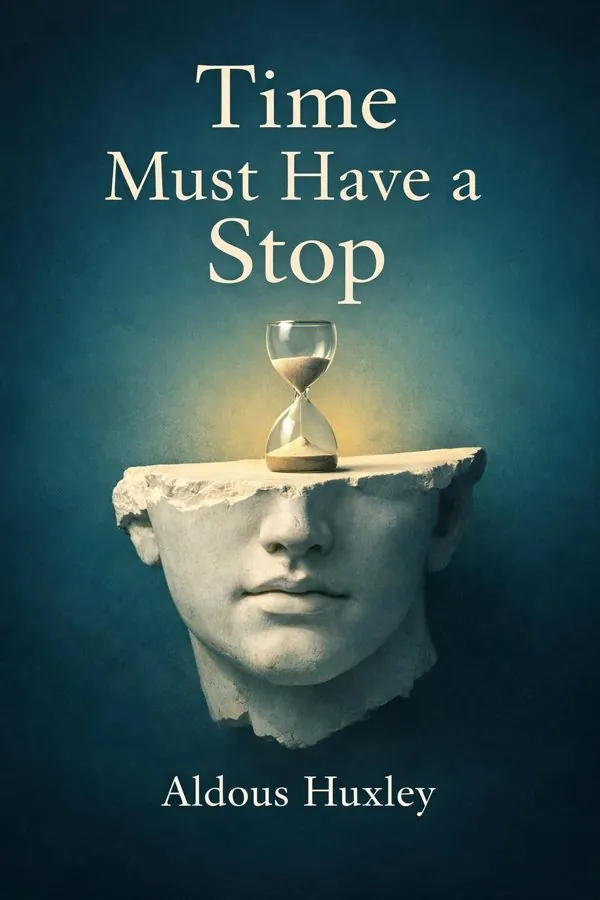
Time Must Have a Stop: Summary & Key Insights
 10 min9 chaptersAudio available
Key Takeaways from Time Must Have a Stop
A young person’s ideals are often mixed with vanity, and Huxley understands how difficult it is to tell the difference.
We are rarely formed by abstract beliefs alone; we are shaped by the emotional atmosphere we inherit.
Beauty can refine the soul, but it can also become a luxurious form of escape.
The novel insists on an uncomfortable truth: artistic sensitivity is not the same thing as moral depth.
Moral awakening often begins not with grand revelation but with a specific act we cannot comfortably excuse.
What Is Time Must Have a Stop About?
Time Must Have a Stop by Aldous Huxley is a classics book spanning 5 pages. Aldous Huxley’s Time Must Have a Stop is a novel about what happens when intelligence, aesthetic sensitivity, and youthful ambition collide with guilt, mortality, and the search for spiritual truth. At its center is Sebastian Barnack, a gifted but self-absorbed young man who longs for artistic greatness and emotional intensity. As he moves through the refined world of pre-war Europe—especially the seductive atmosphere of Florence—he encounters people who embody rival ways of living: materialism, sensualism, moral seriousness, and mystical aspiration. What begins as a coming-of-age story gradually deepens into a meditation on conscience, death, and the possibility of inner transformation. The novel matters because Huxley refuses easy answers. He does not mock beauty, pleasure, or intellect, but he shows their limits when they are detached from compassion and spiritual discipline. Few writers of the twentieth century were as qualified as Huxley to stage this conflict. A novelist, essayist, and lifelong philosophical inquirer, he brings unusual breadth to the book, blending psychological realism with metaphysical speculation. The result is one of his richest and most searching works: a classic for readers interested not only in how people live, but in what they live for.
This FizzRead summary covers all 9 key chapters of Time Must Have a Stop in approximately 10 minutes, distilling the most important ideas, arguments, and takeaways from Aldous Huxley's work. Also available as an audio summary and Key Quotes Podcast.
Time Must Have a Stop
Aldous Huxley’s Time Must Have a Stop is a novel about what happens when intelligence, aesthetic sensitivity, and youthful ambition collide with guilt, mortality, and the search for spiritual truth. At its center is Sebastian Barnack, a gifted but self-absorbed young man who longs for artistic greatness and emotional intensity. As he moves through the refined world of pre-war Europe—especially the seductive atmosphere of Florence—he encounters people who embody rival ways of living: materialism, sensualism, moral seriousness, and mystical aspiration. What begins as a coming-of-age story gradually deepens into a meditation on conscience, death, and the possibility of inner transformation.
The novel matters because Huxley refuses easy answers. He does not mock beauty, pleasure, or intellect, but he shows their limits when they are detached from compassion and spiritual discipline. Few writers of the twentieth century were as qualified as Huxley to stage this conflict. A novelist, essayist, and lifelong philosophical inquirer, he brings unusual breadth to the book, blending psychological realism with metaphysical speculation. The result is one of his richest and most searching works: a classic for readers interested not only in how people live, but in what they live for.
Who Should Read Time Must Have a Stop?
This book is perfect for anyone interested in classics and looking to gain actionable insights in a short read. Whether you're a student, professional, or lifelong learner, the key ideas from Time Must Have a Stop by Aldous Huxley will help you think differently.
- ✓Readers who enjoy classics and want practical takeaways
- ✓Professionals looking to apply new ideas to their work and life
- ✓Anyone who wants the core insights of Time Must Have a Stop in just 10 minutes
Want the full summary?
Get instant access to this book summary and 100K+ more with Fizz Moment.
Get Free SummaryAvailable on App Store • Free to download
Key Chapters
A young person’s ideals are often mixed with vanity, and Huxley understands how difficult it is to tell the difference. Sebastian Barnack begins the novel as an intelligent, emotionally intense young man who believes he is devoted to beauty, poetry, and elevated feeling. He reads, reflects, and aspires to become a serious artist. Yet his idealism is unstable. Beneath the rhetoric of sensitivity lies resentment, self-dramatization, and a deep dissatisfaction with ordinary life. He wants transcendence, but he also wants admiration. He is drawn to truth, but only if truth flatters his sense of uniqueness.
This tension becomes sharper in relation to his father, a practical and material-minded man whose values seem dull and spiritually impoverished. Huxley uses this family contrast to show a familiar human pattern: we often define ourselves against what we reject without truly knowing what we affirm. Sebastian sees his father’s worldliness as vulgar, but his own cultivated sensibility is still entangled with ego. He has not yet learned discipline, humility, or love. His aspirations are genuine, but they remain immature because they are centered on self-image rather than service or wisdom.
This idea extends beyond the novel. Many people confuse aspiration with growth. A student may love “big ideas” but avoid hard work. An artist may speak of authenticity while chasing attention. A professional may reject conventional success, yet secretly crave superiority. Huxley invites us to ask whether our ideals have actually changed our character.
The practical lesson is to examine the motives beneath our noblest ambitions. If your desire for beauty, excellence, or meaning leaves you more compassionate, patient, and truthful, it is maturing. If it mainly feeds self-importance, it is still trapped in ego. Actionable takeaway: identify one ideal you value—art, spirituality, knowledge, success—and ask how it shows up in your daily conduct, not just in your imagination.
We are rarely formed by abstract beliefs alone; we are shaped by the emotional atmosphere we inherit. In Time Must Have a Stop, Huxley presents the Barnack family not simply as background but as a field of competing moral and psychological forces. Sebastian’s father represents a bluntly worldly outlook, grounded in practicality and appetite rather than reflection. His mother, Florence, embodies a different kind of weakness: emotional vulnerability, romantic confusion, and susceptibility to influence. Together, they create a household in which Sebastian’s sensitivity develops without stable moral guidance.
Huxley’s insight is subtle. He does not suggest that spiritual crisis begins with dramatic trauma alone. It can also arise from quieter distortions—vanity rewarded, honesty avoided, emotional needs manipulated, values never clarified. Sebastian’s imagination grows in an environment where refinement and confusion coexist. He learns to feel intensely before he learns to judge clearly. That imbalance helps explain why he is both perceptive and morally reckless.
The family dynamic also reveals how children often become exaggerated reactions to their parents. Sebastian turns away from crude materialism and seeks higher things, but because his development is reactive, it lacks rootedness. He is against one way of life before he is truly capable of another. Huxley suggests that rejecting our inheritance is not the same as transcending it.
This has practical relevance in modern life. Many adults carry invisible family scripts into work, love, and self-understanding. Someone raised around emotional chaos may romanticize intensity. Someone raised among cynics may mistake detachment for wisdom. Growth begins when inherited patterns become visible.
Actionable takeaway: reflect on one value or habit you inherited from your family—whether attraction to status, fear of feeling, or hunger for approval—and ask whether it still governs your decisions. Awareness is the first step toward freedom.
Beauty can refine the soul, but it can also become a luxurious form of escape. When Sebastian travels to Florence and enters the orbit of his wealthy uncle Eustace, Huxley immerses the reader in a world of art, leisure, sensuality, and cultivated taste. Eustace is no crude hedonist. He surrounds himself with paintings, objects, historical memory, and aesthetic pleasure. He has the appearance of civilization at its highest polish. Yet Huxley slowly exposes the hollowness beneath this elegance. Beauty, in Eustace’s life, has become detached from moral seriousness. It decorates existence but does not redeem it.
Florence itself is crucial. The city represents the concentrated appeal of culture—masterpieces, atmosphere, tradition, and refined enjoyment. For Sebastian, this environment is intoxicating because it seems to confirm his belief that intensity and beauty are enough to justify life. But Huxley complicates that fantasy. In the midst of aesthetic abundance there are still corruption, selfishness, fear, and death. Art does not automatically make people wise. Taste is not virtue. Sensual richness can coexist with spiritual emptiness.
This is one of the novel’s most enduring lessons. In modern terms, it applies to anyone who curates a beautiful life without confronting its ethical center. A person may collect meaningful experiences, travel widely, admire great works, eat exquisitely, and speak intelligently—yet remain inwardly shallow, manipulative, or afraid of reality. Culture can elevate us, but it can also become a sophisticated shield against self-knowledge.
Huxley does not reject beauty. He honors its power. What he rejects is aestheticism as a substitute for transformation. Beauty must point beyond narcissism or it becomes another idol.
Actionable takeaway: enjoy beauty deeply, but ask what it is doing to your character. Does it make you more attentive, grateful, and humane—or merely more fastidious, self-conscious, and addicted to stimulation?
The novel insists on an uncomfortable truth: artistic sensitivity is not the same thing as moral depth. Sebastian believes that because he feels intensely and responds to beauty, he is already living at a higher level than ordinary people. Huxley dismantles this illusion with care. Aesthetic responsiveness may enlarge perception, but by itself it does not cure selfishness, dishonesty, or cowardice. In fact, when disconnected from conscience, it can sharpen self-absorption by giving ego a more flattering language.
Sebastian’s imagination allows him to turn experience into drama, and that ability is both gift and danger. He can interpret events in poetic terms, but he can also romanticize his own motives, justify impulsive acts, and treat other people as supporting figures in the theater of his inner life. Huxley shows how artistic temperament can become a moral alibi. One tells oneself that sensitivity excuses instability, or that genius justifies irresponsibility, or that authenticity requires acting on every emotional impulse.
This theme remains strikingly contemporary. Today, creativity is often treated as a mark of virtue in itself. We may assume that someone who is expressive, original, or culturally sophisticated must also be psychologically mature. But talent and goodness are different achievements. A brilliant creator can still be careless, exploitative, or spiritually confused. Likewise, an ordinary person with no artistic ambitions may possess far deeper honesty and love.
For readers, the practical application is clear. Whether you write, design, lead, teach, or simply care about living meaningfully, ask whether your gifts are integrated with discipline and responsibility. Does your creativity help you face reality more truthfully, or does it provide new ways to avoid accountability?
Actionable takeaway: choose one ability you are proud of and test it ethically. Ask not only, “Am I good at this?” but “Does the way I use this gift make me more truthful, dependable, and kind?”
Moral awakening often begins not with grand revelation but with a specific act we cannot comfortably excuse. One of the novel’s turning points is Sebastian’s theft, an act that crystallizes his inner disorder. The theft is important not merely because it is wrong, but because it exposes the gap between Sebastian’s self-image and his actual character. He has imagined himself as refined, elevated, and spiritually promising. Yet under pressure, vanity, desire, and weakness lead him into a concrete betrayal.
Huxley treats this event as a psychological and spiritual test. Before the theft, Sebastian can still inhabit abstractions about beauty and vocation. After it, he must confront the reality that he is capable of ordinary wrongdoing. This is humiliating, but it is also necessary. Genuine conscience is born when we stop treating evil as something external—located in society, parents, bad taste, or lesser minds—and recognize its presence within ourselves. That recognition is painful because it collapses flattering narratives. But without it, there can be no real change.
In daily life, people often encounter smaller versions of this moment: lying to protect an image, taking credit unfairly, betraying trust, indulging convenience over integrity. The first instinct is usually self-justification. We explain, minimize, reinterpret. Huxley suggests that growth starts when we resist that instinct and remain present to moral discomfort. Shame alone is not enough; what matters is whether shame becomes honest self-knowledge.
The theft also shows that conscience is not merely social fear. Sebastian’s deeper disturbance comes from inward recognition, not just from the possibility of punishment. He begins to sense that wrong action deforms the self.
Actionable takeaway: think of one recent action you have been tempted to rationalize. Instead of defending it, describe it plainly and ask what it reveals about your motives. Clarity, not self-punishment, is the beginning of conscience.
Nothing tests a worldview like death. Huxley uses mortality not as background tragedy but as a philosophical force that strips away illusion. The life of Eustace, rich in objects, pleasures, and cultivated experiences, appears enviable while it lasts. But death raises a devastating question: what, in the end, can be kept? Taste, wealth, social performance, and sensory gratification all depend on a self still able to consume and arrange them. Mortality interrupts that arrangement and exposes how fragile possession really is.
This is why the novel’s treatment of death feels so searching. Huxley is not merely asking whether people fear dying. He is asking whether the kind of life they have built can survive contact with the fact of death. A person may spend years assembling comfort, status, and aesthetic richness, only to discover that none of these answer the deepest human need for meaning. Death makes that discrepancy impossible to ignore. It reveals whether one has lived toward reality or merely decorated avoidance.
For Sebastian, this confrontation is transformative. Death enters his moral education as a corrective to fantasy. It forces him to see that beauty and excitement are temporary, and that a life organized entirely around appetite or self-display cannot satisfy the soul. Huxley’s point is not morbid. Rather, mortality becomes a teacher. By reminding us that time is limited, death places urgency on the question of what is truly worth loving.
This lesson is practical. Many people live as if significance can be accumulated through experiences, acquisitions, or recognition. But the awareness of mortality can reorder priorities: relationships over vanity, truth over performance, inner freedom over display.
Actionable takeaway: ask yourself what in your current life would still matter if time became visibly short. Use your answer to revise one priority this week—how you spend attention, money, or emotional energy.
Huxley ventures into daring territory when he suggests that consciousness may not be exhausted by bodily life. After Eustace’s death, the novel opens toward questions that many realist novels avoid: what if the self persists in some form, and what if death reveals not annihilation alone but spiritual consequence? Huxley handles this material not as cheap supernaturalism but as part of his larger inquiry into the structure of reality. The possibility of posthumous awareness intensifies the moral stakes of the entire narrative.
What matters here is not whether every reader accepts Huxley’s metaphysics literally. More important is the shift in perspective this idea introduces. If consciousness is larger than material existence, then human life cannot be judged only by pleasure, achievement, or social success. Inner state becomes central. Attachment, selfishness, fear, and delusion may continue to imprison the soul even after worldly roles fall away. Conversely, detachment, love, and awakening may represent genuine preparation for a deeper order of being.
Eustace’s posthumous dimension dramatizes a profound irony: a man who possessed so much may remain spiritually impoverished. His cultivated lifestyle does not guarantee freedom. Huxley thereby extends his critique of materialism beyond death itself. The self cannot save itself through accumulation, because what most needs transformation lies deeper than possessions and appearances.
Even for secular readers, this idea has practical value. One need not affirm an afterlife to recognize that some forms of living leave us inwardly cramped while others enlarge awareness. The question becomes: what are we becoming underneath the visible story of our lives?
Actionable takeaway: spend a few minutes imagining that titles, possessions, and public identity have fallen away. What qualities of mind and heart would remain? Choose one of those qualities—such as patience, courage, or compassion—and practice it deliberately today.
Insight can begin a transformation, but it cannot complete one. A recurring lesson in Time Must Have a Stop is that spiritual and moral growth demand more than powerful feelings or sudden realizations. Sebastian experiences shame, attraction to higher ideals, and moments of altered understanding. Yet Huxley does not sentimentalize awakening. He knows that people can have moving experiences and still remain fundamentally unchanged. Lasting transformation requires training attention, correcting habits, and submitting ego to a more demanding standard.
This is where the novel departs from romantic notions of self-development. Sebastian initially trusts intensity: if he feels enough, sees enough, or suffers enough, he imagines he will become profound. Huxley counters that genuine growth is often less dramatic and more disciplined. It may involve renunciation, honest self-observation, restraint, prayer or contemplation, and repeated acts of moral choice. The point is not repression but integration. Desire, imagination, and intellect must be ordered rather than merely indulged.
This theme applies widely. People often mistake inspiration for commitment. They read a life-changing book, attend a retreat, make a promise after a crisis, or feel clarity in a powerful moment. Then daily habits quietly restore the old self. Huxley suggests that the bridge between vision and reality is practice. If a new understanding does not become a new routine, it remains decorative.
Readers can use this idea in any domain: spiritual life, creative work, emotional maturity, or ethical conduct. Change happens when repeated action educates character. Feelings may start the process, but habits carry it forward.
Actionable takeaway: convert one ideal into a discipline. If you value truth, practice one difficult honesty. If you value peace, create ten minutes of silence daily. If you value compassion, perform one unadvertised act of care. Give the ideal a schedule, not just a sentiment.
Human beings cannot stop time, but they can decide what time will do to them. The title Time Must Have a Stop suggests both mortality and the limits of temporal life, yet the novel does not end in despair. Huxley’s deeper claim is that suffering, guilt, and impermanence need not merely crush the self; they can become instruments of awakening. Time strips away illusions. It humbles youthful fantasies, exposes false values, and carries every pleasure toward disappearance. But this stripping can create the conditions for redemption.
Sebastian’s journey embodies that paradox. He does not mature through success alone. He is educated by loss, moral failure, disillusionment, and contact with death. These experiences do not automatically ennoble him; many people become harder, more cynical, or more desperate when confronted by suffering. What makes change possible is the willingness to learn from exposure rather than defend against it. Huxley presents redemption not as innocence regained, but as consciousness deepened. One becomes redeemable by seeing more truthfully and loving less selfishly.
This is one of the novel’s most humane insights. A damaged past does not prevent growth if it is honestly faced. Mistakes can become teachers. Time can be an enemy when we waste it in distraction, but it can also be a severe ally when it burns away illusion. The central question is whether we cooperate with what experience is trying to reveal.
For modern readers, this offers a mature form of hope. You do not need a perfect beginning to move toward a better life. What you need is sincerity, self-knowledge, and the courage to let painful experience change you.
Actionable takeaway: revisit one disappointment, failure, or painful period in your life and ask not only, “Why did this happen?” but “What truth did this force me to see that comfort would have hidden?”
All Chapters in Time Must Have a Stop
About the Author
Aldous Huxley (1894–1963) was an English novelist, essayist, critic, and public intellectual whose work ranged across literature, science, philosophy, politics, and spirituality. Born into a prominent intellectual family, he was educated at Eton and Oxford and emerged as one of the most distinctive literary voices of the twentieth century. Huxley is best known for Brave New World, but his career was remarkably broad, including satirical novels, cultural criticism, travel writing, and explorations of consciousness and mysticism. Over time, his interests shifted increasingly toward ethics, religion, and the possibility of inner transformation, concerns that strongly shape Time Must Have a Stop. His writing is notable for combining sharp social observation with deep philosophical curiosity, making him a major figure for readers interested in both modern civilization and the spiritual questions it cannot escape.
Get This Summary in Your Preferred Format
Read or listen to the Time Must Have a Stop summary by Aldous Huxley anytime, anywhere. FizzRead offers multiple formats so you can learn on your terms — all free.
Available formats: App · Audio · PDF · EPUB — All included free with FizzRead
Download Time Must Have a Stop PDF and EPUB Summary
Key Quotes from Time Must Have a Stop
“A young person’s ideals are often mixed with vanity, and Huxley understands how difficult it is to tell the difference.”
“We are rarely formed by abstract beliefs alone; we are shaped by the emotional atmosphere we inherit.”
“Beauty can refine the soul, but it can also become a luxurious form of escape.”
“The novel insists on an uncomfortable truth: artistic sensitivity is not the same thing as moral depth.”
“Moral awakening often begins not with grand revelation but with a specific act we cannot comfortably excuse.”
Frequently Asked Questions about Time Must Have a Stop
Time Must Have a Stop by Aldous Huxley is a classics book that explores key ideas across 9 chapters. Aldous Huxley’s Time Must Have a Stop is a novel about what happens when intelligence, aesthetic sensitivity, and youthful ambition collide with guilt, mortality, and the search for spiritual truth. At its center is Sebastian Barnack, a gifted but self-absorbed young man who longs for artistic greatness and emotional intensity. As he moves through the refined world of pre-war Europe—especially the seductive atmosphere of Florence—he encounters people who embody rival ways of living: materialism, sensualism, moral seriousness, and mystical aspiration. What begins as a coming-of-age story gradually deepens into a meditation on conscience, death, and the possibility of inner transformation. The novel matters because Huxley refuses easy answers. He does not mock beauty, pleasure, or intellect, but he shows their limits when they are detached from compassion and spiritual discipline. Few writers of the twentieth century were as qualified as Huxley to stage this conflict. A novelist, essayist, and lifelong philosophical inquirer, he brings unusual breadth to the book, blending psychological realism with metaphysical speculation. The result is one of his richest and most searching works: a classic for readers interested not only in how people live, but in what they live for.
More by Aldous Huxley
You Might Also Like


Browse by Category
Ready to read Time Must Have a Stop?
Get the full summary and 100K+ more books with Fizz Moment.