
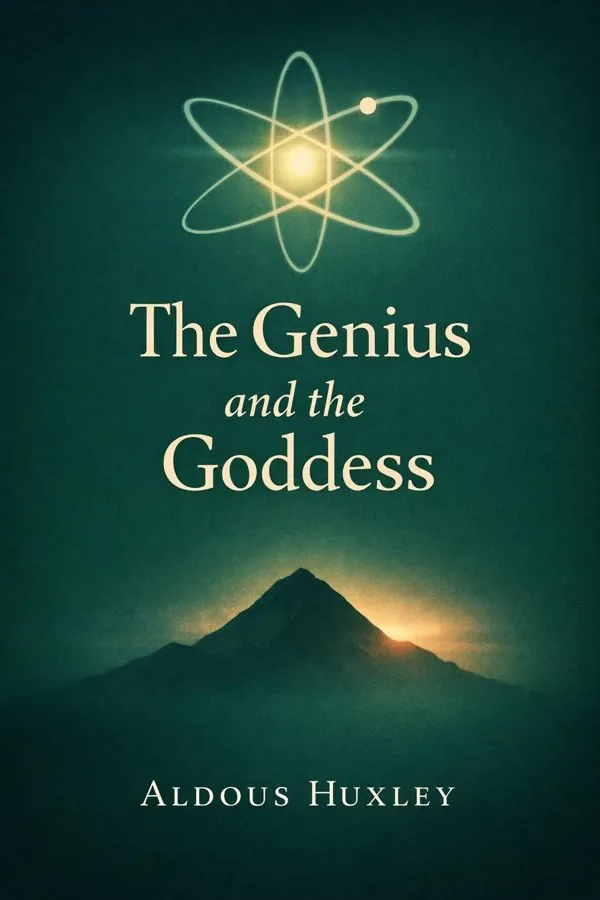
The Genius and the Goddess: A Novel: Summary & Key Insights
 10 min3 chaptersAudio available
What Is The Genius and the Goddess: A Novel About?
The Genius and the Goddess: A Novel by Aldous Huxley is a classics book spanning 3 pages. Aldous Huxley's unforgettable tale of a brilliant physicist, his beautiful wife, and the young man who tears their world apart. Set in postwar England, the novel explores the complex interplay between intellect, passion, and morality as a young scientist becomes entangled with his mentor’s family, confronting the tension between scientific rationality and human desire.
This FizzRead summary covers all 3 key chapters of The Genius and the Goddess: A Novel in approximately 10 minutes, distilling the most important ideas, arguments, and takeaways from Aldous Huxley's work. Also available as an audio summary and Key Quotes Podcast.
The Genius and the Goddess: A Novel
Aldous Huxley's unforgettable tale of a brilliant physicist, his beautiful wife, and the young man who tears their world apart. Set in postwar England, the novel explores the complex interplay between intellect, passion, and morality as a young scientist becomes entangled with his mentor’s family, confronting the tension between scientific rationality and human desire.
Who Should Read The Genius and the Goddess: A Novel?
This book is perfect for anyone interested in classics and looking to gain actionable insights in a short read. Whether you're a student, professional, or lifelong learner, the key ideas from The Genius and the Goddess: A Novel by Aldous Huxley will help you think differently.
- ✓Readers who enjoy classics and want practical takeaways
- ✓Professionals looking to apply new ideas to their work and life
- ✓Anyone who wants the core insights of The Genius and the Goddess: A Novel in just 10 minutes
Want the full summary?
Get instant access to this book summary and 100K+ more with Fizz Moment.
Get Free SummaryAvailable on App Store • Free to download
Key Chapters
When I conceived Henry Maartens, I imagined a man whose intellect borders on the divine—a being who grasps the very mechanics of the universe but fails to perceive the human heart beating beside him. Rivers’s recollection begins at the threshold of Henry’s home, a place both majestic and claustrophobic. Here, science reigns supreme; ideas float in the air thicker than conversation. Instruments hum, formulas cross chalkboards, and the man at the center of it all lives absorbed within his own abstraction.
For the young Rivers, entering this world feels like initiation into a sacred temple. Henry speaks of energy and matter, of cosmic equilibrium and the mysterious order of existence. He is the quintessential genius—isolated within his brilliance, revered by his peers, feared by those who love him. And yet, the same house that shelters his genius also shelters another presence—Katy Maartens—a woman of warmth, grace, and emotional clarity. She is the eternal counterpoint to Henry’s transcendence, the embodiment of what intellect disowns but secretly craves.
Through Rivers’s eyes, we see the imbalance: Henry, caught in his invulnerable sphere of thought, and Katy, left yearning for the intimacy her husband’s mind cannot offer. The juxtaposition is deliberate; it marks the beginning of Rivers’s awakening to the truth that thought, untempered by love, breeds loneliness, and that love, untempered by reflection, breeds ruin.
I wanted the Maartens household to be both sanctuary and trap—a place where high ideals collide with emotional hunger. As Rivers becomes part of their world, he feels the magnetic pull of Henry’s intellect, admiring its power, yet sensing a hollowness behind it. In Katy’s presence, by contrast, he feels life itself—immediate, sensuous, and disconcertingly real. Between these two figures, he discovers that genius and humanity are not allies, but adversaries within himself.
The house itself functions as metaphor: every room illuminated by Henry’s scientific apparatuses, yet shadowed by unspoken desires. It is here Rivers learns his first lesson—that knowledge can build walls, and that love, so often dismissed as emotional weakness, may be the only force capable of bridging them.
As Rivers’s admiration for Henry grows, so too does his confusion. He sees genius in its purest form—brilliant, methodical, godlike—but he also sees its cost: the loneliness of abstraction, the inability to touch another’s soul. Katy’s loneliness becomes visible to him with each passing day, and slowly, imperceptibly, compassion turns to yearning.
This transformation is not swift; it is a quiet corrosion. He becomes confessor and companion, drawn to the emotional warmth Katy radiates. Where Henry’s conversation dwells in the stars, Katy’s centers on the human heart. In her eyes, Rivers finds empathy—a force he has never encountered in lab equations or academic debates.
The novel’s moral tension grows here. Rivers loves his mentor as he loves the scientific ideal Henry represents. But he begins to see that ideal stripped of humanity becomes monstrous. His attraction to Katy is, at its core, a rebellion against sterile perfection; she embodies life’s imperfections—the very chaos that genius seeks to regulate.
When their intimacy blossoms into an affair, it is not mere lust but a collision of moral universes. In their shared passion, Rivers confronts the fracture within himself—the division between mind and body, duty and freedom. He is torn between the purity of intellectual aspiration and the inevitable impurity of emotion. Katy, too, is divided: her devotion to Henry and her need for tenderness drift into war with each other.
From my perspective, this chapter of their entanglement embodies the timeless dilemma—how far can one pursue truth before it destroys goodness? Rivers’s affair with Katy is an experiment conducted not in the laboratory but within the psyche. Its results are painful but illuminating: guilt does not cancel desire, nor does knowledge neutralize suffering. Every action carries consequence, and even the act of love, so often romanticized, can become a mirror revealing our deepest contradictions.
Through this stage of the narrative, I sought to dismantle the illusion that intellect refines morality. Instead, I reveal that morality must be lived, felt, and suffered—not merely reasoned. Rivers’s guilt is not an error in logic but a necessary symptom of self-awareness. In loving Katy, he faces the painful truth that humanity’s quest for understanding often leads not to purity but to confession.
+ 1 more chapters — available in the FizzRead app
All Chapters in The Genius and the Goddess: A Novel
About the Author
Aldous Huxley (1894–1963) was an English writer and philosopher known for his novels, essays, and wide-ranging intellectual interests. His works often examine the impact of science and technology on society and the human condition. Among his best-known works are 'Brave New World' and 'The Doors of Perception.'
Get This Summary in Your Preferred Format
Read or listen to the The Genius and the Goddess: A Novel summary by Aldous Huxley anytime, anywhere. FizzRead offers multiple formats so you can learn on your terms — all free.
Available formats: App · Audio · PDF · EPUB — All included free with FizzRead
Download The Genius and the Goddess: A Novel PDF and EPUB Summary
Key Quotes from The Genius and the Goddess: A Novel
“When I conceived Henry Maartens, I imagined a man whose intellect borders on the divine—a being who grasps the very mechanics of the universe but fails to perceive the human heart beating beside him.”
“As Rivers’s admiration for Henry grows, so too does his confusion.”
Frequently Asked Questions about The Genius and the Goddess: A Novel
The Genius and the Goddess: A Novel by Aldous Huxley is a classics book that explores key ideas across 3 chapters. Aldous Huxley's unforgettable tale of a brilliant physicist, his beautiful wife, and the young man who tears their world apart. Set in postwar England, the novel explores the complex interplay between intellect, passion, and morality as a young scientist becomes entangled with his mentor’s family, confronting the tension between scientific rationality and human desire.
More by Aldous Huxley

You Might Also Like






Browse by Category
Ready to read The Genius and the Goddess: A Novel?
Get the full summary and 100K+ more books with Fizz Moment.