
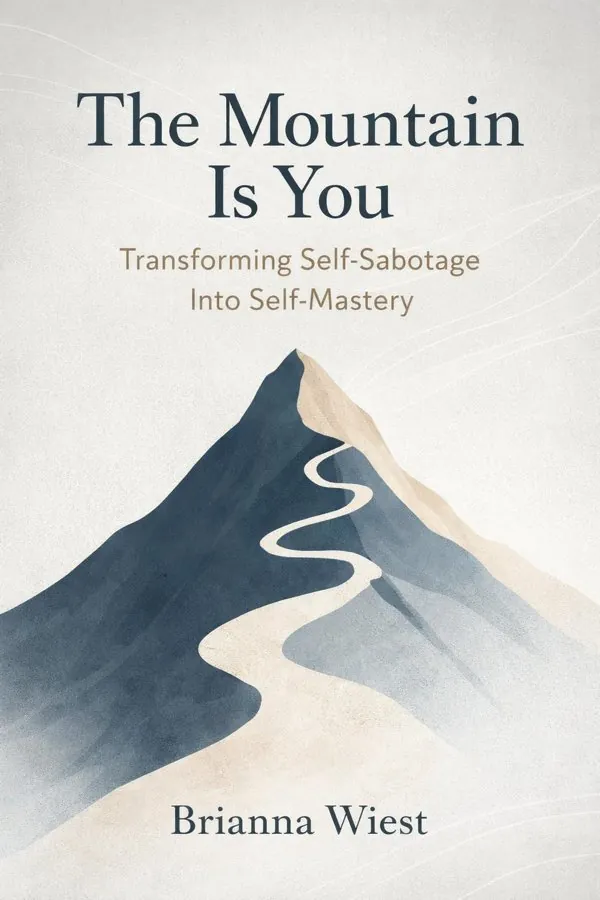
The Mountain Is You: Summary & Key Insights
 10 min9 chaptersAudio available
Key Takeaways from The Mountain Is You
One of the most important ideas in The Mountain Is You is that self-sabotage is rarely random.
This inner conflict often begins in early experiences that shape our self-image.
A major turning point in personal growth comes when we stop organizing our lives around avoiding pain.
Self-awareness is the foundation of all lasting change in The Mountain Is You.
Thoughts shape emotions, and emotions shape behavior, which is why Wiest places such importance on challenging the stories we repeat in our minds.
What Is The Mountain Is You About?
The Mountain Is You by Brianna Wiest is a self-help book published in 2020 spanning 9 pages. Why do people so often become the very thing standing in their own way? That is the central question at the heart of The Mountain Is You, a self-help book about self-sabotage, emotional healing, and personal transformation. Brianna Wiest explores the uncomfortable truth that many of our biggest obstacles are not external circumstances, but the internal patterns we repeat without realizing it. Fear, avoidance, perfectionism, emotional reactivity, and limiting beliefs can quietly shape our decisions until we feel stuck in a life we say we want to change. Wiest argues that these patterns are not signs that we are broken. They are signals that unresolved needs, pain, and internal conflict are asking to be understood. This perspective makes the book especially powerful: instead of shaming readers for procrastinating, overthinking, or holding themselves back, it helps them decode why those behaviors exist in the first place. Known for writing about emotional intelligence, mindfulness, and self-development, Wiest offers an accessible guide to turning inner resistance into self-mastery. The result is a compassionate roadmap for anyone ready to stop fighting themselves and start growing with intention.
This FizzRead summary covers all 9 key chapters of The Mountain Is You in approximately 10 minutes, distilling the most important ideas, arguments, and takeaways from Brianna Wiest's work. Also available as an audio summary and Key Quotes Podcast.
The Mountain Is You: Transforming Self-Sabotage Into Self-Mastery
Why do people so often become the very thing standing in their own way? That is the central question at the heart of The Mountain Is You, a self-help book about self-sabotage, emotional healing, and personal transformation. Brianna Wiest explores the uncomfortable truth that many of our biggest obstacles are not external circumstances, but the internal patterns we repeat without realizing it. Fear, avoidance, perfectionism, emotional reactivity, and limiting beliefs can quietly shape our decisions until we feel stuck in a life we say we want to change. Wiest argues that these patterns are not signs that we are broken. They are signals that unresolved needs, pain, and internal conflict are asking to be understood. This perspective makes the book especially powerful: instead of shaming readers for procrastinating, overthinking, or holding themselves back, it helps them decode why those behaviors exist in the first place. Known for writing about emotional intelligence, mindfulness, and self-development, Wiest offers an accessible guide to turning inner resistance into self-mastery. The result is a compassionate roadmap for anyone ready to stop fighting themselves and start growing with intention.
Who Should Read The Mountain Is You?
This book is perfect for anyone interested in self-help and looking to gain actionable insights in a short read. Whether you're a student, professional, or lifelong learner, the key ideas from The Mountain Is You by Brianna Wiest will help you think differently.
- ✓Readers who enjoy self-help and want practical takeaways
- ✓Professionals looking to apply new ideas to their work and life
- ✓Anyone who wants the core insights of The Mountain Is You in just 10 minutes
Want the full summary?
Get instant access to this book summary and 100K+ more with Fizz Moment.
Get Free SummaryAvailable on App Store • Free to download
Key Chapters
One of the most important ideas in The Mountain Is You is that self-sabotage is rarely random. It is usually a protective response that developed for a reason. What looks like laziness, inconsistency, or lack of discipline is often fear wearing a disguise. A person might procrastinate on applying for a dream job not because they do not care, but because success would force them to face rejection, visibility, or a new identity. Someone else may obsess over making everything perfect because imperfection feels emotionally unsafe. Wiest reframes these behaviors with compassion: self-sabotage happens when there is a gap between what we consciously want and what our subconscious believes is safe.
Recognizing self-sabotage begins with noticing patterns instead of judging them. Ask: When do I shut down? What goal keeps repeating itself without progress? What emotion appears right before I avoid action? These questions reveal the hidden logic beneath destructive habits. A practical way to begin is to track one recurring behavior for a week, such as scrolling instead of working or withdrawing during conflict. Then identify the feeling underneath it: fear, shame, overwhelm, or uncertainty. The insight here is liberating. If self-sabotage is a message rather than a personal flaw, then each setback becomes useful data. The behavior is not the real problem; it is the clue pointing to the wound, belief, or fear that needs healing.
Wiest explains that many people live with an internal split: one part wants growth, love, success, or peace, while another part clings to familiar pain because it feels predictable. This inner conflict often begins in early experiences that shape our self-image. If someone grew up feeling criticized, ignored, or emotionally unsafe, they may develop beliefs such as “I am not enough,” “I have to earn love,” or “It is dangerous to be fully seen.” Even when adult life offers healthier opportunities, the nervous system may still react according to those old scripts.
This is why change can feel so difficult even when it is deeply desired. For example, a person may want a stable relationship but keep choosing emotionally unavailable partners because chaos feels familiar. Another may long for creative expression but freeze every time they are about to share their work because being visible once felt risky. Understanding inner conflict means learning to connect present behavior with past conditioning without turning that insight into self-blame.
A helpful practice is to identify one persistent frustration and finish the sentence: “A part of me wants this, but another part of me believes…” That second part often reveals the real obstacle. Once brought into awareness, it can be met with compassion instead of denial. Wiest’s message is that healing does not require pretending the past did not happen. It requires understanding how it still lives inside us, and then choosing new beliefs and behaviors deliberately.
A major turning point in personal growth comes when we stop organizing our lives around avoiding pain. Wiest suggests that much of self-sabotage is really pain avoidance: we delay difficult conversations, avoid bold decisions, numb ourselves with distractions, or stay small because discomfort feels threatening. Yet the very feelings we try to outrun often contain the guidance we need. Fear can show us where growth is asking to happen. Pain can reveal what needs attention, grieving, or change.
Facing pain and fear does not mean becoming reckless or forcing yourself into constant discomfort. It means learning to stay present with hard emotions long enough to understand them. For instance, if starting a business triggers panic, the goal is not to push through blindly. It is to ask: Am I afraid of failure, of judgment, of instability, or of outgrowing who I have been? Naming the fear reduces its power. Likewise, if heartbreak resurfaces every time intimacy deepens, the work is to acknowledge the old pain rather than assume the current relationship is the problem.
A practical approach is to build emotional tolerance in small steps. Sit with a difficult feeling for five minutes before reacting. Write down what your fear predicts, then compare it to what is actually happening. Have the conversation you have been rehearsing. Wiest’s core insight is that transformation requires emotional bravery. We do not become free by avoiding pain; we become free by learning that we can survive it, understand it, and grow through it.
Self-awareness is the foundation of all lasting change in The Mountain Is You. Without it, people stay trapped in automatic cycles, reacting from old wounds while believing life is simply happening to them. Wiest emphasizes that self-awareness is more than noticing your feelings in the moment. It is the deeper ability to see your habits, triggers, assumptions, emotional patterns, and coping mechanisms with honesty. This kind of awareness creates choice. Once you can observe yourself clearly, you are no longer completely controlled by unconscious reactions.
For example, someone may notice they become defensive whenever they receive feedback. At first, it seems like other people are always too critical. With self-awareness, they begin to see that feedback activates an old fear of inadequacy. That recognition changes everything. Instead of lashing out or shutting down, they can pause and respond from the present. Another person might realize that every time they feel uncertain, they rush to overplan their entire future. Awareness helps them see the difference between preparation and anxiety-driven control.
To cultivate self-awareness, Wiest’s ideas point toward reflective practices such as journaling, noticing body sensations, and reviewing emotional reactions after significant events. Questions like “What did I feel?” “What story did I tell myself?” and “What was I trying to protect?” can uncover hidden patterns. The goal is not hyper-analysis or perfection. It is learning to witness yourself with enough clarity and compassion that your inner world stops being a mystery. That awareness becomes the doorway to intentional living.
Thoughts shape emotions, and emotions shape behavior, which is why Wiest places such importance on challenging the stories we repeat in our minds. Many self-defeating behaviors are sustained by thought patterns that feel true simply because they are familiar. A person who believes “If I fail once, I am not capable” may never try long enough to improve. Someone who constantly thinks “People always leave” may interpret ordinary distance or disagreement as abandonment. These beliefs become filters, and filters quietly create reality.
Reframing thought patterns is not about forced positivity or pretending difficult things do not exist. It is about moving from distorted, fear-based interpretations toward more accurate and empowering ones. For example, “I am behind in life” can become “My path is unfolding at a different pace.” “I always mess things up” can become “I am learning through trial and error.” Even this subtle shift reduces shame and makes action easier. The goal is not to manufacture confidence overnight, but to stop reinforcing hopelessness.
One useful technique is to catch repetitive negative thoughts and test them with evidence. Is this fact or fear? Is there another explanation? What would I say to a friend thinking this? Another powerful practice is replacing identity-based thoughts with process-based ones: instead of “I am bad at relationships,” try “I am learning healthier ways to connect.” Wiest’s message is that changing your life often begins by changing the narrative through which you interpret yourself. New thinking does not solve everything, but it opens space for new choices.
In Wiest’s framework, self-mastery is not emotional suppression. It is emotional intelligence in action. Many people think growth means becoming unaffected, perfectly calm, or endlessly productive. But true self-mastery is the ability to understand your emotions, regulate your responses, and act in alignment with your values rather than your impulses. Emotions are not obstacles to success; they are information. Problems arise when people either ignore them completely or let them dictate every decision.
Consider the difference between feeling anger and being ruled by it. Emotional intelligence allows someone to notice anger, understand what boundary or hurt it points to, and choose a wise response. The same applies to anxiety, grief, jealousy, or disappointment. If you can identify what you feel and why you feel it, you gain leverage over how you act next. A person who notices they are overwhelmed can rest or simplify before burning out. Someone who recognizes envy can ask what desire it is revealing instead of spiraling into resentment.
Building self-mastery often involves daily practices rather than dramatic breakthroughs. Pausing before responding, naming emotions precisely, sleeping well, reducing overstimulation, and honoring boundaries all support emotional regulation. So does learning that intense feelings are temporary and do not always require immediate action. Wiest shows that maturity is not the absence of emotional storms. It is the skill of moving through them without abandoning yourself, your goals, or your integrity.
Insight alone does not change a life. One of the clearest messages in The Mountain Is You is that healing must eventually become behavior. You can understand your trauma responses, identify your limiting beliefs, and recognize your patterns, but if you continue making the same choices, the mountain remains. Wiest emphasizes personal responsibility not as blame, but as power. We may not be responsible for everything that happened to us, but we are responsible for what we do next.
This is especially important because self-sabotage often thrives in vagueness. People say they want change, but they postpone specific action until they feel ready, certain, or fearless. Wiest challenges this mindset by showing that action often creates clarity, not the other way around. Someone who wants better mental health may need to create a routine before motivation appears. Someone who wants more confidence may need to speak up while still feeling nervous. Responsibility means accepting that your future is shaped by repeated, often small decisions.
Action becomes more sustainable when it is broken into concrete steps. Instead of “fix my life,” choose “apply to one position,” “schedule one therapy session,” or “set a boundary in one conversation.” Keep promises to yourself in manageable ways, because self-trust grows from evidence. Wiest’s larger point is that transformation is built through consistency. Awareness reveals the path, but responsibility is what actually walks it.
Wiest makes it clear that self-work does not happen in isolation. The way we relate to others often mirrors the way we relate to ourselves. If we are harsh internally, we may become defensive, controlling, or emotionally distant in relationships. If we do not feel worthy, we may overgive, tolerate mistreatment, or confuse intensity with love. Understanding self-sabotage therefore requires looking closely at patterns in friendships, romance, family dynamics, and even work relationships.
Empathy is central here, but Wiest’s perspective suggests that empathy must begin inward and then extend outward in healthy ways. When people understand their own wounds, they become less reactive and more capable of seeing others clearly. For example, a person who recognizes their fear of abandonment may stop accusing a partner every time plans change. Someone who understands their people-pleasing tendencies may finally realize that resentment has been building because they rarely express their true needs.
Healthy relationships require both compassion and boundaries. Empathy is not absorbing everyone else’s emotions or excusing harmful behavior. It is understanding what may drive behavior while still honoring what is acceptable. A practical takeaway is to ask in conflict: What am I feeling, what is the other person likely feeling, and what boundary or truth needs to be communicated? This creates connection without self-betrayal. Wiest’s insight is that relationships become transformative when we stop using them to replay old pain and start using them as spaces for honesty, responsibility, and mutual care.
The final stage of growth in The Mountain Is You is not perfection but integration. Wiest suggests that healing is not about erasing your fear, history, flaws, or emotional complexity. It is about bringing all the fragmented parts of yourself into a more honest and coherent whole. The goal is not to become someone entirely new, but to stop being divided against yourself. When the parts of you that want safety, love, expression, rest, ambition, and healing can coexist, life becomes less of an internal battle.
Integration often looks quieter than people expect. It may mean no longer reacting the same way to old triggers. It may mean recognizing a destructive urge without obeying it. It may mean grieving what happened, accepting what is true, and moving forward without needing to keep reliving the same lesson. A person who once needed external validation to feel worthy may still enjoy praise, but no longer depend on it for identity. That is transcendence in a grounded form: not escaping humanity, but relating to it differently.
A helpful way to support integration is to regularly reflect on how you have changed. What triggers have softened? What boundaries come more naturally now? What old beliefs have lost their grip? This turns growth into something visible and real. Wiest’s overarching message is that the mountain can be climbed when inner conflict becomes inner alignment. The summit is not a flawless life. It is the freedom that comes from no longer being at war with yourself.
All Chapters in The Mountain Is You
About the Author
Brianna Wiest is an American author and essayist known for her work in emotional intelligence, mindfulness, and self-development. Her writing centers on personal transformation, introspection, and the patterns that shape how people think, feel, and grow. She is widely recognized for translating complex inner experiences into clear, relatable guidance that encourages readers to build clarity, resilience, and purpose. In books and essays alike, Wiest focuses on helping people better understand themselves so they can create more intentional lives. Her voice is especially valued by readers seeking practical insight into emotional healing and long-term personal growth.
Get This Summary in Your Preferred Format
Read or listen to the The Mountain Is You summary by Brianna Wiest anytime, anywhere. FizzRead offers multiple formats so you can learn on your terms — all free.
Available formats: App · Audio · PDF · EPUB — All included free with FizzRead
Download The Mountain Is You PDF and EPUB Summary
Key Quotes from The Mountain Is You
“One of the most important ideas in The Mountain Is You is that self-sabotage is rarely random.”
“Wiest explains that many people live with an internal split: one part wants growth, love, success, or peace, while another part clings to familiar pain because it feels predictable.”
“A major turning point in personal growth comes when we stop organizing our lives around avoiding pain.”
“Self-awareness is the foundation of all lasting change in The Mountain Is You.”
“Thoughts shape emotions, and emotions shape behavior, which is why Wiest places such importance on challenging the stories we repeat in our minds.”
Frequently Asked Questions about The Mountain Is You
The Mountain Is You by Brianna Wiest is a self-help book that explores key ideas across 9 chapters. Why do people so often become the very thing standing in their own way? That is the central question at the heart of The Mountain Is You, a self-help book about self-sabotage, emotional healing, and personal transformation. Brianna Wiest explores the uncomfortable truth that many of our biggest obstacles are not external circumstances, but the internal patterns we repeat without realizing it. Fear, avoidance, perfectionism, emotional reactivity, and limiting beliefs can quietly shape our decisions until we feel stuck in a life we say we want to change. Wiest argues that these patterns are not signs that we are broken. They are signals that unresolved needs, pain, and internal conflict are asking to be understood. This perspective makes the book especially powerful: instead of shaming readers for procrastinating, overthinking, or holding themselves back, it helps them decode why those behaviors exist in the first place. Known for writing about emotional intelligence, mindfulness, and self-development, Wiest offers an accessible guide to turning inner resistance into self-mastery. The result is a compassionate roadmap for anyone ready to stop fighting themselves and start growing with intention.
Compare The Mountain Is You



More by Brianna Wiest

You Might Also Like
Featured In
Browse by Category
Ready to read The Mountain Is You?
Get the full summary and 100K+ more books with Fizz Moment.