
The Power of Now: Summary & Key Insights
 10 min13 chapters
Key Takeaways from The Power of Now
At the heart of *The Power of Now* is a radical shift in how we relate to thinking.
In Tolle’s framework, true insight does not come from thinking harder and harder.
Tolle sees anxiety and fear as powerful consequences of living psychologically in the future.
Although *The Power of Now* is spiritual in tone, it is also deeply practical because presence must be practiced until it becomes a habit.
In a world addicted to stimulation, silence can feel uncomfortable at first.
What Is The Power of Now About?
The Power of Now by Eckhart Tolle is a self-help book published in 2020 spanning 13 pages. What if most of your stress, fear, and dissatisfaction came not from what is happening in your life, but from your inability to stay rooted in the present moment? That is the life-changing promise at the center of *The Power of Now*. In this widely read self-help classic, Eckhart Tolle argues that peace, clarity, and emotional freedom become possible when we stop identifying so completely with the restless voice in our head and begin inhabiting the present more fully. Rather than offering productivity tricks or surface-level positivity, the book addresses a deeper problem: the way compulsive thinking pulls us into regret about the past and anxiety about the future. What makes this book matter is its simplicity. Tolle’s message is direct but profound: the present moment is not just a slice of time; it is the only place where life actually happens. By learning to observe thoughts instead of being ruled by them, readers can reduce suffering, improve relationships, and experience a more grounded sense of self. Tolle is best known for his spiritual teachings on presence and inner transformation, and *The Power of Now* remains his signature work for readers seeking calm, awareness, and practical spiritual insight.
This FizzRead summary covers all 13 key chapters of The Power of Now in approximately 10 minutes, distilling the most important ideas, arguments, and takeaways from Eckhart Tolle's work.
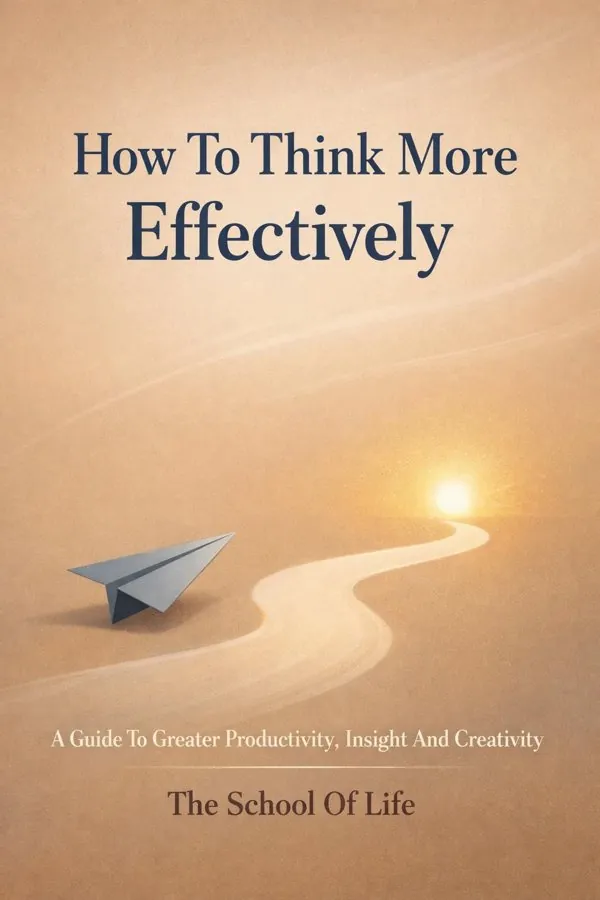
How To Think More Effectively: A Guide To Greater Productivity, Insight And Creativity
What if most of your stress, fear, and dissatisfaction came not from what is happening in your life, but from your inability to stay rooted in the present moment? That is the life-changing promise at the center of *The Power of Now*. In this widely read self-help classic, Eckhart Tolle argues that peace, clarity, and emotional freedom become possible when we stop identifying so completely with the restless voice in our head and begin inhabiting the present more fully. Rather than offering productivity tricks or surface-level positivity, the book addresses a deeper problem: the way compulsive thinking pulls us into regret about the past and anxiety about the future.
What makes this book matter is its simplicity. Tolle’s message is direct but profound: the present moment is not just a slice of time; it is the only place where life actually happens. By learning to observe thoughts instead of being ruled by them, readers can reduce suffering, improve relationships, and experience a more grounded sense of self. Tolle is best known for his spiritual teachings on presence and inner transformation, and *The Power of Now* remains his signature work for readers seeking calm, awareness, and practical spiritual insight.
Who Should Read The Power of Now?
This book is perfect for anyone interested in self-help and looking to gain actionable insights in a short read. Whether you're a student, professional, or lifelong learner, the key ideas from The Power of Now by Eckhart Tolle will help you think differently.
- ✓Readers who enjoy self-help and want practical takeaways
- ✓Professionals looking to apply new ideas to their work and life
- ✓Anyone who wants the core insights of The Power of Now in just 10 minutes
Want the full summary?
Get instant access to this book summary and 100K+ more with Fizz Moment.
Get Free SummaryAvailable on App Store • Free to download
Key Chapters
At the heart of *The Power of Now* is a radical shift in how we relate to thinking. Tolle does not say thoughts are bad; he says our suffering begins when we become unconsciously identified with them. Most people assume the nonstop voice in their head is who they are. They replay conversations, anticipate disasters, judge themselves, and mentally rehearse the future without noticing that this constant stream of thought is draining their energy. Tolle invites readers to see that there is a difference between having thoughts and being possessed by them.
A simple practical step is to start listening to your mind as if you were listening to another person. Notice repetitive worries, complaints, or labels. For example, if you catch yourself thinking, “I always mess things up,” don’t argue with the thought immediately. First, observe it. That pause creates awareness, and awareness loosens the grip of the mind. Tolle’s core insight is that the observer of thought is deeper than thought itself.
This idea can be applied in everyday life. During a tense work email, a family disagreement, or a sleepless night, ask: “What is my mind saying right now?” The goal is not to force silence but to stop total identification. Once you see thoughts as mental events rather than absolute truth, you gain freedom, clarity, and the first taste of inner stillness.
In Tolle’s framework, true insight does not come from thinking harder and harder. It arises when the mind becomes quiet enough for deeper intelligence to emerge. Modern life teaches us to value analysis, speed, and constant mental effort, but *The Power of Now* suggests that wisdom often appears in moments of presence rather than mental struggle. When you stop filling every gap with internal noise, you create space for understanding.
This explains why answers often come during ordinary pauses: while walking, washing dishes, sitting in silence, or simply looking out a window. These are moments when the mind softens its grip. Tolle encourages readers to stop worshipping compulsive thought and to trust stillness as a source of perception. Insight, in this sense, is not a dramatic mystical event. It may be as simple as realizing you are creating unnecessary suffering by resisting a situation, or noticing that a recurring fear is just a familiar thought pattern.
A practical way to cultivate insight is to build short moments of presence into the day. Before opening your phone, take one conscious breath. Before responding in conflict, feel your body from within. After a problem arises, sit quietly before trying to solve it. These small pauses interrupt mental momentum. Tolle’s message is clear: when thought stops dominating, a more intelligent and peaceful awareness can guide your life.
Tolle sees anxiety and fear as powerful consequences of living psychologically in the future. When the mind continually imagines what might go wrong, it creates a state of tension that the body experiences as real. Even when nothing dangerous is happening in the present, the nervous system reacts to mental projections. *The Power of Now* teaches that fear often survives because we rarely question the time-based thinking that feeds it.
One of Tolle’s most practical ideas is to distinguish between practical caution and psychological fear. If you need to prepare for a meeting, pay a bill, or address a health concern, that is a real-life action. But if your mind keeps spinning stories like “What if I fail?” or “What if everything falls apart?” long after action is possible, you are no longer dealing with reality but with mental suffering. The antidote is to return attention to the present moment.
A useful exercise is to ask, “What problem do I have right now, in this moment?” Often, the answer is none. You may have challenges, but in the immediate present you are breathing, standing, walking, or sitting safely. Grounding attention in the body helps too: feel your feet on the floor, notice your breathing, relax your jaw and shoulders. Tolle does not promise a fear-free life, but he shows that anxiety weakens when we stop feeding imagined futures with constant mental energy.
Although *The Power of Now* is spiritual in tone, it is also deeply practical because presence must be practiced until it becomes a habit. Tolle emphasizes that most people are conditioned to drift into thought automatically. That means peace will not come from one inspiring realization alone; it grows through repeated returns to awareness. Over time, these returns create new mental habits rooted in observation rather than reactivity.
One helpful habit is conscious breathing. Tolle often points readers back to the breath because it anchors attention in the now. Taking even three slow breaths before entering a stressful conversation can interrupt old emotional patterns. Another habit is sensing the “inner body,” or noticing aliveness within your hands, chest, or legs. This shifts awareness away from obsessive thinking and into direct experience. Even routine actions, like drinking tea, waiting in line, or walking to your car, can become reminders to be present.
The key is consistency, not perfection. You will forget, get lost in thought, and react unconsciously. Tolle’s approach is not self-criticism but gentle noticing. Each moment you remember to return is a success. Over weeks and months, the mind becomes less noisy, emotional reactions lose intensity, and your baseline state grows calmer. Presence stops being a rare experience and becomes a way of living.
Tolle’s teaching suggests that solitude is not merely a break from other people; it is a chance to reconnect with the dimension of stillness that is usually drowned out by noise, busyness, and mental chatter. In a world addicted to stimulation, silence can feel uncomfortable at first. That discomfort is revealing. It shows how dependent we have become on distraction to avoid facing our inner state. *The Power of Now* reframes solitude as a healing space where awareness can deepen.
Reflection in Tolle’s sense is different from overthinking. It is not endlessly analyzing your life story. It is noticing what is happening within you without getting trapped in commentary. For example, sitting quietly for ten minutes and observing irritation, sadness, or restlessness without labeling it good or bad creates an inner spaciousness. This simple form of reflection allows emotions to move rather than harden into identity.
Practical solitude can be very ordinary: a morning without your phone, a walk without headphones, or a few quiet minutes before bed. During that time, notice sounds, sensations, and breathing. If thoughts arise, let them pass without chasing them. Tolle’s deeper point is that solitude is valuable because it reveals that your worth and peace do not depend on constant input. When you can be alone without being overwhelmed by your mind, you begin to discover inner stability.
Although Tolle is known for emphasizing inner presence, his ideas have powerful implications for how we relate to other people. Much conflict, he suggests, comes from egoic identification: the need to be right, defend an image, control outcomes, or react from old pain. When two people are lost in unconscious thinking, conversation quickly becomes a collision of mental positions. Presence changes that dynamic by creating space for real listening.
To think well with others, Tolle would encourage less mental preparation and more alert attention. Instead of planning your rebuttal while someone speaks, notice the impulse to interrupt, judge, or defend. Then return to listening. In a disagreement with a partner, colleague, or friend, this can be transformative. You begin responding to what is actually being said rather than to your own inner story about it.
A practical technique is to pause before speaking, especially in emotionally charged moments. Feel one breath, notice your body, and then respond. This tiny gap can prevent escalation. Presence also helps you sense the emotional energy underneath words, making communication more compassionate. Tolle’s broader lesson is that relationships improve not only when we learn better communication skills, but when we bring less unconsciousness into the room. Clearer thinking with others begins with inner stillness.
At first glance, Tolle may not seem interested in organizing thoughts because he emphasizes going beyond thought. But his message actually helps readers bring much more order to the mind. When you are no longer fused with every passing idea, mental clutter becomes easier to recognize. Thoughts can then be used as practical tools instead of becoming a constant, chaotic environment.
Tolle’s distinction is simple: use thought when needed, and let it rest when it is not. This alone is a form of mental organization. For example, if you need to plan a project, write a budget, or solve a work problem, engage thought directly and intentionally. But once the task is done, notice whether the mind keeps replaying it compulsively. That extra mental noise is not useful organization; it is identification.
One practical application is to externalize necessary thinking. Make a list, schedule the task, and then return to the present. If a worry keeps repeating, ask whether it requires action, acceptance, or release. This question helps sort useful thoughts from repetitive ones. Another helpful practice is single-tasking. Focus on one thing fully instead of scattering attention. Tolle’s teaching creates mental order by reducing unnecessary thought and strengthening conscious attention. The result is a clearer mind that can think effectively without being overwhelmed.
Tolle presents creativity as something that flows most naturally when the mind is spacious rather than crowded. Many people assume creativity comes from intense effort alone, but *The Power of Now* points toward a different truth: original ideas often emerge when there is inner stillness. When you are trapped in repetitive thought, you recycle the known. When you become present, you make room for something fresh.
This applies to artists, entrepreneurs, writers, teachers, and anyone solving everyday problems. Consider someone staring at a blank page and becoming increasingly frustrated. The harder they push from anxiety, the tighter the mind becomes. Tolle would suggest stepping away, breathing, and reconnecting with the present moment. From that calmer state, a new phrase, angle, or solution often appears naturally.
A practical creativity ritual inspired by Tolle might include a few minutes of silence before beginning work, turning off notifications, and noticing the body whenever you feel mentally stuck. Instead of panicking, pause. Presence interrupts the fear that blocks flow. Tolle’s deeper insight is that creativity is not just personal effort; it is a collaboration with stillness. The less noise from the egoic mind, the easier it becomes to access intuition, originality, and a sense of effortless creation.
One of the most useful takeaways from *The Power of Now* is that productive thinking is not the same as constant thinking. Many people equate busyness in the mind with effectiveness, but Tolle argues the opposite: compulsive thought often reduces clarity, drains energy, and leads to poor decisions. Truly productive thinking is focused, intentional, and grounded in the present.
This matters in work, study, and decision-making. If you sit down to complete an important task while your mind keeps jumping to unrelated worries, imagined conversations, or self-criticism, your thinking becomes fragmented. Tolle’s solution is to bring full attention to the task at hand. He often points out that the quality of consciousness you bring to an action matters as much as the action itself. Writing one email with full attention is often more effective than rushing through ten in a distracted state.
A practical method is to define the immediate next step and give it your complete presence. If you are overwhelmed by a large project, don’t mentally carry the whole future burden. Just do the next clear action. When the mind wanders into pressure or fantasy, return to now. This approach reduces procrastination because it removes the mental drama around work. Productivity improves not through more strain, but through more presence.
Tolle’s work strongly connects thought and emotion. He teaches that many thoughts are not neutral observations but expressions of deeper emotional patterns. If you feel wounded, ashamed, or threatened, your mind will often generate stories that reinforce those feelings. This is why intellectual insight alone is not enough. To think clearly, you must also become aware of the emotional energy shaping your thoughts.
One of Tolle’s most known ideas is the “pain-body,” a term he uses for accumulated emotional pain that can be triggered and temporarily take over your reactions. When activated, it fuels negative thinking, conflict, and self-sabotage. For example, a small criticism from a coworker may trigger a disproportionate inner storm, not because of the comment alone but because old emotional pain has been stirred. Awareness is the beginning of freedom.
A practical response is to notice emotional activation in the body before it becomes a mental story. Is your chest tight? Is your stomach tense? Are you suddenly defensive? Stay with the sensation for a moment instead of instantly reacting. This creates emotional intelligence in real time. Tolle’s message is not to suppress feelings but to meet them consciously. When emotions are felt without being dramatized by the mind, thinking becomes wiser, kinder, and far less distorted.
While Tolle does not use the modern psychological language of cognitive biases as often as some self-help authors, his teachings offer a powerful way to weaken them. Bias thrives when we are unconscious—when we automatically believe our interpretations, defend our identity, and react from conditioned patterns. Presence interrupts that automaticity. It gives us a gap between perception and reaction, and in that gap, clearer seeing becomes possible.
For example, confirmation bias causes us to favor information that supports what we already believe. Ego strengthens that tendency because being wrong can feel threatening to our self-image. Tolle’s invitation to loosen identification with the ego makes it easier to admit, “I may not be seeing this clearly.” Similarly, negativity bias can keep the mind scanning for problems and danger, even in safe situations. Awareness helps us notice that habit without fully believing it.
A practical way to reduce mental distortion is to question strong reactions. When you feel certain, offended, or threatened, pause and ask: “Is this fact, or my interpretation?” “What am I assuming?” “What part of my identity wants this to be true?” These questions create room for presence. Tolle’s larger lesson is that a quieter mind sees more accurately. The less we are ruled by egoic patterns, the less our thinking is distorted by them.
A major theme in *The Power of Now* is that ego builds identity out of mental positions: opinions, beliefs, roles, and stories. Once we identify with these positions, disagreement feels like a personal attack. Intellectual humility becomes difficult because being right seems tied to being safe or valuable. Tolle challenges this pattern by showing that who you are is deeper than what you think.
This insight creates a more relaxed and open form of intelligence. If your worth does not depend on winning every argument, you can listen more honestly. You can update your views without humiliation. You can say, “I don’t know,” which is often the beginning of wisdom. Tolle does not ask readers to stop thinking or to abandon discernment. He asks them to stop using thought as the foundation of identity.
In practical terms, intellectual humility can be practiced by noticing defensiveness. During a conversation, if you feel the urge to prove yourself immediately, pause. Ask whether you are seeking truth or protecting ego. Another useful practice is to become comfortable with silence instead of filling every gap with opinion. Tolle’s approach makes humility less about being modest and more about being free. The less attached you are to mental labels, the more honestly and clearly you can engage with reality.
The final challenge is not having one moment of presence but sustaining a different relationship with the mind over time. Tolle is realistic: unconscious thinking is deeply conditioned, and the pull of distraction, stress, and ego does not vanish overnight. What matters is building a stable practice of returning to the present until awareness becomes stronger than habit.
Sustaining effective thinking begins with remembering that presence is available in ordinary moments, not only during meditation or retreat. You can practice while washing your hands, opening a door, speaking to a coworker, or waiting at a red light. These small returns matter because they train attention in the middle of real life. Tolle emphasizes that transformation happens now, not later. The future cannot make you present; only this moment can.
To maintain progress, it helps to create anchors: conscious breathing, body awareness, short pauses before meetings, or a few minutes of daily stillness. It also helps to notice relapse without discouragement. If you spend a day lost in stress or overthinking, the response is simply to begin again. Tolle’s enduring message is that effective thinking is not achieved by controlling the mind harshly, but by repeatedly resting in the awareness behind it. From there, thought becomes more useful, quieter, and aligned with peace.
All Chapters in The Power of Now
About the Author
Eckhart Tolle is a spiritual teacher and author best known for *The Power of Now*, a landmark book on presence, consciousness, and inner transformation. His work focuses on helping readers free themselves from compulsive thinking and discover peace through present-moment awareness. Tolle’s teachings blend accessible language with spiritual insight, making complex ideas about ego, suffering, and mindfulness practical for everyday life. He is also known for *A New Earth*, another influential book on consciousness and personal awakening. Through his writing and talks, Tolle has become one of the most widely recognized voices in modern spiritual self-help.
Get This Summary in Your Preferred Format
Read or listen to the The Power of Now summary by Eckhart Tolle anytime, anywhere. FizzRead offers multiple formats so you can learn on your terms — all free.
Available formats: App · Audio · PDF · EPUB — All included free with FizzRead
Download The Power of Now PDF and EPUB Summary
Key Quotes from The Power of Now
“At the heart of *The Power of Now* is a radical shift in how we relate to thinking.”
“In Tolle’s framework, true insight does not come from thinking harder and harder.”
“Tolle sees anxiety and fear as powerful consequences of living psychologically in the future.”
“Although *The Power of Now* is spiritual in tone, it is also deeply practical because presence must be practiced until it becomes a habit.”
“In a world addicted to stimulation, silence can feel uncomfortable at first.”
Frequently Asked Questions about The Power of Now
The Power of Now by Eckhart Tolle is a self-help book that explores key ideas across 13 chapters. What if most of your stress, fear, and dissatisfaction came not from what is happening in your life, but from your inability to stay rooted in the present moment? That is the life-changing promise at the center of *The Power of Now*. In this widely read self-help classic, Eckhart Tolle argues that peace, clarity, and emotional freedom become possible when we stop identifying so completely with the restless voice in our head and begin inhabiting the present more fully. Rather than offering productivity tricks or surface-level positivity, the book addresses a deeper problem: the way compulsive thinking pulls us into regret about the past and anxiety about the future. What makes this book matter is its simplicity. Tolle’s message is direct but profound: the present moment is not just a slice of time; it is the only place where life actually happens. By learning to observe thoughts instead of being ruled by them, readers can reduce suffering, improve relationships, and experience a more grounded sense of self. Tolle is best known for his spiritual teachings on presence and inner transformation, and *The Power of Now* remains his signature work for readers seeking calm, awareness, and practical spiritual insight.
Compare The Power of Now


More by Eckhart Tolle

You Might Also Like
Featured In
Browse by Category
Ready to read The Power of Now?
Get the full summary and 100K+ more books with Fizz Moment.