
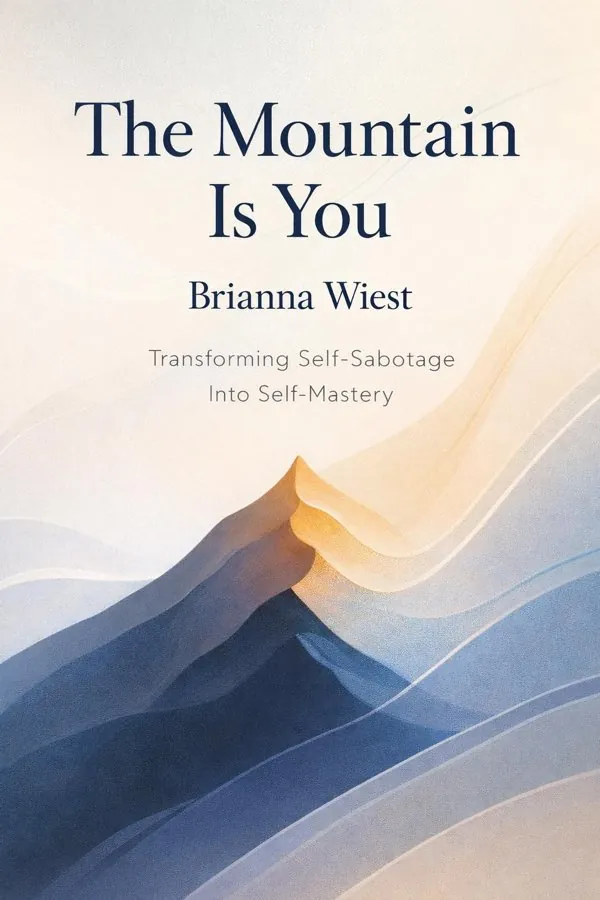
The Mountain Is You: Transforming Self-Sabotage Into Self-Mastery: Summary & Key Insights
 10 min8 chaptersAudio available
Key Takeaways from The Mountain Is You: Transforming Self-Sabotage Into Self-Mastery
The behaviors that hold you back are often the very behaviors once designed to keep you safe.
What provokes you often points directly to what still needs your attention.
You cannot build a peaceful life with a constantly activated nervous system.
People do not usually repeat painful patterns because they enjoy suffering.
You will struggle to create a new life if you are still loyal to an old identity.
What Is The Mountain Is You: Transforming Self-Sabotage Into Self-Mastery About?
The Mountain Is You: Transforming Self-Sabotage Into Self-Mastery by Brianna Wiest is a self_awareness book. The Mountain Is You by Brianna Wiest is a thoughtful and emotionally intelligent guide to one of the most frustrating human patterns: self-sabotage. Instead of treating self-defeating behavior as laziness, weakness, or lack of discipline, Wiest argues that it is often a sign of unresolved emotional needs, conflicting beliefs, and survival patterns we learned long ago. The “mountain” in the title is not the world outside us, but the internal terrain we must learn to understand, climb, and ultimately master. What makes this book resonate is its blend of psychological insight, compassionate self-inquiry, and practical guidance. Wiest explores why people procrastinate, repeat unhealthy relationship dynamics, avoid opportunities, or undermine their own happiness even when they deeply want change. Her answer is both challenging and hopeful: transformation does not begin with force, but with awareness, emotional regulation, and a willingness to become who we truly are. For readers navigating anxiety, burnout, self-doubt, or stalled personal growth, this book offers a powerful framework for change. It matters because it reframes inner struggle not as proof of failure, but as an invitation to heal and evolve.
This FizzRead summary covers all 8 key chapters of The Mountain Is You: Transforming Self-Sabotage Into Self-Mastery in approximately 10 minutes, distilling the most important ideas, arguments, and takeaways from Brianna Wiest's work. Also available as an audio summary and Key Quotes Podcast.
The Mountain Is You: Transforming Self-Sabotage Into Self-Mastery
The Mountain Is You by Brianna Wiest is a thoughtful and emotionally intelligent guide to one of the most frustrating human patterns: self-sabotage. Instead of treating self-defeating behavior as laziness, weakness, or lack of discipline, Wiest argues that it is often a sign of unresolved emotional needs, conflicting beliefs, and survival patterns we learned long ago. The “mountain” in the title is not the world outside us, but the internal terrain we must learn to understand, climb, and ultimately master.
What makes this book resonate is its blend of psychological insight, compassionate self-inquiry, and practical guidance. Wiest explores why people procrastinate, repeat unhealthy relationship dynamics, avoid opportunities, or undermine their own happiness even when they deeply want change. Her answer is both challenging and hopeful: transformation does not begin with force, but with awareness, emotional regulation, and a willingness to become who we truly are.
For readers navigating anxiety, burnout, self-doubt, or stalled personal growth, this book offers a powerful framework for change. It matters because it reframes inner struggle not as proof of failure, but as an invitation to heal and evolve.
Who Should Read The Mountain Is You: Transforming Self-Sabotage Into Self-Mastery?
This book is perfect for anyone interested in self_awareness and looking to gain actionable insights in a short read. Whether you're a student, professional, or lifelong learner, the key ideas from The Mountain Is You: Transforming Self-Sabotage Into Self-Mastery by Brianna Wiest will help you think differently.
- ✓Readers who enjoy self_awareness and want practical takeaways
- ✓Professionals looking to apply new ideas to their work and life
- ✓Anyone who wants the core insights of The Mountain Is You: Transforming Self-Sabotage Into Self-Mastery in just 10 minutes
Want the full summary?
Get instant access to this book summary and 100K+ more with Fizz Moment.
Get Free SummaryAvailable on App Store • Free to download
Key Chapters
The behaviors that hold you back are often the very behaviors once designed to keep you safe. That is one of Brianna Wiest’s most important insights. Self-sabotage rarely appears out of nowhere. It usually develops as a coping mechanism, a learned response to fear, uncertainty, rejection, or emotional pain. What looks irrational on the surface often makes sense when viewed through the lens of your past. If success once led to criticism, visibility felt dangerous, or vulnerability ended in hurt, your mind may still associate growth with risk.
Wiest invites readers to stop asking, “What is wrong with me?” and begin asking, “What is this behavior trying to protect me from?” That shift changes everything. Procrastination may be protecting you from the fear of failure. Perfectionism may be protecting you from judgment. Emotional withdrawal may be protecting you from disappointment. These patterns become problems when the protection they offer is outdated, limiting, and no longer aligned with the life you want.
Understanding this helps reduce shame. Shame keeps self-sabotage alive because it drives more avoidance, more hiding, and more internal conflict. Compassion creates the conditions for real change. Instead of attacking yourself, you begin investigating yourself. You look for the underlying need beneath the destructive habit.
In practice, this means tracking your recurring patterns. Notice when you pull away, delay, overthink, or create chaos. Then ask what emotion shows up first. Is it fear, helplessness, exposure, or unworthiness? Once you identify the emotional trigger, you can work on the root instead of just the symptom.
Actionable takeaway: The next time you catch yourself self-sabotaging, pause and write down one sentence: “This behavior is trying to protect me from…” Let that answer guide your healing.
What provokes you often points directly to what still needs your attention. Wiest emphasizes that emotional triggers are not random inconveniences; they are signals. When a situation creates an outsized reaction, it usually means an old wound has been activated. The external event may be small, but the internal memory it awakens is much larger. This is why people sometimes react intensely to delayed texts, criticism, being ignored, uncertainty, or feeling excluded. The present moment touches the past.
The book encourages readers to treat triggers as information rather than evidence that they are broken. A trigger can reveal where you still feel unsafe, unseen, or unworthy. It can expose the beliefs you formed early in life, such as “I have to earn love,” “If I fail, I lose value,” or “People always leave.” Until those beliefs are brought into awareness, they silently shape decisions, relationships, and self-image.
Wiest does not suggest indulging every emotional reaction, but she does argue for listening to it. The goal is not to become ruled by emotions, nor to suppress them. It is to understand them well enough to respond consciously. For example, if feedback at work sends you into panic, the issue may not just be the feedback itself. It may connect to a deeper fear of not being enough. Once identified, that wound can be worked with through reflection, therapy, journaling, and new experiences that challenge the old story.
A practical application is to create a “trigger log.” After a strong reaction, write what happened, what you felt, what it reminded you of, and what belief it seems to reinforce. Over time, patterns emerge. Those patterns are clues to the real work.
Actionable takeaway: Instead of asking why you are so reactive, ask what old belief a current trigger is bringing to the surface.
You cannot build a peaceful life with a constantly activated nervous system. A central theme in The Mountain Is You is that sustainable change is not created through self-punishment, but through emotional regulation. Many people try to transform themselves by using pressure, criticism, extreme discipline, or panic. They wait until discomfort becomes unbearable, then attempt dramatic change. But when your body is in fight, flight, freeze, or fawn mode, clarity becomes harder, consistency declines, and self-sabotage increases.
Wiest argues that true self-mastery begins with creating internal safety. This means learning how to sit with emotions without being consumed by them. It means understanding that your body stores experiences, and that your reactions are not only mental but physiological. If you are chronically overwhelmed, exhausted, or anxious, your brain may resist even positive change because it reads uncertainty as danger.
This perspective is deeply practical. Instead of asking, “How do I become a better version of myself overnight?” Wiest suggests asking, “How do I become stable enough to support the life I want?” Emotional regulation can include rest, breathwork, therapy, mindfulness, routines, movement, reduced overstimulation, and honest emotional expression. It also includes noticing when you are interpreting a challenge as a threat.
For example, if you want to start a business, return to school, or leave an unhealthy relationship, motivation alone may not carry you through. You need the ability to soothe fear, tolerate discomfort, and return to center when uncertainty appears. Mastery is not the absence of emotion. It is the ability to remain grounded within it.
Actionable takeaway: Build one daily regulation habit, such as a 10-minute walk without your phone, deep breathing before work, or journaling before bed, and treat it as essential groundwork for growth.
People do not usually repeat painful patterns because they enjoy suffering. They repeat them because some unrecognized need is being met. Wiest highlights a difficult but liberating truth: even harmful behaviors can offer emotional payoffs. They may create familiarity, predictability, distraction, control, numbness, or temporary relief. Until you understand what a pattern is giving you, it is hard to let it go.
This idea explains why someone may remain in unstable relationships, constantly overwork, avoid success, spend impulsively, or recreate conflict. The behavior may be serving a hidden purpose. Chaos can feel familiar if calm once felt unsafe. Overworking can feel validating if worth was tied to achievement. Avoiding success can protect you from visibility, envy, or increased expectations. These unconscious needs are powerful because they operate beneath intention.
Wiest urges readers to identify the function of the behavior, not just the behavior itself. If you binge distractions at night, what are you escaping? If you sabotage healthy relationships, what kind of closeness feels threatening? If you always quit when progress begins, what future are you afraid of inhabiting? Once the hidden need is exposed, you can begin meeting it in healthier ways.
For example, if perfectionism gives you a sense of control, you may need structure, reassurance, and self-trust. If emotional withdrawal protects your independence, you may need boundaries rather than distance. If overspending gives you relief, you may need comfort, expression, or regulation that money cannot sustainably provide.
The goal is not merely to eliminate a bad habit. It is to replace its emotional function with something less destructive and more honest.
Actionable takeaway: Pick one recurring self-defeating habit and ask, “What need does this fulfill for me?” Then brainstorm two healthier ways to meet that same need.
You will struggle to create a new life if you are still loyal to an old identity. One of Wiest’s most powerful contributions is her focus on self-concept. Many people say they want change, but their internal identity remains anchored to familiar stories: I am the anxious one. I am always behind. I am bad at relationships. I never finish anything. These beliefs may feel factual because they have been repeated for years, but they are often interpretations reinforced by habit, not permanent truths.
Self-sabotage thrives when your actions begin to outgrow your identity. If you start becoming healthier, more visible, more disciplined, or more fulfilled, an older self-concept may interpret that change as a betrayal of who you are. You may unconsciously return to old patterns simply because they feel more familiar than your potential.
Wiest challenges readers to examine the identity they are protecting. Sometimes people cling to pain because it has become central to how they understand themselves. Letting go of struggle can feel disorienting. Who are you without the crisis, the dysfunction, the chasing, the proving? Self-mastery requires making room for a new answer.
A practical way to do this is to pay attention to the language you use about yourself. Statements repeated often become instructions. Instead of saying, “I am terrible with money,” “I always ruin good things,” or “I am just not confident,” begin using language that reflects growth and openness: “I am learning consistency,” “I am becoming more secure,” “I am practicing trust.” This is not denial. It is intentional identity reconstruction.
Actionable takeaway: Write down three limiting identity statements you repeat, and rewrite each one into a growth-based identity you are willing to practice daily.
Not every uncomfortable feeling is a warning sign. Sometimes it is evidence that you are expanding beyond the limits of your old life. Wiest distinguishes between harmful pain and transformative discomfort. This is crucial because many people abandon growth the moment it feels unfamiliar. They assume that if something brings anxiety, uncertainty, or vulnerability, it must be wrong. But often those feelings simply reflect the challenge of becoming someone new.
Climbing a mountain is difficult not because you are failing, but because ascension requires effort. In the same way, building healthy habits, setting boundaries, speaking honestly, ending misaligned relationships, or pursuing meaningful work can feel deeply uncomfortable at first. You are not just changing behavior. You are changing your emotional baseline, your relationships, and your internal world.
Wiest encourages readers not to confuse the loss of familiarity with the loss of safety. If chaos has been normal, calm can feel dull or suspicious. If emotional unavailability has been common, a healthy relationship can feel unsettling. If urgency has fueled productivity, steady discipline may initially seem uninspiring. Growth often asks you to tolerate the awkwardness of not yet feeling at home in your next chapter.
A helpful application is to ask whether your discomfort is coming from misalignment or expansion. Misalignment drains, diminishes, and disconnects you from yourself. Expansion stretches you, but it also moves you toward clarity, dignity, and possibility. Learning to tell the difference is a major part of self-mastery.
Actionable takeaway: When you feel discomfort around a new decision, ask, “Is this hurting me, or is this stretching me?” Let the answer shape your next step.
Life changes less through grand declarations than through repeated, ordinary decisions. Wiest makes the case that self-mastery is not a sudden breakthrough but a daily practice. People often wait for a perfect plan, a surge of motivation, or a dramatic turning point. But the life they want is usually built through small actions repeated long enough to become evidence of a new way of being.
This idea is especially important for readers who feel overwhelmed by their own patterns. If self-sabotage has been present for years, trying to fix everything at once can trigger more avoidance. Wiest’s approach is more sustainable: create momentum through manageable, consistent choices. Answer the email. Take the walk. Go to sleep on time. Tell the truth. Spend within your plan. Keep the promise you made to yourself today.
These actions may seem minor, but they are psychologically powerful because they teach self-trust. Every time you follow through, you reinforce the belief that you are someone who can care for your future. Over time, discipline becomes less about force and more about identity. You are no longer trying to become a stable person; you are practicing stability.
This also means accepting that progress is often uneven. Some days will be productive, some emotional, some messy. A setback does not erase growth. The key is returning quickly instead of using imperfection as an excuse to abandon the process. Transformation belongs to those who can begin again without dramatizing every stumble.
Actionable takeaway: Choose one tiny habit that supports the person you want to become, and commit to it daily for the next 30 days, even when the effort feels unimpressive.
Healing is compassionate, but it is not passive. Wiest ultimately moves readers toward a mature form of self-responsibility. She acknowledges that many painful patterns are rooted in trauma, conditioning, or circumstances we did not choose. But she also insists that if we want a different life, we must become active participants in our own transformation. Awareness without responsibility becomes insight with no outcome.
Self-responsibility in this context does not mean blaming yourself for everything that happened. It means recognizing that while you may not control the origin of a wound, you are responsible for how you tend to it now. This includes your habits, your boundaries, your healing practices, and the stories you continue repeating. It means accepting that no one else can do your internal work for you.
This perspective is empowering because it returns agency to the reader. You are not doomed to reenact the same cycles forever. You can interrupt patterns, choose different responses, and create a life that reflects your values rather than your fears. But to do so, you have to become honest. Where are you waiting to be rescued? Where are you calling avoidance intuition? Where are you using your pain to justify stagnation?
In practical terms, self-responsibility can look like seeking support, ending enabling relationships, creating healthier routines, apologizing when needed, or deciding that your growth is no longer optional. It is a quiet but powerful shift from “Why is this happening to me?” to “What is mine to do next?”
Actionable takeaway: Identify one area where you have been waiting for change instead of creating it, and define a single concrete action you can take this week.
All Chapters in The Mountain Is You: Transforming Self-Sabotage Into Self-Mastery
About the Author
Brianna Wiest is a contemporary author and essayist best known for her work on emotional intelligence, self-awareness, and personal transformation. Her writing has reached a wide global audience through bestselling books and widely shared essays that explore how people heal, grow, and redefine themselves. She is the author of titles such as 101 Essays That Will Change The Way You Think, The Pivot Year, and The Mountain Is You. Wiest’s style combines psychological insight with reflective, emotionally resonant language, making her work especially appealing to readers navigating change, anxiety, identity shifts, or deeper inner work. Her central themes often include self-sabotage, resilience, relationships, and the process of becoming more conscious and intentional. She is widely recognized for helping readers translate inner struggle into meaningful personal growth.
Get This Summary in Your Preferred Format
Read or listen to the The Mountain Is You: Transforming Self-Sabotage Into Self-Mastery summary by Brianna Wiest anytime, anywhere. FizzRead offers multiple formats so you can learn on your terms — all free.
Available formats: App · Audio · PDF · EPUB — All included free with FizzRead
Download The Mountain Is You: Transforming Self-Sabotage Into Self-Mastery PDF and EPUB Summary
Key Quotes from The Mountain Is You: Transforming Self-Sabotage Into Self-Mastery
“The behaviors that hold you back are often the very behaviors once designed to keep you safe.”
“What provokes you often points directly to what still needs your attention.”
“You cannot build a peaceful life with a constantly activated nervous system.”
“People do not usually repeat painful patterns because they enjoy suffering.”
“You will struggle to create a new life if you are still loyal to an old identity.”
Frequently Asked Questions about The Mountain Is You: Transforming Self-Sabotage Into Self-Mastery
The Mountain Is You: Transforming Self-Sabotage Into Self-Mastery by Brianna Wiest is a self_awareness book that explores key ideas across 8 chapters. The Mountain Is You by Brianna Wiest is a thoughtful and emotionally intelligent guide to one of the most frustrating human patterns: self-sabotage. Instead of treating self-defeating behavior as laziness, weakness, or lack of discipline, Wiest argues that it is often a sign of unresolved emotional needs, conflicting beliefs, and survival patterns we learned long ago. The “mountain” in the title is not the world outside us, but the internal terrain we must learn to understand, climb, and ultimately master. What makes this book resonate is its blend of psychological insight, compassionate self-inquiry, and practical guidance. Wiest explores why people procrastinate, repeat unhealthy relationship dynamics, avoid opportunities, or undermine their own happiness even when they deeply want change. Her answer is both challenging and hopeful: transformation does not begin with force, but with awareness, emotional regulation, and a willingness to become who we truly are. For readers navigating anxiety, burnout, self-doubt, or stalled personal growth, this book offers a powerful framework for change. It matters because it reframes inner struggle not as proof of failure, but as an invitation to heal and evolve.
More by Brianna Wiest
You Might Also Like
Rising Strong
Brené Brown
10 min
You Do You
Sarah Knight
10 min
Master Your Emotions: A Practical Guide to Overcome Negativity and Better Manage Your Feelings
Thibaut Meurisse
10 min
101 Essays That Will Change The Way You Think
Brianna Wiest
10 min
A Radical Awakening: Turn Pain into Power, Embrace Your Truth, Live Free
Shefali Tsabary
10 min
Acts of Faith: Daily Meditations for People of Color
Iyanla Vanzant
10 minBrowse by Category
Ready to read The Mountain Is You: Transforming Self-Sabotage Into Self-Mastery?
Get the full summary and 100K+ more books with Fizz Moment.