

The Four Agreements: Summary & Key Insights
 10 min6 chaptersAudio available
Key Takeaways from The Four Agreements
Ruiz begins by explaining that human beings are “domesticated” in much the same way animals are trained: through reward, punishment, approval, and rejection.
Ruiz describes the word as a creative force.
His argument is simple but liberating.
Ruiz argues that assumptions quietly poison communication.
The fourth agreement turns the previous three into a lived practice.
What Is The Four Agreements About?
The Four Agreements by Don Miguel Ruiz is a self-help book published in 1997 spanning 6 pages. What if much of your stress, shame, conflict, and self-doubt came not from reality itself, but from invisible rules you learned long ago and never questioned? That is the life-changing premise at the heart of *The Four Agreements*. In this modern self-help classic, Don Miguel Ruiz draws on Toltec wisdom to show how people become trapped by limiting beliefs, harsh self-judgment, and fear-based habits—and how they can break free through four simple but demanding practices. The power of the book lies in its clarity: Ruiz does not offer a complicated philosophy or a rigid system, but a practical code for speaking, relating, thinking, and acting with greater awareness. His four agreements—be impeccable with your word, don’t take anything personally, don’t make assumptions, and always do your best—sound simple on the surface, yet they challenge the patterns that drive everyday suffering. Ruiz is best known as a Mexican author and spiritual teacher whose work centers on personal transformation through Toltec-inspired insight. For readers seeking emotional freedom, healthier relationships, and a calmer inner life, *The Four Agreements* remains one of the most accessible and transformative books in the personal growth space.
This FizzRead summary covers all 6 key chapters of The Four Agreements in approximately 10 minutes, distilling the most important ideas, arguments, and takeaways from Don Miguel Ruiz's work. Also available as an audio summary and Key Quotes Podcast.
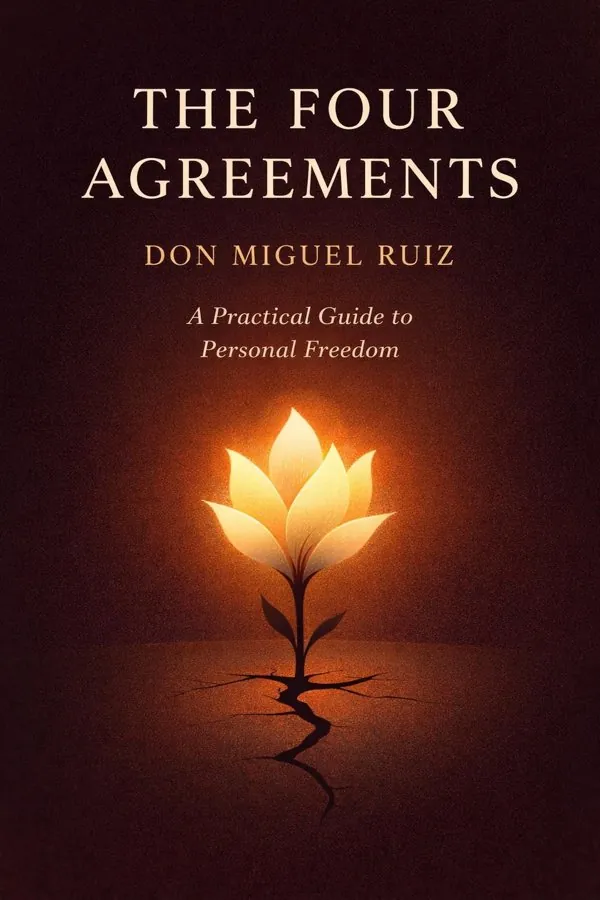
The Four Agreements: A Practical Guide to Personal Freedom
What if much of your stress, shame, conflict, and self-doubt came not from reality itself, but from invisible rules you learned long ago and never questioned? That is the life-changing premise at the heart of *The Four Agreements*. In this modern self-help classic, Don Miguel Ruiz draws on Toltec wisdom to show how people become trapped by limiting beliefs, harsh self-judgment, and fear-based habits—and how they can break free through four simple but demanding practices. The power of the book lies in its clarity: Ruiz does not offer a complicated philosophy or a rigid system, but a practical code for speaking, relating, thinking, and acting with greater awareness. His four agreements—be impeccable with your word, don’t take anything personally, don’t make assumptions, and always do your best—sound simple on the surface, yet they challenge the patterns that drive everyday suffering. Ruiz is best known as a Mexican author and spiritual teacher whose work centers on personal transformation through Toltec-inspired insight. For readers seeking emotional freedom, healthier relationships, and a calmer inner life, *The Four Agreements* remains one of the most accessible and transformative books in the personal growth space.
Who Should Read The Four Agreements?
This book is perfect for anyone interested in self-help and looking to gain actionable insights in a short read. Whether you're a student, professional, or lifelong learner, the key ideas from The Four Agreements by Don Miguel Ruiz will help you think differently.
- ✓Readers who enjoy self-help and want practical takeaways
- ✓Professionals looking to apply new ideas to their work and life
- ✓Anyone who wants the core insights of The Four Agreements in just 10 minutes
Want the full summary?
Get instant access to this book summary and 100K+ more with Fizz Moment.
Get Free SummaryAvailable on App Store • Free to download
Key Chapters
Ruiz begins by explaining that human beings are “domesticated” in much the same way animals are trained: through reward, punishment, approval, and rejection. As children, we quickly learn which behaviors earn love, praise, or belonging and which lead to criticism or shame. Over time, this external conditioning becomes internal. We no longer need parents, teachers, or society to punish us, because we develop an inner Judge that does the job automatically. This inner voice compares us to an invisible set of standards—Ruiz calls it the Book of Law—and tells us when we are failing. The result is a life shaped by guilt, fear, and the constant need to be “good enough.”
A practical example is how many adults still feel anxious when setting boundaries, asking for help, or making mistakes at work. The reaction often seems disproportionate because it is fueled by old agreements such as “I must please everyone” or “If I fail, I am unworthy.” Ruiz’s key insight is that these beliefs are not truths; they are learned agreements. Once you see that, change becomes possible. A useful exercise is to write down recurring self-critical thoughts and ask, “Who taught me this? Is it objectively true? Does it create peace or suffering?” That process helps expose the false rules you have been living by. The chapter sets up the entire book: before you can live freely, you must recognize that much of your inner world was inherited rather than consciously chosen.
Ruiz describes the word as a creative force. Language shapes identity, influences relationships, and directs attention. To be “impeccable” with your word means to use speech in a way that does not go against yourself or others. In the book, this means speaking with truth, integrity, and intention rather than using words for gossip, manipulation, self-attack, or casual cruelty. One of the most powerful takeaways is that words are not neutral. A sentence repeated often enough—“I’m lazy,” “You never listen,” “Nothing ever works out for me”—can become an emotional script that defines reality.
This agreement starts with self-talk. If you constantly narrate your life through criticism, you reinforce insecurity and fear. If you speak to yourself with honesty and compassion, you create room for growth. In everyday life, being impeccable might mean refusing to join workplace gossip, avoiding exaggeration in conflict, or replacing “I’m terrible at this” with “I’m learning this slowly.” It also means saying what you mean clearly instead of using silence, sarcasm, or blame. Ruiz’s broader point is that every word is a form of power. Used unconsciously, it creates suffering; used wisely, it creates trust, clarity, and love. Because the other agreements all depend on awareness and communication, this first one is the foundation. Change your language, and you begin to change the emotional atmosphere of your life.
This agreement is Ruiz’s antidote to one of the most common sources of emotional pain: the belief that other people’s words, moods, judgments, and behaviors are fundamentally about us. His argument is simple but liberating. What others say and do comes from their own beliefs, wounds, expectations, and state of mind. Even when their actions affect us, they are still acting from their own internal world. When you take things personally, you hand over your emotional stability to circumstances you cannot control.
Consider a familiar example: a manager gives blunt feedback, a friend forgets to reply, or a stranger makes a rude comment online. The immediate impulse is often to interpret the event as proof that something is wrong with you. Ruiz invites readers to interrupt that pattern. The feedback may reflect the manager’s stress, the friend’s distraction, or the stranger’s unhappiness more than your worth. Not taking things personally does not mean becoming passive, naive, or emotionally numb. It means refusing to absorb other people’s projections as your identity.
An actionable way to practice this is to pause before reacting and ask, “What story am I telling myself about this?” Then consider at least two alternative explanations that have nothing to do with your value. This creates emotional distance and reduces unnecessary suffering. Ruiz suggests that when you stop personalizing everything, criticism loses much of its sting and praise loses its power to control you. You become more grounded, less defensive, and far more free in relationships.
Ruiz argues that assumptions quietly poison communication. Instead of asking questions, clarifying intentions, or expressing needs, people often fill in the blanks with stories. We assume we know what others mean, what they feel, why they acted a certain way, or what they expect from us. Then we respond not to reality, but to our interpretation of reality. This is how avoidable conflict begins: one person forgets to call, another assumes they do not care; a partner is quiet, the other assumes anger; a colleague sends a short email, and it gets read as disrespect.
The danger of assumptions is that they feel true even when they are completely invented. Once the mind creates a narrative, emotions follow quickly—hurt, resentment, anxiety, jealousy. Ruiz’s advice is refreshingly practical: ask. If you are confused, seek clarity. If you need something, say it directly. If you are unsure what someone meant, check rather than guess. This agreement requires courage because honest communication can feel vulnerable, but it prevents far more pain than mind-reading ever solves.
A simple habit is to replace internal conclusions with clarifying language: “Can you help me understand what you meant?” “I realize I may be assuming—what’s actually going on?” “Here’s what I need.” This approach strengthens trust because it reduces hidden expectations. Ruiz’s larger message is that assumptions keep people trapped in illusion, while questions bring them back to truth. In both personal and professional life, clearer communication leads to fewer misunderstandings, less drama, and more peace.
The fourth agreement turns the previous three into a lived practice. Ruiz emphasizes that “your best” is not a fixed standard. It changes from day to day depending on your energy, health, emotional state, and circumstances. Your best on a well-rested, focused morning will not look the same as your best when you are grieving, exhausted, or overwhelmed. The wisdom here is that peace comes not from perfection, but from sincere effort. When you truly do your best in the moment, you reduce regret, self-judgment, and the tendency to punish yourself for being human.
This idea is especially useful for people trapped in all-or-nothing thinking. Many either overperform to earn worth or give up because they fear falling short. Ruiz offers a healthier middle path: commit fully, but without self-abuse. For example, if your best today is 30 minutes of focused work, an honest apology, a difficult conversation handled calmly, or simply not repeating an old destructive pattern, that still counts. The goal is consistency in awareness, not flawless execution.
A practical way to apply this agreement is to end each day with two questions: “Did I act as consciously as I could?” and “What would a slightly better best look like tomorrow?” This keeps growth compassionate rather than punishing. Ruiz also notes that when you do your best, the other agreements become easier. You may still slip into gossip, sensitivity, or assumptions at times, but sincere effort allows you to learn and reset quickly instead of drowning in guilt.
After introducing the four agreements, Ruiz turns to the deeper challenge: replacing old fear-based patterns with new ways of living. Insight alone is not enough. People often recognize destructive beliefs—“I need approval to matter,” “Conflict means rejection,” “I must be perfect to be loved”—yet continue acting from them because those agreements are emotionally ingrained. Breaking them requires repetition, awareness, and what Ruiz frames as a shift from fear to love. Love, in this context, means acceptance, presence, truthfulness, and a refusal to keep wounding yourself with old stories.
This process is less about sudden transformation and more about daily unlearning. For instance, if you notice that you automatically take criticism personally, the work is not to shame yourself for it. The work is to notice it sooner, breathe, question the old agreement, and choose a new response. If you tend to assume what others think, practice asking instead. If your inner voice is harsh, replace one self-attack each day with a truthful, kinder statement. Small repeated changes gradually weaken the old script.
Ruiz’s broader vision is freedom: freedom from emotional poison, from inherited beliefs, and from the constant need to control how others see you. Living with love and awareness does not remove pain from life, but it changes your relationship to it. You become more conscious, less reactive, and more capable of choosing peace. The destination is not perfection; it is personal sovereignty—the ability to live from your own deepest truth rather than from fear-conditioned habits.
All Chapters in The Four Agreements
About the Author
Don Miguel Ruiz is a Mexican author and spiritual teacher best known for bringing Toltec wisdom to modern readers through accessible, practical teachings on awareness and personal transformation. His work focuses on how beliefs, language, and perception shape human suffering and freedom. Ruiz became internationally known through *The Four Agreements*, a widely read self-help classic that has introduced millions of readers to his core ideas about truth, love, and inner freedom. His teaching style blends ancient spiritual themes with clear, everyday guidance, making his books especially appealing to readers looking for simple principles with lasting emotional and spiritual impact.
Get This Summary in Your Preferred Format
Read or listen to the The Four Agreements summary by Don Miguel Ruiz anytime, anywhere. FizzRead offers multiple formats so you can learn on your terms — all free.
Available formats: App · Audio · PDF · EPUB — All included free with FizzRead
Download The Four Agreements PDF and EPUB Summary
Key Quotes from The Four Agreements
“Ruiz begins by explaining that human beings are “domesticated” in much the same way animals are trained: through reward, punishment, approval, and rejection.”
“Ruiz describes the word as a creative force.”
“This agreement is Ruiz’s antidote to one of the most common sources of emotional pain: the belief that other people’s words, moods, judgments, and behaviors are fundamentally about us.”
“Ruiz argues that assumptions quietly poison communication.”
“The fourth agreement turns the previous three into a lived practice.”
Frequently Asked Questions about The Four Agreements
The Four Agreements by Don Miguel Ruiz is a self-help book that explores key ideas across 6 chapters. What if much of your stress, shame, conflict, and self-doubt came not from reality itself, but from invisible rules you learned long ago and never questioned? That is the life-changing premise at the heart of *The Four Agreements*. In this modern self-help classic, Don Miguel Ruiz draws on Toltec wisdom to show how people become trapped by limiting beliefs, harsh self-judgment, and fear-based habits—and how they can break free through four simple but demanding practices. The power of the book lies in its clarity: Ruiz does not offer a complicated philosophy or a rigid system, but a practical code for speaking, relating, thinking, and acting with greater awareness. His four agreements—be impeccable with your word, don’t take anything personally, don’t make assumptions, and always do your best—sound simple on the surface, yet they challenge the patterns that drive everyday suffering. Ruiz is best known as a Mexican author and spiritual teacher whose work centers on personal transformation through Toltec-inspired insight. For readers seeking emotional freedom, healthier relationships, and a calmer inner life, *The Four Agreements* remains one of the most accessible and transformative books in the personal growth space.
Compare The Four Agreements

More by Don Miguel Ruiz
You Might Also Like

Featured In
Jay Shetty's Book Picks
Jay Shetty's Mindful Reading List
Brené Brown's Book Picks
Brené Brown's Bookshelf: Reads on Courage, Vulnerability, and Connection
Paulo Coelho's Book Picks
Paulo Coelho's Spiritual Reading Journey
Curated's Book Picks
Best Self-Help Books of All Time — Transform Your Life
Curated's Book Picks
Books That Will Change Your Life — Must-Read List
Curated's Book Picks
Best Books for Women — Empowering Reads
Browse by Category
Ready to read The Four Agreements?
Get the full summary and 100K+ more books with Fizz Moment.