
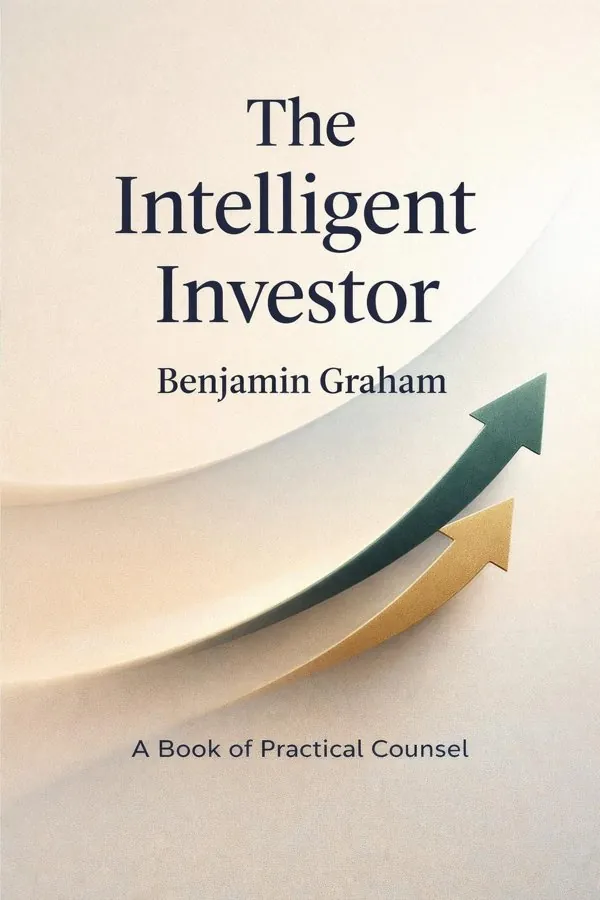
The Intelligent Investor: Summary & Key Insights
 10 min13 chaptersAudio available
Key Takeaways from The Intelligent Investor
Graham begins with a deceptively simple but essential definition: an investment operation is one that, after thorough analysis, promises safety of principal and an adequate return.
For Graham, intelligence in investing has little to do with IQ, advanced math, or market predictions.
One of Graham’s most memorable teaching tools is Mr.
If one concept sits at the heart of Graham’s philosophy, it is the margin of safety.
Graham wisely recognizes that not all investors should follow the same approach.
What Is The Intelligent Investor About?
The Intelligent Investor by Benjamin Graham is a finance book published in 1949 spanning 13 pages. Why does one investor build durable wealth over decades while another repeatedly chases hot tips, panics in downturns, and ends up disappointed? Benjamin Graham’s The Intelligent Investor answers that question with unusual clarity. First published in 1949, this classic remains one of the most respected books on value investing because it focuses less on prediction and more on judgment, discipline, and protection against avoidable mistakes. Graham, widely regarded as the father of modern security analysis, wrote for ordinary investors who wanted a rational framework in a market often driven by noise, excitement, and fear. His advice is timeless precisely because human behavior in markets rarely changes. Instead of promising quick riches, he teaches readers how to think about risk, intrinsic value, portfolio construction, and emotional control. Concepts such as the margin of safety, the distinction between investment and speculation, and the famous allegory of Mr. Market have shaped generations of investors, including many professionals. If you want a practical philosophy for making smarter financial decisions and avoiding costly psychological traps, this book still matters enormously.
This FizzRead summary covers all 13 key chapters of The Intelligent Investor in approximately 10 minutes, distilling the most important ideas, arguments, and takeaways from Benjamin Graham's work. Also available as an audio summary and Key Quotes Podcast.
The Intelligent Investor: A Book of Practical Counsel
Why does one investor build durable wealth over decades while another repeatedly chases hot tips, panics in downturns, and ends up disappointed? Benjamin Graham’s The Intelligent Investor answers that question with unusual clarity. First published in 1949, this classic remains one of the most respected books on value investing because it focuses less on prediction and more on judgment, discipline, and protection against avoidable mistakes. Graham, widely regarded as the father of modern security analysis, wrote for ordinary investors who wanted a rational framework in a market often driven by noise, excitement, and fear. His advice is timeless precisely because human behavior in markets rarely changes. Instead of promising quick riches, he teaches readers how to think about risk, intrinsic value, portfolio construction, and emotional control. Concepts such as the margin of safety, the distinction between investment and speculation, and the famous allegory of Mr. Market have shaped generations of investors, including many professionals. If you want a practical philosophy for making smarter financial decisions and avoiding costly psychological traps, this book still matters enormously.
Who Should Read The Intelligent Investor?
This book is perfect for anyone interested in finance and looking to gain actionable insights in a short read. Whether you're a student, professional, or lifelong learner, the key ideas from The Intelligent Investor by Benjamin Graham will help you think differently.
- ✓Readers who enjoy finance and want practical takeaways
- ✓Professionals looking to apply new ideas to their work and life
- ✓Anyone who wants the core insights of The Intelligent Investor in just 10 minutes
Want the full summary?
Get instant access to this book summary and 100K+ more with Fizz Moment.
Get Free SummaryAvailable on App Store • Free to download
Key Chapters
Graham begins with a deceptively simple but essential definition: an investment operation is one that, after thorough analysis, promises safety of principal and an adequate return. Anything that does not meet those standards is speculation. That distinction matters because many people call their behavior “investing” when they are really betting on price movements, hype, or hope. Buying a stock because it has doubled recently, because social media loves it, or because “it can only go up” is speculation, even if it sounds sophisticated. By contrast, buying a financially sound business at a sensible price after studying its earnings, assets, debt, and competitive position is investing.
Graham does not say speculation is forbidden. He says it must be recognized, controlled, and kept separate from serious capital. A practical rule is to limit speculative activity to a small portion of your portfolio and never mix it with money needed for retirement, education, or essential goals. For example, an investor might put 90–95% into diversified, fundamentally chosen holdings and reserve a small “risk bucket” for higher-risk ideas. The real lesson is honesty. If you know why you are buying and what facts justify the decision, you are far more likely to act intelligently when markets become emotional.
For Graham, intelligence in investing has little to do with IQ, advanced math, or market predictions. The intelligent investor is defined mainly by temperament. He or she can stay calm when others are euphoric, skeptical when others are reckless, and patient when results take time. That emotional steadiness is a competitive advantage because markets constantly tempt people into bad decisions: buying after prices have already surged, selling in panic during declines, or abandoning a sensible plan because the crowd is doing something more exciting.
Consider a broad market drop of 20%. The undisciplined investor may interpret falling prices as proof that everything is broken and rush to sell. The intelligent investor asks a different question: has the underlying value of the businesses changed as much as the stock prices suggest? If not, lower prices may represent opportunity rather than disaster. Graham’s point is that behavior often matters more than brilliance. A good-enough strategy followed consistently can outperform a clever strategy ruined by emotional reactions.
Actionable advice flows directly from this idea: create written rules before emotions rise. Decide your asset allocation, your buying criteria, and your rebalancing policy in advance. Review businesses and valuations, not headlines. When markets become noisy, discipline protects you from becoming your own worst enemy.
One of Graham’s most memorable teaching tools is Mr. Market, an imaginary business partner who shows up every day offering to buy your shares or sell you his at a new price. Some days he is cheerful and optimistic, naming very high prices. Other days he is despondent and offers absurdly low ones. The key insight is that Mr. Market is there to serve you, not instruct you. His moods should create opportunities, not dictate your judgment.
This allegory reframes volatility. Most investors treat market movements as authoritative signals: if prices rise, they feel validated; if prices fall, they feel threatened. Graham urges the opposite response. Price and value are not the same. A temporary decline in the market price of a solid business does not automatically mean the business is worth less. Likewise, a soaring stock price does not guarantee greater underlying value.
A practical example: imagine a profitable company with steady earnings trades at $100, then falls to $70 during a broad market panic even though its fundamentals remain largely intact. Mr. Market is offering a different quote, not delivering a final truth. The intelligent investor compares price to intrinsic value and acts only when the gap is attractive. The lesson is powerful: use market volatility as a tool, not a source of emotional commands.
If one concept sits at the heart of Graham’s philosophy, it is the margin of safety. Because investors can never know the future with certainty, every investment analysis is vulnerable to error: earnings may weaken, industries may change, recessions may hit, and managers may disappoint. The margin of safety is the buffer that protects you when reality turns out worse than expected. In simple terms, it means paying a price sufficiently below estimated intrinsic value so that even if your judgment is imperfect, the risk of permanent loss is reduced.
Think of it like engineering. A bridge designed to hold exactly the expected load is dangerous; one designed with a cushion is safer. Investing works the same way. If you estimate a business is worth $100 per share, buying it at $95 gives little room for mistakes. Buying it at $65 offers more protection. Graham’s point is not that you must know value with precision, but that you should demand favorable odds.
This principle also applies beyond stock selection. Diversification, conservative assumptions, and skepticism toward optimistic forecasts all create forms of margin of safety. Actionably, investors can ask: what must go right for this investment to work, and what happens if several things go wrong? The best opportunities often arise when strong businesses or solid assets are temporarily priced as if their futures are permanently impaired.
Graham wisely recognizes that not all investors should follow the same approach. He distinguishes between the defensive investor and the enterprising investor. The defensive investor wants a sound, low-maintenance strategy that minimizes mistakes and does not require constant analysis. For this person, broad diversification, high-quality holdings, and disciplined asset allocation are more important than trying to beat the market. The enterprising investor, by contrast, is willing to devote significant time, effort, and skill to finding undervalued opportunities and managing a more selective portfolio.
This distinction is practical because many people overestimate their willingness or ability to do serious investment work. Reading a few articles or watching market commentary is not enough to justify an aggressive strategy. If you do not enjoy studying financial reports, comparing valuations, and waiting patiently for bargains, a defensive approach is often superior. There is no shame in simplicity; in fact, simplicity often outperforms complexity when emotions and costs are considered.
A useful self-test is to ask how much time you can consistently dedicate to investing and how you behave under stress. If market declines make you anxious, a rules-based defensive strategy may suit you best. If you have the temperament, training, and patience for deeper analysis, an enterprising approach can exploit inefficiencies. Graham’s message is clear: choose the strategy that fits your character, then follow it with discipline.
Graham emphasizes that intelligent investing is not just about picking securities; it is also about structuring a portfolio that matches your financial needs and emotional tolerance. A sensible allocation between stocks and bonds—or, more broadly today, growth assets and stabilizing assets—helps investors avoid extreme positions. Graham famously favored moderation, warning against becoming fully committed to either optimism or pessimism. The right allocation reduces the chance that a market swing will push you into a bad emotional decision.
Risk tolerance is often misunderstood as a personality quiz result, but Graham treats it more concretely. Real risk is not just volatility; it is the chance of permanent capital loss and the chance that you will abandon your plan at the worst possible time. For example, a portfolio that is technically suitable on paper may still be too aggressive if a 30% decline would cause you to sell everything in panic. Your ideal allocation is the one you can actually maintain.
Actionable advice includes setting a target allocation range and rebalancing periodically. If stocks surge and become too large a share of your portfolio, trim them back. If markets fall and stocks drop below your target range, add gradually. This process turns volatility into discipline. The broader lesson is that portfolio design should protect both your capital and your temperament.
Graham’s stock-selection approach is rooted in caution, evidence, and price discipline. He looks for common stocks that offer a sound relationship between quality and valuation rather than exciting stories. Important factors include consistent earnings, financial strength, reasonable debt levels, dividend records, and prices that are not excessive relative to earnings or assets. The goal is not to find glamorous companies everyone is talking about, but to identify securities selling for less than they are likely worth.
An undervalued security may emerge when the market overreacts to temporary problems: a cyclical downturn, one bad quarter, or broad fear affecting an entire sector. Suppose a durable company with healthy cash flow and manageable debt falls out of favor because investors expect near-term weakness. If the long-term earning power remains intact, that pessimism can create an attractive entry point. Graham teaches investors to distinguish between temporary disappointment and permanent deterioration.
He also warns against overpaying for excellence. Even a wonderful business can become a poor investment if bought at an inflated price. Practical screening criteria might include comparing price-to-earnings ratios, balance-sheet strength, dividend history, and earnings consistency across several years. Most importantly, investors should ask not “Is this company impressive?” but “Am I getting enough value for the price I must pay?”
Markets move in cycles of enthusiasm and despair, but human psychology often turns those normal cycles into costly mistakes. In bull markets, investors begin to believe high prices are justified simply because they keep rising. In bear markets, they assume low prices reflect permanent doom. Graham’s great contribution is to separate market mood from business reality. He reminds readers that temporary popularity and temporary fear are both unreliable guides to long-term investment decisions.
A long-term perspective does not mean ignoring problems. It means evaluating whether short-term disruptions truly damage intrinsic value. For example, recessions can depress earnings for a year or two, but they do not automatically destroy a strong company’s long-run earning power. Investors who understand cycles are less likely to sell quality assets at distressed prices or chase speculative surges near a peak.
This idea becomes especially practical when combined with routine habits. Continue investing according to a plan, rebalance when allocations drift, and review companies over multi-year periods rather than reacting to daily price changes. One of Graham’s enduring lessons is that time can be an ally for the disciplined investor and an enemy for the emotional one. Wealth usually grows not through constant activity, but through patience, selectivity, and the ability to stay rational while others lose perspective.
Graham insists that intelligent investing requires looking beneath the stock ticker and into the actual business. Financial statements are the investor’s primary tools for doing that. Income statements reveal earnings power, balance sheets show assets and liabilities, and cash flow patterns help indicate whether profits are backed by real financial strength. Without this groundwork, an investor is operating in the dark, relying on narratives instead of evidence.
Fundamental analysis does not require predicting the future with exactness. It requires asking sensible questions. Is the company consistently profitable? Does it carry manageable debt? Are earnings stable or wildly erratic? Are margins and returns reasonable relative to competitors? Has management preserved shareholder value prudently? A company may report rising revenue while quietly weakening through excessive borrowing or poor cash generation. Graham wants investors to catch those warning signs before committing capital.
A practical example: two companies may trade at similar earnings multiples, but one has strong cash reserves, modest debt, and a decade of steady profits, while the other depends on aggressive financing and unstable results. Fundamental analysis helps reveal that these are not equally attractive investments. Graham’s broader message is that careful reading of financial information turns investing from guessing into judgment. It won’t eliminate risk, but it greatly improves the odds of sound decision-making.
Graham acknowledges that many people neither want nor need to analyze individual securities in depth. For them, investment funds and professional management can be useful—provided they are chosen thoughtfully. The key is not to assume that a professional label guarantees superior results. Investors must still evaluate costs, incentives, strategy, and whether the advisor or fund is acting in the client’s best interest. Convenience is valuable, but not at any price.
A well-structured fund can offer diversification, risk reduction, and simplicity, especially for defensive investors. However, Graham would caution against being dazzled by recent performance or marketing language. A fund that did brilliantly in a speculative boom may simply have taken excessive risk. Likewise, an advisor who promises market-beating returns without clearly explaining the process deserves skepticism. Intelligent delegation still requires intelligent oversight.
Actionably, investors should ask clear questions: What are the fees? What is the investment philosophy? How much turnover is there? Does the manager emphasize valuation and risk control, or chase trends? Is performance being judged over full market cycles rather than one hot year? Graham’s lesson is empowering: you may hire expertise, but you should never outsource judgment completely. Whether managing your own portfolio or using professionals, the principles of prudence and value still apply.
Inflation quietly erodes purchasing power, making it a crucial issue for long-term investors. Graham understood that preserving capital in nominal terms is not enough if rising prices steadily reduce what that capital can buy. This is why an intelligent investment approach must consider real returns, not just stated ones. A bond yielding 3% may appear safe, but if inflation is 4%, the investor is effectively losing ground in purchasing power.
At the same time, Graham avoids simplistic conclusions. He does not present common stocks as a magical shield against inflation in every circumstance. Instead, he encourages investors to think carefully about the type of businesses they own and the prices they pay. Companies with durable demand, pricing power, and strong balance sheets may adapt better to inflationary environments than firms with thin margins or heavy debt burdens. Price discipline still matters; overpaying for an “inflation-resistant” asset can cancel out its benefits.
For practical investing, this means building a portfolio that balances stability with growth potential. Relying entirely on fixed-income instruments may expose you to purchasing-power risk over time, while relying entirely on equities may create emotional and market risk. Graham’s broader insight is that inflation should push investors toward realism, diversification, and a focus on long-term resilience rather than short-term certainty.
Graham’s ideas become especially convincing when applied to actual investment situations. Value investing is not an abstract theory; it is a method for deciding what to do when the market misprices a business or security. Imagine a company with a strong brand, solid balance sheet, and years of profitability hits a temporary setback—perhaps supply issues, an industry slowdown, or a cyclical drop in earnings. The market, focused on near-term headlines, pushes the stock down sharply. A value investor investigates whether the decline reflects a genuine long-term impairment or merely exaggerated fear.
If intrinsic value remains significantly above the current price, and if there is a margin of safety, the situation may become attractive. On the other hand, Graham’s framework also prevents false bargains. A stock can look cheap after falling 60%, but if debt is excessive, cash flow is weak, and the business model is deteriorating, it may be a trap rather than a value opportunity. Price alone does not create value.
The practical takeaway is to build a repeatable checklist: examine financial strength, estimate normalized earnings, compare price to assets and earning power, and identify what could go wrong. Real-world application demands patience because bargains often appear when markets are uncomfortable. Graham teaches investors to welcome that discomfort when the facts support the case.
Graham closes not with a formula for instant success, but with a philosophy for enduring success. Rationality, patience, and discipline are the investor’s true edge. Markets will continue to swing between excitement and despair, new fads will appear, and predictions will remain seductive. Yet the investor who can think independently, wait for favorable prices, and stick to sound principles already possesses an advantage most participants never develop.
Patience is especially central. Good investments may take time to be recognized by the market, and even excellent decisions can look wrong in the short run. Graham asks readers to judge results over years, not weeks. Discipline means following a method when it is boring, uncomfortable, or temporarily unfashionable. Rationality means anchoring decisions in evidence, value, and risk rather than stories and social proof.
A practical way to apply this counsel is to maintain written rules: define what qualifies as an investment, require a margin of safety, diversify intelligently, and review your behavior as seriously as your returns. Many investors fail not because the principles are hidden, but because they abandon them under pressure. Graham’s final message is reassuring and demanding at once: you do not need to outguess the market. You need to outgovern yourself.
All Chapters in The Intelligent Investor
About the Author
Benjamin Graham (1894–1976) was an American economist, professor, and investor widely recognized as the founder of security analysis and one of the most influential thinkers in modern finance. He taught at Columbia University and helped establish the intellectual foundation of value investing, a disciplined approach centered on intrinsic value, downside protection, and rational decision-making. Graham also mentored Warren Buffett, who later credited him as a major influence. His best-known works include Security Analysis and The Intelligent Investor, both of which became enduring classics for individual and professional investors seeking a more analytical and less speculative way to approach the stock market.
Get This Summary in Your Preferred Format
Read or listen to the The Intelligent Investor summary by Benjamin Graham anytime, anywhere. FizzRead offers multiple formats so you can learn on your terms — all free.
Available formats: App · Audio · PDF · EPUB — All included free with FizzRead
Download The Intelligent Investor PDF and EPUB Summary
Key Quotes from The Intelligent Investor
“Graham begins with a deceptively simple but essential definition: an investment operation is one that, after thorough analysis, promises safety of principal and an adequate return.”
“For Graham, intelligence in investing has little to do with IQ, advanced math, or market predictions.”
“One of Graham’s most memorable teaching tools is Mr.”
“If one concept sits at the heart of Graham’s philosophy, it is the margin of safety.”
“Graham wisely recognizes that not all investors should follow the same approach.”
Frequently Asked Questions about The Intelligent Investor
The Intelligent Investor by Benjamin Graham is a finance book that explores key ideas across 13 chapters. Why does one investor build durable wealth over decades while another repeatedly chases hot tips, panics in downturns, and ends up disappointed? Benjamin Graham’s The Intelligent Investor answers that question with unusual clarity. First published in 1949, this classic remains one of the most respected books on value investing because it focuses less on prediction and more on judgment, discipline, and protection against avoidable mistakes. Graham, widely regarded as the father of modern security analysis, wrote for ordinary investors who wanted a rational framework in a market often driven by noise, excitement, and fear. His advice is timeless precisely because human behavior in markets rarely changes. Instead of promising quick riches, he teaches readers how to think about risk, intrinsic value, portfolio construction, and emotional control. Concepts such as the margin of safety, the distinction between investment and speculation, and the famous allegory of Mr. Market have shaped generations of investors, including many professionals. If you want a practical philosophy for making smarter financial decisions and avoiding costly psychological traps, this book still matters enormously.
Compare The Intelligent Investor


More by Benjamin Graham
You Might Also Like


Featured In
Browse by Category
Ready to read The Intelligent Investor?
Get the full summary and 100K+ more books with Fizz Moment.