
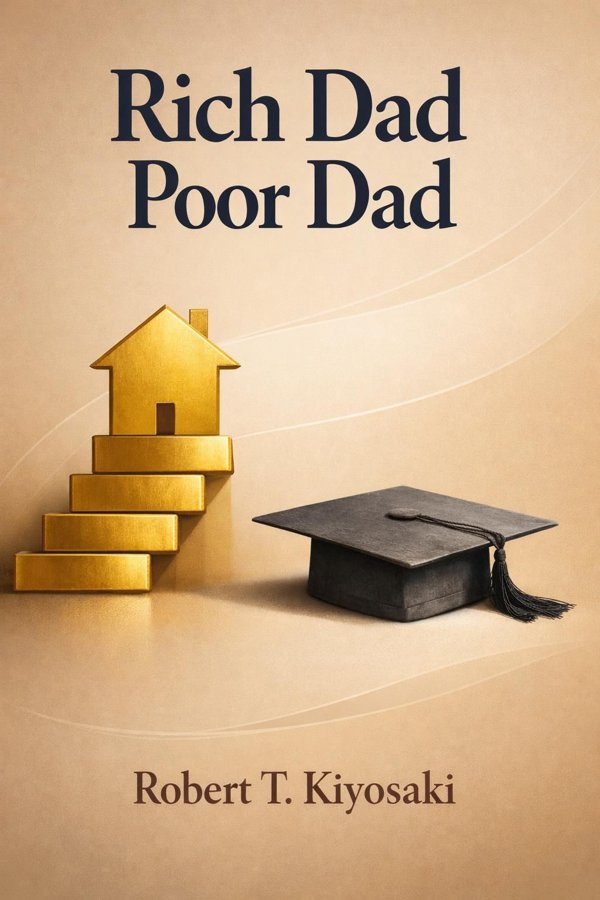
Rich Dad Poor Dad: Summary & Key Insights
 10 min10 chaptersAudio available
Key Takeaways from Rich Dad Poor Dad
At the heart of Rich Dad Poor Dad is a powerful contrast: two intelligent, well-meaning father figures offered Robert Kiyosaki completely different maps for life.
One of the book’s most memorable stories begins when Kiyosaki and his friend Mike ask Rich Dad how to become rich.
Kiyosaki challenges a deeply comforting myth: that hard work alone creates wealth.
Perhaps the most famous lesson in Rich Dad Poor Dad is Kiyosaki’s simple distinction: an asset puts money in your pocket, while a liability takes money out.
A recurring theme in the book is that traditional education prepares people to work for money, but rarely teaches them how to manage, grow, or protect it.
What Is Rich Dad Poor Dad About?
Rich Dad Poor Dad by Robert Kiyosaki is a finance book published in 1997 spanning 10 pages. Why do some people work hard for decades and still feel financially trapped, while others build wealth that seems to grow on its own? In Rich Dad Poor Dad, Robert T. Kiyosaki tackles that question by challenging one of the most deeply accepted beliefs in modern life: that a good education, a stable job, and years of hard work automatically lead to financial security. Through the memorable contrast between his “poor dad,” a highly educated employee, and his “rich dad,” an entrepreneur and investor, Kiyosaki argues that the real divide is not income alone, but financial mindset and financial education. This book matters because it reframes money as a skill set, not just a salary. Instead of teaching readers to chase paychecks, it encourages them to understand assets, cash flow, taxes, business structures, and the emotional habits that shape financial decisions. Kiyosaki, best known for his Rich Dad series, became a leading voice in personal finance by making wealth-building concepts accessible to everyday readers. Whether you agree with all his views or not, the book remains influential because it pushes people to think differently about work, risk, and long-term freedom.
This FizzRead summary covers all 10 key chapters of Rich Dad Poor Dad in approximately 10 minutes, distilling the most important ideas, arguments, and takeaways from Robert Kiyosaki's work. Also available as an audio summary and Key Quotes Podcast.
Rich Dad Poor Dad: What the Rich Teach Their Kids About Money – That the Poor and Middle Class Do Not!
Why do some people work hard for decades and still feel financially trapped, while others build wealth that seems to grow on its own? In Rich Dad Poor Dad, Robert T. Kiyosaki tackles that question by challenging one of the most deeply accepted beliefs in modern life: that a good education, a stable job, and years of hard work automatically lead to financial security. Through the memorable contrast between his “poor dad,” a highly educated employee, and his “rich dad,” an entrepreneur and investor, Kiyosaki argues that the real divide is not income alone, but financial mindset and financial education. This book matters because it reframes money as a skill set, not just a salary. Instead of teaching readers to chase paychecks, it encourages them to understand assets, cash flow, taxes, business structures, and the emotional habits that shape financial decisions. Kiyosaki, best known for his Rich Dad series, became a leading voice in personal finance by making wealth-building concepts accessible to everyday readers. Whether you agree with all his views or not, the book remains influential because it pushes people to think differently about work, risk, and long-term freedom.
Who Should Read Rich Dad Poor Dad?
This book is perfect for anyone interested in finance and looking to gain actionable insights in a short read. Whether you're a student, professional, or lifelong learner, the key ideas from Rich Dad Poor Dad by Robert Kiyosaki will help you think differently.
- ✓Readers who enjoy finance and want practical takeaways
- ✓Professionals looking to apply new ideas to their work and life
- ✓Anyone who wants the core insights of Rich Dad Poor Dad in just 10 minutes
Want the full summary?
Get instant access to this book summary and 100K+ more with Fizz Moment.
Get Free SummaryAvailable on App Store • Free to download
Key Chapters
At the heart of Rich Dad Poor Dad is a powerful contrast: two intelligent, well-meaning father figures offered Robert Kiyosaki completely different maps for life. Poor Dad believed success came from formal education, steady employment, promotions, and retirement benefits. Rich Dad believed true wealth came from owning businesses, buying income-producing assets, and learning how money actually works. The lesson is not that one man was good and the other bad, but that beliefs shape financial outcomes. One mindset says, “Play it safe.” The other says, “Learn the rules, then use them.”
This idea matters because many people unconsciously inherit their money beliefs from parents, teachers, and culture. If you were taught that debt is always bad, risk should always be avoided, or a job is the only reliable path, you may never explore the skills that build wealth. Kiyosaki invites readers to audit those assumptions. A practical way to apply this is to write down the money messages you grew up hearing—such as “Money doesn’t grow on trees” or “Investing is too risky”—and ask whether they are helping or limiting you. As Rich Dad’s philosophy suggests, financial freedom begins when you question inherited beliefs and replace fear-based thinking with financial intelligence.
One of the book’s most memorable stories begins when Kiyosaki and his friend Mike ask Rich Dad how to become rich. Instead of giving them a lecture, he pays them a tiny wage to work in one of his stores. The boys quickly feel underpaid and frustrated, and that discomfort becomes the lesson. Rich Dad wants them to understand how easily people get trapped in the cycle of working for money, resenting their jobs, then seeking only a bigger paycheck instead of a new strategy. In his view, fear of not having enough money pushes people into jobs, while greed for more money keeps them there.
The deeper insight is that money is a game with rules, patterns, and incentives. If you never learn those rules, you simply react to life instead of designing it. Many adults live exactly as the boys first did: they complain about income but never study investing, cash flow, taxes, or ownership. Kiyosaki’s point is that financial freedom begins with observation. Notice where your money comes from, where it goes, and how dependent you are on active labor. An actionable step is to track your monthly income sources and ask: if I stopped working for 30 days, what would still come in? That question reveals whether you have built any financial leverage—or whether you are still only earning by the hour.
Kiyosaki challenges a deeply comforting myth: that hard work alone creates wealth. He does not dismiss effort; instead, he argues that effort without financial strategy often leads to exhaustion, not freedom. Many people work longer hours, get advanced degrees, and climb career ladders, only to discover that higher income often brings higher taxes, bigger expenses, and more dependence on a paycheck. In other words, they become busier but not wealthier. The key difference is between earning income and building systems that produce income.
Think of two people with the same salary. One spends nearly everything on lifestyle upgrades—a bigger house, newer car, expensive subscriptions. The other uses part of that same income to buy shares, save for a rental property, or build a small side business. Both work hard, but only one converts labor into long-term assets. That is Kiyosaki’s central point: effort matters most when it is directed toward ownership. A useful takeaway is to stop asking only, “How can I earn more?” and start asking, “What can I buy or build that will pay me repeatedly?” Even small moves matter. Setting aside money each month to invest, acquiring a skill that can become a business, or buying tools that generate revenue can shift you from pure labor to leveraged wealth-building.
Perhaps the most famous lesson in Rich Dad Poor Dad is Kiyosaki’s simple distinction: an asset puts money in your pocket, while a liability takes money out. This is the core framework he wants readers to use when making financial decisions. The reason this idea resonates is that many people own things that look impressive but quietly drain cash every month. A car payment, a heavily mortgaged house, or luxury purchases may signal success socially, but if they require constant income to maintain, they do not create freedom.
Kiyosaki urges readers to focus first on acquiring assets that produce cash flow. That might mean investments, business ownership, or real estate that generates rental income. The practical wisdom here is not about never buying anything enjoyable; it is about sequence. Build assets first, then let those assets pay for lifestyle choices. For example, instead of upgrading your car after a raise, you might direct that extra money into investments for a year and use the returns later. A simple action step is to review your monthly budget and label each major item as either an asset, a liability, or a neutral expense. This exercise can be eye-opening. Once you begin thinking in terms of cash flow rather than appearances, your financial choices become clearer, more intentional, and more aligned with long-term independence.
A recurring theme in the book is that traditional education prepares people to work for money, but rarely teaches them how to manage, grow, or protect it. Kiyosaki argues that schools teach reading, writing, and professional skills, yet often ignore the everyday financial knowledge people need most: how to read a financial statement, understand taxes, evaluate investments, manage risk, and distinguish between good debt and bad decisions. As a result, even highly educated people can earn impressive incomes and still make poor money choices.
This idea remains powerful because financial confusion is expensive. Without financial education, people may sign loans they don’t fully understand, confuse income with wealth, or assume a job alone is enough to secure the future. Kiyosaki’s message is that financial literacy should be treated like a life skill, not a niche specialty. The practical application is straightforward: commit to learning one money concept at a time. Start with cash flow, budgeting, investing basics, or tax awareness. Read annual reports, follow business news, or study simple balance sheets. You do not need to become a Wall Street expert overnight. You need to become less financially passive. Rich Dad’s philosophy is that every dollar decision either teaches you something or costs you something. The more financially educated you become, the more options you create for yourself.
For Kiyosaki, the goal is not just to earn well—it is to build income streams that do not depend entirely on your daily labor. That is why he emphasizes entrepreneurship and investing as pathways to passive or semi-passive income. A job can provide stability and seed capital, but long-term freedom often comes from ownership. Businesses, investments, and real estate can continue generating cash flow after the initial effort has been made. This is what Rich Dad means by making money work for you.
The idea is especially valuable for readers who assume entrepreneurship always means quitting their job and taking huge risks. Kiyosaki’s broader lesson is about gradually increasing ownership. You might start with a side business, invest a portion of your salary each month, or learn a niche skill that can later become an independent income source. For example, someone employed full-time could use evenings to build an online service business, buy dividend-producing investments, or save toward an income property. The point is not speed, but direction. Actionable advice here includes choosing one asset-building path and studying it deeply for six months rather than dabbling in everything. The wealthiest mindset, in Kiyosaki’s view, is not “I need a raise,” but “How do I create a system that earns even when I’m not present?”
Kiyosaki argues that financial outcomes are shaped not just by knowledge, but by emotion. Two forces dominate most money decisions: fear and greed. Fear makes people cling to safety, avoid investing, stay too long in unfulfilling jobs, or hold cash while inflation quietly erodes its value. Greed pushes them to chase status, overleverage, speculate recklessly, or buy things they cannot truly afford. The tragic part is that both emotions can operate at the same time—fear of missing out and fear of losing money often fuel bad decisions together.
This lesson is one of the book’s most psychologically useful insights. You can know what an asset is and still fail to buy one if fear controls you. You can earn more and still remain broke if greed turns every income increase into higher spending. Kiyosaki encourages readers to become emotionally aware and financially disciplined. A practical technique is to pause before any major financial move and ask: am I acting from analysis or emotion? For example, are you buying something because it creates value, or because you want to look successful? Are you avoiding investing because the opportunity is poor, or because uncertainty makes you uncomfortable? Wealth-building requires calm, patience, and the ability to delay gratification. Mastering money often means mastering yourself first.
One of Kiyosaki’s more provocative arguments is that wealthy people often play by a different set of financial rules—not because they are magically smarter, but because they understand systems like taxes, corporations, expenses, and legal structures better than the average worker. Employees are typically paid, taxed, and then spend what remains. Business owners and investors, by contrast, often structure their finances more strategically. Kiyosaki uses this contrast to show that knowledge of tax rules and ownership structures can significantly affect how much money you keep.
The broader lesson is not that everyone should become a tax expert overnight, but that financial literacy includes understanding the framework around money, not just the money itself. A person who earns a high salary but ignores tax planning may keep less than someone earning less but using smarter structures. Actionably, readers can begin by learning the basics of how businesses, deductions, and legal entities work in their country, ideally with professional guidance. Even understanding concepts like business expenses, incorporation, and cash-flow timing can change how you think about earning. Kiyosaki’s point is simple: if you only know how to work, you know one rule set. If you also understand ownership and structure, you unlock a more advanced financial game.
A major strength of Rich Dad Poor Dad is its insistence that financial knowledge has little value unless it changes behavior. Kiyosaki repeatedly emphasizes action—small, imperfect, real-world action. Many people consume books, podcasts, and advice about money but never invest, never negotiate, never start a side business, and never review their spending honestly. They become informed but not transformed. Rich Dad’s philosophy is that intelligence becomes powerful only when tested in reality.
This idea is especially relevant because perfectionism often disguises itself as responsibility. People say they are “waiting until they know more,” but years pass and nothing changes. Kiyosaki urges readers to learn by doing: study a deal, analyze an investment, start a project, make mistakes, and build experience. An actionable way to apply this is to set one 30-day money goal. It could be opening an investment account, reading one personal finance book, cutting one recurring liability, or earning your first dollar from a side venture. Progress creates clarity. The more you act, the more your confidence grows and the less abstract finance becomes. Wealth is not built only by understanding concepts like assets and cash flow. It is built by consistently making decisions that put those concepts into practice.
The final and most expansive lesson of the book is that financial freedom begins as an internal shift before it becomes an external result. Kiyosaki is ultimately writing about mindset: how you think about work, risk, debt, opportunity, and responsibility. If you believe money is scarce, the world is dangerous, and security comes only from a job, you will likely make defensive choices. If you believe money follows skills, opportunities can be learned, and assets can be built over time, you begin to act differently. That shift in thinking can change your entire financial destiny.
Importantly, Kiyosaki does not present freedom as an overnight event. It is a path made up of repeated choices: learning instead of avoiding, buying assets instead of only consuming, creating value instead of waiting to be rescued. Someone may start with an ordinary income and still move toward freedom by steadily improving financial habits. A practical way to embody this lesson is to create a personal financial mission statement. Define what freedom means to you—less stress, more time, early retirement, family security, or creative independence—and use that definition to guide decisions. The book’s deeper promise is not just more money, but more agency. When your mindset changes, your behavior changes. When behavior changes consistently, outcomes eventually follow.
All Chapters in Rich Dad Poor Dad
About the Author
Robert T. Kiyosaki is an American entrepreneur, investor, and educator best known for the Rich Dad series, which helped popularize financial education for mainstream readers. His work focuses on personal finance, investing, entrepreneurship, and the pursuit of financial independence through business ownership and real estate. Kiyosaki became especially influential for challenging conventional beliefs about employment, school-based education, and retirement planning. Through his books and teaching, he has encouraged readers around the world to improve their financial literacy, understand cash flow, and think more strategically about wealth creation.
Get This Summary in Your Preferred Format
Read or listen to the Rich Dad Poor Dad summary by Robert Kiyosaki anytime, anywhere. FizzRead offers multiple formats so you can learn on your terms — all free.
Available formats: App · Audio · PDF · EPUB — All included free with FizzRead
Download Rich Dad Poor Dad PDF and EPUB Summary
Key Quotes from Rich Dad Poor Dad
“At the heart of Rich Dad Poor Dad is a powerful contrast: two intelligent, well-meaning father figures offered Robert Kiyosaki completely different maps for life.”
“One of the book’s most memorable stories begins when Kiyosaki and his friend Mike ask Rich Dad how to become rich.”
“Kiyosaki challenges a deeply comforting myth: that hard work alone creates wealth.”
“Perhaps the most famous lesson in Rich Dad Poor Dad is Kiyosaki’s simple distinction: an asset puts money in your pocket, while a liability takes money out.”
“A recurring theme in the book is that traditional education prepares people to work for money, but rarely teaches them how to manage, grow, or protect it.”
Frequently Asked Questions about Rich Dad Poor Dad
Rich Dad Poor Dad by Robert Kiyosaki is a finance book that explores key ideas across 10 chapters. Why do some people work hard for decades and still feel financially trapped, while others build wealth that seems to grow on its own? In Rich Dad Poor Dad, Robert T. Kiyosaki tackles that question by challenging one of the most deeply accepted beliefs in modern life: that a good education, a stable job, and years of hard work automatically lead to financial security. Through the memorable contrast between his “poor dad,” a highly educated employee, and his “rich dad,” an entrepreneur and investor, Kiyosaki argues that the real divide is not income alone, but financial mindset and financial education. This book matters because it reframes money as a skill set, not just a salary. Instead of teaching readers to chase paychecks, it encourages them to understand assets, cash flow, taxes, business structures, and the emotional habits that shape financial decisions. Kiyosaki, best known for his Rich Dad series, became a leading voice in personal finance by making wealth-building concepts accessible to everyday readers. Whether you agree with all his views or not, the book remains influential because it pushes people to think differently about work, risk, and long-term freedom.
Compare Rich Dad Poor Dad

You Might Also Like
Featured In
Browse by Category
Ready to read Rich Dad Poor Dad?
Get the full summary and 100K+ more books with Fizz Moment.