
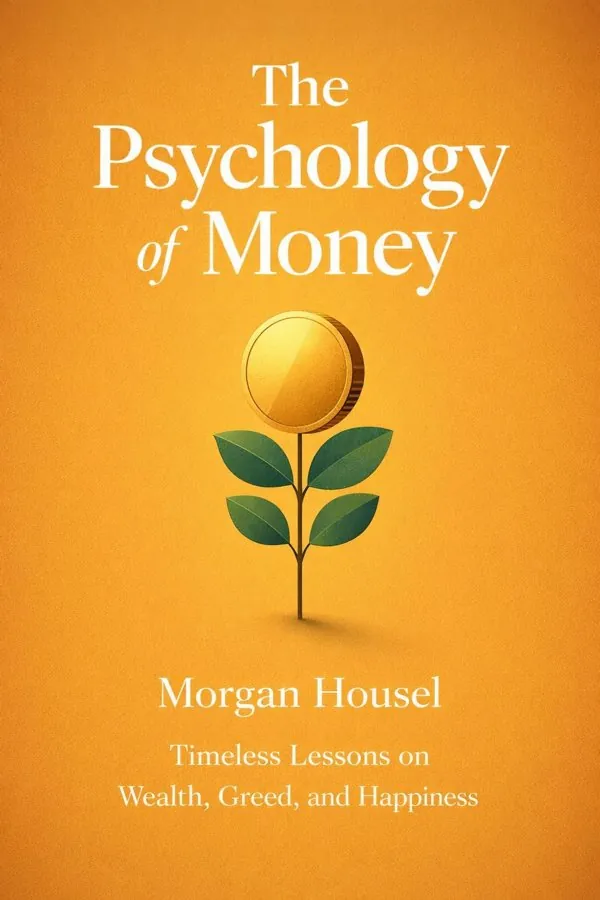
The Psychology of Money: Summary & Key Insights
 10 min9 chaptersAudio available
Key Takeaways from The Psychology of Money
One of the most important truths about money is that people do not make financial decisions on spreadsheets alone.
The most extraordinary results in finance often come from ordinary actions repeated for a very long time.
Many people think of saving as delayed consumption, but Housel reframes it as a source of control, flexibility, and emotional security.
One of Housel’s sharpest observations is that people often confuse being rich with being wealthy.
It is comforting to believe that success always reflects skill and failure always reflects poor choices, but Housel argues that reality is far messier.
What Is The Psychology of Money About?
The Psychology of Money by Morgan Housel is a finance book. Money is often treated as a math problem, but Morgan Housel argues that it is really a behavior problem. In The Psychology of Money, he explores how wealth, spending, saving, risk, and happiness are shaped less by spreadsheets and more by emotion, ego, fear, luck, and personal history. The book explains why smart people can make poor financial decisions, why average people can build remarkable wealth, and why doing well with money has more to do with temperament than raw intelligence. Rather than offering complicated formulas or market predictions, Housel focuses on the habits and mindsets that drive long-term financial success. His lessons are practical, memorable, and rooted in stories from investors, business leaders, and everyday people. As a respected financial writer and former columnist for The Wall Street Journal and The Motley Fool, Housel brings both credibility and clarity to the subject. This book matters because it helps readers build a healthier relationship with money, make better decisions under uncertainty, and define success on their own terms.
This FizzRead summary covers all 9 key chapters of The Psychology of Money in approximately 10 minutes, distilling the most important ideas, arguments, and takeaways from Morgan Housel's work. Also available as an audio summary and Key Quotes Podcast.
The Psychology of Money
Money is often treated as a math problem, but Morgan Housel argues that it is really a behavior problem. In The Psychology of Money, he explores how wealth, spending, saving, risk, and happiness are shaped less by spreadsheets and more by emotion, ego, fear, luck, and personal history. The book explains why smart people can make poor financial decisions, why average people can build remarkable wealth, and why doing well with money has more to do with temperament than raw intelligence. Rather than offering complicated formulas or market predictions, Housel focuses on the habits and mindsets that drive long-term financial success. His lessons are practical, memorable, and rooted in stories from investors, business leaders, and everyday people. As a respected financial writer and former columnist for The Wall Street Journal and The Motley Fool, Housel brings both credibility and clarity to the subject. This book matters because it helps readers build a healthier relationship with money, make better decisions under uncertainty, and define success on their own terms.
Who Should Read The Psychology of Money?
This book is perfect for anyone interested in finance and looking to gain actionable insights in a short read. Whether you're a student, professional, or lifelong learner, the key ideas from The Psychology of Money by Morgan Housel will help you think differently.
- ✓Readers who enjoy finance and want practical takeaways
- ✓Professionals looking to apply new ideas to their work and life
- ✓Anyone who wants the core insights of The Psychology of Money in just 10 minutes
Want the full summary?
Get instant access to this book summary and 100K+ more with Fizz Moment.
Get Free SummaryAvailable on App Store • Free to download
Key Chapters
One of the most important truths about money is that people do not make financial decisions on spreadsheets alone. They make them through the lens of emotion, past experience, social influence, and personal identity. Morgan Housel’s central argument is that financial success is not primarily about what you know. It is about how you behave when uncertainty, temptation, fear, and envy show up. That is why highly educated investors can lose fortunes while ordinary savers quietly build lasting wealth.
Housel points out that each person’s view of money is shaped by the world they grew up in. Someone raised during a recession may see debt and investing very differently from someone raised during a boom. Neither person is necessarily irrational. They are responding to the evidence life gave them. This is a powerful idea because it explains why people can disagree so strongly about risk, markets, or saving and still believe they are being logical.
In practice, this means good financial decisions should fit your personality, not just some idealized model of rational behavior. If an aggressive investment strategy keeps you awake at night, it is probably not the right strategy for you, even if it looks optimal on paper. If automating savings helps you avoid emotional decisions, then simplicity is a strength, not a compromise.
The real edge in money is self-awareness. Understand your triggers. Know what kind of investor or spender you are. Build systems that protect you from your worst impulses and support your best habits. Actionable takeaway: create a financial plan you can stick with emotionally, not just one that looks impressive mathematically.
The most extraordinary results in finance often come from ordinary actions repeated for a very long time. Housel emphasizes that compounding is not just a mathematical concept. It is a life-changing force that rewards patience, consistency, and endurance. Wealth does not usually come from one brilliant move. More often, it comes from avoiding interruptions and allowing gains to build on themselves year after year.
He uses the example of Warren Buffett to show that Buffett’s success is not only about exceptional skill. It is also about time. Buffett started investing young and kept going for decades, giving compounding an enormous runway. This insight changes how we think about success. Instead of asking how to get rich quickly, the better question becomes how to stay invested long enough for compounding to work.
This applies beyond stocks. Saving a modest amount every month, reinvesting dividends, avoiding unnecessary fees, and resisting the urge to constantly trade can all produce dramatic long-term outcomes. In contrast, frequent changes, panic selling, or chasing trends can interrupt compounding and destroy momentum.
The lesson is humbling. You do not need to be a genius to benefit from compounding. You need to be patient enough not to sabotage it. A person who earns average returns for decades may end up far ahead of someone who earns higher returns but cannot stay consistent.
Actionable takeaway: focus less on finding the perfect investment and more on building habits that let your money compound uninterrupted over long periods.
Many people think of saving as delayed consumption, but Housel reframes it as a source of control, flexibility, and emotional security. Money saved is not just money unspent. It is independence. It gives you options when life becomes uncertain and freedom when you want to make choices based on values rather than desperation.
A key point in the book is that saving is valuable even when you do not have a precise goal for every dollar. Not all financial value can be predicted in advance. Emergencies happen. Opportunities appear unexpectedly. Jobs change. Relationships shift. Health can improve or decline. Savings create a buffer between you and the unpredictable nature of life.
This mindset also reduces stress. A person with cash reserves can leave a toxic job, handle a surprise bill, survive a market downturn without panic, or take time to learn new skills. That is real wealth, even if it does not look flashy. Housel argues that one of the highest forms of financial success is the ability to wake up and have more control over your time.
In practical terms, this means building a meaningful emergency fund, keeping lifestyle inflation in check, and treating savings as a tool for resilience rather than a punishment. Even small amounts matter because the habit itself reinforces discipline and creates momentum.
Actionable takeaway: save consistently, even without a perfect plan, and view your savings as a reservoir of freedom, not merely a pile of postponed spending.
One of Housel’s sharpest observations is that people often confuse being rich with being wealthy. Rich is what others can see: expensive cars, luxury watches, large homes, visible consumption. Wealth is what remains unseen: assets not spent, investments quietly growing, and the financial margin that creates security. This distinction matters because many people chase the appearance of success while sacrificing the substance of it.
Visible spending can create admiration, but it can also hide fragility. Someone may look affluent while carrying enormous debt or living paycheck to paycheck. Meanwhile, another person may dress simply, drive an ordinary car, and have significant savings and investments. The second person may have far more real freedom, even if they attract less attention.
Housel warns that status spending is especially dangerous because it is often driven by comparison. People buy things not because they truly value them, but because those things signal success. Yet when you spend money to show others how successful you are, you are often reducing the very wealth that would make you secure.
A practical application of this idea is to separate lifestyle choices from identity. Buy what genuinely improves your life, not what helps perform a role for others. Measure financial progress by net worth, cash flow, and peace of mind, not by appearances.
Actionable takeaway: stop using visible consumption as your scoreboard and start defining wealth by what you own, save, and control behind the scenes.
It is comforting to believe that success always reflects skill and failure always reflects poor choices, but Housel argues that reality is far messier. Luck and risk influence nearly every financial outcome. The same decision can produce very different results depending on timing, context, and factors outside your control. Recognizing this does not eliminate responsibility. It adds humility.
Housel uses examples from business and investing to show how some people succeed in part because they benefited from favorable circumstances, while others fail despite making sensible decisions. This matters because when we ignore luck and risk, we draw overly simple lessons. We idolize successful people as if their paths are fully repeatable, and we judge struggling people as if outcomes were entirely within their control.
This perspective improves decision-making in two ways. First, it encourages caution. Since outcomes are never guaranteed, wise people build margins of safety, diversify, and avoid strategies that can ruin them. Second, it promotes empathy. Not every result should be interpreted as a moral verdict or proof of superior intelligence.
In everyday life, this means planning for uncertainty. Do not assume your income, investments, or career path will unfold exactly as expected. Build emergency reserves, insure major risks, and avoid overconfidence after periods of success.
Actionable takeaway: make decisions that can survive bad luck, stay humble during good luck, and judge financial choices by their process, not just their outcome.
Traditional finance often assumes that people should always make perfectly rational choices. Housel counters that in the real world, being reasonable is more useful than being technically optimal. A financial strategy only works if you can actually live with it. The best plan is not necessarily the one with the highest expected return. It is the one you can follow through recessions, bull markets, personal setbacks, and emotional stress.
For example, an investor may know that a highly concentrated portfolio could maximize gains, but if that concentration causes panic during volatility, the investor may sell at the worst possible time. A more diversified portfolio may produce slightly lower theoretical returns but much higher real-life success because it is emotionally sustainable.
This idea applies to budgeting too. An extreme spending plan might work for a month, but if it feels punishing, it will likely collapse. A balanced plan that allows for enjoyment while maintaining steady savings is often more durable. Housel repeatedly shows that consistency beats optimization when human behavior is involved.
The broader lesson is that your financial system should reduce the chance of self-sabotage. Favor rules you can maintain. Leave room for uncertainty. Avoid situations where one bad emotional decision can do major damage.
Actionable takeaway: build a money strategy that feels realistic and repeatable in your actual life, even if it is not the most mathematically perfect option available.
Many financial mistakes come not from scarcity, but from the inability to recognize when you already have enough. Housel argues that endless ambition can become dangerous when it turns into comparison, greed, or a willingness to risk what matters for what does not. Knowing when to stop is one of the hardest and most valuable money skills.
He highlights the tragedy of people who had great fortunes yet kept pushing for more, taking reckless risks they did not need to take. The problem was not lack of intelligence. It was the belief that more was always better. But if pursuing more puts your existing security, reputation, relationships, or peace of mind in danger, the cost may be far greater than the reward.
This idea encourages readers to define their own standard of sufficiency. How much income supports your life well? What level of savings makes you feel secure? What trade-offs are no longer worth it? Without clear answers, it is easy to be pulled into someone else’s definition of success.
In practical terms, this might mean resisting lifestyle inflation after a raise, declining an investment that promises huge upside but carries ruinous downside, or deciding that additional status is not worth additional stress.
Actionable takeaway: write down what “enough” means for your lifestyle, savings, and risk tolerance, and use that definition to protect yourself from needless financial overreach.
Short-term noise dominates headlines, market commentary, and everyday conversation, but Housel reminds readers that wealth is built through long-term behavior. Markets rise and fall. Economies boom and contract. News cycles create urgency. Yet the people who benefit most are often those who can ignore constant distraction and keep making steady decisions over many years.
This requires accepting volatility as normal rather than treating it as a signal to abandon your plan. Housel emphasizes that market declines are not always signs that something has gone wrong. They are often simply the price of admission for long-term returns. If you want the rewards of investing, you must be willing to endure periods of discomfort.
The principle also applies to careers, businesses, and personal development. Significant progress often looks slow at first because results accumulate beneath the surface. Long-term thinking means making choices that may not impress others today but can transform your position over a decade.
A practical example is continuing to invest through downturns instead of waiting for perfect certainty. Another is focusing on asset allocation and saving rate rather than reacting to every economic forecast. Patience is not passive. It is disciplined restraint.
Actionable takeaway: reduce your exposure to short-term financial noise and commit to a long-term plan that you continue following through both excitement and uncertainty.
A small number of events often account for the majority of results. Housel stresses that in investing, business, and life, outcomes are not evenly distributed. A handful of stocks may drive most portfolio gains. One major career opportunity may outweigh years of smaller decisions. One severe mistake can undo a decade of progress. Understanding this helps explain why financial journeys often feel uneven and unpredictable.
This idea should change how people evaluate both success and failure. You do not need every decision to be perfect. You need to survive long enough to benefit from the few big wins that matter. At the same time, you must avoid catastrophic losses that permanently remove you from the game.
In investing, this supports diversification and patience. Since it is difficult to know in advance which companies or assets will produce extraordinary results, spreading risk can help you stay exposed to upside while limiting damage. In personal finance, it means recognizing that resilience matters more than precision. Missing a few opportunities is survivable. A wipeout is not.
For example, someone who stays invested in broad index funds for decades may capture the few big market winners that generate most returns. Someone who constantly jumps in and out may miss those critical periods. Likewise, one uninsured disaster or one reckless leveraged bet can have outsized consequences.
Actionable takeaway: structure your financial life to endure losses, stay in the game, and remain available for the relatively few high-impact opportunities that shape long-term results.
All Chapters in The Psychology of Money
About the Author
Morgan Housel is a financial writer and investor best known for his work on behavioral finance, wealth, and decision-making. He is a partner at The Collaborative Fund, where he writes about investing, markets, and the ways psychology shapes economic outcomes. Earlier in his career, he was a columnist for The Wall Street Journal and a writer at The Motley Fool, earning a reputation for making complex financial ideas accessible to broad audiences. Housel has received honors from the Society of American Business Editors and Writers and is widely respected for his thoughtful, story-driven approach to money. His writing focuses less on prediction and more on timeless principles, helping readers understand that success with money depends as much on temperament and perspective as on technical skill.
Get This Summary in Your Preferred Format
Read or listen to the The Psychology of Money summary by Morgan Housel anytime, anywhere. FizzRead offers multiple formats so you can learn on your terms — all free.
Available formats: App · Audio · PDF · EPUB — All included free with FizzRead
Download The Psychology of Money PDF and EPUB Summary
Key Quotes from The Psychology of Money
“One of the most important truths about money is that people do not make financial decisions on spreadsheets alone.”
“The most extraordinary results in finance often come from ordinary actions repeated for a very long time.”
“Many people think of saving as delayed consumption, but Housel reframes it as a source of control, flexibility, and emotional security.”
“One of Housel’s sharpest observations is that people often confuse being rich with being wealthy.”
“It is comforting to believe that success always reflects skill and failure always reflects poor choices, but Housel argues that reality is far messier.”
Frequently Asked Questions about The Psychology of Money
The Psychology of Money by Morgan Housel is a finance book that explores key ideas across 9 chapters. Money is often treated as a math problem, but Morgan Housel argues that it is really a behavior problem. In The Psychology of Money, he explores how wealth, spending, saving, risk, and happiness are shaped less by spreadsheets and more by emotion, ego, fear, luck, and personal history. The book explains why smart people can make poor financial decisions, why average people can build remarkable wealth, and why doing well with money has more to do with temperament than raw intelligence. Rather than offering complicated formulas or market predictions, Housel focuses on the habits and mindsets that drive long-term financial success. His lessons are practical, memorable, and rooted in stories from investors, business leaders, and everyday people. As a respected financial writer and former columnist for The Wall Street Journal and The Motley Fool, Housel brings both credibility and clarity to the subject. This book matters because it helps readers build a healthier relationship with money, make better decisions under uncertainty, and define success on their own terms.
Compare The Psychology of Money

More by Morgan Housel


You Might Also Like

Featured In
Browse by Category
Ready to read The Psychology of Money?
Get the full summary and 100K+ more books with Fizz Moment.