
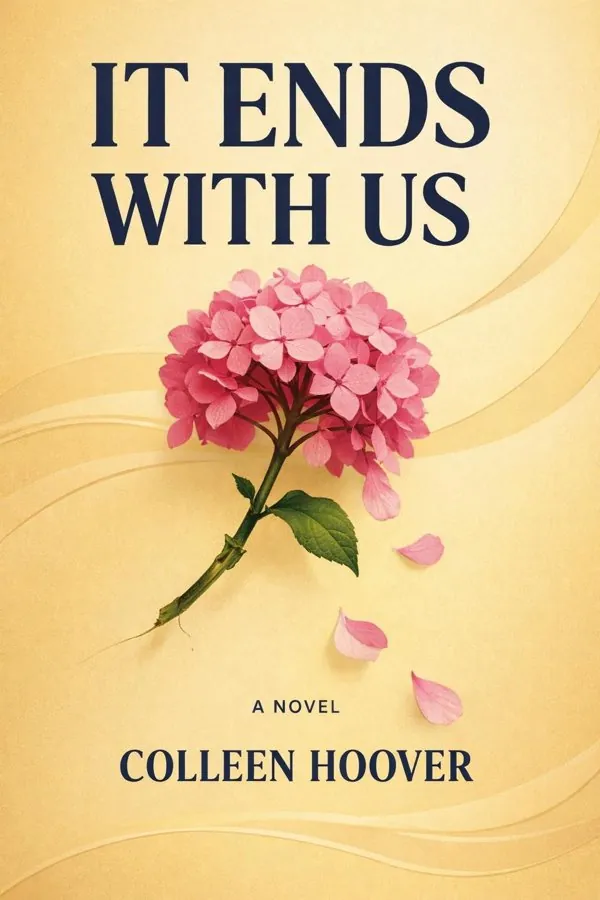
It Ends with Us: Summary & Key Insights
 10 min5 chaptersAudio available
Key Takeaways from It Ends with Us
Lily Bloom’s story begins long before Boston, the flower shop, or her relationship with Ryle.
Ryle Kincaid is compelling because he is not written as an obvious villain from the start.
Atlas Corrigan represents more than Lily’s first love; he represents a memory of what kindness feels like when it asks for nothing in return.
One of the most unsettling strengths of It Ends with Us is how carefully it depicts the escalation of abuse.
The emotional climax of It Ends with Us lies in Lily’s decision to break a pattern that has shaped generations before her.
What Is It Ends with Us About?
It Ends with Us by Colleen Hoover is a romance book published in 2016 spanning 5 pages. What makes someone stay in a relationship that is clearly causing pain? That question sits at the heart of It Ends with Us, one of Colleen Hoover’s most widely discussed contemporary romance novels. On the surface, the book follows Lily Bloom, a determined young woman who moves to Boston, builds a new life, and falls for the ambitious neurosurgeon Ryle Kincaid. But very quickly, the story reveals itself to be far more than a love story. It is a piercing exploration of trauma, denial, memory, generational patterns, and the brutal complexity of loving someone who can also hurt you. What gives this novel its power is the way Hoover blends emotional immediacy with uncomfortable realism. She doesn’t present abuse as simple or easy to identify from the inside. Instead, she shows how affection, chemistry, hope, and fear can become tangled together. Hoover, a bestselling American author known for emotionally intense contemporary fiction, writes with a directness that makes Lily’s choices feel deeply human rather than easy to judge. The result is a novel that resonates with readers looking for romance, but stays with them because it asks a harder question: when love and harm coexist, what does true courage actually look like?
This FizzRead summary covers all 5 key chapters of It Ends with Us in approximately 10 minutes, distilling the most important ideas, arguments, and takeaways from Colleen Hoover's work. Also available as an audio summary and Key Quotes Podcast.
It Ends With Us: A Novel
What makes someone stay in a relationship that is clearly causing pain? That question sits at the heart of It Ends with Us, one of Colleen Hoover’s most widely discussed contemporary romance novels. On the surface, the book follows Lily Bloom, a determined young woman who moves to Boston, builds a new life, and falls for the ambitious neurosurgeon Ryle Kincaid. But very quickly, the story reveals itself to be far more than a love story. It is a piercing exploration of trauma, denial, memory, generational patterns, and the brutal complexity of loving someone who can also hurt you.
What gives this novel its power is the way Hoover blends emotional immediacy with uncomfortable realism. She doesn’t present abuse as simple or easy to identify from the inside. Instead, she shows how affection, chemistry, hope, and fear can become tangled together. Hoover, a bestselling American author known for emotionally intense contemporary fiction, writes with a directness that makes Lily’s choices feel deeply human rather than easy to judge. The result is a novel that resonates with readers looking for romance, but stays with them because it asks a harder question: when love and harm coexist, what does true courage actually look like?
Who Should Read It Ends with Us?
This book is perfect for anyone interested in romance and looking to gain actionable insights in a short read. Whether you're a student, professional, or lifelong learner, the key ideas from It Ends with Us by Colleen Hoover will help you think differently.
- ✓Readers who enjoy romance and want practical takeaways
- ✓Professionals looking to apply new ideas to their work and life
- ✓Anyone who wants the core insights of It Ends with Us in just 10 minutes
Want the full summary?
Get instant access to this book summary and 100K+ more with Fizz Moment.
Get Free SummaryAvailable on App Store • Free to download
Key Chapters
Lily Bloom’s story begins long before Boston, the flower shop, or her relationship with Ryle. It begins in a home where violence quietly reshaped what love looked like. Her father’s abuse of her mother leaves Lily carrying a painful contradiction: she understands that what happened was wrong, yet she also grew up inside a family structure where silence, forgiveness, and endurance were treated as normal. That tension matters because it explains why later decisions are not simple. Children raised around abuse often absorb dangerous lessons without realizing it: that anger can pass for passion, that apologies can erase harm, and that staying is proof of loyalty.
When Lily moves to Boston and opens her flower shop, she is not just starting a business; she is reclaiming authorship over her own life. The shop symbolizes choice. Flowers once represented performative remorse in her childhood world, but now they become evidence that beauty can exist without fear attached to it. This is one of the novel’s clearest insights: healing often starts with building something tangible that belongs entirely to you.
A practical takeaway from Lily’s beginning is that self-awareness matters. Our earliest experiences shape our relationship standards, emotional reflexes, and blind spots. The book encourages readers to ask: What patterns from my upbringing still influence what I tolerate? What have I mistaken for love simply because it feels familiar? Lily’s past does not define her, but it does follow her—until she chooses to confront it honestly.
Ryle Kincaid is compelling because he is not written as an obvious villain from the start. He is intelligent, successful, charismatic, and emotionally intense. His first rooftop conversation with Lily is memorable precisely because it feels raw and electric. He is honest about his reluctance toward commitment, and that honesty can seem refreshing in a world of mixed signals. Hoover uses that early chemistry to show how attraction often begins with admiration. Ryle appears disciplined and accomplished—the kind of man who seems capable of building a stable future. For Lily, who longs for a different kind of love than the one she witnessed growing up, that image is powerfully seductive.
But the novel carefully reveals how control can hide inside charm. Ryle’s intensity is not only romantic; it also carries entitlement, impatience, and a need to dominate outcomes. These traits do not initially announce themselves as abuse. They appear in flashes: a mood that turns too quickly, a reaction that feels too forceful, a possessiveness that gets interpreted as deep caring. That is one of the book’s most important observations—harm rarely enters a relationship wearing a warning label.
An actionable insight here is to pay attention to patterns, not isolated gestures. A grand apology, professional success, or deep affection does not cancel repeated moments of intimidation or volatility. Lily’s experience reminds readers to ask better questions in relationships: Do I feel safe disagreeing? Do I edit myself to avoid someone’s anger? Does passion come with fear? The allure of control is that it can look like confidence, strength, or devotion. The danger is realizing too late that what felt protective was actually restrictive.
Atlas Corrigan represents more than Lily’s first love; he represents a memory of what kindness feels like when it asks for nothing in return. Through Lily’s journal entries addressed to Ellen DeGeneres, readers are taken back to her teenage years, where Atlas appears at a moment when she is lonely, observant, and already shaped by violence at home. Their connection is built not on glamour or intensity, but on recognition. Atlas sees Lily clearly, and just as importantly, he does not try to control her. In a novel full of emotional confusion, that distinction matters.
The journals function as a narrative mirror. They remind both Lily and the reader that she once understood the difference between pain and tenderness. Atlas, who is himself vulnerable and struggling, offers presence, respect, and quiet care. Their bond shows that love does not need to be loud to be meaningful. A small act of compassion—a shared conversation, a safe place, a meal, a promise remembered—can leave a deeper mark than dramatic declarations.
This key idea offers a useful real-world insight: healthy love often feels steadier than people expect. It may not create chaos, obsession, or constant emotional highs, but it creates safety. Lily’s memories of Atlas help her measure her present against her past in a new way. Instead of only comparing Ryle to her father, she can also compare him to a person who made her feel seen without fear. The journals become emotional evidence: her heart already knows that love and harm are not supposed to be inseparable.
One of the most unsettling strengths of It Ends with Us is how carefully it depicts the escalation of abuse. Violence does not arrive all at once; it emerges through denial, rationalization, apologies, and the desperate hope that an incident is an exception rather than a pattern. Lily wants to believe in the version of Ryle she fell for—the affectionate, ambitious, vulnerable man who can be loving and attentive. That hope is what makes the later harm so psychologically believable. People rarely stay because they do not see the bad. Often, they stay because they keep remembering the good.
Hoover captures the inner negotiation that victims often experience: Was it really that serious? Did stress trigger it? Is remorse enough? Could love fix this? Lily’s confusion is not weakness. It is the result of trauma colliding with attachment. The novel shows that abuse is not defined only by isolated moments of physical harm, but by an atmosphere of instability, fear, and power imbalance. When one person’s anger dictates the emotional climate, the relationship has already become unsafe.
A key takeaway here is to trust recurring discomfort. If someone’s reactions make you anxious, if you feel pressure to minimize what happened, or if apologies are followed by repeated harm, those are serious warning signs. The “cracks” matter precisely because people are often taught to overlook them while admiring the polished exterior. Hoover’s message is clear: perfection is often a performance, and what matters most is how a person behaves when they are frustrated, vulnerable, or denied control.
The emotional climax of It Ends with Us lies in Lily’s decision to break a pattern that has shaped generations before her. This is not a dramatic act of revenge or triumph in the traditional romantic sense. It is quieter, harder, and more realistic: she chooses to protect herself and her child, even though doing so means grieving the future she once imagined. That choice is the core of the novel’s title. “It ends with us” is not just a statement of personal resolve; it is a rejection of inherited pain.
What makes Lily’s decision powerful is that she does not stop loving simply because she sees clearly. Hoover refuses the simplistic idea that leaving becomes easy once abuse is recognized. Lily still feels attachment, empathy, and loss. But she learns that love is not the same as permission. Caring about someone does not require enduring harm from them. That distinction is one of the book’s most valuable lessons.
For readers, the practical insight is profound: resilience is not about tolerating more pain; it is about setting a boundary where pain no longer gets normalized. Breaking cycles may involve disappointing others, rewriting your self-image, or walking away from a relationship that still contains real feelings. It may also mean refusing to repeat what previous generations accepted in silence. Lily’s courage shows that endings can be acts of protection, not failure. Sometimes the bravest expression of love is choosing a future built on safety rather than hope alone.
All Chapters in It Ends with Us
About the Author
Colleen Hoover is an American author born in Sulphur Springs, Texas, in 1979. She is best known for contemporary romance and young adult fiction that blends emotional intensity with highly readable storytelling. Her literary career gained major momentum with the self-publication of Slammed in 2012, and she went on to become a multiple New York Times bestselling author. Hoover has built a large readership through novels that often explore grief, love, trauma, and complicated relationships with a direct and accessible style. She is widely recognized for creating emotionally immersive stories that spark strong reader discussion.
Get This Summary in Your Preferred Format
Read or listen to the It Ends with Us summary by Colleen Hoover anytime, anywhere. FizzRead offers multiple formats so you can learn on your terms — all free.
Available formats: App · Audio · PDF · EPUB — All included free with FizzRead
Download It Ends with Us PDF and EPUB Summary
Key Quotes from It Ends with Us
“Lily Bloom’s story begins long before Boston, the flower shop, or her relationship with Ryle.”
“Ryle Kincaid is compelling because he is not written as an obvious villain from the start.”
“Atlas Corrigan represents more than Lily’s first love; he represents a memory of what kindness feels like when it asks for nothing in return.”
“One of the most unsettling strengths of It Ends with Us is how carefully it depicts the escalation of abuse.”
“The emotional climax of It Ends with Us lies in Lily’s decision to break a pattern that has shaped generations before her.”
Frequently Asked Questions about It Ends with Us
It Ends with Us by Colleen Hoover is a romance book that explores key ideas across 5 chapters. What makes someone stay in a relationship that is clearly causing pain? That question sits at the heart of It Ends with Us, one of Colleen Hoover’s most widely discussed contemporary romance novels. On the surface, the book follows Lily Bloom, a determined young woman who moves to Boston, builds a new life, and falls for the ambitious neurosurgeon Ryle Kincaid. But very quickly, the story reveals itself to be far more than a love story. It is a piercing exploration of trauma, denial, memory, generational patterns, and the brutal complexity of loving someone who can also hurt you. What gives this novel its power is the way Hoover blends emotional immediacy with uncomfortable realism. She doesn’t present abuse as simple or easy to identify from the inside. Instead, she shows how affection, chemistry, hope, and fear can become tangled together. Hoover, a bestselling American author known for emotionally intense contemporary fiction, writes with a directness that makes Lily’s choices feel deeply human rather than easy to judge. The result is a novel that resonates with readers looking for romance, but stays with them because it asks a harder question: when love and harm coexist, what does true courage actually look like?
Compare It Ends with Us



More by Colleen Hoover
You Might Also Like

Browse by Category
Ready to read It Ends with Us?
Get the full summary and 100K+ more books with Fizz Moment.