
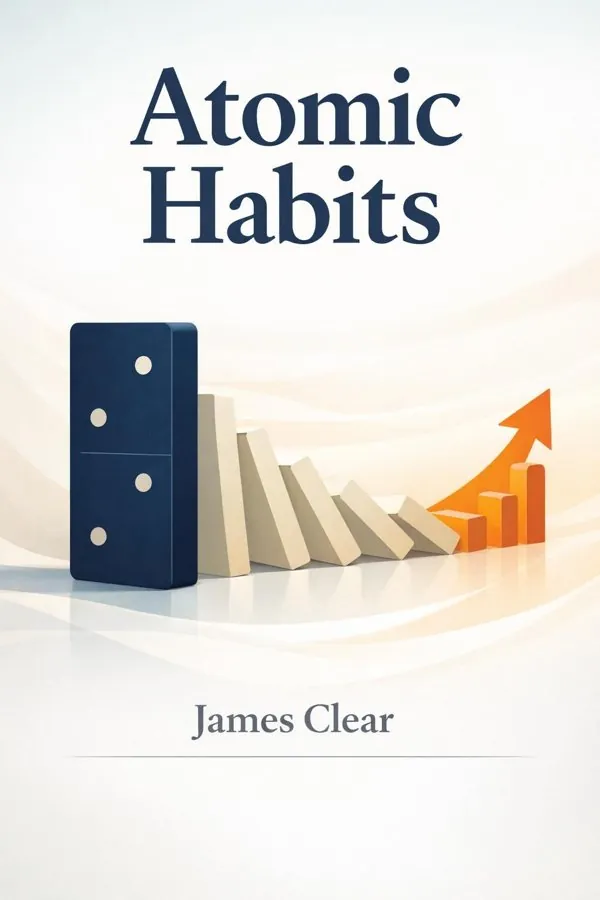
Atomic Habits: Summary & Key Insights
by James Clear
 10 min9 chaptersAudio available
Key Takeaways from Atomic Habits
We tend to overestimate the importance of one big moment and underestimate the power of small daily improvements.
Goals set direction, but systems determine progress.
The most durable habits are not built by forcing yourself to act differently for a few days.
Behavior is strongly shaped by cues, and most habits begin long before the action itself.
If good habits can be encouraged through smart design, bad habits can be weakened by making them less visible, less attractive, and more difficult.
What Is Atomic Habits About?
Atomic Habits by James Clear is a self-help book. What if the quality of your life depends less on dramatic breakthroughs and more on the tiny actions you repeat every day? In Atomic Habits, James Clear argues that lasting transformation does not come from radical reinvention, but from small, consistent improvements that compound over time. The book explains how habits shape identity, influence performance, and quietly determine whether we move toward the future we want or drift away from it. Rather than relying on motivation alone, Clear shows how to design systems that make good behaviors easier and bad behaviors harder. The book matters because most people fail to change not because they lack ambition, but because they use strategies that fight human nature. Clear combines insights from psychology, neuroscience, behavioral economics, and real-world examples from sports, business, and personal development to create a practical framework anyone can apply. As a writer and speaker known for his work on habit formation and continuous improvement, he has helped millions of readers rethink productivity and self-discipline. Atomic Habits stands out because it turns behavior change into something concrete, manageable, and deeply empowering.
This FizzRead summary covers all 9 key chapters of Atomic Habits in approximately 10 minutes, distilling the most important ideas, arguments, and takeaways from James Clear's work. Also available as an audio summary and Key Quotes Podcast.
Atomic Habits
What if the quality of your life depends less on dramatic breakthroughs and more on the tiny actions you repeat every day? In Atomic Habits, James Clear argues that lasting transformation does not come from radical reinvention, but from small, consistent improvements that compound over time. The book explains how habits shape identity, influence performance, and quietly determine whether we move toward the future we want or drift away from it. Rather than relying on motivation alone, Clear shows how to design systems that make good behaviors easier and bad behaviors harder.
The book matters because most people fail to change not because they lack ambition, but because they use strategies that fight human nature. Clear combines insights from psychology, neuroscience, behavioral economics, and real-world examples from sports, business, and personal development to create a practical framework anyone can apply. As a writer and speaker known for his work on habit formation and continuous improvement, he has helped millions of readers rethink productivity and self-discipline. Atomic Habits stands out because it turns behavior change into something concrete, manageable, and deeply empowering.
Who Should Read Atomic Habits?
This book is perfect for anyone interested in self-help and looking to gain actionable insights in a short read. Whether you're a student, professional, or lifelong learner, the key ideas from Atomic Habits by James Clear will help you think differently.
- ✓Readers who enjoy self-help and want practical takeaways
- ✓Professionals looking to apply new ideas to their work and life
- ✓Anyone who wants the core insights of Atomic Habits in just 10 minutes
Want the full summary?
Get instant access to this book summary and 100K+ more with Fizz Moment.
Get Free SummaryAvailable on App Store • Free to download
Key Chapters
We tend to overestimate the importance of one big moment and underestimate the power of small daily improvements. One workout rarely changes a body. One page rarely writes a book. One good decision rarely transforms a career. Yet repeated over weeks, months, and years, tiny actions compound into extraordinary outcomes. This is the central promise of Atomic Habits: a 1 percent improvement repeated consistently can produce results far beyond what seems possible in the moment.
James Clear uses the idea of compounding to show that habits are like interest for self-improvement. Good habits make time your ally, while bad habits make time your enemy. Reading ten pages a day seems minor, but over a year it becomes multiple books. Saving a small amount each week may feel insignificant, but it builds financial stability. Likewise, repeated procrastination, mindless snacking, or poor sleep slowly erode quality of life.
What makes this insight so useful is that it removes the pressure to change everything at once. You do not need a complete life overhaul to make progress. You need a repeatable process that nudges you in the right direction. When progress feels invisible, many people quit too soon. Clear reminds us that habits often deliver delayed rewards, and the breakthrough usually comes after a long period when nothing seems to be happening.
Actionable takeaway: Stop chasing dramatic overnight change. Pick one tiny behavior you can repeat daily, such as writing for five minutes or taking a ten-minute walk, and trust consistency more than intensity.
Goals set direction, but systems determine progress. That distinction changes everything. Most people think achievement is about setting better goals: lose twenty pounds, launch a business, get promoted, run a marathon. But James Clear argues that winners and losers often share similar goals. The difference lies in the systems they follow each day.
A goal is a desired result. A system is the collection of habits, routines, and environments that make the result more likely. If your goal is to write a book, your system might include waking early, writing before checking email, keeping notes organized, and tracking word count. If your goal is to improve health, your system might involve meal prep, regular sleep, and a scheduled exercise routine. Goals can motivate, but systems sustain.
This matters because goals create an either-or mentality. You are either at the destination or not. Systems encourage ongoing improvement. They pull your attention away from fantasy and toward execution. They also help after success. Once a goal is reached, many people relax and backslide because the structure that created the result was never fully internalized.
A system-centered mindset is more resilient. If results are slow, you can still win by sticking to the process. It also makes setbacks less emotional because you can ask, “What part of my system needs adjustment?” rather than “What is wrong with me?”
Actionable takeaway: Choose one important goal, then write the daily and weekly system that supports it. Measure whether you are following the system, not just whether you have reached the outcome.
The most durable habits are not built by forcing yourself to act differently for a few days. They are built by becoming the kind of person who naturally does those things. This is one of the most powerful ideas in Atomic Habits. James Clear argues that true behavior change starts with identity, not outcomes.
There are three levels of change: outcomes, processes, and identity. Outcomes are what you get. Processes are what you do. Identity is what you believe about yourself. Many people begin at the outcome level: “I want to lose weight,” “I want to save money,” or “I want to be more productive.” But lasting change becomes easier when the goal shifts to identity: “I am a healthy person,” “I am someone who manages money wisely,” or “I am the type of person who finishes what I start.”
Every action casts a vote for the type of person you want to become. One workout does not make you an athlete, but it is a vote for that identity. One organized work session is a vote for being focused and disciplined. The key is repetition. The more evidence you collect, the stronger the identity becomes.
This approach also changes self-talk. Instead of saying, “I am trying to quit smoking,” a person might say, “I am not a smoker.” Instead of “I want to read more,” say, “I am a reader.” Identity-based habits create internal alignment. You no longer rely only on willpower because your actions support who you believe you are.
Actionable takeaway: Ask, “Who do I want to become?” Then choose one small daily habit that proves that identity, and repeat it until the evidence becomes part of how you see yourself.
Behavior is strongly shaped by cues, and most habits begin long before the action itself. We often think discipline is the key driver of behavior, but environment usually matters more. James Clear’s first two laws of behavior change are simple and practical: make it obvious and make it easy.
A habit starts with a cue, so if you want a good habit to stick, bring the cue into view. If you want to take vitamins, place them beside your toothbrush. If you want to practice guitar, leave it on a stand in the middle of the room. If you want to read more, put a book on your pillow. This strategy, often called habit stacking or cue design, reduces the need for memory and motivation.
Ease matters just as much. Human beings naturally move toward the path of least resistance. The more friction a behavior requires, the less likely it is to happen. Prepare your workout clothes the night before. Keep healthy snacks visible. Use app blockers during work. Reduce the number of steps between intention and action. The goal is not to make change heroic. The goal is to make it automatic.
One useful method is the two-minute rule: when starting a habit, scale it down to a version that takes two minutes or less. “Read before bed” becomes “read one page.” “Start exercising” becomes “put on running shoes.” Small starts lower resistance and create consistency.
Actionable takeaway: Redesign one part of your environment today so the habit you want is visible, convenient, and easy enough to begin in under two minutes.
If good habits can be encouraged through smart design, bad habits can be weakened by making them less visible, less attractive, and more difficult. This is a refreshing shift from the common belief that self-control alone should solve everything. James Clear points out that people with strong habits are not always more disciplined. They are often better at avoiding tempting situations in the first place.
Bad habits are frequently triggered by cues in the environment. If your phone is always within reach, you will likely check it. If junk food is on the counter, you will probably eat it. If streaming apps are one click away, you may watch more than intended. The cue drives the craving before conscious thought catches up. That is why removing cues can be more effective than resisting them repeatedly.
Friction is the second tool. Increase the effort required to perform the unwanted behavior. Delete distracting apps from your phone. Keep sweets in a hard-to-reach place or do not buy them at all. Log out of social media after every use. Put your television remote in another room. Even small barriers can interrupt automatic behavior and create a moment of choice.
You can also use commitment devices. For example, automate savings transfers so money is not available to spend impulsively, or set website blockers during your work hours. These systems protect your future self from your present impulses.
Actionable takeaway: Identify the cue that triggers one recurring bad habit, then remove it or add friction so the behavior becomes inconvenient enough to interrupt.
One reason bad habits are hard to break is that they often feel good now, while their costs arrive later. Good habits usually work in reverse: they feel inconvenient in the moment, but their rewards come in the future. James Clear explains that human behavior is heavily influenced by immediate consequences, which is why the third law of behavior change is to make habits satisfying.
If a behavior feels rewarding, the brain learns to repeat it. That does not mean every habit must be fun, but it helps to create some immediate positive feedback. For example, after finishing a workout, you might mark it on a visible habit tracker. After completing a focused work session, you might enjoy a short break or a favorite tea. The satisfaction does not need to be large. It simply needs to reinforce the identity and make repetition more appealing.
Habit tracking is especially powerful because it turns invisible progress into something visible. A growing chain of completed days creates momentum and a desire not to break the streak. This taps into the human need for closure and accomplishment. However, Clear warns that tracking should support the habit, not replace the purpose behind it.
For breaking bad habits, attach immediate costs when possible. An accountability partner, a financial penalty, or a public commitment can make the downside of failure more immediate. The closer the consequence is to the behavior, the more likely it is to influence action.
Actionable takeaway: Add a small, immediate reward to one habit you want to build, and create a visible way to track your consistency so progress feels real every day.
The most dangerous moment in behavior change is often not failure, but discouragement. People expect progress to be linear, so when results seem slow, they assume their efforts are not working. James Clear calls attention to this hidden phase of growth, where habits are accumulating value beneath the surface before visible outcomes appear.
An ice cube remains solid as the temperature rises from twenty-five to thirty-one degrees. Then, at thirty-two degrees, it melts. The breakthrough seems sudden, but it was prepared by every degree that came before. Habits work much the same way. You may exercise for weeks before seeing a change in the mirror. You may publish content for months before gaining an audience. You may save money for a long time before feeling financially secure. The work matters even when the reward is delayed.
This idea is crucial because many people quit during the plateau of latent potential. They misread delayed results as evidence that change is not happening. In reality, they are often much closer than they think. Consistency is what carries you through the valley where progress is real but not yet visible.
Clear also emphasizes recovery from mistakes. Missing once is a normal part of life. Missing twice can become the start of a new habit. The goal is not perfection, but quick recovery. Long-term success depends less on never slipping and more on returning to the routine without drama or self-judgment.
Actionable takeaway: When progress feels invisible, keep the habit alive. Use the rule “never miss twice” so temporary setbacks do not become permanent patterns.
People often assume habits are mostly personal choices, but context shapes behavior far more than we like to admit. James Clear shows that environment is not just the backdrop of our lives. It is an active force directing attention, desire, and action. If you want lasting change, redesigning your surroundings is often more effective than trying to become more motivated.
A productive environment reduces distractions and makes focus easier. A healthy environment puts better options within reach. A creative environment encourages experimentation. For instance, if your desk is cluttered with unrelated tasks, your brain receives a constant signal of chaos. If your phone is beside your bed, the morning may begin with scrolling instead of intention. If your kitchen is stocked with highly processed snacks, good nutritional choices become harder.
Clear also notes that we imitate the habits of those around us. Culture matters. It is easier to adopt behaviors that are normal in your family, workplace, or social circle. Joining a group where your desired behavior is expected can speed up change dramatically. A running club makes running normal. A writing group makes writing feel natural. Social identity reinforces personal identity.
This principle can be applied at home, at work, and online. Curate the spaces you enter and the people you spend time with. The less your environment fights your goals, the less energy you waste resisting temptation.
Actionable takeaway: Choose one environment you use every day and redesign it so the behavior you want feels natural, while the behavior you want to avoid becomes less convenient and less visible.
Habits create consistency, but consistency alone is not enough for long-term growth. Repetition can build skill, but it can also lock in mediocrity if you stop reflecting. James Clear points out that the ultimate purpose of habits is not mindless routine. It is to free mental energy so you can improve what matters.
As behaviors become automatic, they require less attention. That is efficient, but it can also lead to stagnation. Someone may work out regularly without progressing because the routine never changes. A professional may perform familiar tasks every day without developing new abilities. Habits should support mastery, not replace deliberate improvement.
This is why periodic review matters. Clear suggests evaluating habits and systems at regular intervals. Ask what is working, what is not, and whether your habits still match the person you want to become. A system that served you at one stage of life may need to evolve. Reviewing habits helps prevent autopilot living.
Another key idea is to play to your strengths. The best habits are not copied blindly from others. They are adapted to your personality, energy patterns, and circumstances. A morning routine may work well for one person and poorly for another. Some people thrive with strict structure; others need flexibility. The right system is the one you can sustain.
Actionable takeaway: Set a recurring weekly or monthly review to assess your habits, refine your system, and ensure your routines still align with your goals, identity, and natural strengths.
All Chapters in Atomic Habits
About the Author
James Clear is an American writer, speaker, and productivity expert best known for his work on habits, decision-making, and continuous improvement. He built a large audience through his widely read articles and newsletter, where he translates behavioral science into practical strategies for everyday life. His writing focuses on how small actions, repeated consistently, can lead to meaningful personal and professional growth. Clear’s breakthrough book, Atomic Habits, became an international bestseller and established him as one of the leading voices in modern self-development. He is especially valued for his ability to make complex psychological ideas simple, actionable, and relevant for readers seeking lasting change.
Get This Summary in Your Preferred Format
Read or listen to the Atomic Habits summary by James Clear anytime, anywhere. FizzRead offers multiple formats so you can learn on your terms — all free.
Available formats: App · Audio · PDF · EPUB — All included free with FizzRead
Download Atomic Habits PDF and EPUB Summary
Key Quotes from Atomic Habits
“We tend to overestimate the importance of one big moment and underestimate the power of small daily improvements.”
“Goals set direction, but systems determine progress.”
“The most durable habits are not built by forcing yourself to act differently for a few days.”
“Behavior is strongly shaped by cues, and most habits begin long before the action itself.”
“If good habits can be encouraged through smart design, bad habits can be weakened by making them less visible, less attractive, and more difficult.”
Frequently Asked Questions about Atomic Habits
Atomic Habits by James Clear is a self-help book that explores key ideas across 9 chapters. What if the quality of your life depends less on dramatic breakthroughs and more on the tiny actions you repeat every day? In Atomic Habits, James Clear argues that lasting transformation does not come from radical reinvention, but from small, consistent improvements that compound over time. The book explains how habits shape identity, influence performance, and quietly determine whether we move toward the future we want or drift away from it. Rather than relying on motivation alone, Clear shows how to design systems that make good behaviors easier and bad behaviors harder. The book matters because most people fail to change not because they lack ambition, but because they use strategies that fight human nature. Clear combines insights from psychology, neuroscience, behavioral economics, and real-world examples from sports, business, and personal development to create a practical framework anyone can apply. As a writer and speaker known for his work on habit formation and continuous improvement, he has helped millions of readers rethink productivity and self-discipline. Atomic Habits stands out because it turns behavior change into something concrete, manageable, and deeply empowering.
Compare Atomic Habits

More by James Clear
You Might Also Like


Featured In
Joe Rogan's Book Picks
Joe Rogan's Go-To Books: What He Can't Stop Recommending
Cal Newport's Book Picks
Cal Newport's Deep Work Reading List
Mel Robbins's Book Picks
Mel Robbins' Motivation Essentials
Curated's Book Picks
Best Self-Help Books of All Time — Transform Your Life
Curated's Book Picks
Books Everyone Should Read — Universal Essentials
Curated's Book Picks
Best Audiobooks of All Time — Listen to the Greatest Books
Psychology's Book Picks
Inside Your Mind: Psychology Books That Change Everything
Curated List's Book Picks
Best Motivational Books of All Time - 15 Must-Read Books | FizzRead
Browse by Category
Ready to read Atomic Habits?
Get the full summary and 100K+ more books with Fizz Moment.