
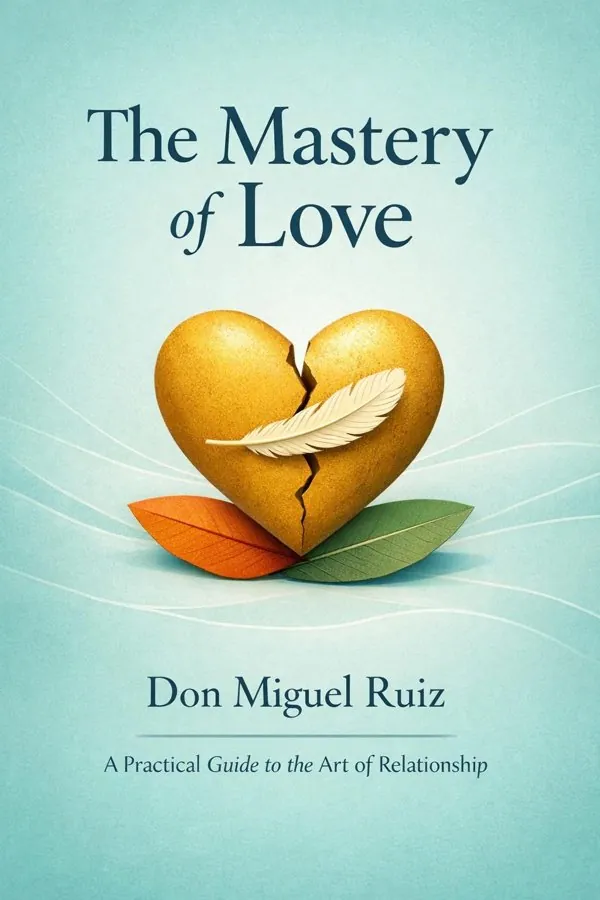
The Mastery of Love: Summary & Key Insights
 10 min9 chaptersAudio available
Key Takeaways from The Mastery of Love
Most relationship pain begins long before the relationship itself.
Fear becomes powerful when it starts to feel like your own voice.
One of the great illusions in relationships is the belief that another person can give you the love you do not give yourself.
The quality of your relationship with yourself sets the ceiling for every other relationship in your life.
Many people imagine the perfect relationship as total emotional fusion: two people who always agree, always understand each other, and never feel distance.
What Is The Mastery of Love About?
The Mastery of Love by Don Miguel Ruiz is a self-help book published in 1999 spanning 7 pages. Why do so many people long for love yet repeatedly create pain in their closest relationships? In The Mastery of Love, Don Miguel Ruiz argues that the answer is not a lack of love, but a mind shaped by fear, emotional wounds, and false beliefs. Drawing on Toltec wisdom, Ruiz reframes love as a natural state that already exists within us. What blocks it are the stories we carry about rejection, control, worthiness, jealousy, and need. Rather than offering dating advice or communication tricks, Ruiz goes deeper. He explores how childhood conditioning creates what he calls the wounded mind, how fear becomes the hidden force behind conflict, and why many relationships are built on dependency instead of genuine affection. From there, he shows how self-love, awareness, forgiveness, and emotional responsibility can transform the way we relate to others. The book matters because it treats love not as luck, chemistry, or sacrifice, but as a practice of inner freedom. Ruiz, best known for The Four Agreements, brings spiritual clarity and practical insight to one of life’s most universal struggles: learning how to love without fear.
This FizzRead summary covers all 9 key chapters of The Mastery of Love in approximately 10 minutes, distilling the most important ideas, arguments, and takeaways from Don Miguel Ruiz's work. Also available as an audio summary and Key Quotes Podcast.
The Mastery of Love
Why do so many people long for love yet repeatedly create pain in their closest relationships? In The Mastery of Love, Don Miguel Ruiz argues that the answer is not a lack of love, but a mind shaped by fear, emotional wounds, and false beliefs. Drawing on Toltec wisdom, Ruiz reframes love as a natural state that already exists within us. What blocks it are the stories we carry about rejection, control, worthiness, jealousy, and need.
Rather than offering dating advice or communication tricks, Ruiz goes deeper. He explores how childhood conditioning creates what he calls the wounded mind, how fear becomes the hidden force behind conflict, and why many relationships are built on dependency instead of genuine affection. From there, he shows how self-love, awareness, forgiveness, and emotional responsibility can transform the way we relate to others.
The book matters because it treats love not as luck, chemistry, or sacrifice, but as a practice of inner freedom. Ruiz, best known for The Four Agreements, brings spiritual clarity and practical insight to one of life’s most universal struggles: learning how to love without fear.
Who Should Read The Mastery of Love?
This book is perfect for anyone interested in self-help and looking to gain actionable insights in a short read. Whether you're a student, professional, or lifelong learner, the key ideas from The Mastery of Love by Don Miguel Ruiz will help you think differently.
- ✓Readers who enjoy self-help and want practical takeaways
- ✓Professionals looking to apply new ideas to their work and life
- ✓Anyone who wants the core insights of The Mastery of Love in just 10 minutes
Want the full summary?
Get instant access to this book summary and 100K+ more with Fizz Moment.
Get Free SummaryAvailable on App Store • Free to download
Key Chapters
Most relationship pain begins long before the relationship itself. Ruiz suggests that from childhood, we inherit emotional wounds from a world already shaped by fear. Parents, teachers, siblings, and institutions may love us, yet they often pass along shame, punishment, criticism, and unrealistic expectations. Over time, we learn to fear rejection, to seek approval, and to hide parts of ourselves in order to feel safe. This is how the wounded mind is formed.
The important point is not to blame others. Those who taught us fear were usually repeating what they themselves had learned. But unless we recognize this inherited pattern, we keep reenacting it in adult love. We may become jealous because we fear abandonment. We may become controlling because uncertainty feels unbearable. We may settle for poor treatment because our self-worth was damaged early on.
A simple example is someone who grew up being praised only for achievement. As an adult, they may unconsciously believe they must perform to deserve love. In relationships, this can look like overgiving, people-pleasing, or panic when a partner seems disappointed. Another person raised in criticism may interpret neutral comments as attacks and react defensively.
Ruiz invites readers to see these reactions with compassion rather than judgment. Your patterns are not proof that you are broken; they are signs of old wounds asking to be healed. The more clearly you understand where your fear comes from, the less control it has over your behavior.
Actionable takeaway: Identify one recurring relationship trigger and trace it back to an early belief about love, safety, or worthiness. Awareness is the first step in healing the wounded mind.
Fear becomes powerful when it starts to feel like your own voice. Ruiz uses the metaphor of the parasite to describe the inner force that feeds on negative emotions such as jealousy, anger, resentment, guilt, and self-pity. This parasite thrives when your mind is crowded with fear-based thoughts, because each painful emotion gives it more energy. In practical terms, it is the pattern of inner dialogue that keeps suffering alive.
Think about how one small insecurity can spiral. A partner takes longer than usual to reply to a message. Instead of waiting calmly, the mind invents stories: They are losing interest. I did something wrong. Maybe they found someone else. Very quickly, anxiety becomes accusation, withdrawal, or emotional drama. The original event was small, but the parasite amplified it by feeding on fear.
Ruiz’s insight is that many people mistake this voice for truth. They assume every suspicion is valid, every hurt feeling is evidence, and every emotional impulse deserves expression. But the parasite is not wisdom. It is a conditioned pattern that survives by keeping you reactive.
The antidote is not repression but observation. When you can pause and notice, “This is fear speaking,” you weaken its hold. You stop identifying completely with every emotional storm. This creates space for wiser action: asking a clear question, calming your body, or refusing to escalate conflict.
The parasite also feeds on self-attack. If you regularly tell yourself that you are unlovable, unattractive, or not enough, you strengthen the system that creates suffering. Self-love interrupts that cycle.
Actionable takeaway: The next time you feel emotionally triggered, name the parasite directly. Ask, “What story is fear trying to make me believe right now?”
One of the great illusions in relationships is the belief that another person can give you the love you do not give yourself. Ruiz argues that this expectation is the source of endless disappointment. When you look to a partner to complete you, rescue you, or make you feel worthy, love becomes mixed with need, control, and fear. You do not relate freely; you relate from emotional hunger.
This myth appears in many forms. People believe the right partner will erase loneliness, heal insecurity, or finally prove that they matter. But if your inner world is already dominated by self-rejection, no external affection will feel stable for long. Compliments will be doubted. Reassurance will need repeating. Temporary closeness will be followed by fresh anxiety.
Ruiz does not deny the beauty of shared love. Instead, he insists that healthy love flows between two full people rather than two empty people trying to fill each other. When you discover that love already exists within you, relationships become expressions of joy rather than survival strategies.
For example, someone grounded in self-love can appreciate a partner’s affection without turning every disagreement into a threat. They can enjoy companionship without clinging. They can be honest about needs without demanding that another person regulate their entire emotional world.
This idea is especially helpful for anyone who confuses attachment with love. Attachment says, “I need you so I can feel okay.” Love says, “I choose you, and I also remain connected to my own worth.” That shift changes everything.
Actionable takeaway: Replace one thought of emotional dependency with a truth of self-sufficiency, such as “I welcome love from others, but my worth does not depend on it.”
The quality of your relationship with yourself sets the ceiling for every other relationship in your life. Ruiz teaches that self-love is not vanity, selfishness, or self-absorption. It is the willingness to treat yourself with dignity, truth, and compassion. Without it, love from others will either feel undeserved or become something you desperately cling to.
Many people claim to love others while quietly abusing themselves. They speak harshly in their own minds, ignore their boundaries, compare themselves constantly, and accept behavior they know is harmful. Then they wonder why love feels unstable. If you do not honor yourself, you teach others how little honor you expect.
Self-love means accepting yourself as you are while remaining open to growth. It means caring for your body, protecting your peace, and refusing to define yourself by old wounds. It also means ending the internal war between who you are and who you think you must be to earn approval.
Consider someone who fears being alone, so they stay in a relationship where they are regularly dismissed. Their real healing begins not when the other person changes, but when they decide their own heart deserves respect. That decision may lead them to communicate differently, seek support, or walk away entirely.
Ruiz’s broader point is simple: when you are full of love, you naturally become more generous, patient, and clear with others. You stop bargaining for affection because you are no longer starving.
Actionable takeaway: Practice one act of self-love daily this week, such as speaking kindly to yourself, saying no without guilt, or making time for rest that honors your emotional well-being.
Many people imagine the perfect relationship as total emotional fusion: two people who always agree, always understand each other, and never feel distance. Ruiz offers a very different vision. A healthy relationship is not built on possession or control, but on freedom, respect, and mutual choice. Love flourishes when both people are free to be themselves.
This means real intimacy cannot be forced. You cannot love someone well while trying to manage their thoughts, control their friendships, monitor their emotions, or shape them into your ideal. The moment love becomes ownership, fear has taken over. Jealousy, manipulation, and constant demands for reassurance are not signs of depth; they are signs that freedom is missing.
In practice, respect for freedom looks like honest communication without coercion. It means letting your partner have their own feelings, boundaries, interests, and growth process. It also means preserving your own individuality. Two people can be deeply committed without disappearing into each other.
For example, a secure couple may spend meaningful time together but still support each other’s friendships, private reflection, career ambitions, or creative goals. When conflict arises, they seek understanding rather than victory. They know that agreement is not the same as love, and difference is not the same as rejection.
Ruiz calls this kind of bond a relationship between two masters rather than two victims. Each person takes responsibility for their own happiness and offers love as a gift, not a contract. That creates more peace, less drama, and a stronger connection.
Actionable takeaway: Ask yourself where control has replaced respect in one important relationship, and choose one behavior this week that gives more freedom and less pressure.
Unforgiven pain does not stay in the past; it leaks into the present. Ruiz emphasizes that emotional healing requires forgiveness, not because harmful actions were acceptable, but because carrying resentment keeps you tied to the wound. As long as the past controls your reactions, it continues to shape your capacity to love.
Forgiveness begins with understanding that wounded people often wound others. This does not excuse betrayal, neglect, criticism, or abuse. It simply allows you to see that much of what hurt you came from fear and unconsciousness rather than from your true value. When you stop personalizing every injury as proof of your unworthiness, healing becomes possible.
Ruiz also points out that self-forgiveness is essential. Many people remain trapped not only by what others did to them, but by shame over what they tolerated, how they reacted, or mistakes they made in return. They replay old scenes and punish themselves repeatedly. This keeps the wound alive.
In practical terms, forgiveness may involve grieving what happened, telling the truth about its effects, and choosing not to let it define your future relationships. For some, it means having a conversation. For others, it means releasing internally without re-entering unsafe dynamics. Forgiveness does not always require reconciliation.
Imagine someone betrayed in a past relationship. Without healing, they may suspect every future partner, search for signs of dishonesty, and sabotage closeness. With forgiveness, they do not erase the lesson, but they stop making every new person pay for an old injury.
Actionable takeaway: Write down one past hurt that still shapes your present behavior and complete this sentence: “I am ready to stop carrying this because…”
You cannot transform a pattern you do not notice. Ruiz presents awareness as the doorway to true love because awareness interrupts automatic fear-based behavior. Before change becomes possible, you must see clearly: your stories, your emotional habits, your defensive reactions, and the agreements you have made about what love means.
Awareness is more than intellectual understanding. It is moment-to-moment witnessing. It is the ability to observe your internal state without immediately acting from it. When jealousy appears, you notice it. When anger rises, you feel it without letting it dictate your words. When a familiar fear says, “You are being rejected,” you pause long enough to examine whether that is actually true.
This is powerful because most relationship damage happens on autopilot. A partner makes a careless remark, and an old wound is triggered. Before you know it, you are attacking, withdrawing, blaming, or begging. Awareness creates a gap between trigger and response, and in that gap, freedom begins.
A practical example is noticing bodily signs of emotional escalation: tight chest, racing thoughts, clenched jaw, urge to interrupt. These signals can become invitations to slow down rather than evidence that you must react immediately. Awareness also helps you detect recurring agreements, such as “If someone loves me, they should always know what I need,” or “Conflict means the relationship is failing.”
Ruiz sees awareness as compassionate truth-telling. It does not shame you for your conditioning; it helps you outgrow it. The more conscious you become, the less available you are for drama and the more available you are for love.
Actionable takeaway: Start a daily two-minute reflection practice by asking, “What fear ran my behavior today, and what would love have done instead?”
Much relationship suffering comes not from what is actually happening, but from what people assume is happening. While Ruiz’s broader teachings often emphasize the danger of assumptions, The Mastery of Love applies this directly to intimacy. People expect partners to read minds, interpret moods correctly, and satisfy unspoken needs. When that does not happen, they feel hurt, rejected, or angry.
The problem is that assumptions are usually written by fear. If your partner is quiet, you may assume disapproval. If they need space, you may assume abandonment. If they forget something important, you may assume you do not matter. In reality, many conflicts begin not with bad intent, but with private stories left untested.
Healthy love requires honest communication. This means expressing needs clearly, asking questions instead of accusing, and listening without preparing a defense. It also means saying what is true for you without expecting another person to rescue every discomfort. Clear communication is an act of respect because it gives the other person a fair chance to understand and respond.
For example, compare “You obviously do not care about me” with “When you canceled our plan without much explanation, I felt hurt and would like to talk about it.” The second statement leaves room for connection instead of pushing the conversation into conflict. It focuses on truth rather than interpretation.
Ruiz’s deeper message is that love becomes simpler when we stop making others responsible for our imagined narratives. Communication cannot guarantee agreement, but it reduces unnecessary suffering and builds trust.
Actionable takeaway: In your next difficult conversation, replace one accusation with a question and one assumption with a direct statement of what you feel and need.
Love deepens where appreciation is present. Ruiz concludes with a vision of life rooted not merely in healing from fear, but in actively living through gratitude, joy, and presence. Once you are no longer consumed by inner drama, you can experience love as a state of abundance rather than scarcity. Gratitude shifts your attention from what is missing to what is already alive and beautiful.
This does not mean denying pain or pretending everything is perfect. It means refusing to let fear dominate your perception. Many people overlook the goodness in their relationships because they are trained to scan for danger, disappointment, or proof of rejection. Gratitude retrains the mind to recognize care, growth, effort, and shared moments of connection.
In practical terms, gratitude may look like thanking a partner for a small act of consideration, appreciating your own progress in healing, or simply noticing the peace of an honest conversation. Joy can be found in laughter, affection, creativity, and ordinary moments that require no drama to feel meaningful.
Ruiz suggests that when your heart is open, love becomes less about struggle and more about radiance. You stop treating suffering as evidence of seriousness. Instead, you understand that the healthiest relationships often feel lighter, freer, and more playful than the wounded mind expects.
This applies beyond romance. Gratitude improves friendships, family bonds, and your relationship with life itself. It reinforces the truth that love is not rare when your heart is available to perceive it.
Actionable takeaway: End each day by naming three moments of love or goodness you experienced, however small, and let gratitude train your mind away from fear.
All Chapters in The Mastery of Love
About the Author
Don Miguel Ruiz is a Mexican author, spiritual teacher, and one of the most influential modern interpreters of Toltec wisdom. Although he was trained as a medical doctor, a life-changing spiritual awakening led him away from medicine and toward a path of teaching and writing. Ruiz became internationally known through The Four Agreements, a bestselling self-help classic that introduced millions of readers to ideas about personal freedom, awareness, and the power of belief. His work blends ancient spiritual insights with direct, practical guidance for everyday life. In books such as The Mastery of Love, The Voice of Knowledge, and The Fifth Agreement, he explores how fear and limiting agreements create suffering, and how truth, self-love, and consciousness can restore inner peace and authentic connection.
Get This Summary in Your Preferred Format
Read or listen to the The Mastery of Love summary by Don Miguel Ruiz anytime, anywhere. FizzRead offers multiple formats so you can learn on your terms — all free.
Available formats: App · Audio · PDF · EPUB — All included free with FizzRead
Download The Mastery of Love PDF and EPUB Summary
Key Quotes from The Mastery of Love
“Most relationship pain begins long before the relationship itself.”
“Fear becomes powerful when it starts to feel like your own voice.”
“One of the great illusions in relationships is the belief that another person can give you the love you do not give yourself.”
“The quality of your relationship with yourself sets the ceiling for every other relationship in your life.”
“Many people imagine the perfect relationship as total emotional fusion: two people who always agree, always understand each other, and never feel distance.”
Frequently Asked Questions about The Mastery of Love
The Mastery of Love by Don Miguel Ruiz is a self-help book that explores key ideas across 9 chapters. Why do so many people long for love yet repeatedly create pain in their closest relationships? In The Mastery of Love, Don Miguel Ruiz argues that the answer is not a lack of love, but a mind shaped by fear, emotional wounds, and false beliefs. Drawing on Toltec wisdom, Ruiz reframes love as a natural state that already exists within us. What blocks it are the stories we carry about rejection, control, worthiness, jealousy, and need. Rather than offering dating advice or communication tricks, Ruiz goes deeper. He explores how childhood conditioning creates what he calls the wounded mind, how fear becomes the hidden force behind conflict, and why many relationships are built on dependency instead of genuine affection. From there, he shows how self-love, awareness, forgiveness, and emotional responsibility can transform the way we relate to others. The book matters because it treats love not as luck, chemistry, or sacrifice, but as a practice of inner freedom. Ruiz, best known for The Four Agreements, brings spiritual clarity and practical insight to one of life’s most universal struggles: learning how to love without fear.
More by Don Miguel Ruiz
You Might Also Like

Featured In
Browse by Category
Ready to read The Mastery of Love?
Get the full summary and 100K+ more books with Fizz Moment.