
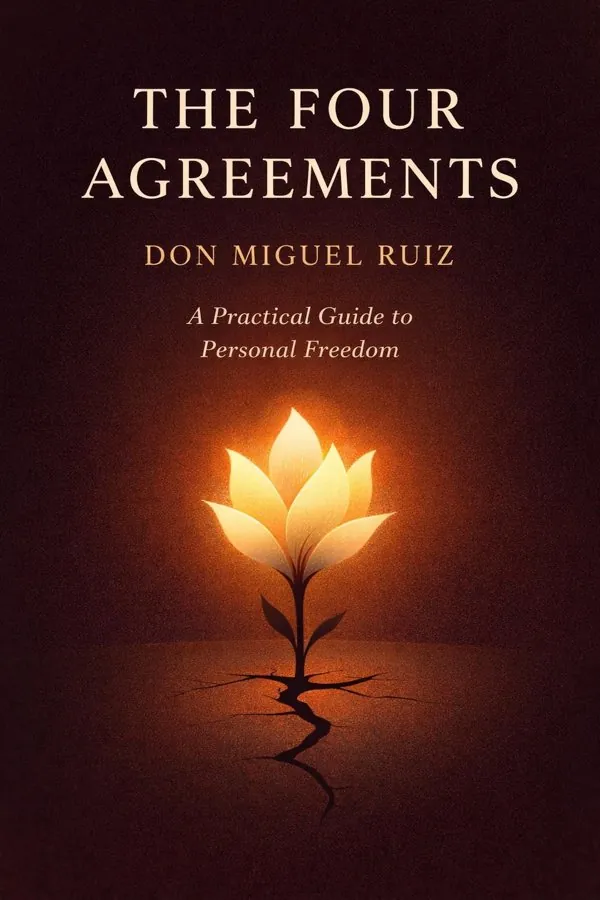
The Four Agreements: A Practical Guide to Personal Freedom: Summary & Key Insights
 10 min9 chaptersAudio available
Key Takeaways from The Four Agreements: A Practical Guide to Personal Freedom
One of the book’s most striking ideas is that most people are not simply living life; they are living inside a dream they did not consciously choose.
A single sentence can heal a wound, ignite a war, or imprison a person for years.
Much of our emotional pain comes not from what happens, but from the meaning we attach to what happens.
Ruiz’s third agreement, “Don’t make assumptions,” targets one of the mind’s favorite shortcuts.
The fourth agreement, “Always do your best,” sounds simple, but Ruiz uses it to dissolve two major sources of suffering: self-judgment and inconsistency.
What Is The Four Agreements: A Practical Guide to Personal Freedom About?
The Four Agreements: A Practical Guide to Personal Freedom by Don Miguel Ruiz is a eastern_wisdom book spanning 8 pages. The Four Agreements is a small book with an unusually large impact. Drawing on what Don Miguel Ruiz presents as ancient Toltec wisdom, it argues that much of human suffering is not caused by life itself, but by the invisible beliefs, fears, and stories we absorb from family, culture, religion, and our own inner critic. Ruiz’s central claim is simple yet radical: if we replace our unconscious conditioning with four conscious agreements, we can live with greater peace, integrity, and freedom. Those agreements are to be impeccable with your word, not take anything personally, not make assumptions, and always do your best. What makes the book enduring is its practicality. Ruiz does not offer abstract philosophy for its own sake; he offers a framework for changing how we speak, interpret conflict, relate to others, and respond to ourselves. His authority comes from his background as a Mexican spiritual teacher shaped by Toltec tradition, but the book’s appeal is universal because its insights touch everyday life. Whether you struggle with anxiety, resentment, self-judgment, or relationship tension, this book offers a clear path toward emotional freedom.
This FizzRead summary covers all 9 key chapters of The Four Agreements: A Practical Guide to Personal Freedom in approximately 10 minutes, distilling the most important ideas, arguments, and takeaways from Don Miguel Ruiz's work. Also available as an audio summary and Key Quotes Podcast.
The Four Agreements: A Practical Guide to Personal Freedom
The Four Agreements is a small book with an unusually large impact. Drawing on what Don Miguel Ruiz presents as ancient Toltec wisdom, it argues that much of human suffering is not caused by life itself, but by the invisible beliefs, fears, and stories we absorb from family, culture, religion, and our own inner critic. Ruiz’s central claim is simple yet radical: if we replace our unconscious conditioning with four conscious agreements, we can live with greater peace, integrity, and freedom. Those agreements are to be impeccable with your word, not take anything personally, not make assumptions, and always do your best.
What makes the book enduring is its practicality. Ruiz does not offer abstract philosophy for its own sake; he offers a framework for changing how we speak, interpret conflict, relate to others, and respond to ourselves. His authority comes from his background as a Mexican spiritual teacher shaped by Toltec tradition, but the book’s appeal is universal because its insights touch everyday life. Whether you struggle with anxiety, resentment, self-judgment, or relationship tension, this book offers a clear path toward emotional freedom.
Who Should Read The Four Agreements: A Practical Guide to Personal Freedom?
This book is perfect for anyone interested in eastern_wisdom and looking to gain actionable insights in a short read. Whether you're a student, professional, or lifelong learner, the key ideas from The Four Agreements: A Practical Guide to Personal Freedom by Don Miguel Ruiz will help you think differently.
- ✓Readers who enjoy eastern_wisdom and want practical takeaways
- ✓Professionals looking to apply new ideas to their work and life
- ✓Anyone who wants the core insights of The Four Agreements: A Practical Guide to Personal Freedom in just 10 minutes
Want the full summary?
Get instant access to this book summary and 100K+ more with Fizz Moment.
Get Free SummaryAvailable on App Store • Free to download
Key Chapters
A single sentence can heal a wound, ignite a war, or imprison a person for years. Ruiz’s first agreement, “Be impeccable with your word,” begins with the claim that words are creative power. Language does not merely describe reality; it shapes how we experience reality. The stories we tell ourselves and others become emotional architecture. Repeated often enough, they become identity.
To be impeccable with your word means to use language with integrity, truth, and love. Ruiz warns against using words as poison through gossip, self-attack, blame, manipulation, or careless criticism. When someone says to a child, “You’re lazy,” “You’re difficult,” or “You’ll never succeed,” those words can become long-term agreements the child carries into adulthood. The same thing happens in self-talk. Quiet inner phrases like “I always ruin things” or “Nobody really values me” can shape mood, behavior, and possibility.
Being impeccable does not mean being soft, silent, or unrealistically positive. It means speaking honestly without using truth as a weapon. It also means refusing to participate in verbal toxicity, including gossip that spreads emotional contamination. In daily life, this can look like pausing before responding in anger, correcting yourself when you exaggerate, or replacing self-insults with accurate observations. Instead of “I’m terrible at this,” you might say, “I’m still learning.”
Ruiz presents this agreement as the most powerful because it directly changes the code of the dream. Better words create a better inner and outer world. Actionable takeaway: for one day, monitor your speech closely. Eliminate gossip, catch one negative self-statement, and replace it with language that is honest but not harmful.
Much of our emotional pain comes not from what happens, but from the meaning we attach to what happens. Ruiz’s second agreement, “Don’t take anything personally,” is a direct challenge to the habit of making ourselves the center of other people’s behavior. He argues that what others say and do reflects their own beliefs, fears, wounds, expectations, and emotional state. Their reactions are expressions of their personal dream, not objective truths about you.
This idea is liberating because it weakens the hold of praise and criticism alike. If someone insults you, rejects you, overlooks you, or lashes out, the automatic response is often to internalize it: “What is wrong with me?” Ruiz says that this interpretation is unnecessary suffering. The insult may hurt, but it originates in the other person’s conditioning. In the same way, excessive praise can become a trap if your self-worth starts depending on outside approval.
Practically, not taking things personally does not mean becoming indifferent or emotionally numb. It means creating a pause between another person’s behavior and your self-definition. Imagine a coworker responds sharply in a meeting. Instead of concluding, “They don’t respect me,” you might consider that they are stressed, insecure, or distracted. If a friend forgets to text back, it may reflect their busyness, not your value.
This agreement is especially helpful in relationships, workplaces, and social media environments where misunderstanding spreads quickly. It allows you to respond rather than react. Actionable takeaway: the next time someone’s behavior stings, ask yourself three questions: What story am I telling about this? What else could explain their behavior? Do I want to believe this reflects my worth?
Ruiz’s third agreement, “Don’t make assumptions,” targets one of the mind’s favorite shortcuts. We assume people know what we mean, assume silence means rejection, assume tone reveals intention, and assume our interpretation is fact. The problem is that assumptions fill gaps in information with fear, projection, or fantasy. Then we react to the story we invented as if it were reality.
This pattern damages relationships constantly. A partner seems distant, and we assume they are upset with us. A manager sends a brief email, and we assume we are in trouble. A friend does not invite us somewhere, and we assume we are no longer valued. In each case, the mind turns uncertainty into certainty without evidence. The emotional consequence can be resentment, anxiety, defensiveness, or withdrawal.
Ruiz’s solution is surprisingly simple: ask questions, express what you mean clearly, and seek truth rather than guessing. This requires courage because assumptions often feel safer than direct communication. Yet assumptions are only safe in appearance; they create hidden tension and false narratives. Clear communication, though sometimes uncomfortable, prevents many conflicts before they harden.
In practical life, this agreement can transform conversations at home and work. Instead of silently interpreting someone’s mood, ask, “Is something on your mind?” Instead of assuming expectations, ask, “What does success look like here?” Instead of expecting mind reading, say, “What I need is…” This is not about overexplaining everything. It is about refusing to let confusion become a breeding ground for drama.
Actionable takeaway: pick one relationship where tension exists and replace one assumption with one clarifying question this week. Understanding usually begins where guessing ends.
The fourth agreement, “Always do your best,” sounds simple, but Ruiz uses it to dissolve two major sources of suffering: self-judgment and inconsistency. He explains that your best is not a fixed standard. It changes depending on your energy, health, knowledge, emotions, and circumstances. Your best when you are well-rested is different from your best when you are grieving, overwhelmed, or sick. Freedom comes from giving sincere effort in the present moment, not from demanding perfection from every moment.
This agreement matters because many people live in a cycle of overreaching and self-punishment. They set impossible standards, fail to meet them, then attack themselves for not being better. Others avoid effort because they fear imperfection. Ruiz offers a middle path: do what you honestly can, and let that be enough. If your best is genuine, there is less regret, less guilt, and less room for the inner judge to dominate.
In real life, this can mean approaching work with full attention instead of comparing yourself endlessly to others. It can mean showing up kindly in a hard conversation even if you are not eloquent. It can mean exercising for fifteen minutes instead of skipping it because you cannot do an hour. The agreement encourages consistency over ego. It values sincerity over image.
Importantly, doing your best also supports the other agreements. You will not always speak impeccably, avoid assumptions, or remain unshaken by others. But if you keep practicing sincerely, progress replaces perfectionism. Actionable takeaway: at the start of each day, define one area where you will do your best realistically—not ideally. At the end of the day, measure yourself by honesty of effort, not by flawless results.
A powerful premise in the book is that suffering is sustained by agreements we have accepted, often unconsciously. These agreements may sound like: “I must earn love,” “Conflict is dangerous,” “I am not enough,” or “If I fail, I am a failure.” Ruiz emphasizes that these beliefs are not destiny. They are contracts of attention and interpretation, and what has been agreed to can also be challenged, weakened, and replaced.
Breaking old agreements is difficult because they feel familiar and therefore true. Many are tied to emotional memories, social belonging, or fear of rejection. You may understand intellectually that a belief is harmful while still behaving as if it controls you. Ruiz’s contribution is to frame transformation not as self-improvement in the conventional sense, but as a process of unlearning. Freedom is less about adding a new personality and more about removing false commands.
In practice, rewriting agreements begins with noticing repeated patterns. If you constantly apologize, overwork, hide your opinions, or panic at criticism, there is likely an underlying agreement beneath the behavior. Once identified, it can be questioned. Is this belief universally true? Does it bring peace or suffering? Who would I be without it? New agreements gain strength through repetition, action, and self-awareness.
For example, someone raised to believe that rest is laziness may consciously practice a new agreement: “Rest is part of caring for my life.” Someone who fears rejection may replace “I need everyone’s approval” with “I can remain worthy even when misunderstood.” These shifts take time, but each conscious repetition weakens the old program.
Actionable takeaway: write down one painful belief you are ready to release and create a replacement agreement that is both compassionate and believable. Repeat it daily and support it with one aligned action.
Ruiz does not define freedom primarily as independence from external rules, money, institutions, or obligations. He defines it as liberation from the internal system of fear, self-rejection, and automatic belief. This is why the book resonates deeply with readers who seem outwardly functional but inwardly burdened. You can be successful and still not be free if your mind is ruled by shame, resentment, and the need for approval.
The path to personal freedom begins with awareness of how suffering is generated. Ruiz describes a human mind divided by the judge and the victim: one voice condemns, the other absorbs the blow. This inner arrangement keeps people trapped in guilt, blame, and emotional repetition. The four agreements interrupt that cycle. Each one reclaims a part of consciousness: the power of language, the interpretation of others, the need for clarity, and the discipline of sincere effort.
This freedom is practical, not mystical in an abstract sense. It appears in the ability to hear criticism without collapsing, to communicate directly instead of stewing silently, to stop rehearsing old hurts, and to release the impossible burden of being perfect. It also includes self-forgiveness. Ruiz repeatedly points toward love as the opposite of fear, suggesting that a free life is not merely calmer but more open-hearted.
Readers can apply this by treating everyday discomfort as a signal for awareness. A trigger reveals an old agreement. A defensive reaction reveals an assumption. A harsh inner monologue reveals misuse of the word. Freedom grows not through dramatic breakthroughs alone, but through repeated moments of conscious interruption.
Actionable takeaway: when emotional discomfort arises, pause and name which agreement is being challenged. That simple act turns pain into practice and awareness into freedom.
Ruiz uses spiritual language in a practical psychological way. For him, heaven and hell are not distant places but states of consciousness available in daily life. Hell is the ongoing experience of fear, judgment, blame, envy, and inner conflict. Heaven is the experience of love, truth, acceptance, and peace. Most people move between these states constantly, often without realizing that their habits of thought and interpretation help create them.
This framing matters because it returns agency to the individual. If hell is a state produced by toxic agreements, then it is not inevitable. If heaven is a state created by loving awareness, then it can begin now, not after circumstances become perfect. The four agreements function as a bridge from one inner world to another.
Consider how quickly emotional climates change based on interpretation. If you assume a friend’s silence means abandonment, your inner world becomes tense and painful. If you ask, learn they were overwhelmed, and respond with understanding, the suffering dissolves. Or think of self-talk: a mistake can become a descent into personal hell if met with contempt, or a moment of growth if met with honesty and compassion.
Ruiz’s language encourages readers to take responsibility for the emotional atmosphere they cultivate. This does not deny real hardship or injustice. It simply says that the mind can add layers of suffering beyond the event itself. Choosing a different interpretation, a kinder word, or a clearer question changes the climate of experience.
Actionable takeaway: at the end of the day, reflect on one moment when you created inner hell through fear and one moment when you created inner peace through awareness. Study the difference so you can choose more consciously tomorrow.
The final movement of the book is hopeful: if the old dream was learned, a new dream can be created. Ruiz calls this “the new dream,” a way of living rooted not in fear and punishment but in conscious choice. This does not mean escaping society or becoming spiritually perfect. It means participating in life without surrendering your mind to inherited falsehoods. The four agreements are the blueprint for this new dream.
A new dream is built through repetition. You notice harmful speech and change it. You stop personalizing every reaction. You replace assumptions with questions. You offer your best instead of demanding perfection. At first, these choices may feel awkward because the old dream is familiar. But every time you practice differently, you strengthen a new internal pattern.
This idea is especially encouraging because it makes transformation realistic. Ruiz does not promise that pain disappears forever. He suggests instead that suffering no longer has to dominate. You may still feel anger, sadness, or uncertainty, but you do not have to organize your entire identity around them. You become less reactive, less controlled by external approval, and more available for joy.
In everyday terms, a new dream can be seen in calmer relationships, healthier boundaries, more truthful communication, and a quieter mind. It may also show up in simple dignity: saying what you mean, refusing to gossip, forgiving a mistake, or resting without guilt. These are not small changes. They are evidence that inner freedom is becoming embodied.
Actionable takeaway: choose one of the four agreements as your focus for the next seven days. Track where you practiced it, where you forgot it, and what changed. A new dream begins through small, repeated acts of consciousness.
All Chapters in The Four Agreements: A Practical Guide to Personal Freedom
About the Author
Don Miguel Ruiz is a Mexican author, spiritual teacher, and one of the most influential voices in modern personal development. Born into a family shaped by traditional healing and spiritual knowledge, he was introduced early to indigenous wisdom, though he initially pursued a conventional path in medicine and trained as a surgeon. After a profound life-changing experience, he turned away from clinical practice and devoted himself to studying consciousness, self-mastery, and what he describes as Toltec wisdom. Ruiz became internationally known through The Four Agreements, a book that distilled his teachings into four memorable principles for personal freedom. His work blends spiritual insight with practical emotional guidance, helping readers examine belief systems, communication habits, and self-judgment. Through his books and teachings, Ruiz has reached millions seeking greater peace, awareness, and inner freedom.
Get This Summary in Your Preferred Format
Read or listen to the The Four Agreements: A Practical Guide to Personal Freedom summary by Don Miguel Ruiz anytime, anywhere. FizzRead offers multiple formats so you can learn on your terms — all free.
Available formats: App · Audio · PDF · EPUB — All included free with FizzRead
Download The Four Agreements: A Practical Guide to Personal Freedom PDF and EPUB Summary
Key Quotes from The Four Agreements: A Practical Guide to Personal Freedom
“One of the book’s most striking ideas is that most people are not simply living life; they are living inside a dream they did not consciously choose.”
“A single sentence can heal a wound, ignite a war, or imprison a person for years.”
“Much of our emotional pain comes not from what happens, but from the meaning we attach to what happens.”
“Ruiz’s third agreement, “Don’t make assumptions,” targets one of the mind’s favorite shortcuts.”
“The fourth agreement, “Always do your best,” sounds simple, but Ruiz uses it to dissolve two major sources of suffering: self-judgment and inconsistency.”
Frequently Asked Questions about The Four Agreements: A Practical Guide to Personal Freedom
The Four Agreements: A Practical Guide to Personal Freedom by Don Miguel Ruiz is a eastern_wisdom book that explores key ideas across 9 chapters. The Four Agreements is a small book with an unusually large impact. Drawing on what Don Miguel Ruiz presents as ancient Toltec wisdom, it argues that much of human suffering is not caused by life itself, but by the invisible beliefs, fears, and stories we absorb from family, culture, religion, and our own inner critic. Ruiz’s central claim is simple yet radical: if we replace our unconscious conditioning with four conscious agreements, we can live with greater peace, integrity, and freedom. Those agreements are to be impeccable with your word, not take anything personally, not make assumptions, and always do your best. What makes the book enduring is its practicality. Ruiz does not offer abstract philosophy for its own sake; he offers a framework for changing how we speak, interpret conflict, relate to others, and respond to ourselves. His authority comes from his background as a Mexican spiritual teacher shaped by Toltec tradition, but the book’s appeal is universal because its insights touch everyday life. Whether you struggle with anxiety, resentment, self-judgment, or relationship tension, this book offers a clear path toward emotional freedom.
More by Don Miguel Ruiz


You Might Also Like
A New Earth
Eckhart Tolle
10 min
The Daily Stoic
Ryan Holiday, Stephen Hanselman
10 min
Buddhism: Plain and Simple
Steve Hagen
10 min
Enchiridion
Epictetus
10 min
The Book of Tea
Kakuzō Okakura
10 min
The Light We Give: How Sikh Wisdom Can Transform Your Life
Simran Jeet Singh
10 minBrowse by Category
Ready to read The Four Agreements: A Practical Guide to Personal Freedom?
Get the full summary and 100K+ more books with Fizz Moment.