
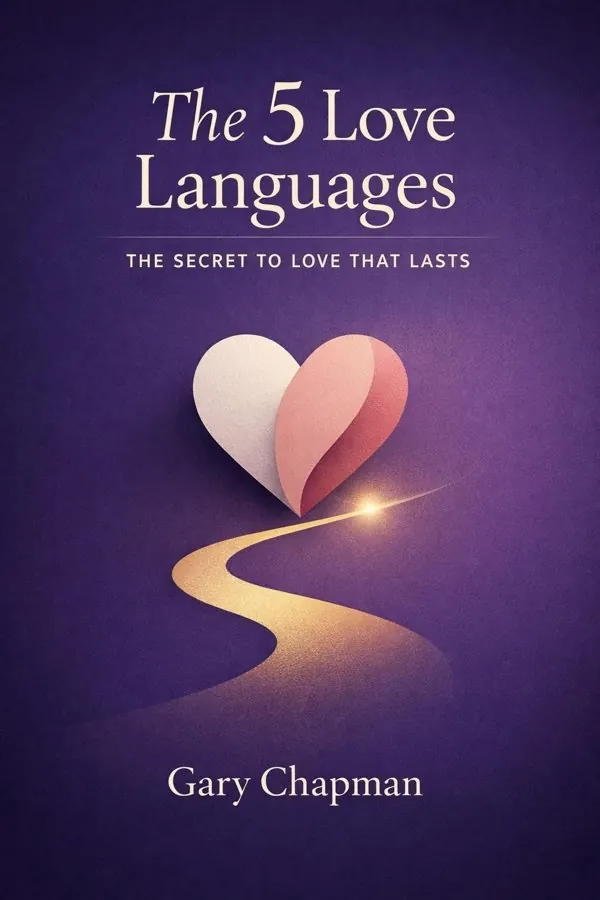
The 5 Love Languages: Summary & Key Insights
by Gary Chapman
 10 min12 chaptersAudio available
Key Takeaways from The 5 Love Languages
Chapman begins with a foundational claim: every person has an “emotional love tank” that needs to be filled.
The book draws a crucial distinction between the thrill of falling in love and the discipline of sustaining love.
For some people, spoken and written words carry enormous emotional weight.
Quality time is not merely being in the same room.
Receiving gifts is often misunderstood as materialism, but Chapman frames it differently: a gift is a visible symbol of love.
What Is The 5 Love Languages About?
The 5 Love Languages by Gary Chapman is a relationships book published in 2015 spanning 12 pages. Why do so many couples sincerely care about each other and still feel chronically misunderstood? That question sits at the heart of *The 5 Love Languages*, one of the most widely discussed relationship books of the modern era. In this practical guide, Gary Chapman argues that love is not only something we feel—it is also something we communicate. And like any form of communication, it can break down when two people are using different “languages.” One partner may show devotion through helpful actions, while the other is waiting for affectionate words or undivided attention. The result is frustration, loneliness, and the painful belief that love has faded when, in reality, it may simply be getting lost in translation. Chapman, an author, counselor, and pastor with a Ph.D. in adult education, draws on years of relationship work to offer a simple but powerful framework: words of affirmation, quality time, receiving gifts, acts of service, and physical touch. His core message is both hopeful and demanding: lasting love is possible, but it requires intention, empathy, and the willingness to love your partner in the way they most deeply receive it.
This FizzRead summary covers all 12 key chapters of The 5 Love Languages in approximately 10 minutes, distilling the most important ideas, arguments, and takeaways from Gary Chapman's work. Also available as an audio summary and Key Quotes Podcast.
The 5 Love Languages: The Secret to Love That Lasts
Why do so many couples sincerely care about each other and still feel chronically misunderstood? That question sits at the heart of *The 5 Love Languages*, one of the most widely discussed relationship books of the modern era. In this practical guide, Gary Chapman argues that love is not only something we feel—it is also something we communicate. And like any form of communication, it can break down when two people are using different “languages.” One partner may show devotion through helpful actions, while the other is waiting for affectionate words or undivided attention. The result is frustration, loneliness, and the painful belief that love has faded when, in reality, it may simply be getting lost in translation. Chapman, an author, counselor, and pastor with a Ph.D. in adult education, draws on years of relationship work to offer a simple but powerful framework: words of affirmation, quality time, receiving gifts, acts of service, and physical touch. His core message is both hopeful and demanding: lasting love is possible, but it requires intention, empathy, and the willingness to love your partner in the way they most deeply receive it.
Who Should Read The 5 Love Languages?
This book is perfect for anyone interested in relationships and looking to gain actionable insights in a short read. Whether you're a student, professional, or lifelong learner, the key ideas from The 5 Love Languages by Gary Chapman will help you think differently.
- ✓Readers who enjoy relationships and want practical takeaways
- ✓Professionals looking to apply new ideas to their work and life
- ✓Anyone who wants the core insights of The 5 Love Languages in just 10 minutes
Want the full summary?
Get instant access to this book summary and 100K+ more with Fizz Moment.
Get Free SummaryAvailable on App Store • Free to download
Key Chapters
Chapman begins with a foundational claim: every person has an “emotional love tank” that needs to be filled. When that tank is full, people tend to be more patient, generous, and emotionally secure. When it is empty, even small irritations can trigger outsized conflict. This idea helps explain why couples often argue about surface issues—dirty dishes, lateness, money, phone use—when the deeper problem is a felt lack of love. A spouse who complains, “You never help me,” may really be saying, “I don’t feel cared for.” Someone who grows distant may not be cold by nature; they may be emotionally depleted.
This is what makes the book so practical: it reframes relationship tension as a signal, not just a flaw. Instead of asking, “Why is my partner so difficult?” Chapman encourages readers to ask, “What need is going unmet?” That shift creates compassion. A useful practice is to regularly check in with each other by asking, “On a scale of 1 to 10, how full is your love tank?” If the answer is low, follow up with, “What would help you feel loved this week?” The central lesson is simple but profound: love is not a luxury in committed relationships. It is emotional nourishment, and without it, connection slowly withers.
The book draws a crucial distinction between the thrill of falling in love and the discipline of sustaining love. Early romance feels effortless because attraction, novelty, and emotional intensity create a kind of tunnel vision. We overlook incompatibilities, idealize the other person, and assume our feelings will naturally carry us forward. Chapman argues that this stage is real but temporary. When the emotional high fades, many couples misread the change as proof that the relationship is broken. In fact, it may simply mean they are entering a more mature phase.
This transition is where intentional love begins. Instead of asking, “Do I still feel the same rush?” Chapman asks couples to consider a better question: “How can I love this person in a way they can truly receive?” Mature love is not less meaningful than romance; it is more reliable. It chooses kindness when moods dip, patience when habits annoy, and generosity when convenience tempts selfishness. For example, a partner who no longer feels swept away by emotion may still choose to plan a thoughtful evening, listen attentively, or offer reassurance after a hard day. Those actions build trust far more effectively than intensity alone. The key insight is that long-term intimacy is not powered by chemistry alone. It is sustained by repeated, meaningful choices.
For some people, spoken and written words carry enormous emotional weight. Compliments, encouragement, appreciation, and kind tone are not “just nice extras”—they are primary ways love becomes believable. If words of affirmation are your partner’s love language, criticism can cut especially deep, while sincere praise can transform their entire day. Chapman emphasizes that these words must be genuine. Empty flattery usually fails, but specific, thoughtful affirmation lands powerfully: “I appreciated how calm you stayed with the kids tonight,” or “You worked hard on that presentation, and I’m proud of you.”
Encouragement is especially important because it communicates faith in the other person’s abilities. A spouse who says, “I know you can do this,” may give their partner courage to pursue a goal they have been avoiding. Tone matters too. Even loving words can lose their effect if delivered with sarcasm, impatience, or distraction. Actionable ways to practice this language include sending a midday text of appreciation, voicing gratitude for ordinary tasks, writing a short note before an important event, or making it a habit to publicly speak well of your partner. Chapman’s broader point is that words can either drain or fill a love tank. Used wisely, they become daily deposits of respect, admiration, and emotional safety.
Quality time is not merely being in the same room. It is the gift of focused attention. For people who receive love this way, presence matters more than proximity. Watching television side by side while scrolling on separate phones may count as time spent together, but it usually does not feel emotionally connecting. What fills the love tank here is undivided attention: eye contact, active listening, meaningful conversation, and shared experiences that signal, “You matter enough for me to slow down and be fully with you.”
Chapman highlights two dimensions of quality time: quality conversation and quality activities. Quality conversation means listening with empathy rather than rushing to solve or dismiss. If a partner says, “I had a rough day,” the goal is not to fix everything immediately but to understand their emotions. Quality activities might include taking a walk, cooking together, trying a hobby, or planning a device-free date night. The activity itself matters less than the sense of togetherness it creates. A practical strategy is to schedule connection before life gets crowded out—perhaps 20 minutes of uninterrupted conversation each evening or one intentional date each week. For this love language, attention is affection. Time cannot be stored or replaced later, which is why giving someone your full presence can feel like one of the deepest expressions of love.
Receiving gifts is often misunderstood as materialism, but Chapman frames it differently: a gift is a visible symbol of love. For people with this love language, the value of a gift lies less in its price and more in what it represents—thought, remembrance, effort, and intentionality. A flower picked on the way home, a favorite snack after a hard week, or a souvenir from a trip can all communicate, “I was thinking of you when you weren’t with me.” The object becomes emotional evidence of care.
This love language also includes the gift of presence. Showing up in a difficult moment—at a hospital, family event, funeral, recital, or stressful appointment—can be just as meaningful as something wrapped in a box. In that sense, gifts are really about visible commitment. If your partner values receiving gifts, the most effective approach is not extravagant spending but observation. Notice what they mention, what makes them smile, what small item would make their routine easier, or what memento could mark a shared memory. Keep a note in your phone of ideas throughout the year. The caution here is to avoid dismissing this language as shallow. For the right person, a meaningful gift says, “You are known, remembered, and cherished,” and that can have a surprisingly lasting emotional impact.
Acts of service communicate love through helpful action. For some people, love becomes real when a partner lightens their burden: making dinner, fixing something broken, taking over a task, handling an errand, or stepping in during a stressful week. The message beneath the action is, “I see your needs, and I want to make your life easier.” This language is especially powerful because it turns affection into something visible and practical.
Chapman notes that acts of service only work as love when they are done with willingness, not resentment. A chore performed while sighing, keeping score, or expecting praise may complete the task but miss the emotional point. What matters is the spirit behind it. If your partner repeatedly asks for help with housework, childcare, or routine responsibilities, they may not simply be demanding efficiency—they may be asking for love in the clearest way they know how. A useful strategy is to ask directly, “What are three things I do that would really help you feel supported?” Then start with one small, repeatable habit, such as making the bed, handling school pickup, or cleaning the kitchen without being asked. Over time, consistency matters more than grand gestures. For people with this love language, dependable service says, louder than romantic speeches ever could, “You are not alone in carrying life.”
Physical touch is a deeply emotional language that includes far more than sexual intimacy. Chapman describes it as the use of appropriate, caring touch to communicate warmth, reassurance, belonging, and closeness. A hand on the shoulder, holding hands during a walk, a hug at the end of a hard day, sitting close on the couch, or a kiss before leaving for work can all carry strong meaning. For someone whose primary love language is physical touch, these gestures create connection in a direct and powerful way.
What makes this language unique is how immediate it feels. Loving touch can calm anxiety, rebuild closeness after tension, and reinforce security without many words. The absence of touch, by contrast, may feel like rejection even when no harm is intended. Chapman’s insight here is that touch must be loving, welcome, and attentive to context. It should never be mechanical or used to pressure the other person. Instead, couples can learn to notice which forms of touch feel most meaningful. One person may value long hugs, another casual affection throughout the day, another closeness during conversation. A practical step is to ask, “What kinds of touch help you feel most loved?” Respectful experimentation matters. For those who receive love physically, touch is not decorative—it is one of the clearest ways affection becomes tangible and emotionally convincing.
One of the most useful parts of the book is learning how to identify your own primary love language—and your partner’s. Chapman suggests looking at three clues: what most often hurts you, what you most frequently request, and how you naturally express love to others. If you feel especially wounded when your efforts go unnoticed, words of affirmation may matter most. If canceled plans upset you more than forgotten compliments, quality time may be your core language. If you often show love by helping, touching, gifting, or encouraging, that pattern may reveal how you most naturally think love should be communicated.
Discovery matters because many people love others in their own preferred language and assume it should work for everyone. But sincere love can still miss its target. A husband may buy presents when his wife is longing for uninterrupted conversation. A wife may speak warmly when her husband is craving practical help. Chapman invites couples to become students of each other. Try discussing moments when you felt especially loved and especially unloved. Ask, “What actions from me mean the most to you?” It can also help to test a language intentionally for a few weeks and observe the response. The goal is not to label people rigidly but to increase accuracy. When you learn someone’s primary language, your efforts become more effective, personal, and emotionally meaningful.
Marriage often exposes love-language differences because daily life creates endless opportunities for both connection and misunderstanding. Chapman’s central claim is that many marital conflicts are not simply about personality or incompatibility but about unmet emotional needs. One spouse may believe, “I work hard and provide for us—of course I love you,” while the other thinks, “We barely talk anymore, so I feel alone.” Both may be sincere, yet both may feel unseen. Learning each other’s language helps reduce this painful disconnect.
In marriage, intentionality is critical because routine can slowly replace romance. Chapman encourages couples to move from assumption to practice. Instead of saying, “You should know I love you,” ask, “What makes you feel loved by me?” Then build habits around the answer. A spouse whose language is acts of service may feel cherished when responsibilities are shared without prompting. A spouse whose language is quality time may care less about expensive vacations than about regular walks and meaningful conversation. The book also implies that love languages are most effective when combined with humility. You may need to offer love in ways that do not come naturally to you, and that is precisely the point. Marriage thrives not when both people wait to be understood first, but when each learns to love the other with intention, consistency, and generosity.
Although the book is best known for helping couples, Chapman’s framework extends beyond marriage. Children, parents, friends, and even coworkers can feel more valued when love or appreciation is expressed in ways they easily recognize. A child who lights up at praise may respond deeply to words of affirmation, while another feels secure through physical affection or focused playtime. A parent may not ask for much but may feel most cared for when visited regularly or helped with errands. The same principle applies: people often receive care differently than we expect.
In friendships, understanding love languages can prevent misreading. One friend may show up with practical help during a crisis, while another sends heartfelt messages. Both are expressing care, just in different forms. Recognizing this can reduce resentment and deepen appreciation. Even in non-romantic settings, the framework encourages emotional intelligence. For example, a manager who offers sincere appreciation may motivate someone far more effectively than generic rewards, while another person may value the symbolic meaning of recognition or thoughtful support. The actionable takeaway is to stop assuming that your preferred way of showing care is universally meaningful. Ask people what matters to them. Pay attention to patterns. When you tailor your efforts to the other person, relationships of all kinds become warmer, clearer, and more resilient.
Knowing the five love languages is not a magic trick; real relationships still face stress, resentment, bad habits, and old wounds. Chapman acknowledges that couples often struggle not because the framework is unclear, but because hurt has built up over time. When anger, disappointment, or mistrust are unresolved, even sincere efforts can feel too little, too late. That is why applying love languages effectively requires honesty and persistence. It may involve apologizing, forgiving, and rebuilding trust before emotional deposits begin to register again.
Another challenge is that speaking your partner’s language may feel unnatural, especially if it is not your own. A practical person may forget verbal encouragement. A busy achiever may find sustained quality time difficult. Someone uncomfortable with touch may need to learn physical affection slowly and respectfully. Chapman’s answer is not perfection but deliberate practice. Start small, be consistent, and ask for feedback. It also helps to avoid scorekeeping. Love languages are not a way to manipulate your partner into reciprocating on demand; they are a way to care more effectively. During conflict, return to curiosity: “What helps you feel safe and loved right now?” The larger lesson is that obstacles do not disprove love—they reveal where growth is needed. With patience, humility, and repetition, couples can change entrenched patterns and make love feel believable again.
The book ultimately rests on a deeply practical idea: lasting love is a choice reinforced by commitment. Feelings matter, but they are too unstable to carry a relationship on their own. Chapman does not dismiss emotion; he simply argues that mature love goes beyond it. It chooses to act for the other person’s good even when convenience, fatigue, stress, or disappointment make that difficult. This is where love languages become more than a communication tool—they become a daily discipline of service, empathy, and loyalty.
Choice is especially important after conflict or during ordinary seasons when life feels repetitive. Commitment says, “I will keep learning you. I will keep showing up. I will not reduce love to whatever I happen to feel in this moment.” In practice, that might mean writing the encouraging note even when you are busy, planning time together when schedules are crowded, or helping with a task when you would rather rest. These choices seem small, but repeated over months and years they create emotional stability. Chapman’s larger message is hopeful: you do not need to rely on luck or chemistry alone to sustain intimacy. You can build it through intentional patterns. Love that lasts is not passive. It is chosen, translated into the other person’s language, and strengthened by commitment over time.
All Chapters in The 5 Love Languages
About the Author
Gary Chapman is an American author, counselor, and pastor best known for his work on marriage and family relationships. He holds a Ph.D. in adult education and has built a reputation for translating counseling insights into practical tools ordinary readers can use. Chapman is widely recognized for popularizing the “love languages” framework, which has influenced conversations about communication, intimacy, and emotional needs in relationships. In addition to *The 5 Love Languages*, he has written numerous books on love, personal growth, and relational health. His writing is known for being clear, accessible, and focused on everyday application.
Get This Summary in Your Preferred Format
Read or listen to the The 5 Love Languages summary by Gary Chapman anytime, anywhere. FizzRead offers multiple formats so you can learn on your terms — all free.
Available formats: App · Audio · PDF · EPUB — All included free with FizzRead
Download The 5 Love Languages PDF and EPUB Summary
Key Quotes from The 5 Love Languages
“Chapman begins with a foundational claim: every person has an “emotional love tank” that needs to be filled.”
“The book draws a crucial distinction between the thrill of falling in love and the discipline of sustaining love.”
“For some people, spoken and written words carry enormous emotional weight.”
“Quality time is not merely being in the same room.”
“Receiving gifts is often misunderstood as materialism, but Chapman frames it differently: a gift is a visible symbol of love.”
Frequently Asked Questions about The 5 Love Languages
The 5 Love Languages by Gary Chapman is a relationships book that explores key ideas across 12 chapters. Why do so many couples sincerely care about each other and still feel chronically misunderstood? That question sits at the heart of *The 5 Love Languages*, one of the most widely discussed relationship books of the modern era. In this practical guide, Gary Chapman argues that love is not only something we feel—it is also something we communicate. And like any form of communication, it can break down when two people are using different “languages.” One partner may show devotion through helpful actions, while the other is waiting for affectionate words or undivided attention. The result is frustration, loneliness, and the painful belief that love has faded when, in reality, it may simply be getting lost in translation. Chapman, an author, counselor, and pastor with a Ph.D. in adult education, draws on years of relationship work to offer a simple but powerful framework: words of affirmation, quality time, receiving gifts, acts of service, and physical touch. His core message is both hopeful and demanding: lasting love is possible, but it requires intention, empathy, and the willingness to love your partner in the way they most deeply receive it.
Compare The 5 Love Languages
More by Gary Chapman
The 5 Love Languages: The Secret to Love That Lasts
Gary Chapman
10 min
The 5 Apology Languages: The Secret to Healthy Relationships
Gary Chapman, Jennifer Thomas
10 min
The 5 Languages of Appreciation in the Workplace: Empowering Organizations by Encouraging People
Gary Chapman, Paul White
10 min
Loving Your Spouse When You Feel Like Walking Away: Real Help for Desperate Hearts in Difficult Marriages
Gary Chapman
10 minYou Might Also Like
Men Are from Mars, Women Are from Venus
John Gray
10 min
She Comes First
Ian Kerner
10 min
No More Mr Nice Guy
Robert Glover
10 min
Hold Me Tight
Sue Johnson
10 min
Mating in Captivity
Esther Perel
10 min
Women Who Love Too Much
Robin Norwood
10 minFeatured In
Browse by Category
Ready to read The 5 Love Languages?
Get the full summary and 100K+ more books with Fizz Moment.